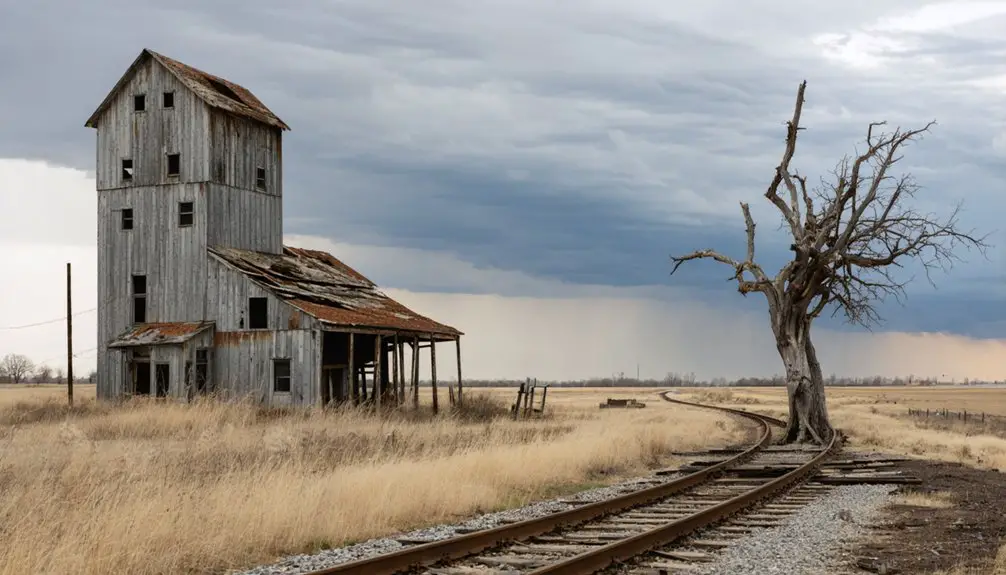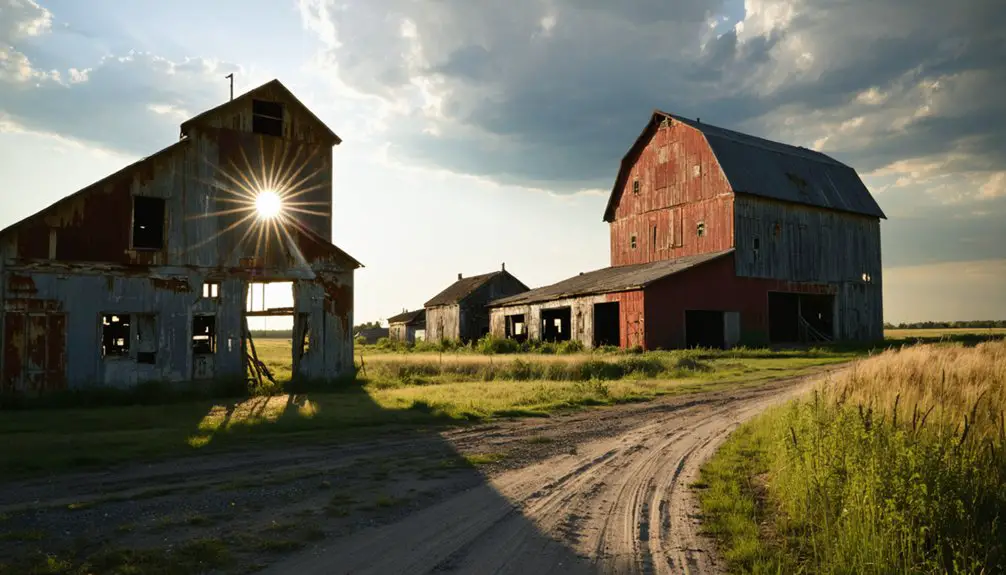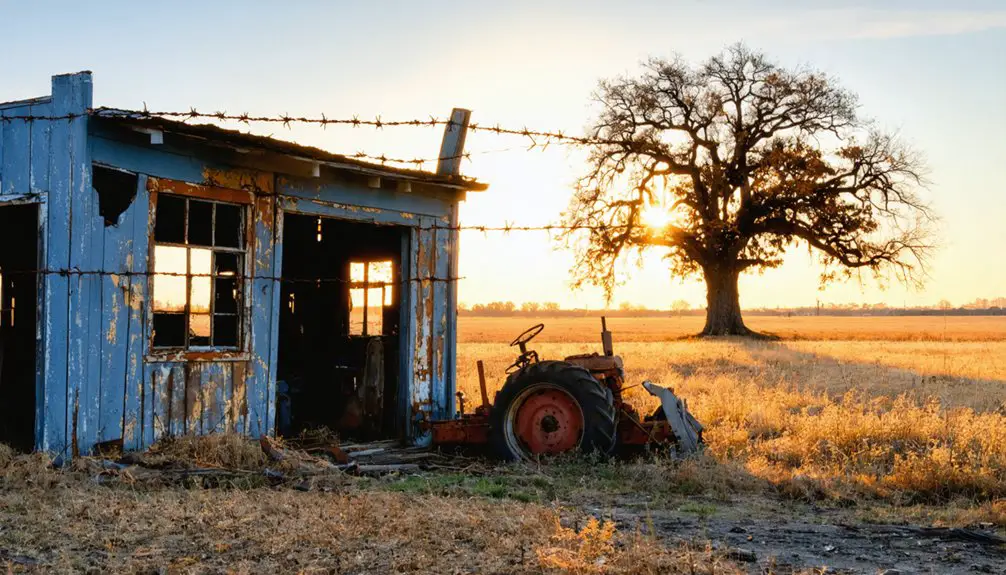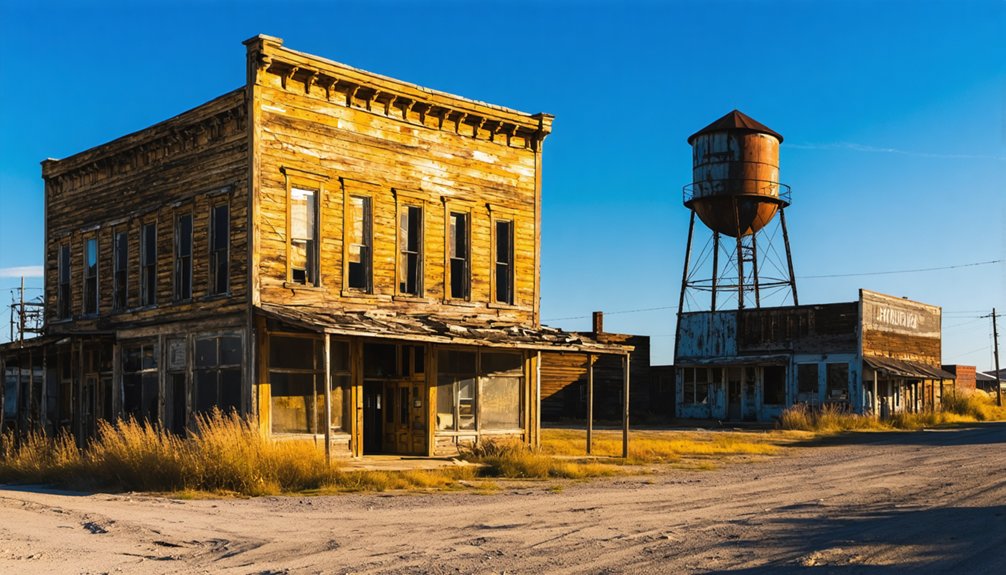
You’ll find Minnesota’s most mesmerizing ghost towns come alive during summer, when warm weather makes exploration irresistible. Head to Forestville for costumed interpreters in an 1890s stagecoach stop, or explore Taconite Harbor’s rusted industrial decay along Lake Superior’s shore. Chippewa City offers an abandoned 1895 church just off Highway 61, while Mineral Center’s cemetery stands as the sole remnant of 350 hopeful settlers. Each site reveals different chapters of Minnesota’s forgotten past, with stories waiting around every crumbling foundation.
Key Takeaways
- Forestville is Minnesota’s most accessible ghost town, featuring restored 1890s buildings with costumed interpreters demonstrating historic trades and daily life.
- Taconite Harbor offers industrial decay exploration along Lake Superior, with abandoned mining facilities, silent docks, and a public harbor access point.
- Mineral Center near Grand Portage preserves only a cemetery from its 1909 gold rush era when 350 settlers sought fortune in mining.
- Chippewa City features a restored 1895 church and historic cemeteries, easily accessible off Highway 61 near Grand Marais with multicultural heritage.
- Bohemian Flats in Minneapolis displays urban ghost town remnants including a historic staircase and street names commemorating Eastern European immigrant trades.
Forestville: A Preserved 1890s Town Frozen in Time
When you step into Forestville, you’re not just visiting a ghost town—you’re walking into an authentic 1890s community preserved exactly as it was when the last residents departed. Located in southeastern Minnesota’s Fillmore County, this former stagecoach stop once bustled with 150 residents before the railroad bypassed it in 1868.
You’ll explore the Meighen General Store, still stocked with original goods, and wander past restored sawmills, blacksmith shops, and the historic Forestville Bridge.
During summer, costumed interpreters bring daily life to vivid reality, demonstrating how farmers traded produce and children attended school here. The town also supported skilled tradesmen, with an 1857 census recording six carpenters, two cabinetmakers, a blacksmith, and a brickmaker working in the community.
The Minnesota Historical Society’s preservation efforts have maintained this time capsule within Forestville/Mystery Cave State Park. The town was originally purchased in the mid-1850s by Robert Foster from Levi Waterman and initially named Watertown before becoming Forestville in April 1854. Plan 2-3 hours to experience what Thrillist dubbed Minnesota’s coolest ghost town.
Exploring the historic ghost towns of Minnesota allows visitors to step back in time and witness the remnants of early settlement life. From abandoned stores to crumbling homes, each site tells a story of resilience and change. These towns, once bustling with activity, offer a hauntingly beautiful glimpse into the past.
In addition to Forestville, there are several other abandoned towns to visit in Minnesota that capture the essence of the state’s history. Places like Hill City and Broudette reveal fascinating tales of the past, inviting explorers to uncover the secrets hidden within their dilapidated structures. Each abandoned site serves as a reminder of the vibrant communities that once thrived in these now quiet landscapes.
Taconite Harbor: Exploring Ruins Along Lake Superior’s Shore
Along Lake Superior’s rugged North Shore, Taconite Harbor stands as a haunting reminder of Minnesota’s industrial boom and bust. Built in the 1950s to house Erie Mining Company workers, this once-thriving community of 22 homes completely vanished by 1991.
From boom to ghost town—22 homes and countless dreams abandoned along Lake Superior’s desolate industrial shoreline.
You’ll discover industrial decay everywhere—crumbling foundations, ghost streets, and rusted streetlights marking where families once lived.
Drive the winding road from Highway 61 to explore shoreline remnants at your own pace. The abandoned loading docks, which once shipped 10 million tons of taconite annually, now sit silent. Designed for fastest loading in the world, these docks transported pellets via train to Detroit and east coast steel mills.
You can visit the small outdoor mining museum, launch your boat at the public harbor, and walk the basketball court where kids once played. The last resident departed in 1988, leaving behind only the skeletal remains of what was once an idyllic 1950s neighborhood.
It’s raw, unrestricted access to Minnesota’s forgotten mining heritage.
Mineral Center: Where Tourism Once Flourished in the Wilderness
Deep in Cook County’s wilderness, six miles up Mineral Center Road from Grand Portage, you’ll find scattered remnants of a community that once housed 350 hopeful settlers.
Malcolm Linnell’s 1909 discovery of trace minerals sparked dreams of striking it rich, drawing 54 families from Wisconsin by 1930.
Though the gold, silver, and copper never materialized in profitable quantities, these pioneers built something remarkable:
- Three schools educating frontier children
- United Congregational Church, first used in 1920
- A thriving post office and general store
- Homesteads carved from untamed forest
- Historical mining sites now reclaimed by nature
When the Federal Government purchased these homesteads in 1940, returning land to the Grand Portage Tribe, wilderness preservation efforts began erasing human footprints.
Buildings and homes were relocated or dismantled, their lumber salvaged as the community dispersed.
Mineral Center represents one of 200-300 ghost towns scattered across Minnesota alone, each a monument to the economic booms that once shaped the Northern Wilds.
Today, only the cemetery stands witness to their determination.
Chippewa City: The Most Accessible North Shore Ghost Town
Just fifteen miles southwest of Grand Marais, you’ll discover Chippewa City’s weathered church rising from the forest—a ghost town far easier to reach than Mineral Center’s remote wilderness location.
Unlike Mineral Center’s challenging wilderness access, Chippewa City’s haunting church remains beckons just fifteen miles from Grand Marais—history without the hardship.
St. Francis Xavier stands as the sole survivor of what was once a thriving community of 200 mainly Ojibwe residents in the 1890s.
You’ll find Native American history etched into two cemeteries flanking the dirt road—the original half-acre plot from 1892 marked by a towering white cross, and the 1926 cemetery across the way.
Highway expansion, fire, and the 1918 flu epidemic emptied this settlement by the late 1930s. The church, built in 1895 in French style by Ojibwe carpenter Frank Wishkop, held its final mass on Christmas 1936 before restoration efforts began in 1958.
Today, these abandoned churches and burial grounds offer you unrestricted access to explore Minnesota’s multicultural past without the grueling trek required by other ghost towns. The church is located lakeside along Highway 61, making it one of the most accessible historic sites on the North Shore.
Bohemian Flats: From Immigrant Settlement to Riverside Park
Beneath the Washington Avenue Bridge in Minneapolis, you’ll discover where a thousand Eastern European immigrants once carved out homes along the Mississippi’s floodplain. Known as Bohemian Flats, this settlement thrived from the 1860s until forced evictions claimed it for industrial progress. Today’s riverside park masks decades of urban decay that followed the demolition.
What you’ll find exploring this transformed landscape:
- 79-step wooden staircase descent from the bridge to floodplain housing
- Street names honoring workers’ trades: Cooper, Mill, and Wood
- Historic preservation markers explaining the immigrant community’s story
- Coal and oil terminal remains from post-eviction industrial use
- Mississippi Gorge Regional Park trails now occupying former home sites
The predominantly Slovak residents maintained their language and customs while facing uncertain landownership disputes with figures like D.W. Washburn and Charles H. Smith. Lower bluff homes rented for as little as $0.50 per year, reflecting the precarious living conditions on flood-prone land. The 1963 eviction of 80-year-old Joseph Kieferle marked the settlement’s final chapter, erasing a community that once powered Minneapolis’s mills and breweries.
Frequently Asked Questions
Are There Any Haunted Ghost Towns in Minnesota Worth Visiting?
Yes, Grey Cloud Island offers eerie thrills with its phantom pickup truck and glowing orbs haunting abandoned landmarks. You’ll find ghostly figures near historic ruins and cemeteries, making it Minnesota’s most supernatural ghost town experience you can actually explore.
What Safety Precautions Should Visitors Take When Exploring Minnesota Ghost Towns?
Like a time traveler stepping through history, you’ll need sturdy boots and flashlights for urban exploration. Respect structural hazards, obtain property access, and practice historical preservation—leaving artifacts untouched so others can experience Minnesota’s haunting past.
Do I Need Permits to Visit Ghost Towns on Private Property?
You don’t need permits, but you’ll need landowner permission before exploring ghost towns on private property. Trespassing laws protect these abandoned places, and private property regulations mean respecting boundaries guarantees your freedom to discover Minnesota’s forgotten landscapes legally.
As you explore Minnesota’s historic ghost towns, keep an eye out for remnants of the past, including abandoned buildings and lost artifacts that tell stories of bygone eras. Each location offers a unique glimpse into the lives once lived there, contributing to the rich tapestry of the state’s history. Taking the time to appreciate these sites not only enriches your understanding of Minnesota but also honors the memories they hold.
Which Minnesota Ghost Towns Are Best for Photography During Summer Months?
You’ll find Dorothy’s abandoned structures offer haunting summer light through empty windows, while Grey Cloud Island’s kiln tower provides unique historical landmarks accessible by canoe. Both locations deliver that raw, untethered exploration you’re craving.
Are Guided Tours Available for Any Minnesota Ghost Towns?
Yes, you’ll find guided tours at Forestville, where interpreters bring ghost town archaeology to life through historic preservation efforts. The restored 1890s general store and townsite offer immersive experiences, though self-guided exploration’s also available for independent adventurers.
References
- https://thievesriver.com/blogs/articles/ghost-towns-in-minnesota
- https://exploringnorthshore.com/north-shore-ghost-towns/
- https://www.minnesotahistory.org/post/a-complete-guide-to-the-ghost-towns-of-hennepin-county
- https://kroc.com/abandoned-places-minnesota/
- https://www.youtube.com/watch?v=SK_qpflb_ao
- https://quickcountry.com/minnesotas-abandoned-ghost-towns/
- https://www.exploreminnesota.com/seasons/fall/spookiest-places-minnesota
- http://www.onlyinyourstate.com/experiences/minnesota/ghost-towns-mn
- https://kdhlradio.com/forestville-named-the-creepiest-and-coolest-ghost-town-in-minnesota/
- https://www.mngoodage.com/voices/mn-history/2019/07/a-ghost-town-turned-history-site/