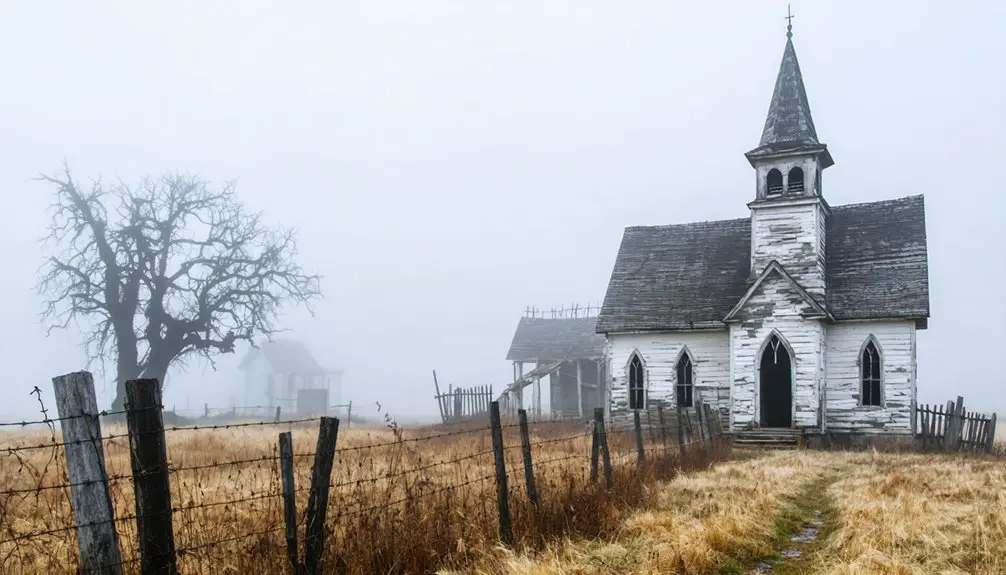
You’ll find Missouri’s most enthralling ghost towns come alive during summer exploration season. Old Greenville along Lake Wappapello offers family-friendly hiking through preserved foundations and an intact cemetery, while Times Beach—now Route 66 State Park—tells America’s most notorious toxic town story. For adventure seekers, Old Lin Creek provides Missouri’s only diveable ghost town experience 40 feet beneath Lake of the Ozarks. Pink Hill’s Civil War ruins bloom with wildflowers, and Jordan’s mysterious cemetery holds local legends. The sections below reveal ideal visiting times, safety guidelines, and hidden details about each haunting destination.
Key Takeaways
- Old Greenville offers intact cemetery, hiking trails, and summer interpretive signs along Lake Wappapello with visible foundations and sidewalks.
- Times Beach, now Route 66 State Park, displays remnants of streets and homes from America’s most infamous toxic ghost town.
- Old Lin Creek is Missouri’s only diveable ghost town, best explored in summer when underwater visibility improves at 40 feet depth.
- Pink Hill Park features Civil War ruins, foundations among wildflowers, and the Veterans Way Memorial east of Independence for historical education.
- Visit early mornings between mid-June and early September for cooler weather, extended daylight, and optimal exploration conditions at all sites.
Old Greenville: A Family-Friendly Ghost Town Adventure
Nestled along the shores of Lake Wappapello in southeastern Missouri, Old Greenville offers a hauntingly beautiful glimpse into a town that refused to surrender completely to progress.
Where progress claimed the living town, Old Greenville’s stubborn remnants stand sentinel beneath the Missouri pines.
When the Wappapello Dam forced residents to relocate in 1940, they left behind foundations, sidewalks, and stairs that now tell compelling ghost town stories throughout the wooded recreation area.
You’ll discover crumbling courthouse steps and car dealership remnants while exploring hiking paths that wind through the heavily forested townsite.
Summer brings interpretive signs near foundations, complete with historical photos that bring preserving ruins to life.
The town once thrived as a lumber and railroad hub near the St. Francis River before devastating floods in 1904, 1915, and 1935 ultimately sealed its fate.
The U.S. Army Corps of Engineers maintains this unique campground where you can pitch your tent among the past, explore an intact cemetery, and let kids safely investigate visible history at their own pace.
Nature is reclaiming the abandoned foundations, with grass growing through cracks and tree roots slowly breaking apart the old pavement.
Times Beach: Missouri’s Most Haunting Abandoned Settlement
How does a thriving Route 66 community transform into America’s most infamous toxic ghost town in less than a decade? You’ll find the answer at Times Beach, where dioxin-contaminated oil sprayed for dust control created the nation’s largest civilian exposure crisis.
Founded in 1925 as a newspaper-promoted resort, this settlement met its doom when 1982 floods spread Agent Orange byproducts throughout every property.
The EPA evacuated 2,000 residents by 1985, bulldozing everything into a massive burial mound.
Today’s Route 66 State Park stands where homes once lined streets, making this urban decay site legendary among ghost town enthusiasts.
The complete federal buyout and disincorporation represent governmental power at its most absolute—erasing an entire community from existence. The cleanup required 265,000 tons of contaminated soil removal between 1996-97, costing taxpayers $110 million. Waste hauler Russell Bliss mixed chemical sludge with used motor oil and sprayed it on roads as dust suppressant, causing over 50 animals to die and children to become sick.
Old Lin Creek: Exploring an Underwater Ghost Town
Beneath forty feet of Lake of the Ozarks water lies Missouri’s most unique ghost town—a complete 19th-century settlement preserved on the lake floor. You’ll discover Old Linn Creek in Linn Creek Cove, where Bagnell Dam’s 1931 construction flooded this former county seat that once housed 500 residents.
Summer offers your best underwater exploration conditions when visibility improves enough to spot foundations, streets, and the Irontown smelter poking through the surface.
This historical preservation site lets you experience genuine adventure—whether diving among submerged structures or viewing the cemetery that survived on nearby bluffs. Before the waters rose, wooden structures including churches burned down while masonry buildings were knocked down in the systematic demolition of the town.
The town’s forced abandonment created Missouri’s only diveable ghost town, where you’ll find remnants of a thriving steamboat hub that served southwest Missouri for ninety years before disappearing beneath the waves. Today, the rebuilt Linn Creek stands on higher ground, with the original site commemorated inside the Willmore Lodge.
Pink Hill: Civil War Ruins Among the Flowers
You’ll find Pink Hill’s tragic past etched into the landscape where Union forces razed an entire village in August 1863. Today, remnants of old foundations hide among the wildflowers at Pink Hill Park, silent witnesses to the guerrilla warfare that once consumed this Jackson County settlement.
Search the grounds carefully—these crumbling stone bases mark where homes, shops, and the original Methodist church stood before Northern soldiers burned everything to ashes. The destruction came amid broader military operations across Missouri that year, including reconnaissance near West Plains and expeditions throughout the region as Union forces worked to suppress Confederate sympathizers and guerrilla fighters.
Before its destruction, Pink Hill had been a thriving community founded in 1854 with four streets and roughly 40 buildings serving a population of over 500 residents. The railroad’s arrival would later bypass the ruins entirely, prompting survivors to relocate down to the valley and establish what became Grain Valley, leaving Pink Hill to fade into memory with only its church, rebuilt in 1871, standing as a testament to the community that once flourished here.
Historic Battle Site Remains
Though pink wildflowers still blanket the hillsides each spring, Pink Hill’s pastoral beauty masks a violent past that transformed this Jackson County settlement into one of Missouri’s most poignant ghost towns.
You’ll discover where two Civil War skirmishes claimed Union casualties in March and May, before the army’s devastating response. In August 1863, federal forces expelled every resident and torched all structures, leaving nothing but desolation across Sni-A-Bar Township.
Today’s Pink Hill Park offers educational opportunities through its Veterans Way Memorial, where preservation efforts connect visitors to Border War history. The Jackson County Historical Society has worked to promote recognition of the area’s wartime significance and share narratives of how the community evolved from these turbulent origins. On June 11, 1862, Confederate forces under William C. Quantrill launched an attack that successfully drove away a Union mail escort at this very location. You can explore these grounds where Southern sympathizers once sheltered Quantrill’s raiders, walking the same terrain where an entire community vanished in flames—a stark reminder of war’s unforgiving toll on Missouri’s frontier settlements.
Finding the Old Foundations
Where Pink Hill’s thriving village once stood with its woodworking shops, blacksmith forge, and three bustling general stores, you’ll now find only scattered foundation stones nestled among summer grasses. These Civil War-era ruins mark where Union forces burned every structure in August 1863, driving residents from their homes in fifteen days.
You can explore these remnants freely in Pink Hill Park, twenty miles east of Independence. Archaeological surveys have identified several building foundations, revealing the town’s layout before total war consumed it. Preservation efforts maintain these stones as silent witnesses to Missouri’s brutal border conflicts.
Wildflowers now bloom where Quantrill’s guerrillas once found refuge, creating a striking contrast between past violence and present peace among the ruins.
Jordan: a Quiet Ghost Town With Mystery and Legend

Tucked away in Hickory County just north of Cross Timbers—itself nearly a ghost town—Jordan stands as one of Missouri’s quieter abandoned settlements.
You’ll find a small church marked “Jordon,” a cemetery, and two weathered buildings amid scattered foundations. This peaceful site offers unguarded exploration during warm summer days.
Cemetery stories and haunted legends surround Jordan’s mysterious past:
- An abandoned silver mine allegedly sits nearby, drawing paranormal enthusiasts who report strange occurrences.
- The cemetery behind the church holds untold stories of settlers who built this vanished community.
- Sparse documentation leaves Jordan’s origins largely unknown, adding to its enigmatic appeal.
Unlike many Missouri ghost towns destroyed by Civil War conflicts, Jordan simply faded away.
You’ll discover authentic rural abandonment here—perfect for photographers seeking atmospheric locations without crowds.
Haun’s Mill: A Historic Mormon Settlement Site
Unlike most Missouri ghost towns that simply faded into obscurity, Haun’s Mill carries the weight of genuine tragedy. On October 30, 1838, this peaceful settlement along Shoal Creek became the site of a brutal massacre when 240 armed men attacked Mormon families, killing seventeen people.
You’ll find little remaining of Jacob Hawn’s 1834 mill or the homes that once housed 30-40 families. The ghost town history here isn’t about economic decline—it’s about religious persecution that forced an entire community to flee Missouri for Illinois by 1839.
Today, preservation efforts maintain the site’s significance in Latter-day Saint collective memory. Standing where the blacksmith shop once stood, you’ll understand why this abandoned settlement represents one of Missouri’s darkest chapters.
Best Times to Visit Missouri Ghost Towns in Summer

Planning your Missouri ghost town adventures requires strategic timing, and summer offers distinct advantages for exploration. You’ll find the seasonal weather creates perfect conditions for outdoor discovery, with warm temperatures ideal for hiking trails and investigating historical sites.
As you delve into Missouri’s historical ghost towns, take the time to uncover their unique stories and the remnants of lives once lived. Each abandoned building and faded sign tells a tale that adds depth to your journey. Embrace the sense of adventure as you navigate these lost pieces of history, where every visit offers a glimpse into the past.
Exploring abandoned towns in Missouri winter can unveil a different kind of beauty, as the quiet landscapes transform into serene, snow-covered vistas. The stillness allows for reflection on the stories of those who once called these places home, creating a hauntingly beautiful atmosphere. Bundle up and venture into these ghostly remnants, where the chill of the season adds to the allure of the past.
Optimal visiting strategies:
- Early morning arrivals – Beat visitor crowds and summer heat by reaching ghost towns between 7 a.m. and 10 a.m., when trails remain cooler and wildlife activity peaks.
- Weekday exploration – Escape increased weekend traffic to experience these abandoned settlements with minimal interference and maximum solitude.
- Mid-June through early September – Capitalize on stable weather conditions and extended daylight hours, giving you more time to explore ruins and riverside areas.
You’ll discover that strategic planning transforms your ghost town visits into unrestricted adventures through Missouri’s forgotten landscapes.
Tips for Exploring Ghost Towns Safely and Respectfully
When you venture into Missouri’s abandoned settlements, your safety depends on thorough preparation and situational awareness. Before entering any structure, assess its stability—sagging roofs and cracked walls signal danger. Wear safety gear including sturdy boots and protective clothing to guard against debris and sharp objects.
Secure legal permissions from property owners before exploring, as trespassing violations carry consequences. Document authorization in writing and respect all posted boundaries. These sites exist on someone’s land, and honoring property rights ensures continued access for future adventurers.
Practice leave-no-trace principles by removing nothing from these historical locations. Photograph rather than collect artifacts, and avoid touching fragile structures. Stay clear of abandoned mines and open shafts—report any hazardous openings to Missouri’s Land Reclamation Program at 800-361-4827.
Frequently Asked Questions
Are Pets Allowed at Missouri Ghost Town Sites and Recreation Areas?
You’ll find pet policies vary at Missouri’s ghost town sites and recreation areas. Most allow leashed dogs, but animal restrictions apply in buildings and swimming areas. Always check specific site rules before visiting with your furry companion.
Do I Need Special Permits to Explore Underwater Ruins at Lake of the Ozarks?
You don’t need special underwater archaeology permits to explore Lake of the Ozarks’ submerged ruins. Standard Missouri boating regulations apply when you navigate to sites like Irontown’s smelter or Old Linn Creek, giving you freedom to discover these hidden historical treasures.
What Photography Equipment Works Best for Capturing Ghost Town Ruins?
You’ll need a wide-angle lens (16-35mm) for historical photography of crumbling structures, a compact tripod for stability, and LED lighting for dark interiors. Pack light—one camera body covers your equipment needs while maintaining mobility through unstable ruins.
Are There Guided Tours Available for Any Missouri Ghost Towns?
You’ll find guided explorations at Missouri’s haunted historic sites rather than traditional ghost towns. These tours emphasize historic preservation through storytelling at locations like Missouri State Penitentiary, Pythian Castle, and Hannibal’s cemeteries, offering authentic paranormal experiences.
Can I Metal Detect at Missouri Ghost Town Locations?
You’ll need to tread carefully—metal detecting laws strictly prohibit detecting at historical ghost town sites on public land. Missouri’s ghost town history remains protected under ARPA, though you’re free to explore private property with owner permission.
References
- https://midwestnomads.com/2022/07/29/ghost-town-at-old-greenville-missouri/
- https://www.youtube.com/watch?v=ERFnlJ5pjBg
- https://www.worldatlas.com/cities/7-coolest-small-towns-in-missouri-for-a-summer-vacation.html
- https://mymix923.com/5-missouri-ghost-towns-to-take-a-day-trip-in-2018/
- https://www.tripadvisor.com/Attractions-g28946-Activities-zft12156-Missouri.html
- https://www.undergroundozarks.com/forum/viewtopic.php?t=445
- https://www.undergroundozarks.com/forum/viewtopic.php?t=1560
- https://www.thatawaydad.com/halloween-hikes-old-greenville-ghost-town/
- https://www.hmdb.org/m.asp?m=208895
- https://www.youtube.com/watch?v=net6k-2hnVs