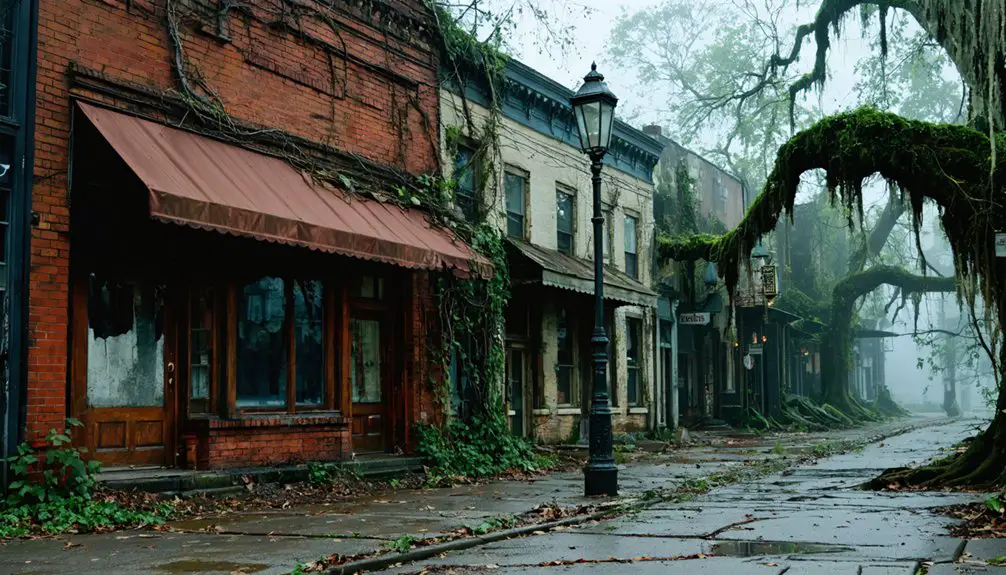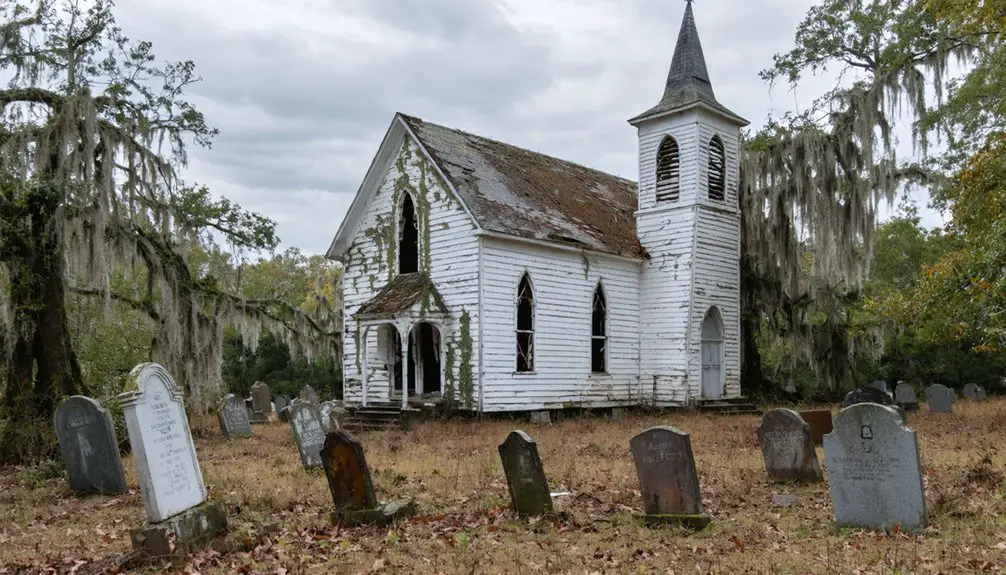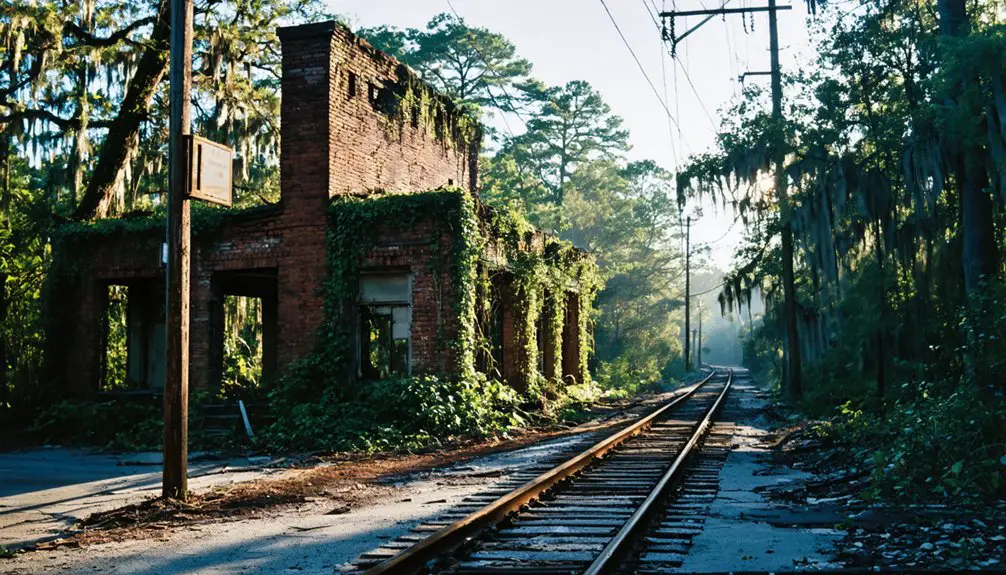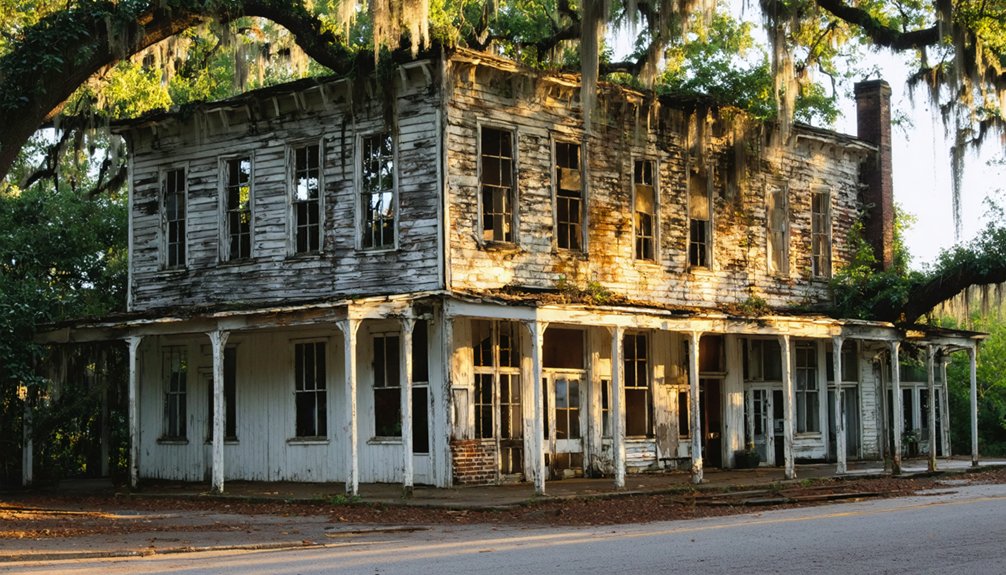
You’ll find South Carolina’s ghost towns waiting beneath summer’s canopy—Dorchester’s colonial foundations emerging from red clay, Hamburg’s crumbling railroad terminus along the Savannah River, and Glenn Springs’ abandoned resort tucked in Spartanburg’s woodlands. These sites preserve stories of cotton empires, Reconstruction violence, and communities erased by floods or Cold War secrecy. While Ellenton remains restricted behind nuclear facility fences and Andersonville sleeps beneath reservoir waters, accessible ruins offer tangible connections to vanished worlds that shaped the state’s complex past.
Key Takeaways
- Dorchester offers year-round access with indoor lab facilities and training programs for hands-on archaeological excavation experiences along the Ashley River.
- Hamburg features accessible historic sites including crumbling foundations and First Providence Baptist Church along the Savannah River border.
- Glenn Springs contains 19 preserved historic structures including the Old Stone Church, providing opportunities to explore a former mineral springs resort.
- Ellenton has limited tour availability through Savannah River Nuclear Solutions due to restricted access and contamination concerns from nuclear site.
- Andersonville is completely submerged underwater with no remaining structures to visit, making it inaccessible for summer exploration.
Dorchester: an Archaeological Window Into Colonial South Carolina
Along the winding banks of the Ashley River, twenty-two miles northwest of Charleston, the weathered oyster-shell walls of Old Dorchester rise from the earth like ancient sentinels guarding secrets buried for centuries.
You’ll discover one of America’s most intact colonial settlements, abandoned in 1788 and frozen in time beneath the soil.
This ghost town invites you to unearth its stories yourself. During spring and fall, you can join public excavations, brushing dirt from pipe stems and military buttons.
Colonial artifacts emerge from your careful work—pottery crafted by enslaved hands, glass fragments from traders’ homes, ammunition from Revolutionary history battles. The Swamp Fox himself once commanded this fortified post.
Fewer than ten of 119 lots have been excavated. What you’ll find remains gloriously unknown.
The site offers accessible training programs that allow visitors to learn proper excavation techniques from experienced archaeologists.
When you need respite from the summer heat, visit the indoor lab where archaeologists continue their analysis work during winter and summer months.
Hamburg: The Savannah River Port Frozen in Time
Where the Savannah River carves the border between South Carolina and Georgia, the ghost of Hamburg lies submerged beneath highway overpasses and floodwaters.
Beneath Carolina’s bridges and flood tides, Hamburg’s ruins mark where commerce, freedom, and violence collided at the river’s edge.
You’ll find remnants of what was once the world’s longest railroad terminus—a cotton-trading powerhouse that rivaled Augusta until canals and rail extensions strangled its commerce.
The Civil War aftermath transformed Hamburg into something unexpected: a freedmen’s village where emancipated citizens built their own government and paraded their militia through streets white merchants had abandoned.
This Reconstruction history ended violently in 1876 when paramilitaries executed seven black residents, shattering the town’s aspirations.
Catastrophic floods finished what intimidation began.
Between the bridges, crumbling foundations whisper stories of ambition, liberation, and erasure—a port frozen between prosperity and tragedy. The First Providence Baptist Church, founded in 1860, still stands as testament to the African-American community that persevered through Hamburg’s darkest chapters. Like Germany’s Hamburg, which withstood devastating 1892 cholera outbreak claiming approximately 8,600 lives, this Southern namesake faced its own extinction through different forces of nature and human cruelty.
Glenn Springs: Upstate’s Abandoned Mineral Resort
Deep in Spartanburg County’s woodlands, where wealthy planters once fled malaria’s grip, the skeletal remains of Glenn Springs tell a story of healing waters turned to ash.
You’ll discover mineral springs that once rivaled Saratoga Springs, drawing South Carolina’s elite to their restorative powers from the 1830s onward. John B. Glenn’s original 1825 vision transformed into Zimmerman’s grand health spa, complete with an elegant hotel that commanded the landscape until flames consumed it in 1941. The mineral waters were widely shipped to markets across America and Europe, building the resort’s reputation far beyond South Carolina’s borders.
Today, you can wander among nineteen historic structures—the boarded Presbyterian Church, abandoned Cates Store, and scattered residences. The Glenn Springs Preservation Society fights to resurrect these ghosts, recently restoring the Old Stone Church. Digital preservation initiatives now document the site’s history, ensuring future generations can access photographs and records of this once-grand resort.
Historic preservation breathes new life into forgotten sanctuaries, where freedom-seekers once found healing in bubbling earth.
Ellenton: The Nuclear Ghost Town Behind the Fence
On November 28, 1950, a single announcement erased an entire town from the map. You’ll find Ellenton’s remnants behind chain-link fences at the Savannah River Site, where 6,000 residents were displaced for Cold War nuclear production.
The government relocated entire graveyards and bulldozed a century of history to manufacture plutonium and tritium for hydrogen bombs.
Today’s ghost town exploration reveals crumbling sidewalks, building foundations, and phantom streets where a thriving railroad community once flourished. The site remains contaminated, but Savannah River Nuclear Solutions offers limited walking tours through this restricted nuclear history.
You’ll discover road markers on Highway 125 noting “Site of Ellenton”—stark remnants of American citizens sacrificed for national security. Among the vanished landmarks was the Stagecoach Inn, built in 1745 by George Foreman’s ancestors, which served as a trading post before succumbing to vandalism and fires.
The town had been incorporated in 1880, growing from a railroad settlement established in the early 1870s and named after Mary Ellen Dunbar. Annual reunions keep memories alive among displaced families who never truly left home.
Andersonville: The Textile Community Claimed by Floods
Before Lake Hartwell‘s waters swallowed it whole, Andersonville thrived as a textile powerhouse at the confluence of the Seneca and Tugaloo Rivers. Founded in 1801 and named after Revolutionary War hero Robert Anderson, this mill town hummed with looms and enterprise throughout the early 1800s.
But its flood history proved relentless—catastrophic waters demolished the mills in 1840, then again in 1852 after rebuilding. When railroads bypassed the battered community, choosing routes elsewhere, residents abandoned their river-dependent town.
The post office shuttered in 1893, sealing Andersonville’s fate as a ghost town decades before Lake Hartwell’s creation in the 1960s finally submerged it completely. Just a few miles away, the Anderson Cotton Mills began operations in 1890, representing the new era of textile manufacturing in the region. Mill villages provided amenities like post offices, grocery stores, churches, and schools that fostered tight-knit communities throughout South Carolina’s textile belt. Today, you’ll find no structures to explore—just waters concealing where the textile industry once flourished against nature’s fury.
Frequently Asked Questions
Are Guided Tours Available for Any of These Ghost Towns?
“Not all who wander are lost”—but you’ll wander alone here. No guided tours exist for these ghost towns. You’re free to explore historical landmarks independently, discovering photographic opportunities at your own pace through crumbling ruins and forgotten memories.
What Safety Precautions Should Visitors Take When Exploring These Sites?
You’ll need essential security tips: wear sturdy boots, bring water, and explore with companions. Practice wildlife awareness—watch for snakes and spiders in abandoned structures. Stay alert, respect boundaries, and let your adventurous spirit roam responsibly through these haunting ruins.
Can You Camp Overnight Near These Abandoned South Carolina Towns?
You can’t camp overnight at these ghost towns due to private property restrictions and preservation rules. Instead, you’ll find nearby campgrounds offering freedom to explore their historical relevance and photography opportunities during extended daylight visits.
Exploring abandoned towns in South Carolina can provide an unforgettable glimpse into the past, revealing stories etched in time. As you wander through the crumbling buildings, you might feel a connection to the lives once lived there, each corner filled with history waiting to be discovered. Don’t forget to bring your camera to capture the haunting beauty of these forgotten places.
Which Ghost Town Is Closest to Charleston or Other Major Cities?
Clementia Mineral Spring sits closest to Charleston—just 14 miles west along Highway 162. You’ll discover hidden histories where preservation efforts guard this forgotten resort’s crumbling spring house, letting you taste freedom through exploration beyond city limits.
Are There Admission Fees to Visit These Historic Ghost Town Sites?
Most authentic ghost towns don’t have admission costs—you’ll discover free exploration awaits. However, verify entry requirements beforehand, as some preserved sites maintain restricted access. You’ll find that abandoned places often welcome wanderers without tickets, offering unbounded discovery through forgotten landscapes.
exploring ghost towns in south carolina can unveil some of the state’s hidden histories and unique stories. You’ll encounter crumbling structures and relics of the past that offer a glimpse into the lives of those who once inhabited these forgotten places. Each visit is an adventure, filled with the mysteries that echo through time in these deserted locales.
Exploring ghost towns in South Carolina not only showcases the remnants of bygone eras but also offers a chance to reflect on the stories behind each abandoned structure. As you wander through these eerie sites, you may stumble upon intriguing artifacts left behind, each whispering tales of the past. The unique atmosphere of these towns fosters a deep connection to history, making every visit a profound experience.
References
- https://kids.kiddle.co/List_of_ghost_towns_in_South_Carolina
- http://www.onlyinyourstate.com/trip-ideas/south-carolina/haunted-road-trip-sc-ghost-towns
- https://www.randomconnections.com/ghost-towns-of-the-pee-dee-part-1-ellas-grove-and-palmer/
- https://www.randomconnections.com/ghost-towns-of-south-carolina/
- https://sctravelguide.com/2018/06/11/south-carolina-ghost-towns/
- https://www.youtube.com/watch?v=KQOA3Q1z0Nc
- https://en.wiktionary.org/wiki/Category:en:Ghost_towns_in_South_Carolina
- https://archaeology.org/issues/march-april-2014/off-the-grid/south-carolina-colonial-dorchester/
- http://www.slipperyrockgazette.net/index.cfm/pageId/964/The Colonial Dorchester State Historic Site/
- https://archaeologysc.org/2020/10/29/archaeology-in-the-parks-colonial-dorchester-state-historic-site/