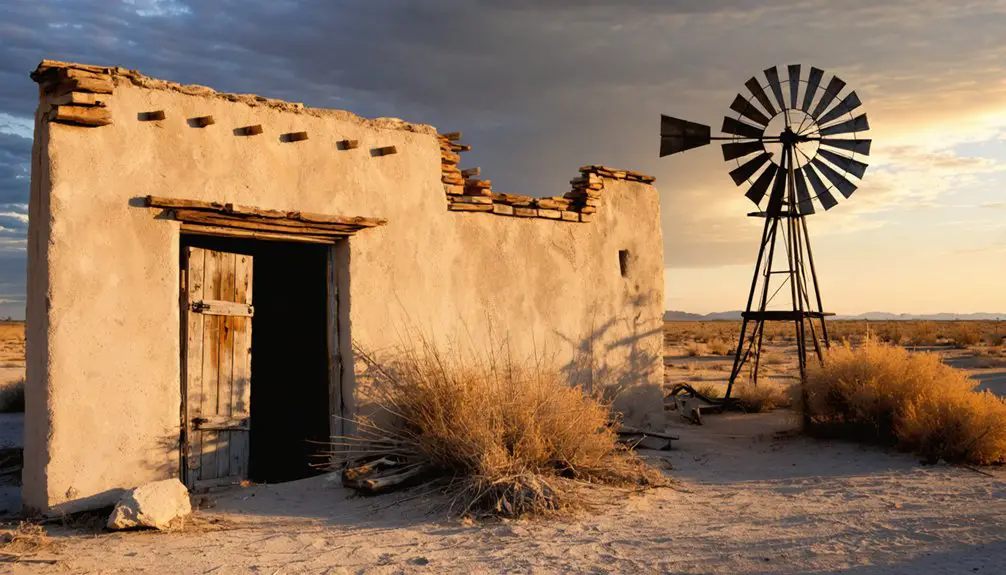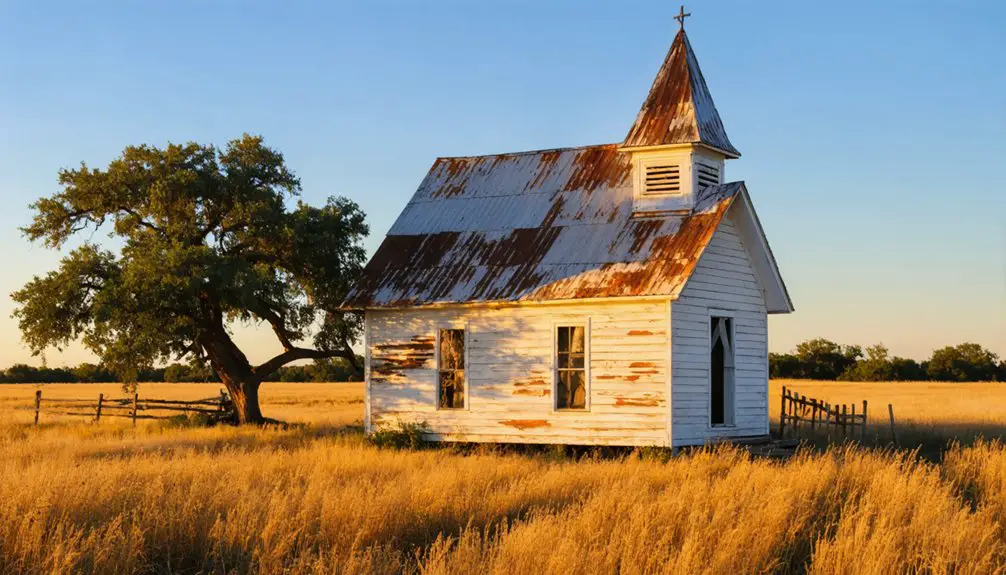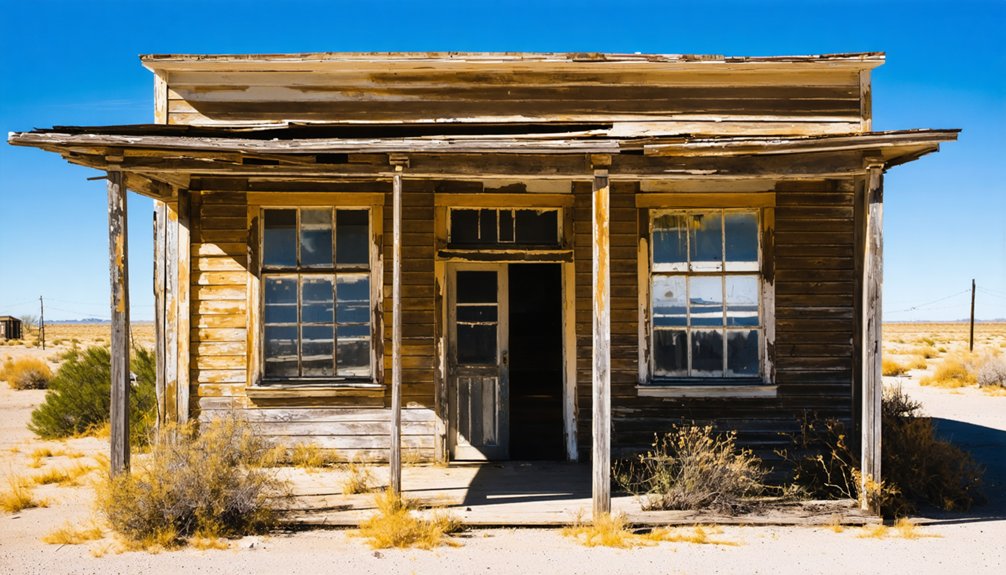
You’ll find fascinating ghost towns scattered across Texas, from Terlingua’s crumbling mercury mining ruins near Big Bend to Bluffton’s submerged structures that emerge from Lake Buchanan during droughts. Route 66 enthusiasts can explore Glenrio’s 17 preserved buildings straddling the Texas-New Mexico border, while Lobo now hosts experimental film festivals in its restored desert structures. Barstow’s sandstone architecture and Belle Plain’s nineteenth-century college ruins offer glimpses into railroad and educational history. Each site reveals unique stories of boom-and-bust cycles, architectural resilience, and cultural heritage worth discovering further.
Key Takeaways
- Terlingua near Big Bend offers restored buildings including Starlight Theatre restaurant, historic church, cemetery, and crumbling mining-era ruins to explore.
- Glenrio on the Texas-New Mexico border preserves Route 66 history with 17 structures including cafes, motels, and vintage roadside architecture.
- Lobo in the Chihuahuan Desert hosts experimental film festivals and features a massive pecan orchard with over 61,000 trees.
- Bluffton’s submerged remains under Lake Buchanan become visible during droughts, revealing churches, cemeteries, and foundation remnants from the 1930s.
- Barstow maintains historical structures including an intact school and Masonic Lodge, functioning as a semi-ghost town with 349 residents.
Terlingua: The Cinnabar Mining Ghost Town of Brewster County
When the mine closed, Terlingua became a true ghost town by the late 1940s.
Today, you’ll witness an impressive ghost town revival—restored buildings house the Starlight Theatre restaurant and Terlingua Trading Company, while the annual chili cook-off draws 10,000 visitors.
The town earned its title as Chili Capital of the World in 1967, cementing its place in culinary tradition.
Explore crumbling ruins, historic St. Agnes Church, and the atmospheric cemetery near Big Bend National Park.
The Chisos Mining Company drove the town’s growth during its mining peak, when mercury deposits attracted over 1,000 residents by the early 1900s.
Bluffton: Texas’ Underwater Town Beneath Lake Buchanan
Imagine walking through a Texas town where sturdy foundation stones and century-old roads lie preserved beneath 30 feet of water. You’ll find Bluffton, settled in 1852, now submerged under Lake Buchanan since 1937.
Beneath Lake Buchanan’s surface rests Bluffton, a 19th-century Texas settlement frozen in time since 1937.
When the Buchanan Dam rose as a New Deal project, fifty families surrendered their properties to bring electricity to Hill Country. The LCRA relocated over 300 graves before flooding, though one remained behind.
During severe droughts in 1984, 2009, and 2012, you could’ve walked nearly two miles across the lakebed to explore these ruins. The exposed remnants included visible structures like churches and cemeteries, along with the foundation of the town’s cotton gin and various homes.
Underwater archaeology efforts by the Texas Historical Commission excavated the forgotten cemetery in 2009.
Lake Buchanan preservation keeps this ghost town hidden at full capacity, but dropping water levels occasionally reveal its secrets to adventurous visitors. You can access the site through mountain bike trails when water levels recede during drought periods.
Lobo: The Restored Ghost Town Hosting Film Festivals
Deep in the Chihuahuan Desert, where Mexican wolves once prowled and the nearest water source stretched 100 miles in any direction, Lobo emerged around a life-saving discovery: the Van Horn Wells. This railroad town thrived until earthquakes and water depletion drove everyone away by 1991.
What makes Lobo exceptional isn’t its urban decay—it’s what came after. German investors rescued the seven-acre ghost town in 2001, transforming crumbling structures into venues for experimental film festivals.
Every two years, short films flicker against weathered walls under vast starry skies, breathing temporary life into abandoned buildings. The property also features a pecan orchard with over 61,000 trees, adding an unexpected agricultural dimension to this desert retreat.
This heritage preservation effort proves unconventional. You can’t simply move here; it’s privately fenced property.
But through arts festivals, Lobo’s found purpose beyond conventional restoration—celebrating impermanence itself. While exploring West Texas, consider extending your trip to nearby Marfa to witness the mysterious Marfa Lights, another captivating desert phenomenon.
Barstow: Former Railroad Stop and Ward County Seat
While most ghost towns fade quietly into obscurity, Barstow fought its extinction with remarkable ferocity—including armed standoffs over government records. Founded in 1892 alongside railroad development by the Texas and Pacific Railway, this irrigation-dependent community once thrived with over 1,500 residents. Its mining history includes red sandstone quarries that fueled early prosperity.
Barstow’s decline began when:
- The Pecos River Dam catastrophically failed in 1910, obliterating farmland
- Subsequent droughts made agriculture impossible by 1918
- The devastating loss of county seat status to oil-rich Monahans in 1937
The town had served as Ward County seat for 46 years before the bitter transfer of power. Today, you’ll find 349 stubborn souls inhabiting this semi-ghost town. The abandoned school building stands intact, windows sealed with metal sheets, while the deteriorating Masonic Lodge crumbles nearby—monuments to a community that refused to surrender without a fight. The local sandstone shaped not only Barstow’s economy but also provided the distinctive red building material visible throughout the remaining structures.
Glenrio: The Route 66 Town on the State Line
You’ll find Glenrio uniquely positioned across the Texas-New Mexico border, where its abandoned buildings tell the story of Route 66’s golden age.
The town’s crumbling gas stations, motels, and cafes line both sides of the state line, their weathered facades frozen in time since Interstate 40’s construction sealed their fate in 1975.
Today, seventeen structures stand as a National Register Historic District, preserving the mid-century architecture that once served millions of travelers on America’s Main Street.
Glenrio’s origins trace back to a Rock Island Railroad stop, establishing its role as a transportation hub long before Route 66 brought automobile tourism to the region.
The town’s strategic border location meant no bars existed on the Texas side due to Deaf Smith County’s prohibition laws, while New Mexico avoided service stations because of higher gasoline taxes.
Straddling Two States
Few ghost towns capture the peculiar quirks of American geography quite like Glenrio, a Route 66 settlement that literally straddled the Texas-New Mexico border.
You’ll discover how border crossers experienced dramatically different worlds simply by stepping across the street, where state regulations created a unique commercial ecosystem:
- Texas side: No bars allowed due to Deaf Smith County’s dry status
- New Mexico side: No gas stations because of higher gasoline taxes
- State Line Cafe: Featured dual signage proclaiming both “Last Stop in Texas” and “First Stop in Texas”
This geographical oddity meant the Texas Longhorn Motel and surrounding businesses capitalized on each state’s advantages.
The federal government ultimately classified Glenrio as Texan, though travelers experienced both jurisdictions within steps of each other.
Historic Route 66 Buildings
When the Chicago, Rock Island, and Pacific Railroad laid tracks through this desolate stretch of high plains in 1901, it sparked the creation of a settlement that would become one of Route 66’s most distinctive ghost towns.
Today, you’ll find seventeen abandoned structures standing as evidence to Glenrio’s glory days. The Little Juarez Cafe’s weathered facade still beckons nonexistent travelers, while vintage signage from gas stations and motels rust under the Texas sun. Adobe buildings that once housed thriving businesses now shelter only desert winds.
Though roadside murals have faded and paint peels from wooden storefronts, these ruins tell stories of 1940s prosperity when chrome-bumpered cars rolled through daily. Walk among concrete foundations where diners served weary migrants, and you’re transported to Route 66’s heyday.
Preserved Mid-Century Architecture
Glenrio stands apart from other Route 66 ghost towns because it earned recognition on the National Register of Historic Places as a complete Historic District, preserving seventeen structures that capture mid-century roadside America in suspended animation. Unlike typical urban decay, this architectural preservation showcases authentic 1940s-1950s roadside culture frozen in time.
You’ll discover three distinctive features that make Glenrio exceptional:
- Little Juarez Cafe – A bricked-over Valentine Diner-style building representing classic roadside architecture
- Western-themed motels – Concrete-foundation structures embodying the era’s automobile tourism
- Original Route 66 roadbed – Still visible alongside abandoned gas stations and the post office
The detour from Interstate 40 reveals tumbleweeds rolling past utilitarian buildings where you can experience genuine mid-century nostalgia without commercialization or crowds—just pure historical authenticity.
Belle Plain: Callahan County’s Abandoned College Town
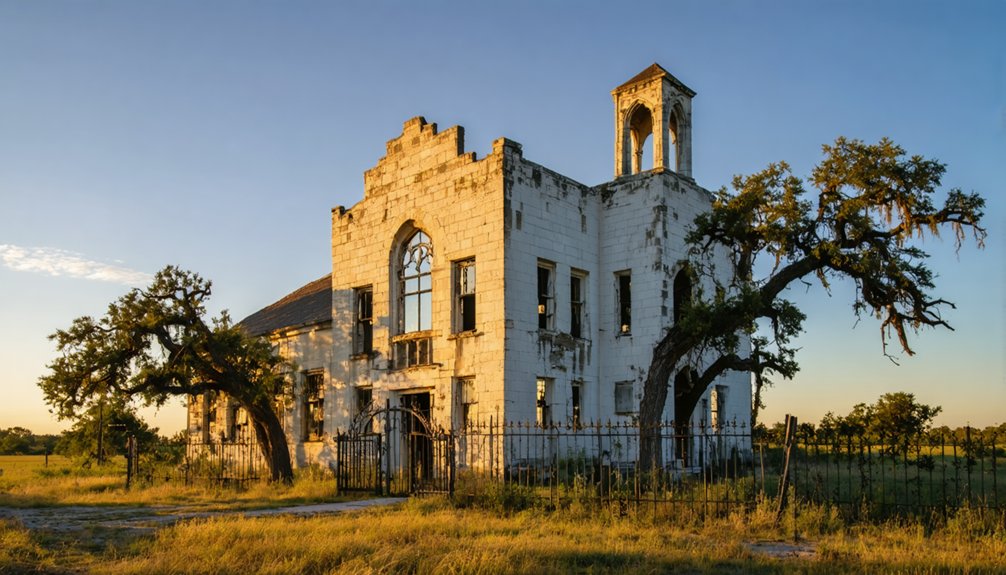
You’ll find Belle Plain’s haunting stone ruins rising from the prairie about 6.5 miles south of Baird, where a once-thriving nineteenth-century college town met its demise after the railroad passed it by.
The main college building’s native stone walls and the dean’s residence still stand as testaments to Methodist educational ambitions that drew 122 students to this remote West Texas settlement in the 1880s.
These weathered structures mark what was once Callahan County’s first seat of government and home to Belle Plain College, an institution celebrated for housing fifteen pianos and training students in classical subjects from astronomy to music.
Historic College Foundations Remain
Rising from an empty field six and a half miles south of Baird, the weathered stone walls of Belle Plain College tell the story of a once-thriving educational center that vanished into the Texas prairie.
The main building’s native stone construction has outlasted its wooden counterparts, preserving this educational heritage through decades of abandonment.
You’ll find remarkable architectural preservation at the site, including:
- The three-story main college building with its distinctive fourth-story cupola
- Remnants of a second college structure, both mortgaged in 1885
- The old courthouse and various stone buildings scattered across the property
Access requires wayfinding winding country roads one mile east of Highway 283.
The ruins remain on private property, where respectful owners maintain the site without public access, letting these stone sentinels stand as Texas’s monument to frontier ambition.
Dean’s Residence Still Stands
Among Belle Plain’s enduring stone structures, the dean’s residence stands as a demonstration of frontier educational ambition. Though time and vandalism have exacted a heavy toll on this once-proud building, it remains a notable relic.
You’ll find this three-story native stone construction near the dirt road accessing Belle Plain. It is positioned about one mile east of U.S. Highway 283.
Unlike wooden structures that vanished decades ago, architectural preservation through stone masonry allowed this residence to survive over a century of abandonment.
However, weathering effects have been brutal.
Vandals removed furniture and torched it in the front yard, accelerating the structure’s decline.
Extensive deterioration eventually required partial demolition.
Despite this damage, you can still observe remnants from the roadside—a haunting testament to Belle Plain’s once-thriving educational community.
Nineteenth Century Educational Legacy
When Belle Plain College opened its doors in 1881, it brought classical education to the rugged frontier of West Texas, transforming a remote county seat into an unlikely beacon of learning. This educational innovation attracted students throughout the region who sought intellectual pursuits beyond survival skills.
The college’s regional cultural influence manifested through:
- Ambitious curriculum featuring astronomy, philosophy, physics, and history alongside practical subjects
- Substantial arts program equipped with a dozen grand pianos for music instruction
- Rapid expansion from 22 students in 1881 to 300 at peak enrollment
Despite closing in 1892 after railway bypasses and drought devastated the town, Belle Plain College demonstrated that frontier communities valued enlightenment.
You’ll find its crumbling structures still stand as testament to pioneers who prioritized education even in harsh, unforgiving landscapes.
Frequently Asked Questions
Are Ghost Towns in Texas Safe to Explore Alone?
You’re dancing with danger exploring Texas ghost towns solo. Pack essential exploration gear—water, GPS, first-aid supplies—and follow safety precautions: tell someone your plans, avoid unstable structures, and prepare for extreme heat exceeding 105°F in remote locations.
Do I Need Special Permits to Photograph Texas Ghost Towns?
You’ll need property owner permission through a valid location agreement for private ghost towns, but no special permits for personal photography. However, if you’re shooting commercially or concerned about historic preservation, verify local requirements first.
What’s the Best Time of Year to Visit Texas Ghost Towns?
Spring and fall paint the perfect canvas for your ghost town adventures. You’ll find comfortable temperatures, blooming landscapes around historical preservation sites, and fewer crowds at these tourist attractions—giving you the freedom to explore Texas’s haunted past unbothered. As you explore abandoned towns in Texas, each corner tells a story of days gone by, from crumbling buildings to remnants of lively communities. The eerie silence coupled with the rustle of the wind creates an atmosphere that’s both haunting and captivating, perfect for photography enthusiasts and history buffs alike. Don’t forget to bring a journal to document your findings as you wander through these ghostly relics of the Lone Star State.
Can You Camp Overnight at Texas Ghost Town Sites?
Yes, you can camp overnight at some Texas ghost towns like Terlingua, which offers designated sites for overnight adventuring. You’ll need to follow specific quiet hours and fire rules while respecting history preservation guidelines.
Are There Guided Tours Available for Texas Ghost Towns?
Unlike Tombstone’s polished historical preservation, most Texas ghost towns lack tourism infrastructure for guided tours. You’ll explore Terlingua independently, though Fort Worth, Galveston, Jefferson, and Fredericksburg offer professionally-led walking experiences combining Wild West history with paranormal storytelling. The ghost towns of Texas history reveal the remnants of once-thriving communities. Each location tells a unique story of the struggles and triumphs of the past, often marked by the rise and fall of the mining industry and cattle drives. As you wander through these deserted streets, you’ll encounter faded storefronts and crumbling buildings that echo the spirit of those who once called them home.
References
- https://www.youtube.com/watch?v=Zd8-gKw-5Hc
- https://www.southernthing.com/ruins-in-texas-2640914879.html
- https://texashighways.com/travel-news/four-texas-ghost-towns/
- https://www.hipcamp.com/journal/camping/texas-ghost-towns/
- https://www.tripadvisor.com/Attractions-g28964-Activities-c47-t14-Texas.html
- https://mix931fm.com/texas-ghost-towns-history/
- https://www.texasescapes.com/TOWNS/Texas_ghost_towns.htm
- https://content.govdelivery.com/accounts/TXPWD/bulletins/1dcdee4
- https://www.legendsofamerica.com/tx-terlingua/
- https://www.dallasites101.com/blog/post/terlingua-texas-ghost-town-guide/