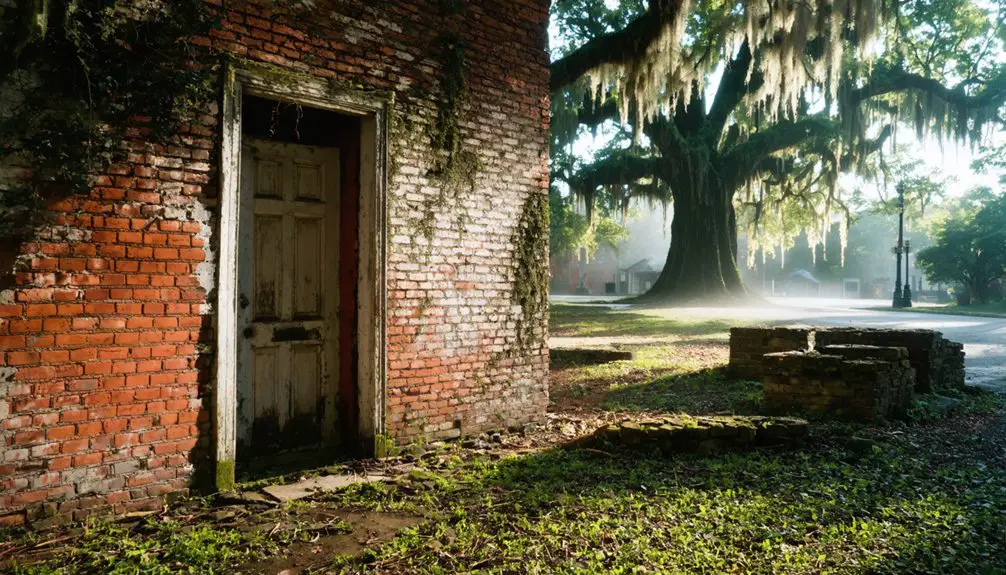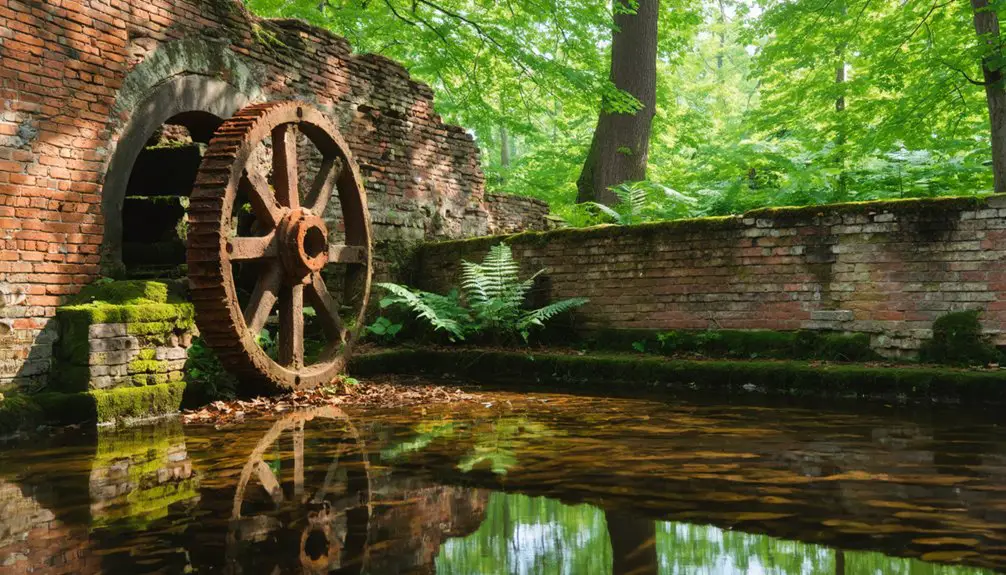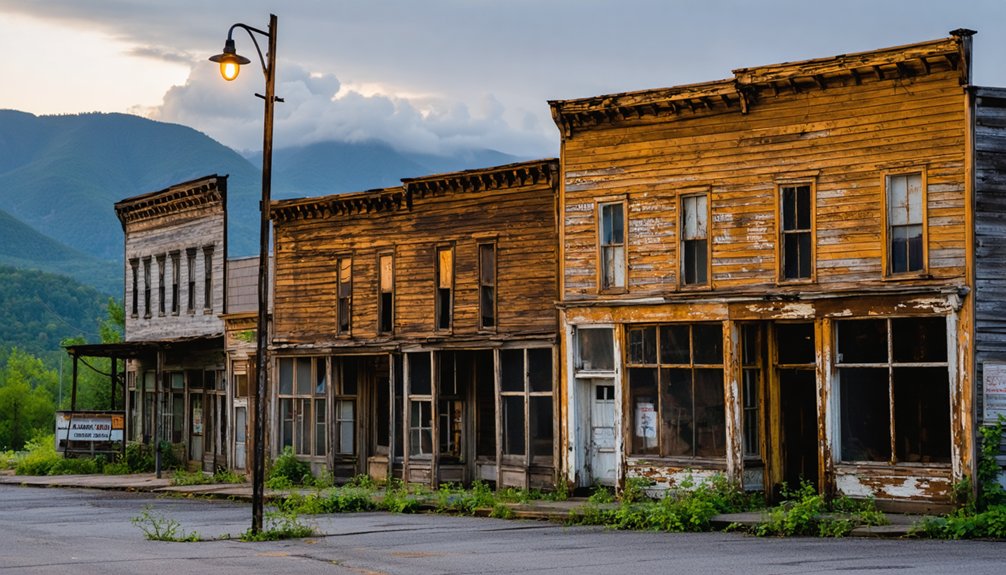
You’ll find Virginia’s most accessible ghost towns at Union Level, where tobacco fortunes collapsed after the Civil War, leaving weathered storefronts along former carriage routes. Pamplin offers the best-preserved experience with its Victorian railroad depot, clay pipe factory ruins, and 31-mile High Bridge Trail threading through abandoned infrastructure. For remote exploration, Mouth of Wilson displays crumbling woolen mills and mansions where Wilson Creek meets the New River. Each site reveals different chapters of Virginia’s industrial past, from canal dreams at Matildaville to WWII deception at Elko Tract‘s phantom airbase, with preservation levels ranging from maintained heritage sites to nature-reclaimed ruins.
Key Takeaways
- Union Level features weathered storefronts, a vintage gas pump, and ruins from over 20 businesses that thrived in the 1920s.
- Pamplin offers Victorian storefronts, a historic railroad depot, clay pipe factory remnants, and access to the 31-mile High Bridge Trail.
- Matildaville at Great Falls Park displays ruins from George Washington’s 1790s canal project, including lock mechanisms and the superintendent’s house.
- Mouth of Wilson contains an 1884 woolen mill, Fields Mansion, general store, and weathered water tower with no active preservation.
- Elko Tract preserves a WWII phantom air base with crumbling streets, a water tower, and visible dummy runway outlines.
Union Level: Tobacco Town Turned Railroad Stop
Tucked away in Mecklenburg County near the North Carolina border, Union Level tells the story of a once-thriving community that time simply passed by. You’ll discover remnants of what was once a bustling tobacco hub that outpaced nearby South Hill in the 1860s.
The town’s fortunes shifted when landowners refused to sell property for tobacco warehouses after the Civil War, sending business elsewhere.
When you visit today, you’ll find weathered storefronts and a vintage gas pump frozen at 35 cents per gallon—haunting symbols of urban decay.
The Southern Railroad breathed temporary life into Union Level in the early 1900s, but the depot’s gone now. Before the railroad arrived, Union Level served as a busy stop along horse and carriage lines in the early 1800s. By 1920, the town flourished with over 20 businesses including stores, barber shops, and a pharmacy.
Preservation challenges mean most buildings aren’t safe to enter, though you’re free to explore the atmospheric roadside ruins where fewer than twenty residents remain.
Elko Tract: The Phantom Air Force Base
You’ll find one of America’s most elaborate wartime ruses hidden in plain sight near Richmond, where the 936th Camouflage Battalion constructed an entire fake air base in 1942—complete with plywood aircraft, canvas hangars, and dummy runways designed to lure Axis bombers away from the real Richmond Army Air Base.
The deception worked so well that enemy planes never came, leaving this phantom military installation to fade into obscurity after soldiers shipped out to the Pacific in 1944. In the post-war years, the state planned to build a mental health hospital for African Americans on the site, but faced fierce resistance from white Henrico residents, ultimately abandoning the project by 1957. Today, crumbling streets, a lonely water tower, and runway outlines etched in the treeline mark where 2,400 acres of farmland became a ghost town that never truly lived. The site now forms part of the White Oak Technology Park, where high-tech factories occupy portions of land that once hosted a massive wartime illusion.
WWII Deception Strategy
Deep in the forests of Henrico County, just southeast of Richmond, lies one of World War II’s most elaborate illusions—a phantom air force base that never launched a single plane.
In 1942, the 936th Camouflage Battalion transformed 2,400 wooded acres into a masterpiece of military camouflage and deception tactics designed to fool Luftwaffe bombers.
The strategy was brilliantly simple: when air raids threatened, Richmond would go dark while Elko Tract blazed to life.
You’d find:
- Plywood P-47s on two-by-four landing gear
- Canvas hangars and cloth-covered trucks
- Fake roads mimicking Richmond’s street grid
- Soldiers repositioning props daily for authenticity
- Hollywood-designed backdrops creating realistic illusions
The Luftwaffe never came, but this “Lost City” protected Richmond’s strategic importance—a testament to American ingenuity and the power of deception.
The decoy’s triangular layout precisely imitated Byrd Field’s design, complete with dummy runways and taxiways that would appear authentic from the air.
The federal government seized the land through condemnation in October 1942, giving local families just 30 days’ notice to vacate their homes.
Post-War Dismantlement
When the war ended, Elko Tract’s elaborate illusion lost its purpose overnight. You’ll find the federal government quickly transferred this phantom base to civilian hands by February 1947.
The state envisioned an African-American mental hospital here, investing $500,000 in water systems, sewage lines, and street infrastructure. Workers erected fire hydrants and water towers across the site, preparing for a facility that would never materialize.
The site later served as a location for infantry training and bombing practice before the Commonwealth of Virginia assumed full control of the property.
Matildaville: Washington’s Failed Canal Dream
Among George Washington’s lesser-known ambitions was a grand vision to connect America’s eastern seaboard with its western frontier through an ambitious canal system. He chartered the Patowmack Company in 1785, envisioning Matildaville as its bustling headquarters.
Washington’s 1785 canal venture promised to unite America’s coasts with its frontier through waterways carved from ambitious dreams.
For seventeen years, workers carved waterways around the Potomac’s treacherous falls.
Today, you’ll discover fragments of this failed dream in Great Falls Park:
- Crumbling superintendent’s house foundations
- Revolutionary-era lock mechanisms showcasing innovative engineering
- Rock-cut canal traces carved by indentured servants
- Remnants of market buildings and sawmills
- Springhouse ruins along the 1.7-mile Matildaville Trail
The canal’s 1802 opening couldn’t save it—usable merely weeks annually, it bankrupted by 1828. The company collected $172,689.39 in tolls by 1818 but had spent over $650,000 on construction, creating an insurmountable debt that doomed the enterprise.
Historical archaeology and canal preservation efforts now protect these ruins, letting you walk through Washington’s pioneering yet ultimately doomed attempt at nation-building infrastructure. The town, named after Matilda Lee, was established in 1790 and included an inn where Washington himself frequently stayed during visits to oversee the canal project.
Pocahontas: Coal Boom Town With New York Flair
Few coal towns in Appalachia could rival the ambition behind Pocahontas when engineer Jedidiah Hotchkiss convinced the Norfolk & Western Railroad to extend its tracks into these remote Virginia mountains in 1881.
You’ll discover mining history that transformed $2-per-acre wilderness into Virginia’s first model company town, where architect Charles W. Bolton designed orderly streets for Hungarian, Swedish, and German immigrants working the legendary 13-foot coal seam.
The town architecture still reflects this multi-ethnic heritage—from workers’ cottages to the exhibition coal mine that opened in 1938.
Pocahontas No. 3 seam produced the world’s finest bituminous coal at 15,000 BTU, fueling America’s industrial revolution.
Today, you can explore where 44 million tons emerged before exhaustion closed operations in 1955.
The Pocahontas Mine No. 1 earned recognition on the National Register of Historic Places, preserving the site where commercial coal mining first began in 1883.
Pamplin: Endangered Railroad Heritage Village
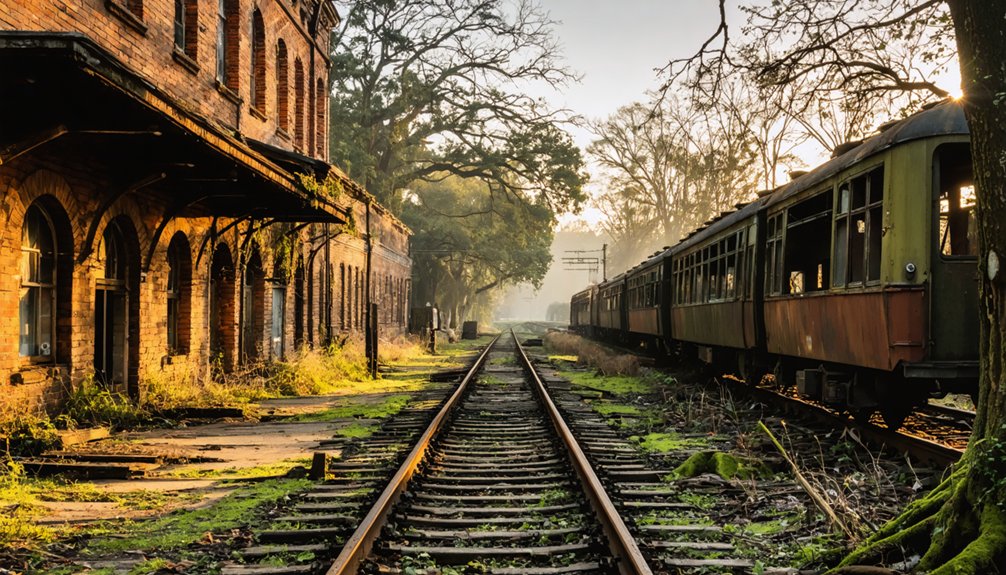
You’ll find Pamplin straddling the edge between preservation and decay. Its Victorian storefronts and grand homes are slowly surrendering to time’s patient siege.
The town earned a spot on Preservation Virginia’s most endangered sites list in 2014, a desperate plea that sparked restoration efforts. These efforts saved its former railroad depot and several historic structures.
Today you can explore this architectural time capsule before parking your car at the High Bridge Trail trailhead just outside town. One of the old Norfolk and Western rail lines has been reborn as a 31-mile pathway cutting through tobacco country.
High Bridge Trail Access
Though time and neglect have hollowed out much of Pamplin’s historic downtown to just ten brick buildings, the town’s designation as the terminus for the 31-mile High Bridge Trail breathes new hope into this endangered railroad heritage village.
You’ll discover authentic railroad history along this Virginia Historic Landmark that follows the original rail corridor where freight and passengers once traveled.
The trail offers you:
- Direct access to High Bridge, the Civil War-era structure that prevented Lee’s escape before Appomattox
- 31 miles of uninterrupted pathway for hiking, biking, and horseback riding
- Connection to Pamplin’s refurbished Norfolk-Southern depot housing town offices
- Freedom to explore remote countryside without vehicular traffic
- Gateway to understanding historic preservation challenges facing small communities
This recreational corridor transforms abandoned infrastructure into your personal exploration route.
Endangered Architectural Treasures
Walking through Pamplin’s Main Street feels like stepping onto an abandoned movie set where time stopped decades ago. You’ll find only ten gaunt structures remaining in the hollowed-out downtown, their crumbling facades telling stories of railroad prosperity turned to industrial decay.
The clay pipe factory—once America’s largest—stands as the crown jewel of this endangered heritage. Its deteriorating kiln and chimney tower over weathered walls that once produced whimsical pipe heads shaped like tomahawks and human faces.
Preservation Virginia designated Pamplin one of the state’s most endangered sites in 2014, spurring architectural preservation efforts. The Archaeological Conservancy now protects the factory grounds.
The restored railroad depot serves as town offices and event space—proof that dedication can rescue these irreplaceable 19th-century treasures from oblivion.
Mouth of Wilson: Preserved Remnants of Rural Life
Nestled where Wilson Creek empties into the New River, this Grayson County settlement carries the somber legacy of its namesake—a surveyor who died during the 1749 Virginia-North Carolina boundary expedition and was laid to rest in the very waterway that would bear his name.
You’ll discover abandoned structures that tell stories of 19th-century rural commerce:
- Woolen mill (1884) built by Colonel Fields J. McMillan
- Fields Mansion, constructed in stages between 1884-1907
- Historic general store and post office buildings
- Water tower standing sentinel over empty streets
- Halsey Farm Service Store, weathered but intact
Despite claiming “preserved remnants” status, there’s no active historic preservation effort here.
The wildlife habitats along Wilson Creek thrive while human structures decay—a poignant reminder of Appalachia’s shifting economic landscape.
Exploring Virginia’s Abandoned Communities
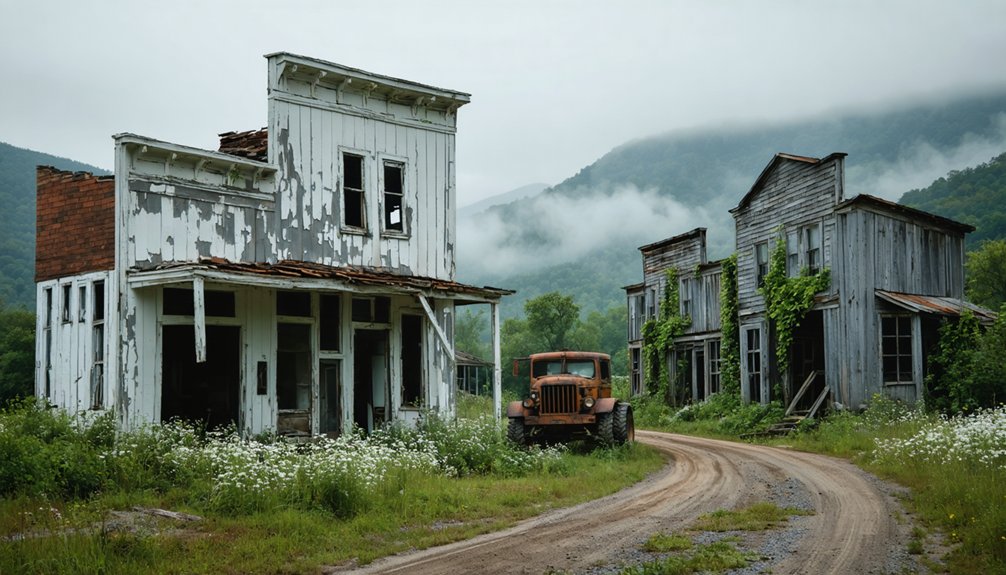
Beyond the well-trodden paths of Colonial Williamsburg and Civil War battlefields, Virginia harbors dozens of settlements where silence has replaced commerce, where nature reclaims what ambition built. You’ll find Union Level’s crumbling storefronts along forgotten rail lines, Matildaville’s stone ruins beside the Potomac, and Henricus’s reconstructed palisades rising from archaeological foundations.
These abandoned communities tell stories urban revitalization can’t touch—tales of tobacco fortunes lost, canal dreams abandoned, and mining towns emptied when ore ran dry.
Historical preservation here takes different forms. Some sites become living museums, while others surrender to Virginia’s relentless green. You’re free to wander Jamestown’s excavations, explore Great Falls Park’s industrial ghosts, or trace stage routes through Mecklenburg County where 188 souls still cling to Union Level’s fading memory.
What Makes a Ghost Town Worth Visiting
When you stand before a ghost town’s weathered structures, you’re weighing whether the journey merits the destination.
The most compelling sites offer tangible connections to Virginia’s past—places where urban decay tells authentic stories rather than manufactured nostalgia.
Worth-visiting ghost towns typically feature:
- Accessible architectural remains including mercantile buildings, homes, or government structures you can actually explore
- Preserved cemeteries holding genealogical treasures and family histories spanning generations
- Visible evidence of economic booms and busts that shaped regional development
- Minimal preservation challenges allowing safe exploration without trespassing concerns
- Dramatic abandonment narratives from mining collapses, railroad bypasses, or natural disasters
The best destinations balance historical significance with exploration freedom, offering you direct encounters with Virginia’s forgotten communities without excessive restrictions or disappointing foundation traces.
Planning Your Virginia Ghost Town Adventure
Your successful ghost town expedition begins long before you arrive at crumbling doorways and overgrown foundations. Start by consulting local historical societies for precise directions and access permissions—sites like Union Level sit on monitored private property where trespassing invites sheriff attention.
Preparation and permission determine ghost town access—trespassing on monitored sites like Union Level guarantees legal consequences, not adventure.
Download ghost town maps and Wikipedia coordinates for locations spanning York County’s Bigler’s Mill to Mecklenburg County’s border settlements.
Consider these abandoned spaces as unintentional eco tourism destinations where wildlife habitats now thrive in human absence. Book advance tours for structured paranormal investigations, and time your visits during dry seasons when trail extensions remain passable.
Respect the delicate balance—these decaying structures shelter both history and nature. Pack accordingly, verify seasonal flooding risks near waterways, and always maintain daytime visibility for safe exploration of Virginia’s forgotten communities.
Frequently Asked Questions
Are Virginia’s Ghost Towns Safe to Explore Alone or at Night?
You’ll face crumbling structures, you’ll navigate uneven terrain, you’ll encounter isolation—exploring Virginia’s ghost towns alone or at night isn’t recommended. Safety considerations outweigh adventure; daylight visits respect historical preservation while protecting you from structural hazards and limited emergency access.
While you may be drawn to the allure of historic ghost towns in Virginia, it’s essential to prepare adequately for your journey. Research the towns well in advance, and consider joining guided tours that not only enhance your experience but also ensure your safety. These tours often provide fascinating insights into the rich history of these abandoned places and the stories that once thrived within their walls.
Do I Need Permission to Photograph Abandoned Buildings in Virginia?
Yes, you’ll need permission since abandoned buildings remain private property. Virginia’s trespassing laws don’t vanish just because a structure looks deserted. Secure permits beforehand—you’ll photograph freely without risking fines, arrest, or unwanted confrontations that’ll kill your creative flow.
Which Ghost Towns Have the Best Preserved Original Structures?
Time stands still at Rosewell Plantation, where towering colonial walls showcase Virginia’s finest historic architecture. Thanks to preservation efforts, you’ll find the most intact structures here—those magnificent brick ruins dwarf other ghost towns’ crumbling remains.
Can I Metal Detect or Collect Artifacts From Virginia Ghost Towns?
You can’t legally metal detect Virginia’s ghost towns without written landowner permission on private property. Legal restrictions protect archaeological sites under ARPA, while equipment requirements vary by location. Public lands generally prohibit artifact removal, risking misdemeanor charges.
Exploring abandoned places in Virginia can be a captivating adventure for history enthusiasts and urban explorers alike. These sites often hold remnants of the past, telling stories of former residents and their everyday lives. However, it is crucial to respect the law and the integrity of these locations to ensure they remain preserved for future generations.
What Weather Conditions Are Best for Visiting Ghost Towns?
Spring and fall paint perfect windows for your seasonal exploration, offering stable trails and comfortable temperatures. You’ll enjoy ideal weather safety conditions—avoiding summer’s scorching heat and winter’s icy grip while discovering Virginia’s abandoned settlements freely.
References
- https://theforgottensouth.com/union-level-virginia-ghost-town-history/
- https://www.blueridgeoutdoors.com/go-outside/southern-ghost-towns/
- https://freepages.history.rootsweb.com/~gtusa/usa/va.htm
- https://en.wikipedia.org/wiki/List_of_ghost_towns_in_Virginia
- https://nvtami.com/2025/01/22/virginia-citys-forgotten-ghost-towns/
- https://www.peterlabau.com/blog/entry/virginia-ghost-town
- https://abcnews4.com/amazing-america/discover-pamplin-virginia-a-nearly-forgotten-ghost-town-with-stories-still-standing
- https://www.youtube.com/watch?v=moYHlyQexj4
- https://www.virginia.org/listing/union-level-ghost-town/4358/
- https://www.onlyinyourstate.com/experiences/virginia/union-level-ghost-town-va