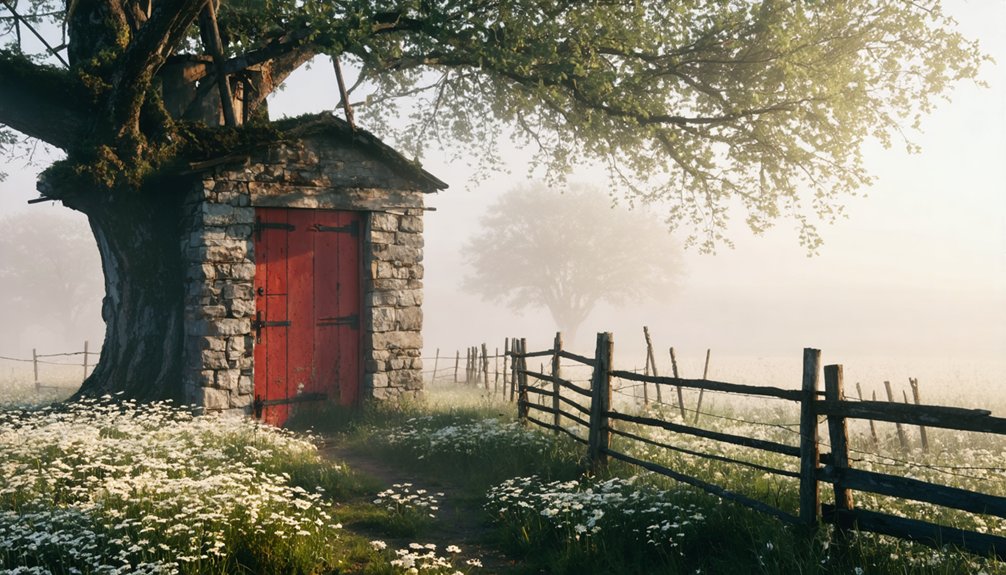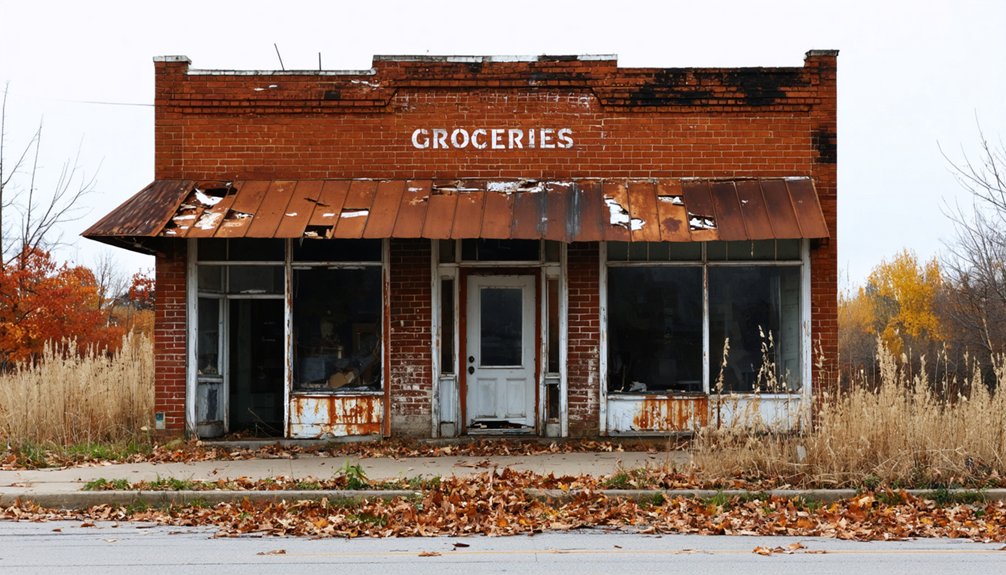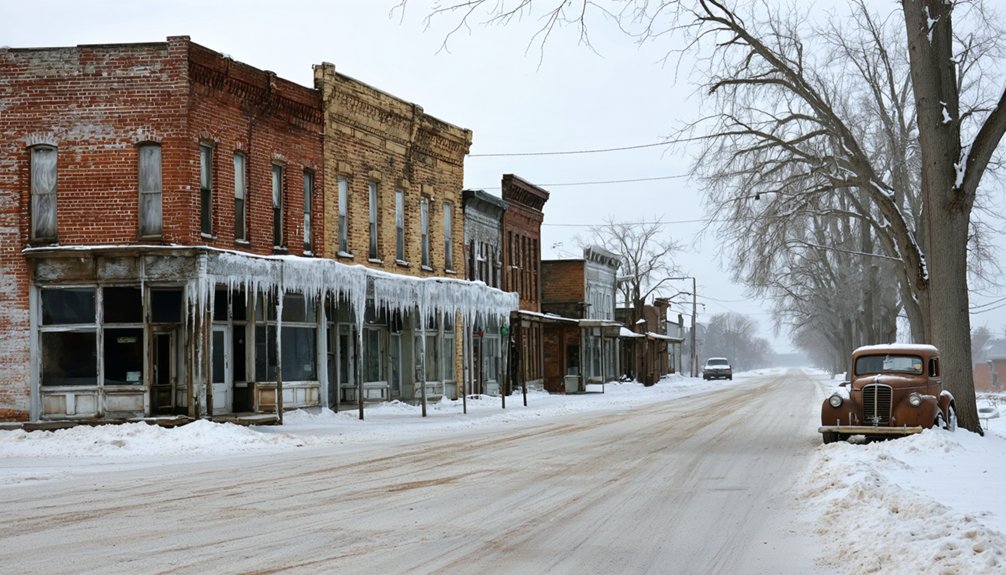
You’ll find Iowa’s most atmospheric ghost towns along Highway 64, where Buckhorn’s crumbling creamery stands beside a whitewashed church, and near Dyersville, where Rockville’s cemetery and old grist mill ruins emerge through winter snow. In Clayton County, Elkport’s foundations lie scattered across flood-reclaimed terrain, while Sunbury’s railroad remnants and Carrollton’s decayed structures offer quiet exploration of rural decay. The frozen landscapes heighten the isolation of these forgotten settlements, each preserving distinct chapters of Iowa’s 19th-century ambitions and agricultural heritage that await your discovery.
Key Takeaways
- Elkport in Clayton County is a modern ghost town submerged by 2004 flooding, featuring scattered foundations across snow-blanketed abandoned terrain.
- Rockville near Dyersville offers a preserved cemetery with thousands of burials and grist mill ruins along snow-covered paths by a frozen river.
- Buckhorn near Maquoketa features a crumbling creamery, whitewashed church, and Civil War-era cemetery accessible along Highway 64.
- Carrollton displays decayed foundations and silent cemeteries after railroad bypass and fires destroyed the former county seat’s structures.
- Sunbury provides quiet exploration of rural decay with remnants of its former dance hall and bank obscured under winter snow.
Buckhorn: A Preserved Slice of Rural Heritage
Tucked away in Jackson County’s windswept countryside, Buckhorn stands as a haunting reminder of Iowa’s pioneer past. Founded in 1836 by Shadrach Burleson, this settlement once thrived around the Buckhorn Tavern, named for the deer antlers adorning its door.
The Farmer’s Union Cooperative Creamery became the town’s economic heartbeat, producing 34 million pounds of butter and hosting picnics that drew thousands. The creamery’s decline began in the late 1950s when farmers left the dairy business, ultimately leading to a merger and the property’s auction in 1963.
Today, you’ll find crumbling historic landmarks scattered along Highway 64 near Maquoketa—a decaying creamery with its collapsed roof, a shuttered whitewashed church, and the overgrown Buckhorn Cemetery containing Civil War-era headstones. Burleson’s philanthropic spirit lives on through land he donated for the school, church, and cemetery that served this frontier community.
While you can’t enter these structures, winter visits offer unmatched rural preservation atmosphere. The isolation and deteriorating buildings create an eerie landscape where Iowa’s agricultural heritage remains frozen in time.
Rockville: Woodland Cemetery and Historic Mill Remains
While Rockville vanished from Iowa’s landscape over a century ago, its weathered remnants still whisper tales of frontier ambition along the North Fork Maquoketa River.
You’ll find hidden narratives etched in the cemetery stones south of Dyersville—graves that prove this stagecoach stop once thrived between 1835 and 1898. The old grist mill ruins stand sentinel along Rockville Road, their crumbling walls marking where water-powered industry drove community prosperity.
Winter transforms these scattered traces into contemplative spaces. Snow blankets the cemetery paths, inviting quiet exploration among headstones that survived when the town couldn’t.
The frozen river amplifies the isolation, perfect for winter reflections on frontier dreams that flickered briefly before Delhi and Dyersville eclipsed their neighbor.
Students rescued this cemetery from disarray, preserving access to Rockville’s stubborn memory. Like Des Moines’ Woodland Cemetery founded in 1848, historic burial grounds offer glimpses into communities that shaped Iowa’s early settlement patterns. That same cemetery eventually grew to hold 40,000-50,000 burials, becoming a vast chronicle of the capital city’s evolution from frontier outpost to metropolitan center.
Elkport: Eerie Atmosphere in Northeast Iowa
Along Elk Creek in Clayton County, Elkport tells one of Iowa’s most haunting modern ghost town stories. This once-thriving agricultural hub of 88 residents met its end when catastrophic flooding in 2004 submerged the entire community under eight to ten feet of water.
Rather than rebuild, every resident accepted federal buyouts, and by 2006, bulldozers razed 150 years of history. Today, you’ll find only scattered foundations and snow-blanketed fields where homes and schools once stood.
The frozen remnants create an eerie atmosphere that intensifies during winter months, when frigid temperatures and isolation amplify the site’s desolation. The catastrophic breach occurred on May 23, 2004, when the Turkey and Volga Rivers unleashed unprecedented flooding that overwhelmed the town’s south-end levee. The town was officially disincorporated in 2005, marking the formal end of its municipal existence. If you’re seeking winter solitude and a stark reminder of nature’s power, Elkport’s abandoned landscape offers profound reflection amid northeast Iowa’s reclaimed terrain.
Sunbury: Faded Agricultural Settlement
Winter transforms these scattered architectural remnants into stark reminders of rural decline. Snow blankets the landscape where fertile loamy soil once guaranteed prosperity. The Sunbury Bank failure during the Great Depression marked the beginning of the town’s decline, its building standing until around 2014. This former railroad town in Cedar County once featured a notable dance hall alongside its banking institution.
You’re free to explore this quiet ghost town without crowds, tracing the railroad routes that brought life—then abandonment—to Iowa’s forgotten agricultural outposts.
Carrollton: Decaying Buildings From Iowa’s Past
Tucked into Carroll County’s windswept farmland, Carrollton stands as a cautionary tale of ambitious beginnings and inevitable decline. Once Iowa’s county seat, this settlement vanished after losing political status and watching the railroad bypass its borders.
Today, historical preservation efforts can’t reverse what fires destroyed—every original structure succumbed to flames by the early 1900s.
What you’ll discover exploring Carrollton’s ghostly remnants:
- Decaying foundations where two banks once served 850 residents
- Empty fields hiding the town’s former waterworks and electric systems
- Ghost town archaeology revealing patterns of pioneer settlement
- Traces of two schoolhouses now reclaimed by farmland
- Silent plots where German immigrant families built their dreams
- Abandoned routes where settlements along the North Coon River once connected this vanished community to nearby Glidden
Winter’s stark landscape exposes Carrollton’s skeleton, offering you unobstructed views into Iowa’s forgotten territorial ambitions and the fragility of frontier prosperity. The Northwestern Railroad’s 1867 bypass sealed the town’s fate, prompting residents to vote for relocating the county seat to Carroll and triggering gradual abandonment.
Guthrie County’s Network of Abandoned Hamlets
Scattered across Guthrie County’s rolling prairie, five forgotten hamlets tell the story of Iowa’s most brutal economic reality—railroads decided which towns lived and which returned to dust.
You’ll find Dalmanutha’s cemetery marking where John Porter’s hotel once sheltered freedom-seekers on the Underground Railroad. John Brown himself allegedly stopped here before Harper’s Ferry. Historical transportation routes determined everything—when railways bypassed this Western Coach stage stop in 1855, the town died.
Wilmington’s sod houses earned it the nickname “Gopher Station” before Dalmanutha absorbed its population.
Bear Grove served Newton’s stagecoach route from 1854 to 1910. Wilkins never materialized beyond paper platting in 1856, while Allenville vanished into Bayard.
Each site represents unfettered 19th-century ambition meeting geography’s harsh verdict.
Underground Railroad connections make Dalmanutha particularly significant for those seeking authentic freedom narratives.
Frequently Asked Questions
What Winter Clothing and Safety Gear Should I Bring When Exploring Ghost Towns?
You’ll need layered merino wool base layers, insulated mid-layers, and waterproof shells. Don’t forget appropriate footwear with wool socks, warm mittens, and face protection. Pack an emergency kit with fire-starters and backup supplies for unpredictable conditions.
Are There Any Guided Tours Available for Iowa’s Ghost Towns During Winter?
Guided ghost town tours aren’t available during winter—you’ll explore independently. However, historical preservation sites offer seasonal experiences where mythical legends emerge. Self-guided road trips through abandoned towns like Elkport provide authentic freedom to discover Iowa’s haunting past at your own pace.
Can I Legally Camp Overnight Near These Ghost Town Locations in Winter?
You can’t legally camp near most Iowa ghost towns in winter, as they’re on private property or lack designated sites. State parks offer winterized camping with wildlife encounters, preserving your freedom while respecting history preservation regulations and property rights.
What Are the Best Photography Settings for Capturing Ghost Towns in Winter Conditions?
Like Ansel Adams freezing time, you’ll want f/8-f/11 aperture, low ISO 100-400, and slower shutter speeds to capture winter light dancing across ruins while snow reflection amplifies textures—settings that’ll preserve your untamed exploration’s raw, haunting beauty.
Are There Nearby Towns With Amenities Like Food and Lodging for Winter Visitors?
You’ll find lodging and dining in Maquoketa, Preston, and Guthrie Center near Iowa’s ghost towns. These communities honor local history through preservation efforts while offering modern amenities, letting you explore abandoned sites comfortably during your winter adventures.
References
- https://www.thegazette.com/travel/a-day-away-plan-a-haunted-iowa-road-trip-to-these-spirited-sites/
- https://khak.com/abandoned-attraction-ghost-town-buckhorn-iowa/
- http://www.iowapbs.org/article/8600/local-legends-around-iowas-haunted-locations
- https://www.traveliowa.com/spirited-adventures-iowas-best-haunted-spots-distillery-stops/
- https://www.youtube.com/watch?v=1J0Qx64ZrwI
- http://www.onlyinyourstate.com/iowa/ia-ghost-town
- https://www.discoverguthriecounty.org/ghosttowns
- https://www.youtube.com/watch?v=YDd_wn2B2js
- https://wdbqam.com/ixp/675/p/abandoned-attraction-ghost-town-buckhorn-iowa/
- https://poweredbyrobots.com/tag/buckhorn-iowa/