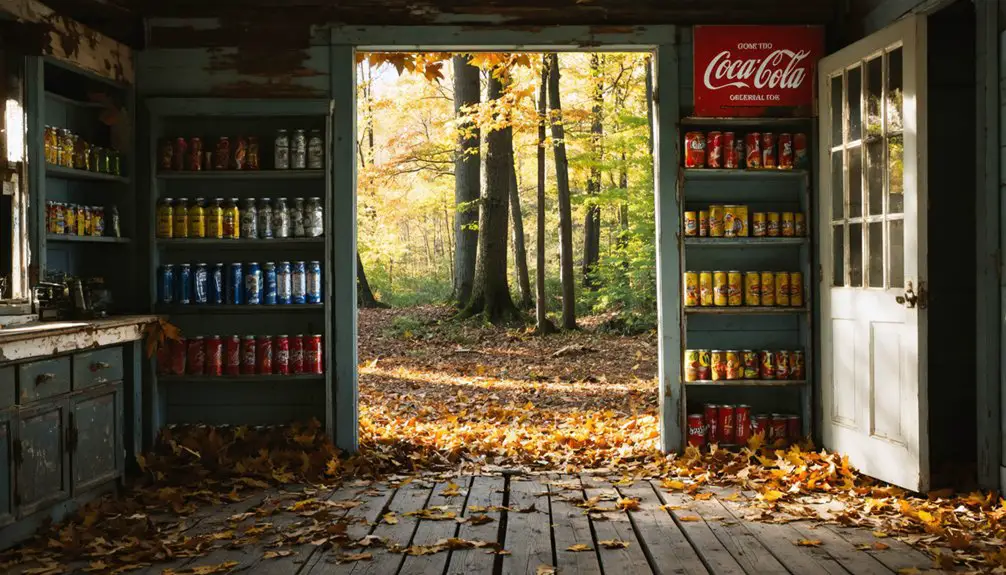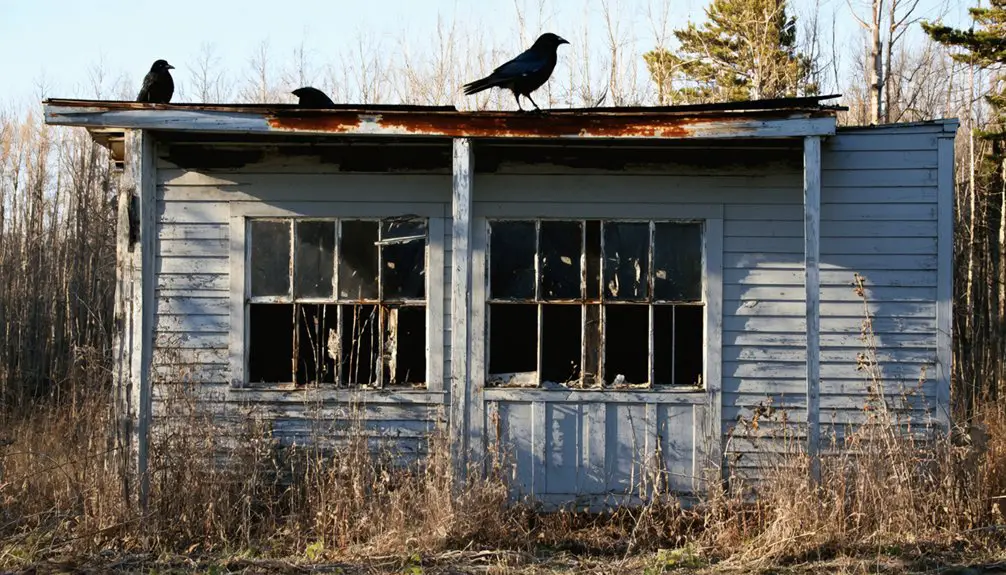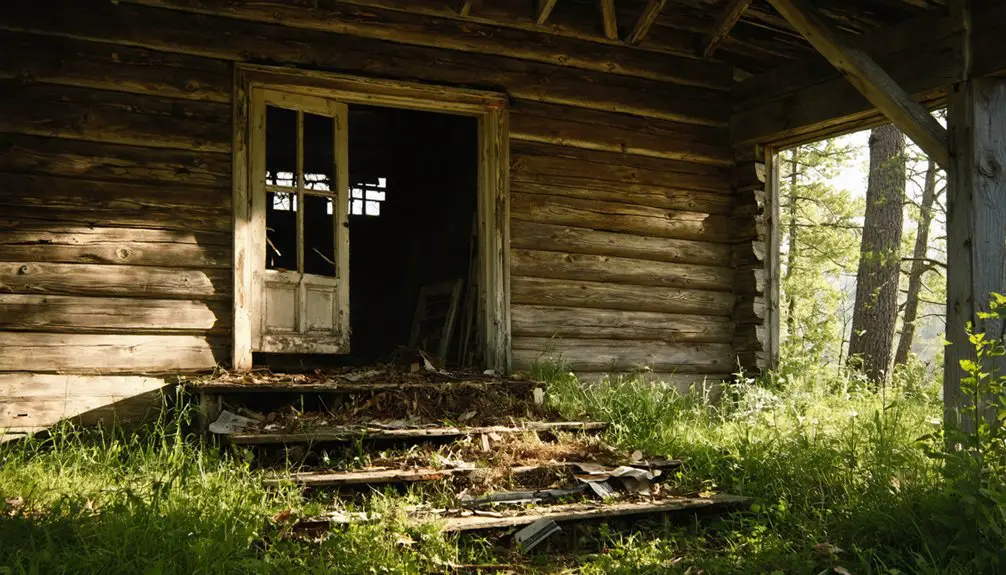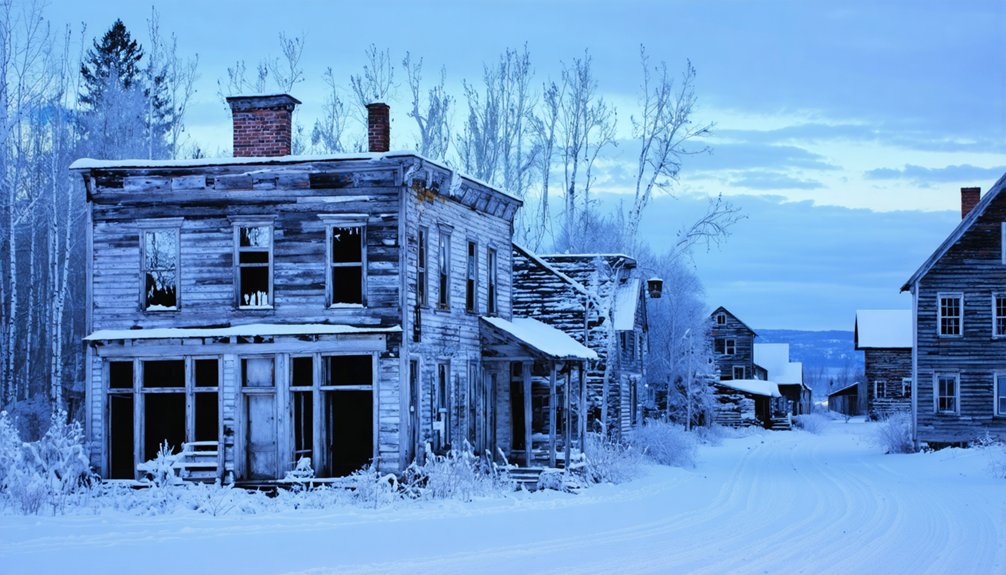
Maine’s winter ghost towns offer haunting exploration from Flagstaff’s submerged village visible beneath frozen Dead River reservoir to Perkins Township’s preserved 1800s structures on Swan Island. You’ll find Riceville’s snow-covered tannery ruins in Hancock County, Fort William Henry’s spectral colonial battlegrounds at Pemaquid, and Evergreen Ski Resort’s abandoned 28,000-square-foot lodge frozen since 1980. January through February provides ideal conditions when sub-zero temperatures create dramatic landscapes around foundation stones and cemetery markers. Proper winter gear including microspikes and GPS devices becomes essential for traversing these remote sites where Maine’s forgotten communities reveal their stories.
Key Takeaways
- Flagstaff’s submerged village becomes visible beneath ice during winter low water levels, revealing foundation stones and mill remnants.
- Swan Island’s Perkins Township offers ferry access to preserved 1800s structures and solitary winter exploration on 1,500 protected acres.
- Fort William Henry provides candlelight ghost tours at Pemaquid Point, featuring colonial ruins and paranormal activity year-round.
- Evergreen Ski Resort showcases a frozen 28,000-square-foot lodge with abandoned lifts across 310 acres in White Mountain National Forest.
- Freeman’s snow-covered stone foundations and cemeteries offer authentic trails for winter activities amid 19th-century agricultural ruins.
Flagstaff: The Submerged Village Beneath the Ice
Winter transforms Flagstaff Lake into a frozen monument where ice conceals an entire community beneath its surface. You’ll stand atop 20 square miles of Maine’s largest man-made lake, knowing complete villages lie directly below your boots.
Central Maine Power flooded this Dead River valley in 1950 after constructing Long Falls Dam. Before that final Fourth of July celebration in 1949, residents watched their century-old homes burn during land clearing operations. Some structures weren’t razed due to disputes—they simply sank.
When you visit during winter’s low water levels, submerged artifacts emerge: foundation stones, mill remnants, and road traces. The village’s origins trace back to Benedict Arnold’s expedition, when his men erected a flagpole that gave the settlement its name. The flooding erased both Flagstaff and Dead River from geographic maps, ending generations of annual communal gatherings. Haunted legends persist among locals who remember families forced to relocate to Eustis and Stratton, their cemetery stones moved but memories anchored beneath the ice.
Perkins Township on Swan Island: Wildlife Meets History
Unlike Flagstaff’s waters that consumed its villages overnight, Swan Island’s abandonment unfolded gradually across decades until the last residents departed in the 1940s.
Swan Island’s slow decline stretched across generations, ending when its final inhabitants left in the 1940s after decades of gradual exodus.
You’ll find this former fishing and shipbuilding community where settlement preservation meets raw wilderness along the Kennebec River. The Maine Department of Inland Fisheries and Wildlife maintains eight historic buildings, including the 1800 Tubbs-Reed House, throughout 1,500 protected acres.
Winter transforms this National Register site into prime territory for wildlife observation.
You’ll navigate frozen pathways past crumbling ice houses and weathered docks where seven ocean-going vessels once launched. The Abenaki people inhabited this land for millennia before colonial settlement, with evidence of human activity dating back at least 9,000 years.
Ferry access from Richmond delivers you to uninterrupted solitude—no crowds, no restrictions beyond seasonal permits. The area was originally incorporated as the town of Perkins before becoming one of Maine’s unorganized territories with no local government.
Birdwatchers and history seekers share these grounds equally, tracking both migratory patterns and nineteenth-century foundations emerging through snow.
Riceville: Forest-Reclaimed Mill Town
Deep in Hancock County’s Township 39, where Buffalo Stream once powered a thriving tannery, Riceville’s forest-reclaimed ruins challenge even determined explorers.
You’ll need permission from the logging company that owns this land, then navigate overgrown roads that barely exist anymore. Winter temperatures make the journey treacherous but reveal what summer’s vegetation conceals.
The Shaw brothers founded this settlement in 1879, but it’s the 1905 fire that sealed Riceville’s fate. When the tannery burned, owners refused to rebuild, scattering 75 residents overnight.
Buzzell and Rice acquired the tannery from the Shaw brothers in the 1880s, ushering in a period of expansion before disaster struck. Forest decay has consumed most structures, leaving a massive cellar, cemetery without markers, and persistent legends of voices calling through the trees. This abandoned settlement reflects the historical shifts in populations that shaped Maine’s past.
Ghost hunters claim something lingers here—you’ll decide for yourself.
Fort William Henry: Colonial Ghosts at Pemaquid Point
At Pemaquid Point, you’ll find the reconstructed stone bastion of Fort William Henry, where 300 years of military conflict have left layers of colonial history—and reportedly, restless spirits from the 1696 siege.
Winter transforms the exposed coastal site into an atmospheric destination, with candlelight ghost tours drawing visitors through the 29-foot tower where French and Native forces once overwhelmed the garrison.
The fort’s turbulent past, from its catastrophic surrender to its dismantling during the Revolutionary War, creates a haunting backdrop against New Harbor’s winter shoreline. The original fortress, constructed in 1692, consumed nearly 20,000 pounds—almost two-thirds of the Massachusetts colony’s entire budget—making it one of the most expensive military installations of its era.
The site was rebuilt in 1908 using the original stones under the guidance of historian John Henry Cartland, preserving the authentic materials that witnessed centuries of colonial warfare.
Fort’s Haunted Military History
Standing sentinel over the rocky shores of Pemaquid Point since its 1908 reconstruction, Fort William Henry harbors more than three centuries of violent colonial history within its stone walls. The frontier battleground witnessed devastating sieges, occupations, and warfare that claimed countless lives between 1692 and 1814.
Winter visitors report haunted legends centered on the fort’s turbulent past:
- Spectral sightings of colonial soldiers patrolling the bastions, remnants from the catastrophic 1696 siege
- Ghostly echoes from the War of 1812 British occupations along the windswept ramparts
- Phantom cannon fire reverberating across the point where HMS Boxer fell to USS Enterprise
You’ll find the fort’s “beautiful and haunted” reputation well-earned—these stone walls witnessed the brutal reality of frontier warfare that shaped Maine’s contested borders. The original fort’s construction came at an enormous cost, requiring £20,000 in 1692 to build the fortification with walls up to 22 feet high and a towering 29-foot stone bastion. The fort’s strategic position linked it to broader conflicts including the French and Indian War, where territorial disputes over North American claims fueled nearly nine years of devastating violence across the frontier.
Winter Candlelight Ghost Tours
Three centuries of violent betrayal echo through Fort William Henry’s stone bastions, where the tragic spirit of Abenaki sagamore Edgeremet still searches for justice alongside his murdered sons. You’ll encounter Native legends intertwined with colonial atrocities as you explore this windswept promontory overlooking Pemaquid‘s winter harbor.
Winter transforms the 1696 siege site into prime ghost-hunting territory. You’re free to roam exterior structures after hours, when glowing orbs and cold spots manifest most intensely. Candlelit tours reveal execution grounds where Chief Taukolexis’s soul still roams after his hanging during King William’s War.
The 1908 reconstructed tower and authentic cellar ruins create an atmospheric backdrop for paranormal encounters. Nearby podcasts and YouTube documentaries detail these spirits’ betrayal tales, while Maine Ghost Hunters preserve evidence of unexplained phenomena dating to the early 1600s.
Freeman: From Abandonment to Winter Sports Hub
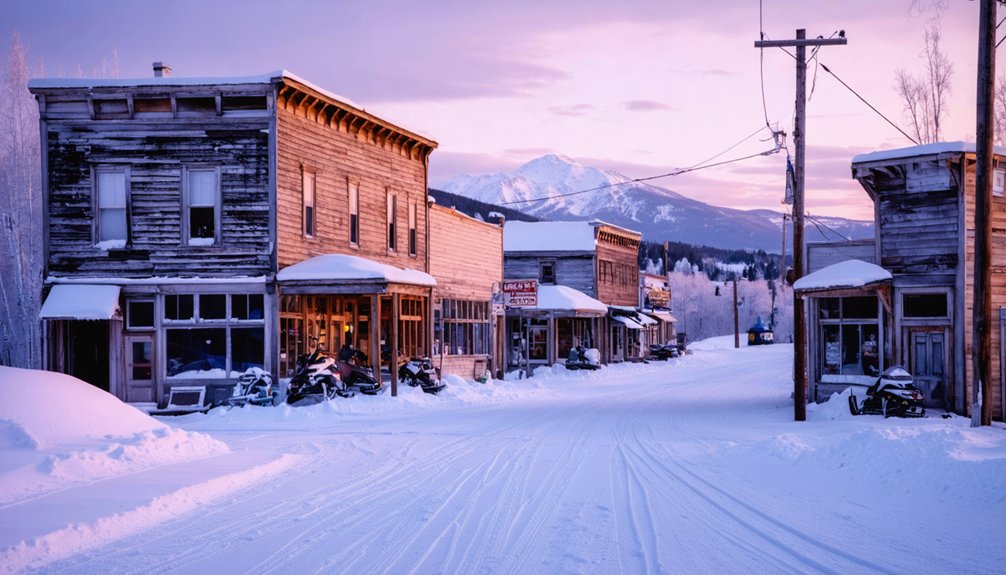
Deep in Franklin County’s backcountry, Freeman’s story reads like a microcosm of rural Maine’s 19th-century rise and fall. Once home to 838 residents across sprawling sheep farms, this incorporated town watched its population collapse from Civil War losses and industrial migration. By 1937, Massachusetts officially repealed its incorporation.
From 838 souls to silence: Freeman’s century-long decline mirrors rural Maine’s transformation from agricultural heartland to memory.
Today’s Freeman offers winter explorers authentic historical preservation through:
- Stone foundations jutting through snowdrifts—skeletal remains of businesses and homesteads
- Wind-swept cemeteries providing haunting winter photography opportunities
- Unmarked trails through former farmland, perfect for snowshoeing
You’ll find no winter sports hub here—that’s marketing fiction. Instead, Freeman delivers something rarer: unvarnished silence where a community once thrived. The snow-covered remnants speak louder than any resort could, revealing Maine’s agricultural past without interpretation centers or admission fees.
Evergreen Ski Resort: Frozen in Time
You’ll find one of Maine’s most haunting winter destinations at the abandoned Evergreen Ski Resort on Adams Mountain in Stoneham.
The resort features a 28,000-square-foot base lodge that sits silent alongside frozen lifts. These lifts haven’t carried skiers since 1980.
This ambitious four-season resort opened with fanfare in 1972 but collapsed within a decade due to financial troubles and poor snow years, leaving behind a perfectly preserved snapshot of 1970s ski culture.
The structures remain frozen in time on the White Mountain National Forest’s eastern edge.
However, you should note that trespassing on the property is prohibited.
Glory Days and Closure
When Evergreen Valley finally opened in December 1972, it represented Maine’s most ambitious ski resort ever built—a state-of-the-art complex sprawling across 310 acres of White Mountain National Forest with three double chairlifts, twelve trails, and a 1,050-foot vertical drop illuminated for night skiing.
The resort’s glory proved fleeting. Vital failures doomed its independence:
- Faulty snowmaking technology plagued operations until 1976-77, crippling reliability during crucial early seasons.
- Ski lift history ended abruptly after just nine operational seasons across a turbulent decade.
- Arab Oil Embargo devastated the 1973-74 season, combining with inadequate expert terrain to hemorrhage revenue.
Two foreclosures later—1975 and 1981—the dream collapsed into bankruptcy by 1982. Maine’s Finance Authority acquired the property for $500,000, but no buyer materialized.
The lifts vanished in the early 1990s, leaving only ghostly remnants.
What Remains Today
Tucked against the eastern boundary of White Mountain National Forest in Stoneham, the 28,000-square-foot base lodge stands as Maine’s most elaborate ski facility from the 1970s—a monument to ambitious dreams gone cold.
You’ll find massive Oregon timbers framing three abandoned cocktail bars and an Olympic-size swimming pool that hasn’t seen water in decades. The abandoned architecture draws urban exploration enthusiasts to Adams Mountain’s three deteriorating double chairlifts and twelve overgrown trails dropping 1,050 vertical feet through 310 acres of forest.
The property’s sprawl reveals more than skiing infrastructure—a derelict nine-hole golf course, failed marina on Kezar Lake, and tennis courts reclaimed by vegetation. Since closing in 1982, it’s remained shuttered despite various redevelopment proposals, preserving this frozen snapshot of New England’s ski boom era.
Visiting the Abandoned Resort
Since Evergreen Valley’s permanent closure in 1982, the property has remained off-limits to the public—it’s private land patrolled by owners who’ve rejected decades of trespassing explorers.
If you’re determined to glimpse this frozen relic, you’ll need to respect boundaries while understanding what draws adventurers here:
- The massive lodge skeleton still dominates the base area, its Oregon timbers weathering Maine’s brutal winters.
- Abandoned infrastructure includes rusting chairlift towers climbing Adams Mountain’s 1,050 vertical feet.
- Winter wildlife has reclaimed the trails—moose, deer, and foxes now navigate what were once groomed runs.
View the property from public roads in Stoneham instead. The distant silhouette of those chairlift towers against winter skies tells the story without risking legal consequences or disrespecting current ownership.
Best Times to Explore Maine’s Ghost Towns in Winter
January and February deliver Maine’s most dramatic ghost town experiences, when heavy snowfall blankets forgotten settlements in a thick white shroud that transforms crumbling foundations and abandoned mills into hauntingly beautiful tableaux.
You’ll encounter sub-zero temperatures and pristine snow landscapes in northern regions like Aroostook County, where nature reclaims history without tourist interference.
March becomes unpredictable—snow persists some years, vanishes others.
Avoid November and April entirely; you’ll face miserable conditions without reliable snow coverage.
December offers hit-or-miss exploration before winter fully establishes itself.
Franklin County sites pair perfectly with nearby ski resorts, while Piscataquis delivers secluded woodland wandering.
Shorter daylight hours demand strategic timing, but you’ll discover seasonal birdwatching opportunities and winter botany amid the ruins, where resilient species survive Maine’s harshest months.
What to Bring for Winter Ghost Town Adventures
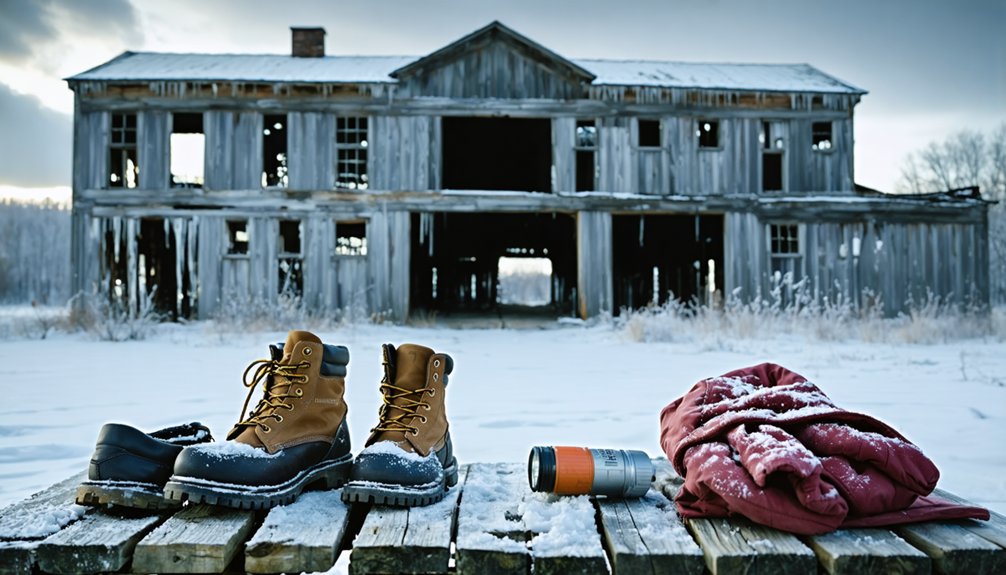
Your winter ghost town expedition demands specialized gear that goes beyond standard cold-weather hiking equipment. Maine’s abandoned settlements often lack shelter and sit in exposed locations where temperatures plummet and winds cut deep.
Pack these essential items:
- Layered winter clothing including moisture-wicking base layers, insulated mid-layers, and waterproof outer shells that’ll keep you mobile while exploring deteriorating structures.
- Navigation and communication safety essentials like GPS devices, backup batteries, and emergency beacons — cell service rarely reaches these forgotten corners.
- Documentation gear such as headlamps with extra batteries, cameras with cold-weather protection, and weatherproof notebooks for recording your discoveries.
You’ll want crampons or microspikes for icy terrain around collapsing foundations.
Bring a first-aid kit tailored for remote winter emergencies, since help won’t arrive quickly in these isolated locations.
Frequently Asked Questions
Are Guided Tours Available for Maine’s Ghost Towns During Winter Months?
Most guided ghost tours don’t operate during Maine’s winter months. However, you’ll find private tour arrangements possible with advance planning. Winter photography opportunities and historic preservation sites remain accessible for independent exploration when you’re seeking authentic, unrestricted experiences.
Do I Need Special Permits to Visit Abandoned Sites in Maine?
You’ll need written permission from property owners before visiting most abandoned sites, as trespassing laws apply. Public lands don’t require permits, but historical preservation rules prohibit removing artifacts. Always verify property ownership status first.
Which Ghost Towns Are Family-Friendly for Children in Winter?
Perkins Township and Flagstaff offer family-friendly winter exploration with historical preservation exhibits and photography opportunities. You’ll find safe, educational adventures where kids can learn pioneer history while enjoying Maine’s scenic beauty without restrictive access requirements.
Can I Camp Overnight at Any of These Ghost Town Locations?
Maine’s abandoned settlements aren’t regulated camping zones—you’ll need proper camping gear at nearby state parks or public lands instead. Winter safety demands designated sites with fire pits. True freedom means respecting Maine’s backcountry rules and your survival needs.
Are the Ghost Towns Accessible by Snowmobile or Only by Foot?
You’ll find snowmobile access reaches several Maine ghost towns like Jackman and Monson through ITS trails, but most sites require winter hiking the final stretch. Freeman and Moose River offer the best trail connectivity for riding right in.
References
- https://newenglandwanderlust.com/things-to-do-in-maine-in-the-winter/
- https://www.mooseriverlookout.com/post/ghost-towns-in-maine-9-haunted-places-to-explore-this-fall-2025-guide
- https://www.hotels.com/go/usa/ghost-towns-maine
- https://downeast.com/features/summer-in-winter/
- http://strangemaine.blogspot.com/2012/02/ghost-towns-of-maine.html
- https://949whom.com/haynesville-woods-ghost-stories/
- https://www.visitaroostook.com/post/maines-best-winter
- https://www.youtube.com/watch?v=eAO4ufIkc_s
- https://www.onlyinyourstate.com/experiences/maine/underwater-city-me
- https://darkdowneast.com/flagstafflake/