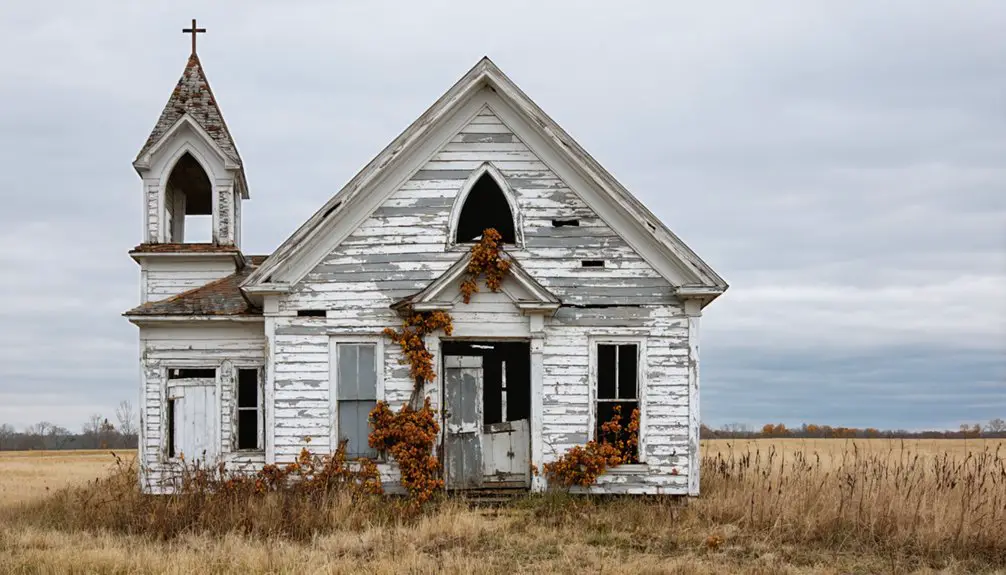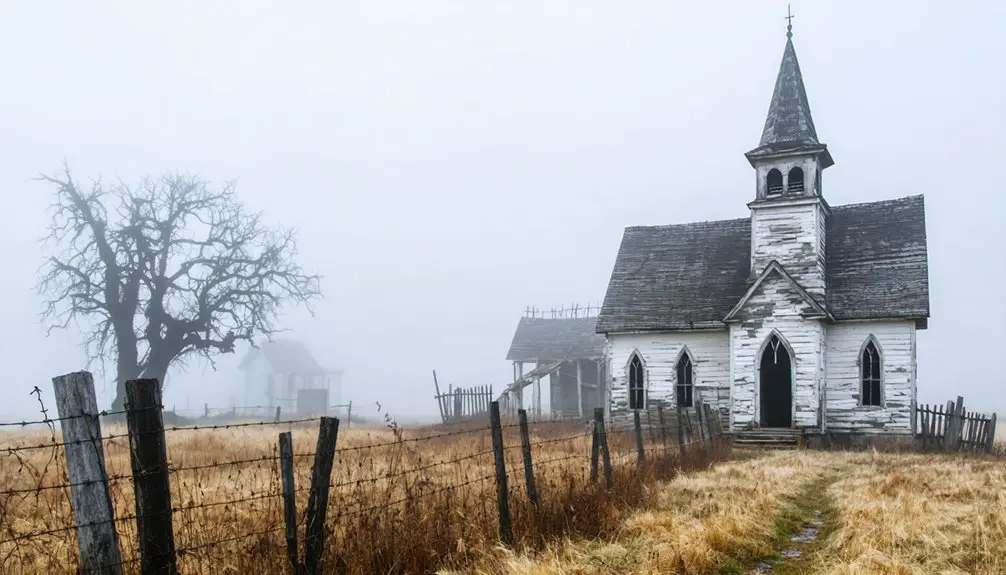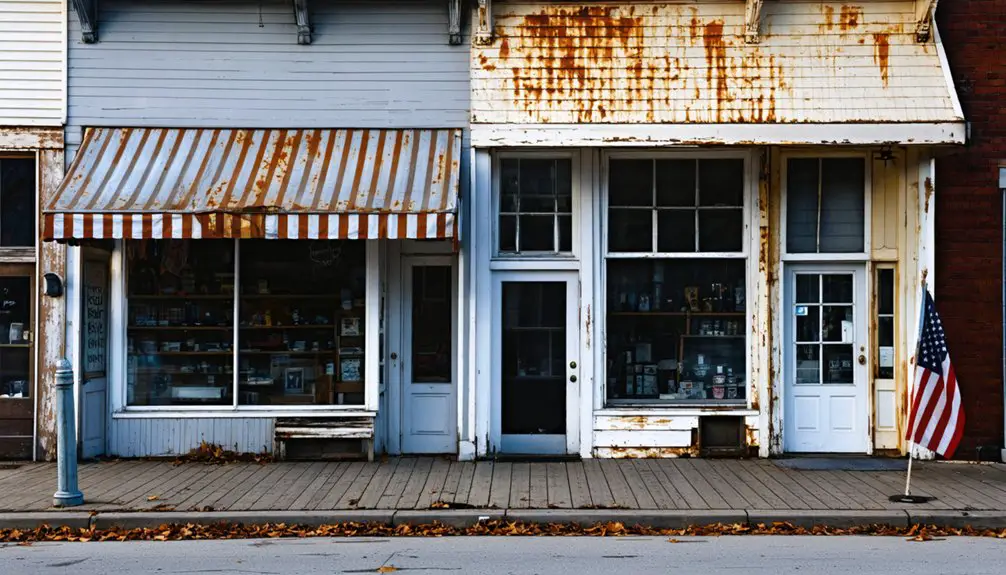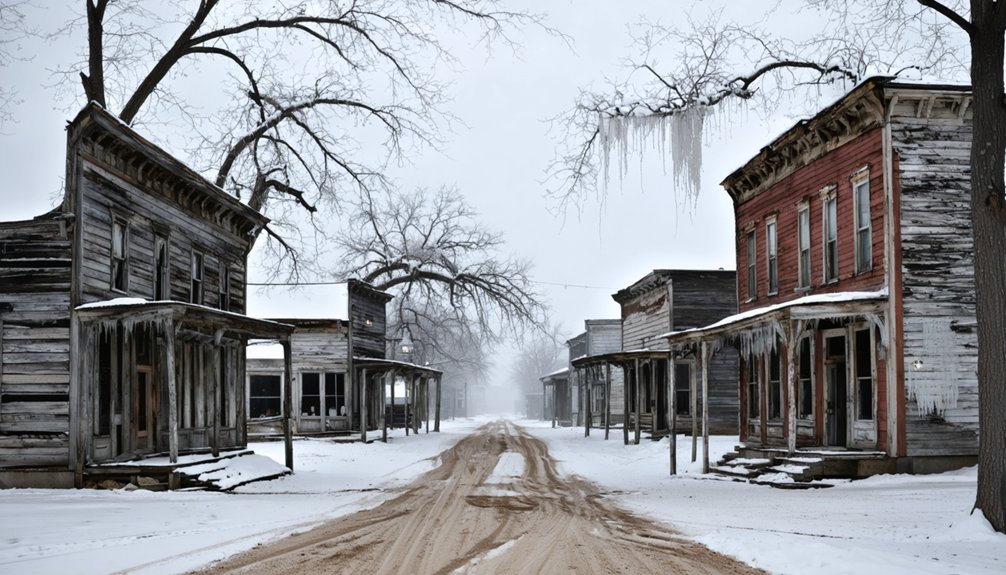
Winter’s bare branches reveal Missouri’s ghostly secrets like no other season. You’ll find Times Beach’s visitor center telling tales of dioxin evacuation, while Red Oak II’s relocated buildings stand frozen in time. Old Greenville’s frost-covered sidewalks trace streets where 1,000 residents once lived, and Melva’s scattered foundations whisper of the 1920 tornado that erased it. Along I-44, Patensburg’s abandoned homes recall 33 survived floods before the final levee break. The cold months strip away summer’s concealing foliage, exposing what warmer weather hides beneath.
Key Takeaways
- Times Beach features a visitor center in a 1935 roadhouse, now a 419-acre park after complete evacuation due to dioxin contamination.
- Red Oak II showcases over thirty relocated historic structures, including Jasper County’s first courthouse, preserved as a living art exhibit.
- Old Greenville Recreation Site offers free access to preserved streets, foundations, and archaeological remains with informative historical photographs.
- Melva’s scattered foundations and debris near Hollister reveal 1900s railroad-era architecture, accessible via trails south of town.
- Winter visibility exposes hidden structural details, artifacts, and foundations while cooler temperatures enhance safe, comfortable exploration throughout Missouri’s ghost towns.
Times Beach: Missouri’s Most Haunting Ghost Town Along the Meramec River
When winter winds sweep across the barren landscape of Route 66 State Park, it’s hard to imagine that 2,000 souls once called this stretch of Missouri River bottomland home.
Times Beach vanished in 1985 after dioxin contamination—300 times the safe threshold—forced the entire town’s evacuation. You’ll find no haunted legends or traditional ghost stories here; the reality proves far more chilling.
Homes, churches, and memories were bulldozed into a massive pit after floodwaters spread toxic Agent Orange byproduct throughout the community in 1982.
The contamination began in 1971 when residents pooled their funds to spray waste oil on unpaved dirt roads to control dust, unknowingly exposing themselves to deadly toxins.
Today, you’re free to explore the 419-acre park where families once swam at Sylvan Beach and danced at Bridgehead Inn.
The visitor center occupies a 1935 roadhouse that once served as the beloved Steinys Inn, offering glimpses into the town’s vibrant past before disaster struck.
The ghosts aren’t supernatural—they’re the abandoned dreams of working-class Americans who lost everything overnight.
Red Oak II: An Open-Air Museum of Relocated History
When you arrive at Red Oak II, you’ll discover something remarkable: an entire town rescued from oblivion by artist Lowell Davis, who couldn’t bear watching his birthplace fade into Missouri farmland.
After finding the original Red Oak abandoned in the 1980s, he spent years hauling historic buildings—a Phillips 66 station, Belle Starr’s house, even a Joplin drunk tank—two miles northeast of Carthage to recreate the community of his childhood. Among the relocated structures stands the oldest structure, a log cabin that served as the first Jasper County courthouse, saved from demolition to become part of this quirky collection.
What stands before you isn’t just preservation; it’s one man’s love letter to rural Missouri, pieced together board by board along the gravel roads off Route 66. The community offers a walkable loop where you can explore this intriguing assembly of rescued structures at your own pace.
Lowell Davis’s Preservation Vision
Beginning in 1987, artist Lowell Davis set out on an audacious mission that would consume the next three decades of his life—rescuing abandoned buildings from Missouri’s dying rural communities and breathing new life into them on his farm near Carthage.
Known as the “Norman Rockwell of Rural Art,” Davis practiced cultural preservation through unconventional means, relocating over thirty structures from ghost towns across the state.
His artistic restoration process went beyond simple reconstruction. Davis integrated his sculptures, vintage vehicles, and repurposed scrap metal throughout the village, transforming weathered frames into living exhibits. Among the relocated structures, the blacksmith shop holds special significance—Davis’s great-grandfather once practiced his trade there.
He never intended Red Oak II as a tourist trap—it was his canvas, a defiant stand against letting history fade into oblivion.
You’ll discover a place where Davis’s creative vision rejected commercialization, offering instead an authentic testament to Missouri’s vanishing rural heritage. Despite appearing on some listings of Missouri ghost towns, the site functions as a living art exhibit rather than an abandoned settlement.
Buildings and Artifacts Collection
When authentic structures proved impossible to locate, Davis built replicas himself.
Historical artifacts fill every corner: weathered farm implements, faded advertisements, forgotten tools of daily survival.
His artistic collections—whimsical animal sculptures and painted Route 66 scenes—transform preservation into something wilder: living memorial to American independence.
The site includes Davis’s original sculptures displayed throughout the recreated town, adding an artistic dimension to the historical experience.
Vintage vehicles and old farm equipment dot the landscape, creating atmospheric vignettes of rural Missouri’s mechanical past.
Old Greenville Recreation Site: Walking Through Preserved Streets and Foundations
The winter wind cuts across the empty streets of Old Greenville, whistling through foundations that once cradled a thriving 1,000-person community. You’ll walk Memory Lane Trail through archaeological remains where homes, stores, and a courthouse stood before the Wappapello Dam forced relocation in 1940.
The historical preservation here isn’t sanitized—it’s raw. Your boots crunch over frost-covered sidewalks that lead nowhere, past concrete foundations marking lives abandoned. Near the gatehouse, a massive mound reveals where the 1926 courthouse once stood, its flood-resistant basement now just another ghost.
Look for water marks on the old bridge—thirty feet high, monument to nature’s fury. Signs with photographs of former buildings help you visualize what stood on each crumbling foundation you pass. There’s no admission fee to explore these ruins, just you and winter silence echoing through Missouri’s drowned past. The site serves as a navigational reference point for understanding how dam construction reshaped entire communities across the region.
Melva: A Forgotten Railroad Town in the Ozark Hills
You’ll find Melva’s story written in absence—a railroad town that thrived south of Hollister until the 1920 tornado erased it so completely that an unopened letter landed eighty miles away in Hartville.
Winter strips away the Ozark underbrush, revealing scattered foundations and debris fields where trains once stopped and families built their lives around the rhythm of iron rails.
The cold months offer the clearest path through Taney County’s hills to this haunting site, where you can trace the town’s footprint before spring vines reclaim what the twister left behind.
Early 1900s Railroad Heritage
Hidden among the frost-dusted Ozark hills just south of Hollister, Melva’s story begins in 1906 with the rhythmic clang of hammers on railroad spikes and the sharp bite of crosscut saws through virgin timber.
You’ll discover where the Missouri Pacific Railroad breathed life into this wilderness, transforming ancient forests into a thriving community.
By 1907, railcars groaned under loads of lumber, ties, and hardwood posts—raw materials that built America’s expanding railway system.
The railroad architecture that remains tells of an era when small towns controlled their destinies through iron and steam.
Today, historic preservation efforts struggle against time’s erosion, but you can still trace the old rail bed where foundations peek through winter’s undergrowth, whispering tales of independence and frontier ambition.
Winter Exploration Benefits
When winter strips the Ozark hills bare, Melva’s secrets emerge from beneath the brambles and scrub oaks that guard them nine months of the year.
You’ll spot foundation stones that summer’s greenery conceals—remnants of homes where families lived before the 1920 tornado erased everything. The stripped hillside above Turkey Creek reveals building footprints with stark clarity, while Lucy Woods’ fireplace still stands defiant against time.
Winter foliage works in your favor here. Cooler temperatures won’t exhaust you on the trail from Branson Creek property, and exploration safety improves dramatically when dry conditions replace muddy tracks.
You’ll navigate cleared paths without wrestling undergrowth, spotting artifacts the low creek water exposes.
Start early—shorter daylight demands it—and you’ll discover debris that traveled seventy miles.
Accessing Taney County Site
The Missouri Pacific Railroad tracks slice through southern Taney County like a historical breadcrumb trail, leading you straight to Melva’s haunted coordinates. Your local access begins south of Hollister, where Turkey Creek whispers alongside rusted rails. Park discreetly and navigate the cleared trail descending toward ghostly foundations—the post office ruins materialize on your left, stone sentinels guarding memories of 1906.
That faded “no trespassing” sign? It’s more suggestion than barrier for determined explorers seeking forgotten America. But recent surveying stakes punctuate the landscape, signaling preservation challenges ahead. Development’s hungry fingers reach toward these sacred ruins.
Winter’s your ally here—bare branches reveal structural bones that summer foliage conceals. Visit now, before bulldozers erase what the 1920 tornado couldn’t completely destroy. Some freedoms expire without warning.
Patensburg: Where River Commerce Once Thrived
Nestled where three creeks converge with the Grand River, Pattonsburg thrived as a bustling river commerce hub from its 1835 founding, swelling to nearly 1,000 residents by the century’s turn. You’ll find no medieval architecture here—just weathered American storefronts that’ve survived thirty-three floods before the catastrophic 1993 deluge finally broke them.
On July 6th, water swallowed the levee, leaving two feet in most buildings. Rather than rebuild, 300 residents accepted FEMA’s buyout and relocated two miles north.
You can explore the abandoned original site now, where forty scarred homes crumble among car-eating streets. United Artists briefly revived Main Street as a Civil War film set for “Ride with the Devil,” adding false facades that spawned urban legends about ghostly Confederate soldiers wandering painted storefronts at dusk.
Additional Ghost Towns Along the I-44 Corridor
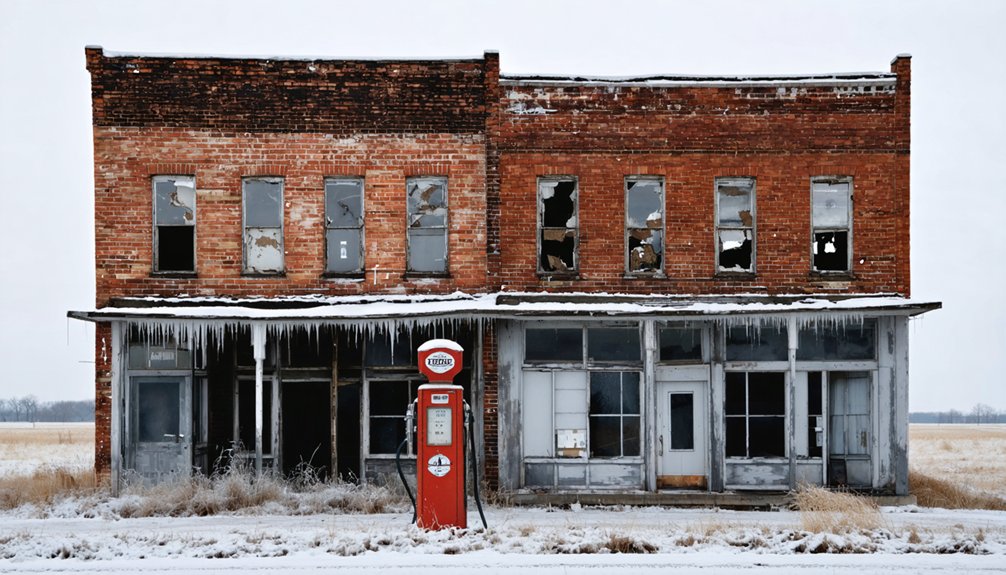
Stretching southwest from St. Louis County, I-44 cuts through Missouri’s forgotten landscapes where ghost towns whisper their stories. You’ll find Times Beach first, evacuated when dioxin-laced oil poisoned the earth—now just one building remains as a visitor center.
Push deeper to Arlington’s shuttered Stony Dell Resort, its empty cabins standing sentinel since 2008.
Bloodland’s the darkest stop: Fort Leonard Wood swallowed this 100-person community in 1940, and haunting legends of displaced residents still circulate.
Near Springfield, Possum Trot‘s lone church and house mark what once was Self.
Finally, Spencer’s abandoned structures line old Route 66, bypassed and forgotten since 1961.
Winter amplifies their silence, revealing decay the summer vines conceal. These roadside ghosts demand exploration.
Why Winter Is the Best Season for Ghost Town Exploration
Cold air sharpens everything along these forgotten roadways—the crunch of frost beneath your boots, the skeletal outlines of abandoned buildings against pewter skies, the creak of warped wood that summer’s humidity muffles.
Winter photography transforms these sites into stark, honest studies of decay. You’ll capture textures invisible in summer’s green chaos: weathered grain in sun-bleached siding, rust patterns on corrugated tin, the precise geometry of collapsed rooflines.
Seasonal solitude matters here. December through February, you’ll explore uninterrupted. No tour groups. No weekend crowds blocking your shots or disturbing your thoughts.
The cold filters out casual visitors, leaving these places to those who genuinely seek them. You’ll move through empty streets at your own pace, documenting stories written in peeling paint and broken glass, free from explanation or schedule.
Frequently Asked Questions
Are Ghost Town Sites in Missouri Accessible Year-Round or Seasonally Closed?
You’ll find Missouri’s ghost towns accessible year-round for remote exploration, though winter brings locked buildings and skeletal landscapes. Preservation efforts maintain these haunting sites through all seasons, but you’re free to wander exterior grounds whenever wanderlust strikes.
Do Any Missouri Ghost Towns Charge Admission Fees for Visitors?
Most Missouri ghost towns don’t charge admission since they’re abandoned ruins. However, you’ll find fees at preserved sites with haunted legends—like Pythian Castle’s $14 entry—where historic preservation efforts fund maintaining these eerie, atmospheric locations you’re free to explore.
Can Visitors Camp Overnight Near These Abandoned Town Locations?
You’ll find camping near some Missouri ghost towns, offering photography opportunities at dawn. However, Times Beach remains off-limits due to contamination. Ha Ha Tonka and Castlewood welcome winter campers, letting you explore historical preservation sites at your own pace.
Are Guided Tours Available at Missouri’s Ghost Town Sites?
You’ll find guided exploration at Missouri’s haunted sites, but true abandoned ghost towns lack formal tours. Historical preservation groups occasionally offer special access, letting you wander weathered buildings independently—experiencing authentic solitude among crumbling walls and forgotten memories.
What Safety Precautions Should Visitors Take When Exploring Abandoned Structures?
You’ll need thorough hazard assessment before entering—test floorboards, watch for rotting beams and rusted nails. Bring essential safety equipment: sturdy boots, gloves, flashlight, and first-aid kit. Never explore alone; freedom requires smart preparation.
References
- https://www.visitmo.com/articles/missouris-most-haunted-places
- https://www.onlyinyourstate.com/trip-ideas/missouri/road-trip-through-mo-ghost-towns
- https://937thebull.iheart.com/content/2023-10-11-missouri-village-named-the-creepiest-ghost-town-in-the-state/
- https://midwestnomads.com/2022/07/29/ghost-town-at-old-greenville-missouri/
- https://www.youtube.com/watch?v=ERFnlJ5pjBg
- https://www.undergroundozarks.com/forum/viewtopic.php?t=893
- https://101theeagle.com/abandoned-northwestern-missouri-towns/
- https://www.legendsofamerica.com/mo-timesbeach/
- https://www.unionprogress.com/2025/04/21/one-womans-defiant-remembering-keeps-the-tragic-story-of-times-beach-alive/
- https://www.youtube.com/watch?v=e2zVN5whO1w