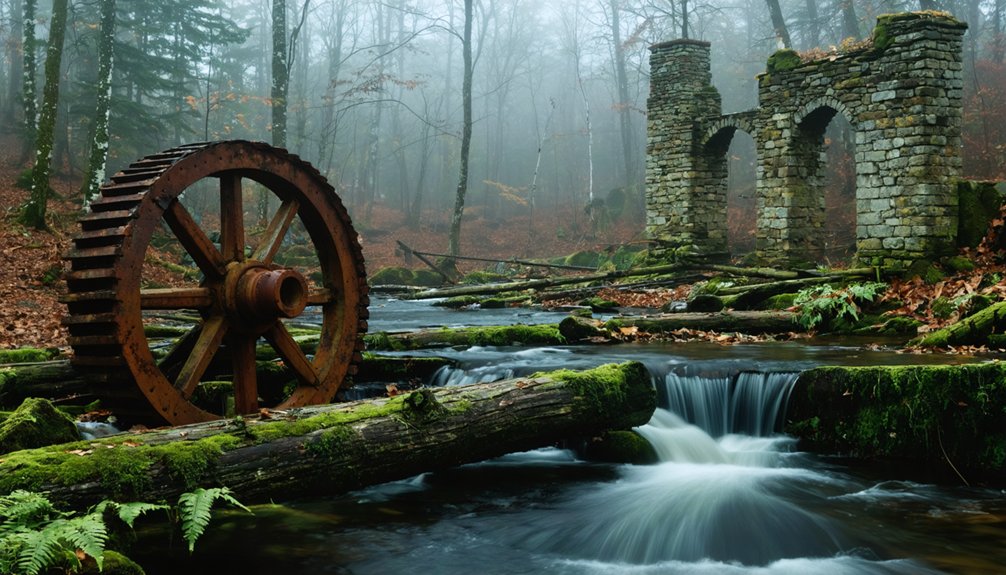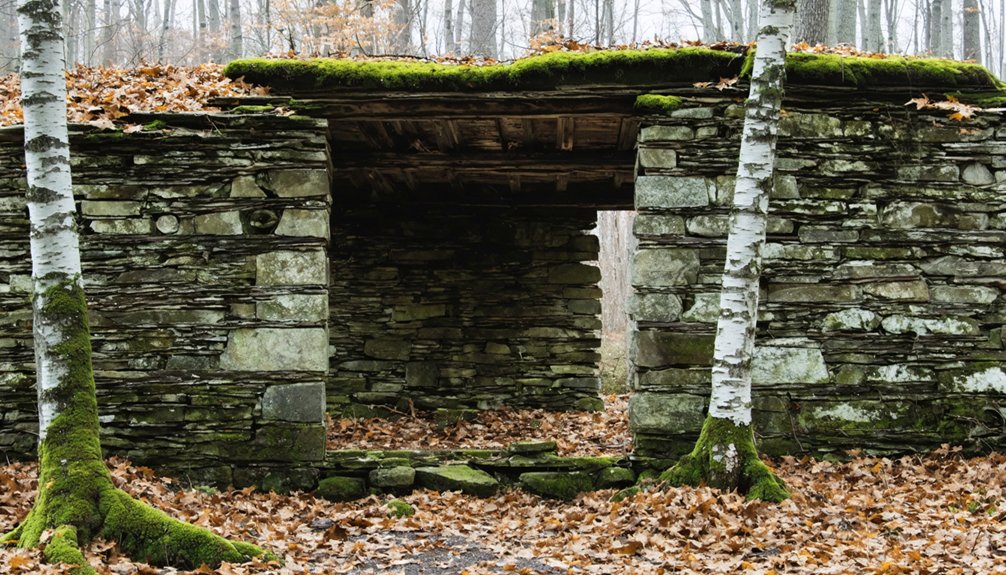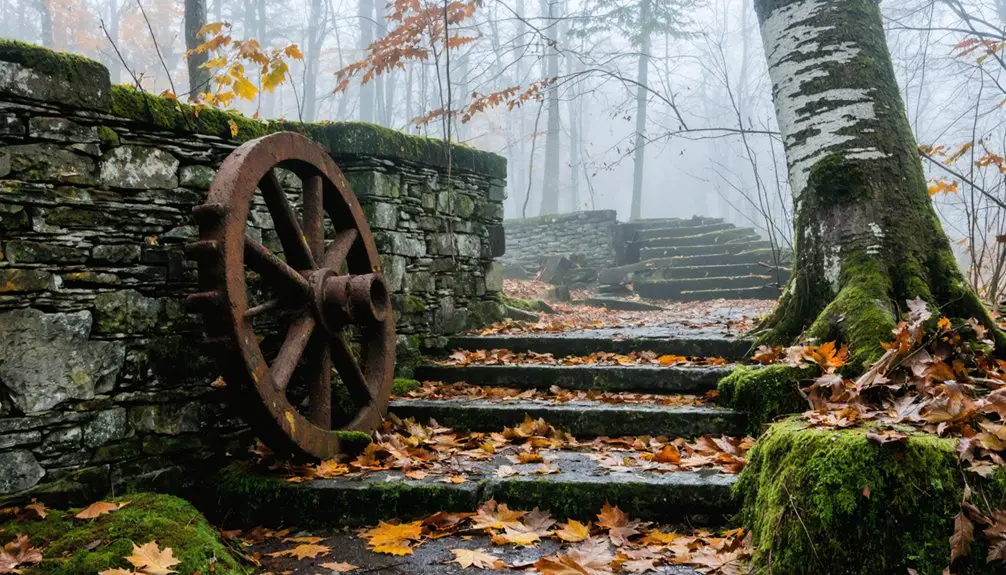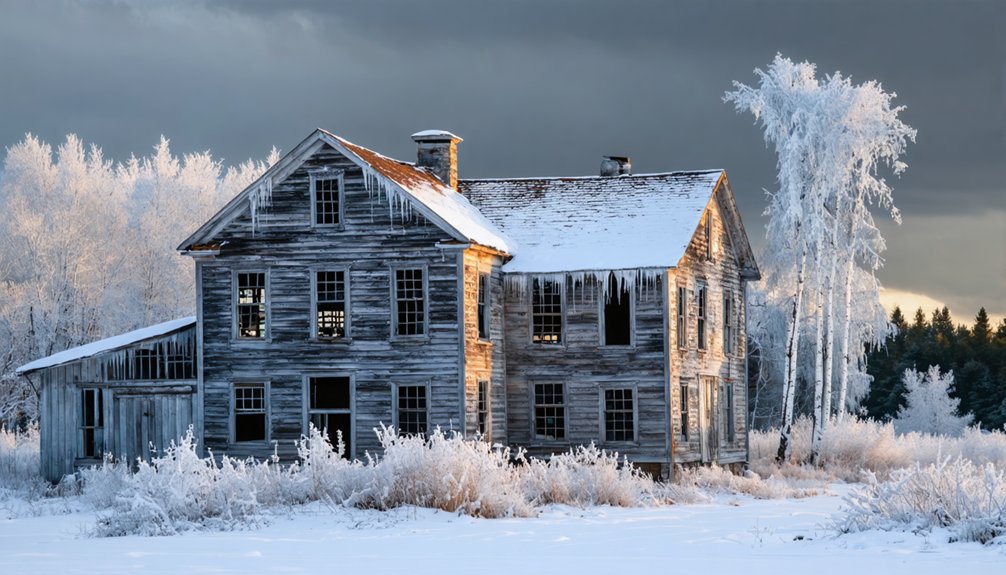
You’ll find New Hampshire’s most mesmerizing ghost towns—Old Hill Village, Livermore, and Monson—transformed by winter’s blanket of snow, where crumbling foundations and cellar holes emerge with haunting clarity against white landscapes. Access requires snowshoes, skis, or dogsleds across frozen floodplains from mid-January through February, when frost accentuates weathered stone staircases at Madame Sherri Castle and silence amplifies the eerie atmosphere. Pack microspikes, emergency gear, and maps since cell service disappears in these remote locations, and discover how historical tragedies and preservation efforts have shaped these frozen, time-capsule settlements.
Key Takeaways
- Old Hill Village, Livermore, Monson Village, and Madame Sherri Castle Ruins offer unique historic remnants like foundations, cellar holes, and weathered staircases.
- Mid-January to February provides ideal conditions when snow coverage enhances visibility of ruins and accentuates the eerie, haunted aesthetic.
- Access requires snowshoes, skis, or snowmobiles; trails demand microspikes, GPS, emergency gear, and awareness of hypothermia risks without cell service.
- Historic tragedies include the 1826 Willey Family rockslide, 1920s Livermore flood, and Hill’s 1937 dam displacement, leaving compelling abandoned infrastructure.
- Visit during quiet weekdays for solitude; winter snow dramatically highlights decay while frost-covered ruins create otherworldly, atmospheric exploring conditions.
Old Hill Village: A True Ghost Town Accessible Only by Winter Transport
Nestled in the floodplain along the Pemigewasset River, Old Hill Village stands as one of New Hampshire’s most authentic ghost towns—a community literally erased from the landscape yet still whispering its history through scattered foundations and weathered sidewalks.
Old Hill Village: a community erased from the map, yet speaking through crumbling foundations and forgotten sidewalks along the Pemigewasset River.
You’ll access this haunting site only by dogsledding, skiing, or snowmobiling during winter months, making it a true backcountry adventure.
The federal government seized the entire village in 1937 for the Franklin Falls Dam project, forcing residents uphill while razing everything below.
Today, you’ll discover plaques marking former hotels, shops, and railroad depots along tree-lined streets.
Winter wildlife tracks crisscross the silent main thoroughfare.
Among the remnants, you’ll find an 1799 church and an 1847 meeting house still standing as monuments to the town’s colonial past.
Along the walking trails, you’ll encounter foundations of mills and cellar holes at Needle Brook, revealing the industrial heritage that once sustained this thriving community.
This historic preservation effort maintains trails shared with snowmobilers, creating an eerie atmosphere where stately trees guard cellar holes and cemetery stones—testimony to a community that refused to scatter.
Livermore: Remnants of New Hampshire’s Logging Legacy
Deep in the White Mountain National Forest, a peculiar scene unfolds along Sawyer River Road—a solitary modern house with its manicured lawn sits defiantly among crumbling brick chimneys, scattered foundation stones, and rusted metal fragments slowly disappearing beneath encroaching forest.
You’ll discover this former logging village‘s layered history through:
- Stone foundations marking the 1880 community of 103 souls
- Brick powerhouse ruins with chimney piercing the canopy
- Sawyer River stanchions from the vanished railroad
- Scattered artifacts—glass, horseshoes, pipes—telling silent stories
Historical preservation here relies on volunteer efforts and nature’s patient archiving. The 1927 flood sealed Livermore’s fate, ending operations by 1928. Once owned entirely by the Saunders family, the settlement included a mill, school, blacksmith shop, and general store before fires and flooding triggered its decline. The town was named after Samuel Livermore, a New Hampshire senator who was related by marriage to the family.
Pull off Sawyer River Road and wander freely through this accessible ghost town, where official recognition as New Hampshire’s smallest municipality (population: 2) keeps this logging legacy alive.
As you delve deeper into the area’s lore, exploring Francestown’s haunted history will reveal chilling tales that have been passed down through generations. Each corner of this town holds stories of its past, echoing the whispers of those who once called it home. Keep an eye out for the old graveyards and historic buildings that add to the eerie ambiance of this quintessential New England setting.
Monson Village: Colonial-Era Settlement With Paranormal Activity
While Livermore’s ruins speak to 19th-century industry, Monson Village carries you back even further—to 1735, when six settlers from Massachusetts and Nova Scotia carved out homesteads in what would become a mysteriously short-lived colonial town. You’ll wander 200 acres of stone walls and cellar holes, each marked with family histories.
The settlement never built a meeting house or school, disbanding in 1770 for reasons still debated—political discord, harsh conditions, or both. The town was incorporated in 1746 but saw all inhabitants leave within just 30 years of settlement.
Preservation efforts saved these remnants in 1998 when developers threatened the site. Today you can explore the restored J. Gould House museum and its collection of paranormal literature. The Gould House, dating from 1756, stands as the only original structure remaining from the colonial settlement.
Haunted legends include the Bailey house fire, where children escaped in nightclothes before the family fled west. Winter amplifies the eerie atmosphere among these 18th-century ghosts.
Madame Sherri Castle Ruins: Year-Round Gothic Architecture
You’ll find Madame Sherri’s legendary stone staircase rising dramatically from the forest floor just a short walk from the Gulf Road trailhead—no strenuous hiking necessary to reach this hauntingly beautiful ruin.
The grand arches and weathered stonework create an otherworldly scene in winter, when snow blankets the foundations where a Paris-born costume designer once hosted theatrical parties that scandalized 1930s New Hampshire.
Though you can’t climb the fragile stairs anymore, standing beneath them feels like stepping onto an abandoned movie set where champagne flutes and fur coats have been replaced by ice crystals and silence. The castle fell into disuse after Madame Sherri’s financial decline, ultimately being destroyed by fire in 1962, leaving behind only these haunting remnants.
The ruins sit within the 513-acre Madame Sherri Forest, a wooded preserve with ponds and trails that offers a slightly-over-a-mile loop for winter hikers seeking both natural beauty and historical intrigue.
Stairway to Heaven Feature
The stone staircase rises from the forest floor like a monument to forgotten extravagance. Its Roman arches frame nothing but winter sky where a French chateau once stood. This “stairway to heaven” once led directly to Madame Sherri’s third-floor bedroom—now it ascends to nowhere, ending abruptly mid-air after partial collapse in 2021.
Photography Tips for Capturing the Ruins:
- Shoot during golden hour when low winter light emphasizes the stone’s texture
- Frame the staircase against fresh snow for dramatic contrast
- Capture the bottom arches from various angles—the top section’s gone
- Document the accessible basement’s steel beams and possible well structure
Haunted legends persist here, with visitors reporting strange sounds echoing through the Gothic stonework. Ghostly apparitions of Madame Sherri herself have been spotted at the top of the staircase, adding to the site’s supernatural mystique. Local lore suggests echoes of her wild parties still haunt the ruins. You’ll find it roped off—climbing’s prohibited due to instability.
No Hiking Required
Just 100 feet from the Gulf Road parking area, Madame Sherri’s stone ruins emerge from the forest floor—no expedition necessary. You’ll navigate snow-dusted pathways through dense woods near the Vermont border, reaching the remains within minutes.
The basement areas invite indoor exploration among Roman-inspired archways and deteriorating stonework, where winter wildlife tracks crisscross the foundation’s scattered rubble. I’ve watched deer pause between the chimneys at dawn, utterly unfazed by human presence.
The Society for the Protection of New Hampshire Forests maintains these 513 acres with minimal intrusion—they’ve added safety railings around the partially collapsed staircase but left the Gothic atmosphere intact.
You’re free to wander through what remains of the 1930 French chateau without committing to grueling winter hikes.
Costume Designer’s Summer Retreat
Before Broadway costumes funded her forest fantasy, Antoinette “Madame Sherri” Bramare was designing elaborate gowns for Ziegfeld Follies performers in Manhattan’s theater district.
Her costume history expertise transformed a secluded Chesterfield hillside into pure theatrical ambiance—a French chateau where live trees pierced through ceilings and animal furs draped across furniture.
What remains of her 1930s party palace:
- Stone staircase fragments ascending to nowhere
- Roman arch foundations beneath New Hampshire snow
- Cellar bistro ruins where red tablecloths once covered intimate tables
- Whispers of Prohibition-era revelry among the pines
She directed builders without blueprints, placing stakes throughout the forest like staging a theatrical production.
When 1962’s fire consumed her castle, it left behind the perfect monument to freedom-seeking spirits who’ve always escaped convention’s constraints.
Winter Access Methods for New Hampshire’s Abandoned Sites
Winter transforms New Hampshire’s ghost towns into remote destinations that demand careful planning and specialized transportation. You’ll need dogsleds or skis to reach Old Hill Village across the frozen floodplain, while snowmobiles grant access through the reservoir project area.
At Thornton Gore, you’re hiking from Tripoli Road’s locked gate after its early November closure—pack accordingly for the trek through White Mountain National Forest.
Monson’s trails remain unmarked once snow blankets the 215-acre site, and parking isn’t guaranteed without winter plowing.
Livermore beckons snowshoers along Sawyer River Trail‘s 1.5-mile route, where winter wildlife tracks crisscross your path toward snow covered ruins.
Madame Sherri’s forest paths transform into eerie corridors post-snowfall, accessible year-round for those seeking ghostly remnants without road restrictions.
What to Expect When Visiting Ghost Towns in Cold Weather
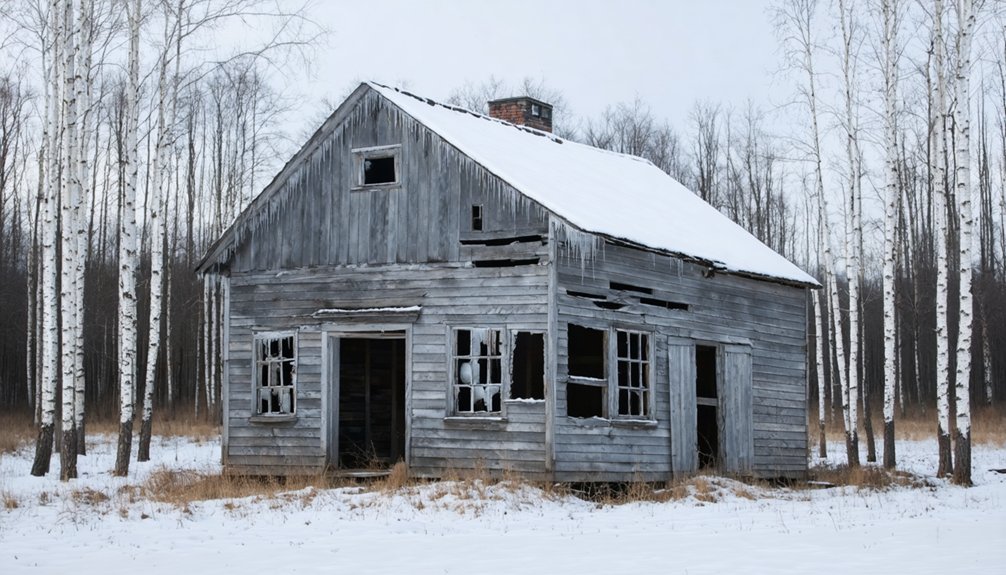
When snow blankets New Hampshire’s ghost towns, you’ll encounter an otherworldly silence broken only by wind whistling through skeletal foundations and your boots crunching across frozen ground. Cold temperatures transform these ruins into hauntingly beautiful landscapes where moss-covered walls wear frost like burial shrouds.
Prepare for these winter realities:
- Icy hazards near brooks and streams require microspikes—remember Nancy Barton’s fatal encounter with frozen waters.
- Hidden cellar holes lurk beneath snow, making trail mapping essential.
- Washed-out paths near Livermore’s foundations become treacherous after thaws.
- Eerie atmospheric conditions amplify ghostly echoes at sites like Madame Sherri’s ruins.
You’ll navigate overgrown trails where stone walls and foundations emerge from white drifts. Winter’s grip strips away summer’s camouflage, revealing what civilization left behind.
Historical Tragedies That Shaped New Hampshire’s Ghost Towns
Catastrophe carved New Hampshire’s ghost towns from living settlements, transforming thriving communities into the snow-draped ruins you’ll explore today.
The 1826 Willey Family rockslide claimed nine lives and ironically sparked tourism—making tragedy a cornerstone of local folklore stories.
You’ll find similar patterns across abandoned villages: Monson’s residents surrendered after thirty years battling impossible conditions, while Livermore’s 1920s flood demolished its mill, scattering families overnight.
Hill disappeared entirely when the government seized it for flood control in 1941.
Historical monument preservation efforts now protect these sites, letting you walk through authentic devastation.
The logging industry’s collapse emptied entire networks of towns—Livermore, Zealand, Beebe River—leaving behind the haunting infrastructure you’re free to discover beneath winter’s veil.
Safety Considerations for Winter Ghost Town Exploration
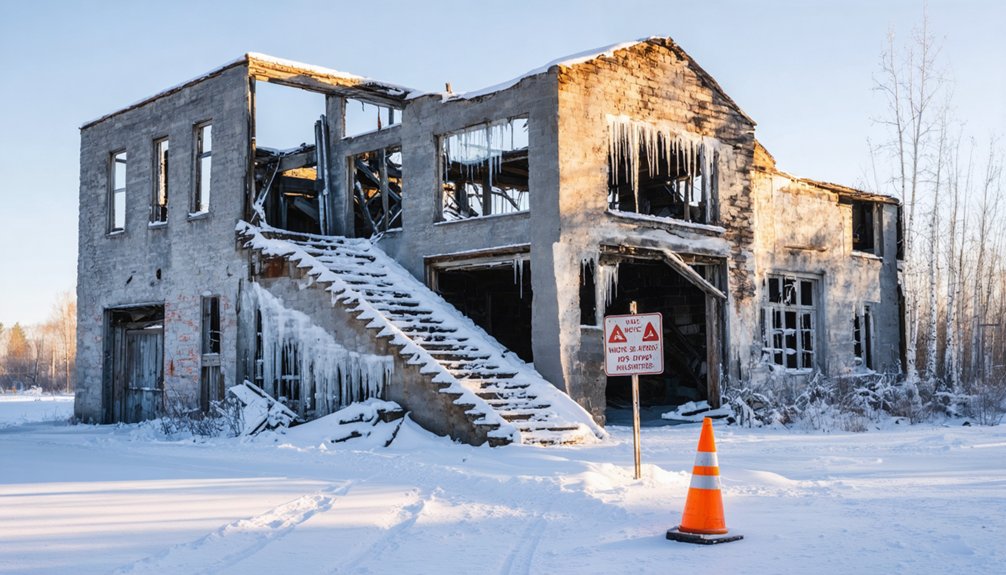
Winter exploration of New Hampshire’s abandoned settlements demands respect for conditions that’ve stranded unprepared visitors in snowdrifts miles from help.
You’ll need three days’ worth of supplies—water, food, shelter, warm layers—because weather shifts without warning in these elevations.
Your 4WD can still sink axle-deep despite chains, so caution is essential.
Before you set foot on those snow-buried trails, download offline maps and mark GPS waypoints at your vehicle.
Cell service vanishes in these valleys, and a wrong turn past collapsed mill foundations means you’re relying solely on your compass and the chalk marks you’ve left behind.
Winter Weather Preparation Essentials
Before you step into the frozen silence of New Hampshire’s abandoned settlements, understanding proper winter preparation can mean the difference between an exhilarating adventure and a dangerous ordeal. Your clothing layers form your first defense—base wicks moisture, mid-layer traps heat, waterproof shell blocks elements.
Pack winter food like nuts for sustained energy when you’re miles from civilization.
Essential gear includes:
- Insulated boots with microspikes for traversing icy foundations
- Headlamp with red light mode to preserve night vision in unlit structures
- Emergency blanket and first-aid kit for hypothermia response
- Map and compass as backups when electronics freeze
Test your traction on varied surfaces beforehand. Limit exposure to two hours in harsh winds, and always recognize early hypothermia symptoms—shivering and confusion signal it’s time to retreat.
Once you’ve packed your gear and dressed for the cold, finding your way through snow-covered ghost towns requires understanding the sparse signage systems that mark these forgotten places. At Livermore, signs along Sawyer River Trail direct you toward foundations, warning against artifact removal.
Monson offers the most detailed trail maintenance, with small biographical markers at each of seven cellar holes and a hand-drawn map from caretaker Russ Dickerson. West Road follows the original main street through fields where seasonal foliage once obscured stone walls.
You’ll navigate 3-mile trail systems linking home sites and town pounds. Winter transforms these paths—Sawyer River Road closes for snowshoeing, requiring self-reliance.
The carved Monson sign appears after a few hundred yards, launching your independent exploration through indentations marking century-old dwellings.
Emergency Communication and Equipment
Remote from civilization and cellular towers, New Hampshire’s ghost towns demand communication systems that function when your phone shows zero bars. I’ve learned this truth watching my smartphone become a useless brick near Livermore’s abandoned homesteads. Equipment redundancies aren’t paranoia—they’re survival strategy.
Your communication protocols should include:
- SPOT beacon clipped to your pack for satellite-based emergency signaling
- Whistle and signal mirror accessible in outer pockets for immediate alerts
- Headlamp with extra batteries for hands-free signaling after sunset
- Portable charging kit protecting your GPS-enabled devices from winter’s power drain
Pack fire-starting tools—smoke signals work when electronics fail. Keep that crank-operated flashlight ready; independence means preparing for technology’s inevitable limitations. Your freedom to explore these forgotten places depends on redundant, reliable communication gear.
Best Times to Visit Each Location During Winter Months
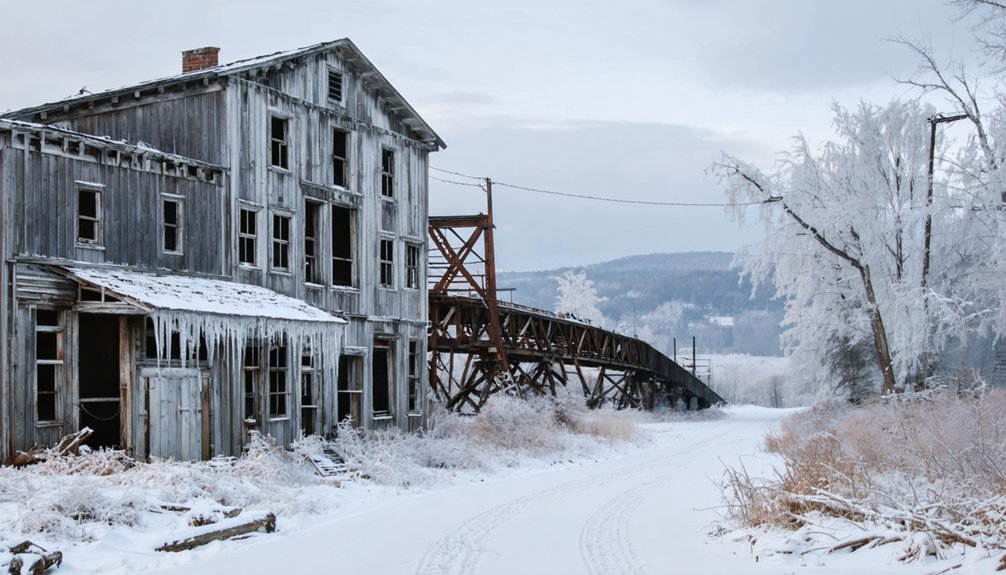
Winter transforms New Hampshire’s ghost towns into landscapes where silence deepens. History becomes tangible through frost-covered ruins. You’ll find seasonal preservation at its peak mid-January through February, when deep snow reveals urban decay most dramatically.
Zealand and Livermore shine during these months—snowshoe through powder-laden trails to discover foundations emerging from white silence.
Old Hill Village opens vehicular access only the first weekend after Labor Day; afterward, you’re dogsledding or skiing until spring.
Monson rewards late-winter visits when leafless trees expose cellar holes along former West Road.
Madame Sherri’s ruins enchant most after fresh snowfall, when ghostly laughter supposedly echoes through Chesterfield’s forests.
Target weekdays for solitude. Weekend crowds destroy the freedom these forgotten places offer—you’re chasing abandonment, not company.
Frequently Asked Questions
Are Pets Allowed When Visiting New Hampshire Ghost Towns in Winter?
Yes, you’ll find minimal pet restrictions at New Hampshire’s ghost towns like Monson Center during winter. Keep your dog leashed on the trails, though winter access isn’t plowed—you’re free to explore these historic sites together year-round.
Do Any Ghost Towns Have Restroom Facilities Available During Winter Visits?
No restrooms are available at these ghost towns during winter. You’ll need to plan ahead for winter safety by using facilities before arriving. These preserved historic sites lack modern amenities, offering authentic exploration freedom without infrastructure.
Can I Camp Overnight Near These Abandoned Sites During Winter Months?
Like pioneers venturing into forgotten territories, you can’t camp near abandoned sites themselves. However, winter camping thrives at nearby Cannon Mountain’s RV Park or White Mountain National Forest campgrounds—offering freedom while respecting closure restrictions at ghost town locations.
Are Guided Tours Available for Winter Ghost Town Visits in New Hampshire?
No guided tours operate for New Hampshire’s ghost towns in winter. You’ll explore abandoned buildings independently through snow-covered trails, experiencing winter scenery solo. Northeast Mountaineering offers moonlight mountain hikes, but ghost town sites like Livermore remain self-guided adventures year-round.
Do I Need Permits to Explore These Ghost Towns During Winter?
You won’t need a wilderness passport or bureaucratic paperwork for winter access to most New Hampshire ghost towns. Permit requirements are pleasantly minimal—just respect preservation guidelines, follow established trails, and you’re free to explore these snow-draped ruins.
References
- https://vitabrevis.americanancestors.org/2016/11/new-hampshire-ghost-town
- https://nothingbutnewengland.com/new-hampshires-haunted-hikes/
- https://www.visitwhitemountains.com/blog/post/spooky-stories-ghost-towns-and-historic-haunted-spots/
- https://www.onlyinyourstate.com/trip-ideas/new-hampshire/abandoned-livermore-nh
- https://thefrogandpenguinn.blogspot.com/2021/07/a-nh-ghost-town.html
- https://www.youtube.com/watch?v=mFBYIdURBvQ
- https://www.scenicnh.com/abandoned-places-white-mountains/
- https://wokq.com/new-hampshire-ghost-towns-make-for-great-winter-hikes-try-these/
- https://outdoorodyssey.net/2024/11/04/the-old-ghost-town-of-hill-new-hampshire/
- https://1happyhiker.blogspot.com/2014/10/a-visit-to-new-hampshire-historic-place.html