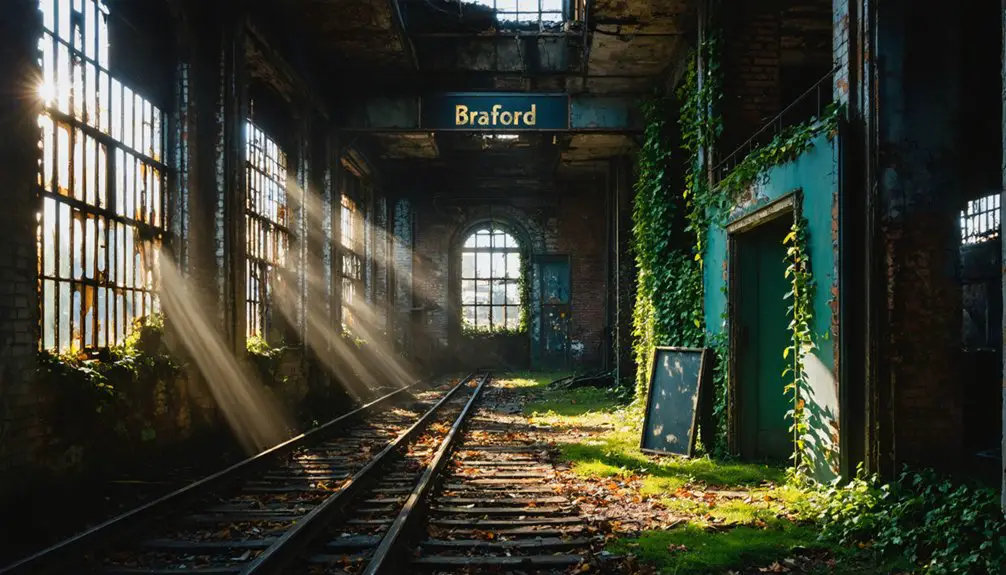
You’ll discover Rhode Island’s haunting past at Hanton City, where 17th-century stone foundations emerge from snowdrifts, and Fort Wetherill, where WWII bunkers cling to 100-foot granite cliffs above frozen Narragansett Bay. The Ram Tail Factory—officially marked “haunted” in the 1885 census—offers less than a mile’s hike to crumbling mill ruins, while Rocky Point’s skeletal amusement park rides stand silent against winter skies. Each site demands waterproof boots, layered clothing, and offline maps, as these forgotten settlements reveal their deepest secrets when exploring their tunnels, foundations, and coastal batteries throughout the colder months.
Key Takeaways
- Hanton City features stone foundations, crumbling walls, and a historic dam from a 1676 settlement abandoned by the mid-19th century.
- Ramtail Factory offers foundation stones and ghostly legends accessible via a short hike from Historic Cemetery #45 trailhead.
- Fort Wetherill showcases WWII bunkers, tunnels, artillery platforms, and German POW barracks atop 100-foot granite cliffs in Jamestown.
- Rocky Point Amusement Park displays skeletal rides and Shore Dinner Hall remnants in a now-public park, abandoned since 1996.
- Winter exploration requires waterproof traction gear, layered clothing, headlamps, offline maps, and caution around ice-covered structures and wildlife.
Hanton City: A Colonial Settlement Frozen in Time
Deep in the woods of Smithfield, where winter strips away the last pretense of civilization, stone foundations rise from the snow like broken teeth. You’ll find Hanton City’s abandoned structures scattered across terrain that doesn’t welcome visitors—dense brush becomes skeletal in January, revealing what summer conceals.
Three English families settled here around 1676, possibly rewarded with land for fighting King Philip’s War. The Colonial history tells of tanners and farmers who thrived until Industrial Revolution mills drained their lifeblood. By mid-19th century, poverty drove everyone away.
Now it’s yours to explore. Stone walls trace property lines nobody defends. An old dam crumbles beside frozen streams. Wells approximately 20 feet deep lurk beneath the snow, some nearly hidden within crumbling stone structures. The settlement developed in the 1730s, when residents sold their goods at Providence markets before economic shifts made their crafts obsolete.
The Alfred Smith Cemetery holds three legible graves—silent witnesses to a community erased by economics, not catastrophe.
Ram Tail Factory: New England’s Only Officially Haunted Site
When the 1885 Rhode Island census taker entered “haunted” beside Ramtail Mill’s listing, he made it New England’s only site with official supernatural status—a designation that survives in state records long after the factory itself burned to rubble.
Rhode Island’s 1885 census officially marked Ramtail Mill as haunted—the only New England location with documented supernatural status in government records.
You’ll find the overgrown ruins along Rams Tail Trail, where haunted legends began after night watchman Peleg Walker cut his throat in 1822. The ghost sightings that followed drove workers away:
- The factory bell tolled at midnight even after removal
- The water wheel spun backwards against the river’s flow
- Machinery roared to life with nobody present
- A lantern-carrying figure stalked the grounds
Today you’ll discover only foundation stones and rock walls reclaimed by forest, yet locals still report Walker’s phantom bell echoing through winter darkness. The mill burned down in 1873, but the supernatural accounts persisted, transforming the surrounding village into a ghost town. Start your visit at Historic Cemetery #45 on Danielson Pike, where limited parking marks the trailhead for this less-than-a-mile hike to the ruins.
Fort Wetherill: Granite Guardian of Narragansett Bay
Standing atop Jamestown’s 100-foot granite cliffs, you’ll discover Fort Wetherill’s concrete gun emplacements rising like ancient monoliths from the winter-bare earth, their camouflaged surfaces now exposed against snow-dusted slopes.
The fortress that once housed 1,200 soldiers guarding Narragansett Bay’s entrance sprawls across 61 acres of abandoned bunkers, underground tunnels, and artillery platforms—a military ghost town where Rhode Island’s wartime past echoes through empty chambers. Seven major concrete gun batteries constructed from the early 20th century through WWII still stand among the ruins, their weathered emplacements bearing names of Revolutionary and Civil War heroes.
Winter transforms these ruins into a stark landscape where ice glazes the cliff edges and frozen sea spray coats the fortifications, demanding careful footing as you navigate the historic military roads threading through this granite guardian’s domain. Managed by the U.S. National Park Service, the site provides educational opportunities to explore the remnants of America’s coastal defense history.
Military History and Architecture
Perched atop 100-foot granite cliffs that plunge into the East Passage of Narragansett Bay, Fort Wetherill commands a vista that’s remained strategically essential for over two centuries.
You’ll discover coastal fortifications that evolved from Revolutionary War earthworks to sophisticated military architecture featuring massive disappearing rifles and concrete bunkers.
The Spanish-American War transformation brought 12-inch guns capable of sinking ironclad warships, while thick earthen embankments concealed deadly firepower beneath innocent-looking vegetation.
Notable Features You’ll Encounter:
- Underground tunnels connecting ammunition storehouses to gun emplacements
- Camouflaged spotting towers—lighthouse-style for aerial concealment, compact fortified versions for gunner protection
- Concrete infrastructure from the 1905-1906 Endicott Defense system
- Former German POW camp barracks from 1945
Today’s 61.5-acre state park preserves this fortress where American soldiers trained without ever firing shots in anger. The site was acquired by the State of Rhode Island in 1972, transforming former military grounds into public parkland after being declared federal surplus property. The fort’s batteries formed part of a defensive network stretching from Point Judith to Sakonnet Point, working alongside other fortifications to protect submarine barriers and minefields.
Winter Exploration Safety Tips
The granite cliffs that made Fort Wetherill a military stronghold transform into treacherous terrain once winter’s first nor’easter sweeps across Narragansett Bay.
You’ll need waterproof boots with traction devices—those smooth concrete bunkers become skating rinks when freezing spray coats every surface. I’ve watched confident explorers slip within seconds of leaving their cars.
Pack winter clothing in layers; the wind howling through gun emplacements cuts deeper than any January cold you’ve experienced inland.
Trail markers disappear beneath snow, and familiar paths between fortifications become disorienting mazes.
Download offline maps before arriving—cell service vanishes along these exposed headlands. Bring a map and compass and know how to use them for navigation when technology fails you.
Share your exploration plans and turn back when conditions deteriorate.
Take photos of distinctive bunker entrances and landmark features to help retrace your route if visibility drops suddenly.
Fort Wetherill’s abandoned tunnels and observation posts aren’t worth risking hypothermia.
Fort Getty: WWII Bunkers Standing Silent
You’ll find Fort Getty’s concrete bunkers crouching in the winter woods, their hulking forms half-buried like sleeping giants who forgot to wake. The underground tunnels still breathe cold air through gaps behind boulders, where tire tracks scar the ceilings—ghostly evidence of bombs and artillery that once rolled overhead.
Before you slip through those eroding entrances, remember that winter ice makes the passageways treacherous, and these silent chambers have stood abandoned since 1948, their darkness hiding more than history.
Concrete Defense Structures Remain
Silent and steadfast, Fort Getty’s concrete bunkers rise from Jamestown’s coastal bluffs like weathered sentinels frozen in time. You’ll discover industrial decay etched into every surface—burn marks scarring storage chambers, rusted ceiling tracks that once hauled massive artillery shells.
Secret tunnels snake beneath your feet, their pitch-black passages accessible through boulder-concealed entrances waiting for your flashlight to pierce the darkness.
Explore these forgotten defense structures:
- Underground networks with multiple narrow passageways connecting ammunition bunkers
- Fire control stations perched strategically across the 41-acre property
- Storage chambers featuring mounted ceiling tracks for weapons transport
- Concrete foundations where twelve-inch coastal guns once defended Narragansett Bay
Winter strips away summer’s crowds, leaving you alone with history. These bunkers stand unmonitored, unpreserved—raw reminders of obsolete warfare frozen mid-century.
Winter Exploration Safety Tips
Before venturing into Fort Getty’s crumbling bunkers, understand that winter transforms these WWII relics into hostile environments where concrete sweats with condensation and metal fixtures frost over.
You’ll need proper gear—waterproof boots with aggressive tread, layered clothing, and a reliable headlamp since these chambers swallow daylight whole. The rocky beach becomes treacherous when ice-slicked, and those tempting shortcuts across frozen tide pools? Don’t risk it without confirming six inches of ice thickness.
Honestly, you’re better off sticking to established trails. Keep your dog leashed on the short estuary paths where southwest winds whip off the harbor. These fortifications have stood since the 1940s; they’ll wait while you prepare correctly for safe exploration.
Napatree Point: Military Remnants Meet Coastal Beauty
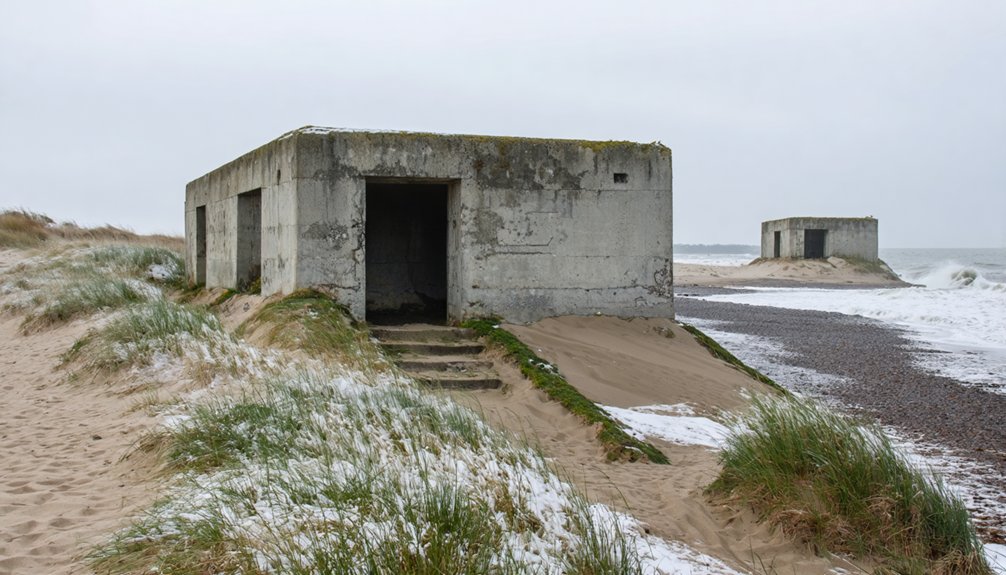
At the windswept tip of Napatree Point, concrete batteries crumble into sea grass like the broken teeth of a forgotten sentinel. Fort Mansfield’s ruins stretch along this 1.5-mile barrier beach between the Atlantic and Little Narragansett Bay, where coastal erosion gradually reclaims what war games abandoned in 1909.
You’ll discover an eerie freedom wandering these overgrown ramparts, where 228 soldiers once manned disappearing guns that couldn’t defend their own obsolescence.
What You’ll Find:
- Underground rooms and gun emplacement structures hidden in vegetation
- Panoramic Rhode Island coastline views from crumbling ramparts
- Marine wildlife thriving among pitch-fire beacon foundations
- Remnants of 18 buildings swallowed by storms and time
Winter transforms this military graveyard into meditative solitude—just you, history’s whispers, and endless horizon.
Rocky Point: Where Amusement Park Dreams Faded
Where laughter once echoed across 120 acres of coastal dreamland, only the skeletal Circle Swing tower now punctures the winter sky—a rusting monument to a century of carousel music and cotton candy summers.
You’ll walk where the Shore Dinner Hall once fed 4,000 guests before Hurricane Carol devoured it in 1954. This abandoned amusement park, born from Captain Winslow’s 1847 seafood outings, survived world’s fairs and presidential phone calls before surrendering to financial ruin in 1996.
Winter preservation has transformed the grounds into Rocky Point State Park, where frozen meadows and silent beaches replace the Wildcat roller coaster’s screams. You’re free to explore without gates or admission fees—just you, the Atlantic wind, and ghosts of a hundred thousand childhood memories crystallized in salt air.
Exploring Rhode Island’s Forgotten Communities Safely
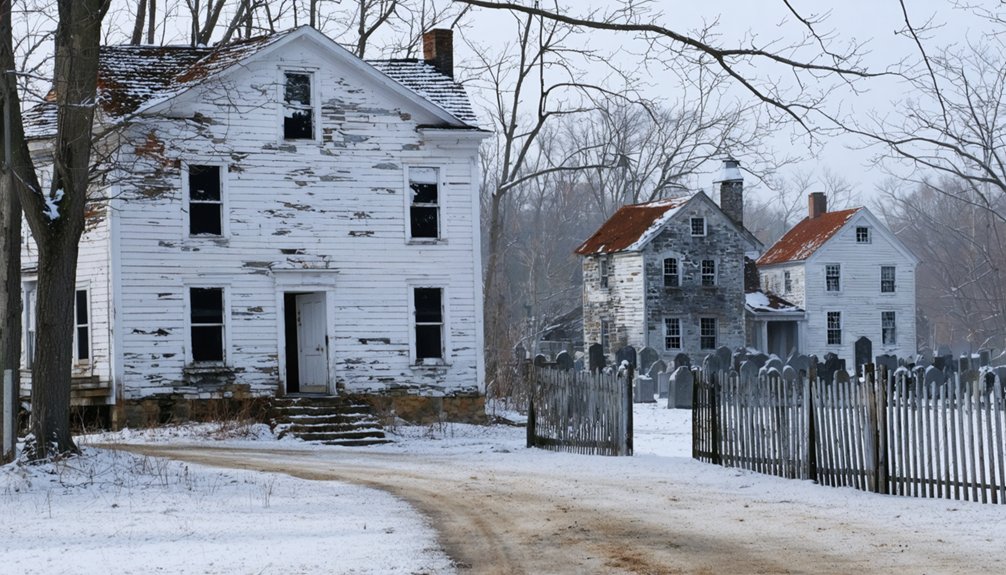
Though Rhode Island’s ghost towns whisper invitations through winter-bare branches, you’ll need preparation beyond curiosity to answer their call. The 3/4-mile trek to Hanton City’s foundations demands sturdy boots and layered clothing—frozen ground conceals uneven terrain where stone walls emerge unexpectedly.
Local wildlife reclaims these spaces aggressively; deer trails now crisscross Ramtail Factory’s remnants, while ice makes Napatree Point’s scattered debris treacherous.
Essential considerations for winter exploration:
- Download offline maps before venturing to sites where cell service vanishes
- Respect preservation challenges by photographing foundations without climbing fragile structures
- Visit during daylight hours when winter darkness arrives by 4:30 PM
- Pack emergency supplies—Rhode Island’s colonial-era settlements sit far from modern conveniences
These forgotten communities reward respectful visitors who understand that freedom includes responsibility.
Best Practices for Winter Ghost Town Adventures
Winter’s grip transforms ghost town exploration into an endeavor where romantic curiosity meets survival necessity.
You’ll navigate Rhode Island’s urban decay differently when snow conceals rotted floorboards and ice glazes crumbling staircases. Before entering abandoned properties, test structural integrity—throw debris ahead, step near wall-supported edges, never trust water-damaged wood. Your eyes must scan upward constantly, identifying collapse risks overhead.
Layer wool against hypothermia‘s silent approach. Pack three days’ supplies beyond your planned return—winter doesn’t negotiate.
That FFP3 mask isn’t paranoia; it’s acknowledging black mold’s patient hunger in basement shadows. Your headlamp becomes essential as December’s darkness swallows afternoon exploration.
Check weather obsessively. Verify access permissions. Remember: these structures stood when communities thrived. Now they’re testing whether you’ve earned passage through their skeletal remains.
Frequently Asked Questions
Are There Guided Tours Available for Rhode Island’s Ghost Towns?
Like lanterns piercing winter darkness, guided ghost tours illuminate Rhode Island’s haunted past, not abandoned towns. You’ll discover historical backgrounds through Newport’s taverns and Providence’s colonial streets, where preservation efforts maintain spine-tingling tales rather than crumbling ghost town ruins.
What Permits or Permissions Are Needed to Explore These Abandoned Sites?
You’ll need landowner permission since most sites sit on private property. Trespassing laws protect these forgotten places, so research ownership through county records first. I’ve learned that respectful contact with owners often opens doors to adventure.
Can I Bring My Dog When Visiting These Ghost Town Locations?
You’ll find dog-friendly trails at most Rhode Island ghost towns, though leash laws apply. Follow essential pet safety tips: watch for unstable structures, hidden cellar holes, and sharp debris that could injure your adventurous companion’s paws.
What Photography Equipment Works Best in Winter Ghost Town Conditions?
You’ll need cold-resistant winter gear: weather-sealed mirrorless cameras, fast prime lenses, sturdy tripods with leg warmers, and extra batteries. Essential photography tips include shooting RAW files, using polarizing filters on snow, and packing protective pouches for moisture.
Are There Nearby Accommodations for Multi-Day Ghost Town Exploration Trips?
You’ll find diverse lodging options near Rhode Island’s ghost towns, from Providence’s haunted Graduate Hotel to Westerly’s coastal inns. Follow safety tips by booking heated accommodations within 20-30 minutes of exploration sites, ensuring warm refuge after your adventures.
References
- https://www.youtube.com/watch?v=oLqHZGUgSxs
- https://www.visitrhodeisland.com/things-to-do/haunted-rhode-island/
- https://ghost-towns.close-to-me.com/states/rhode-island/
- https://newenglandhistoricalsociety.com/six-new-england-ghost-towns/
- https://www.theodysseyonline.com/7-abandoned-places-visit-ri
- https://kids.kiddle.co/Hanton_City
- https://www.youtube.com/watch?v=3bFcmv7IH40
- https://vitabrevis.americanancestors.org/2017/01/no-notorious-scandals
- https://www.chowdaheadz.com/blogs/news/new-england-myths-legends-the-ruins-of-hanton-city-rhode-island
- https://smithapplebyhouse.org/arethereghosts/