Winter’s the best time to explore Texas ghost towns when temperatures drop and crowds disappear. You’ll find Terlingua’s mercury mining ruins dusted with rare desert snow near Big Bend, Glenrio’s skeletal Route 66 structures stark against frozen high plains, and Old Bluffton’s foundations exposed by lowered winter lake levels. Medicine Mound’s sacred dolomite cones rise through occasional snowfall, while Fanthorp Inn’s weathered cedar logs stand beautifully preserved in the crisp Piney Woods air. Each site reveals secrets that summer heat and tourist crowds typically obscure.
Key Takeaways
- Terlingua near Big Bend offers desert ruins, mining relics, and comfortable winter temperatures ranging from upper 60s to mid-70s during the day.
- Glenrio on the Texas-New Mexico border preserves 1950s Route 66 structures, with winter lighting dramatically highlighting its nostalgic architectural remains.
- Medicine Mound features sacred dolomite hills and nearby ghost town ruins, enhanced by winter snow covering the main street’s vintage scene.
- Winter water levels drop at sites like Old Bluffton, exposing submerged foundations and historical artifacts normally hidden underwater.
- Lobo near Van Horn provides remote solitude with abandoned buildings, best explored through daylight photography and proximity to Guadalupe Mountains.
Fanthorp Inn and the Snowy Piney Woods of Grimes County
When winter settles over the rolling hills of Grimes County, the Fanthorp Inn emerges from the mist like a relic suspended in time—its weathered clapboard siding and double-pen cedar logs standing exactly where Henry Fanthorp raised them in 1834.
Step inside where weathered cedar logs and clapboard siding have stood unchanged since Henry Fanthorp built this Texas refuge in 1834.
You’ll walk where Sam Houston and Ulysses S. Grant once slept, exploring eighteen rooms that witnessed Texas ranch life under four different flags without moving an inch.
The historic preservation here runs deeper than restored walls. Ten years of archaeological research stripped away modern additions, returning this stagecoach stop to its 1850s glory. After Henry and Rachel Fanthorp died in 1867, their daughter Mary converted the hotel and tavern back into a family residence.
Visit Friday through Sunday (admission’s free), and you’ll discover Anderson—once a county seat, now barely a crossroads. The inn also served as a post office, connecting frontier travelers to the wider world. The Piney Woods stand silent around it, holding stories of frontier travelers who sought shelter beneath these same timbers nearly two centuries ago.
Terlingua: Where Mining History Meets Desert Winter
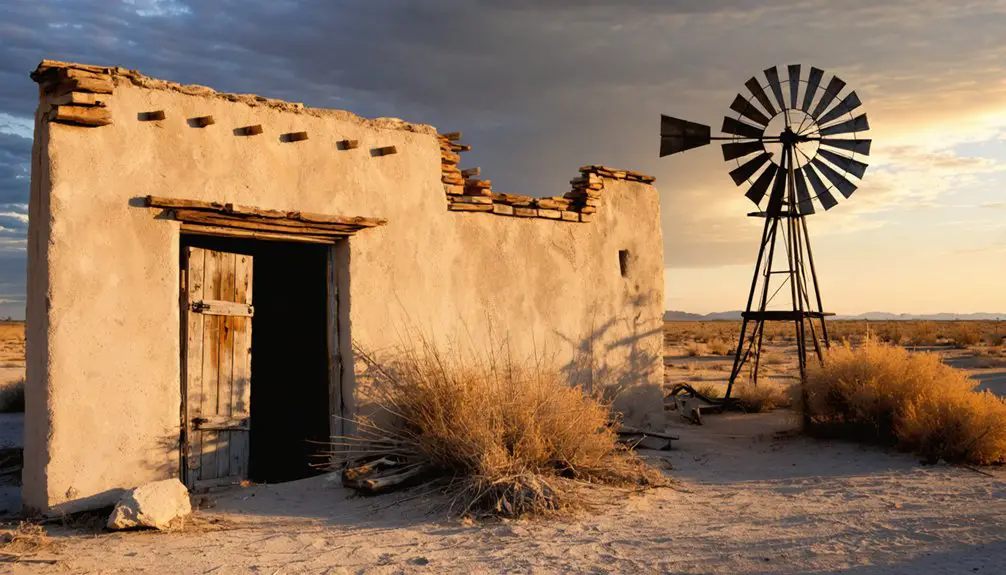
You’ll find Terlingua crumbling into the Chihuahuan Desert like a monument to mercury—its flat sandstone ruins stacked without mortar, where cinnabar once pulled over 1,000 souls to this brutal landscape three miles from the Rio Grande.
Winter transforms the ghost town’s usually scorching terrain into comfortable hiking weather, perfect for wandering among the two-dozen structures that Howard Perry’s Chisos Mining Company left behind when the market crashed in 1943. Wooden door frames still stand within the stone walls, silent markers of the buildings’ original construction.
The air stays crisp and dry as you explore abandoned mineshafts on California Hill and peer through roofless walls that once housed miners who painted their bodies with the same red pigment they extracted from the earth. Beyond the mining ruins, you can experience the town’s modern revival at the Starlight Theatre, where dinner theater performances bring unexpected life to this remote desert settlement.
Historic Cinnabar Mining Operations
The brilliant red cinnabar deposits beneath Terlingua’s desert floor drew prospectors like moths to flame in the mid-1880s, though Native Americans had crushed these same vermillion rocks into body pigment for millennia before any mine shaft pierced the ground.
You’ll discover mining relics scattered across the landscape—crumbling stone furnaces where workers once baked quicksilver from ore in primitive retorts. By 1908, the Chisos Mining Company’s 20-ton Scott Furnace dominated operations, processing cinnabar into liquid mercury for industrial America.
The mercury history carries a darker truth: those 2,000 residents who called this boomtown home paid dearly. Workers died young, poisoned by the very element they extracted, their minds deteriorating like nineteenth-century hatters exposed to toxic vapors. Most miners’ careers lasted less than 5 years before the mercury exposure destroyed their health beyond recovery. The underground workings stretched over 23 miles beneath the surface, a labyrinth of dangerous tunnels where miners descended daily into darkness.
Freedom here meant choosing between poverty and slow death.
Desert Winter Weather Conditions
Terlingua’s winter air strikes your skin with startling contradictions—bone-numbing frost at dawn gives way to shirtsleeve warmth by afternoon as the thermometer climbs forty degrees in just hours.
You’ll peel off layers as January highs reach the upper 60s while February stretches into the mid-70s. Desert flora stands resilient against these swings—creosote and ocotillo adapting to nights dipping into the mid-30s.
Pack strategically: thermal base layers for frozen sunrises, breathable shirts for midday exploration. Winter wildlife emerges during temperate afternoons—roadrunners darting between ruins, jackrabbits orchestrating arroyos.
The Sierra del Carmen mountains create microclimates that shift weather patterns across canyon walls. Dew point temperatures below 50ºF ensure the desert air feels consistently dry against your skin throughout winter months.
Snow appears rarely, maybe 0.3 inches annually, though occasional flurries dust abandoned structures with fleeting magic. Patchy moderate snow can occasionally blanket the desert landscape, adding an enchanting visual contrast to the rugged terrain. Clear skies dominate, perfect for wandering crumbling adobe without crowds or oppressive heat.
Glenrio’s Frozen Route 66 Time Capsule
You’ll find Glenrio straddling the Texas-New Mexico border like a perfectly preserved 1950s postcard, its 17 abandoned buildings frozen in the exact moment Interstate 40 pulled the plug in 1973. The concrete foundations of gas stations and the shuttered Little Juarez Cafe stand as monuments to Route 66’s golden age.
When travelers couldn’t buy a beer on the dry Texas side but had to cross an invisible state line for fuel due to New Mexico’s higher gas taxes, Glenrio was a key stop. Winter’s stark light throws these skeletal structures into sharp relief against the high plains scrub, making the town’s odd geography—straddling a border with neither the valley nor river its name promises—feel even more surreal. The town earned its place in cinema history when it served as a film location for *The Grapes of Wrath* in 1938, capturing the desperation of Depression-era migrants on the newly paved Mother Road. Among the remaining structures, the 1950 Texico service station still displays its original pumps, offering Route 66 enthusiasts a glimpse into mid-century roadside commerce.
Preserved Mid-Century Architecture
Along the windswept border where Texas meets New Mexico, seventeen abandoned buildings stand as silent witnesses to Route 66‘s golden age.
You’ll discover authentic mid century architecture frozen in time—Valentine-style diners with their distinctive shapes, gas stations with ghost pumps, and motels where neon signs once beckoned weary travelers. The Little Juarez Cafe‘s bricked-over facade showcases classic roadside design, while concrete foundations and adobe remnants tell stories of successive building phases from railroad town to automotive heyday.
Route 66 preservation efforts have protected Glenrio’s National Register status, letting you walk through genuine 1940s-1950s commercial styling.
The original roadbed runs alongside I-40, inviting exploration without restrictions. You’re free to photograph these unrestored structures—empty post offices, defunct dance halls, and fuel stations—before winter winds claim more of their weathered beauty.
Interstate Highway Ghost Town
When Interstate 40 opened in 1973, it drew a line through Glenrio’s future as decisively as the Texas-New Mexico border splits its past. You’ll find seventeen abandoned buildings frozen mid-century—the bricked-over Little Juarez Cafe, silent gas pumps, a shuttered motel.
Route preservation efforts have protected this roadside memorial, though there’s no guesthouse availability here. Winter strips away any remaining illusion of life.
Stand where the station master once carried mailbags across state lines, where travelers chose which side to fuel up based on tax rates and liquor laws. The town that served Route 66‘s endless stream of freedom-seekers now serves only as their monument.
Two lanes of cracked asphalt lead nowhere, exactly where you might need to go.
Old Bluffton’s Winter Waters and Submerged Secrets
February offers your best chance. Water levels drop, exposing foundations normally hidden 10-40 feet down.
You’ll find broken glass, rusted tools, medicine bottles—but don’t pocket them.
It’s illegal, and honestly, they belong here.
Lobo: West Texas Solitude in the Cold Season
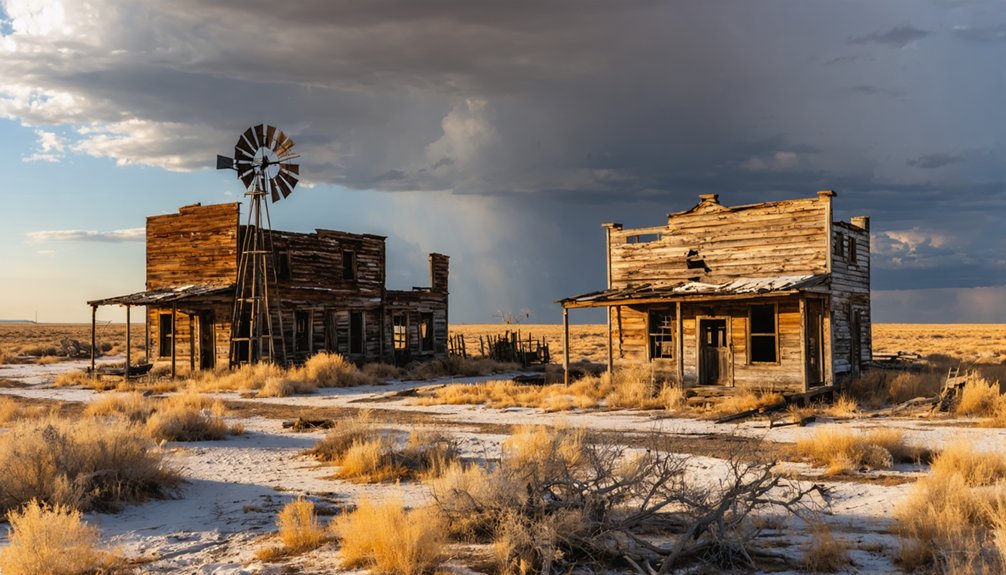
Between the Van Horn and Wylie Mountains, Lobo sits like a mirage you can actually reach—twelve miles south of Van Horn on Highway 90, where the wind cuts across empty pecan orchards and talks to abandoned buildings.
Winter strips this ghost town to its essentials. You’ll find abandoned architecture that’s changed hands from railroad depot to failed revival project, last purchased by German investors for $20,000 in 2001.
The hidden history runs deeper: Mexican wolves once roamed here, giving the town its name before residents walked away in 1991.
Pull off during daylight for photos—it’s private property, fenced and unoccupied.
The sparse 13.2 inches of annual rainfall means clear winter skies.
Guadalupe Mountains National Park lies an hour north, perfect for extending your escape into genuine solitude.
Medicine Mound’s Sacred Hills in Winter Stillness
Four dolomite cones punch skyward from the flatlands of Hardeman County like ancient sentinels—200 to 250 feet of sacred geology that Comanche peoples have revered for centuries.
Four dolomite sentinels rise 200 feet from Hardeman County’s plains—sacred geology revered by Comanche peoples for centuries.
You’ll find the ghost town 2.5 miles north, where rock ruins like the old general store (now Downtown Medicine Mound Museum) stand against winter winds.
Main Street’s snow-covered ruins feel like a vintage campsite frozen in 1932, when fire claimed most structures.
Drive Farm Road 1167 from Quanah—twelve miles southeast—and you’re alone with pioneer history.
The Stermer homestead‘s frame buildings hold implements from another era.
Winter strips away pretense here, leaving only mounds with sixty-mile views and the quietude that comes when a town’s 500 residents dwindle to memory.
Planning Your Texas Ghost Town Winter Road Trip
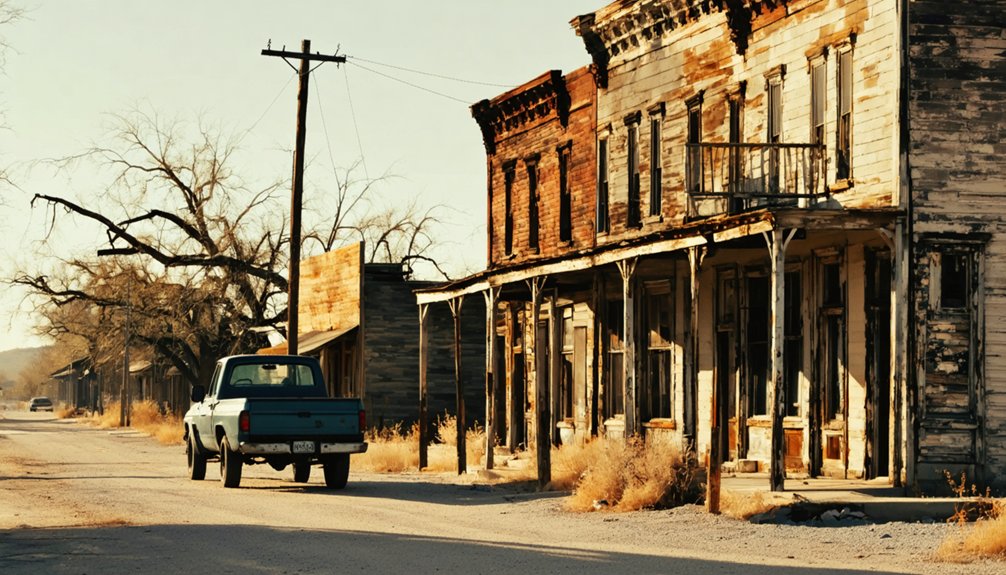
From Medicine Mound’s windswept silence, you’ll want a solid plan before chasing more Texas ghost towns in winter’s grip. Start with Terlingua near Big Bend—it’s a 10-hour haul from Houston but worth every mile. The ghost town’s ruins glow golden at sunset, and nearby Study Butte offers motels when Chisos Basin fills up.
Pack flashlights for cemetery walks under full moons, and respect those weathered graves by leaving artifacts untouched.
String together West Texas stops: Terlingua to Marfa’s two hours north, where Thunderbird Hotel and indoor dining await. Or detour to Barstow’s structures along I-10.
Jefferson’s East Texas ruins offer different terrain entirely. Winter’s short days mean you’ll catch dramatic shadows everywhere, and local crafts in surrounding towns add cultural depth between ghost town explorations.
What to Pack for Cold-Weather Ghost Town Exploration
Winter ghost town exploration demands layering strategies you’d skip on typical Texas trips.
West Texas nights drop unexpectedly fast, transforming crumbling buildings into wind tunnels. You’ll need thermal baselayers that wick moisture, waterproof boots with non-slip soles for unstable terrain, and insulated outerwear rated for sudden temperature swings.
Essential cold-weather items include:
- Merino wool baselayers for warmth without bulk when maneuvering primitive shelters
- Weather-resistant jacket and durable pants for scrambling through abandoned structures
- Warm accessories like touchscreen-compatible gloves and knitted hats
Pack camping gear thoughtfully—these abandoned settlements offer zero modern conveniences.
Bring 5 pairs of warm socks, multiple glove sets, and layers you can shed quickly.
Your freedom to explore depends entirely on preparing for Texas winter‘s unpredictable temperament.
Photography Tips for Capturing Winter Ghost Town Atmosphere
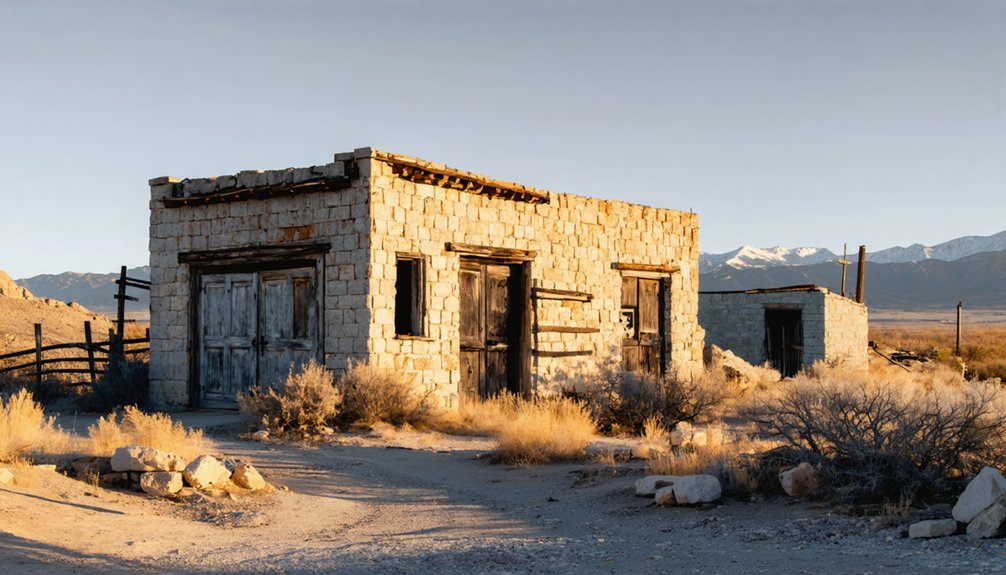
When temperatures plummet and mist clings to weathered timber frames, ghost towns transform into haunting canvases that demand specific photographic approaches.
Mount your Manfrotto 055 tripod for stability during 15-second exposures that capture vintage architecture emerging from darkness. You’ll want f/8 for sharp depth across crumbling saloons and rusted Model Ts, while ISO 1600 handles Texas winter’s early sunsets.
Long exposures on sturdy tripods reveal ghost town secrets that handheld shooting simply cannot capture in fading light.
Light painting reveals urban decay’s textures—sweep your torch across peeling paint and corroded metal during long exposures for ethereal effects.
Overexpose by 1.5 stops when snow blankets abandoned streets; otherwise your camera meters it gray. Flash-freeze falling flakes at 1/4 second for confetti-like atmosphere, or shoot wide establishing angles capturing entire main streets.
Frame storytelling details: footprints crossing pristine drifts, fog swirling through broken windows, moonlight illuminating century-old cemeteries.
Frequently Asked Questions
Are Ghost Town Ruins Safe to Explore During Icy Winter Conditions?
No, you shouldn’t explore ghost town ruins during icy conditions. Historic preservation matters, but crumbling structures become treacherous with ice. Take safety precautions seriously—slippery surfaces plus unstable buildings create deadly combinations. Wait for clear weather to safely experience Texas’s abandoned treasures.
Do Any Texas Ghost Towns Offer Overnight Accommodations for Winter Visitors?
Terlingua Ghost Town offers incredible winter lodging options, from heated casitas with rock showers to luxury yurts with skylights. You’ll find cozy accommodations featuring fireplaces, king beds, and kitchenettes—perfect for your desert freedom adventure.
Which Ghost Towns Require Advance Permission or Have Restricted Winter Access?
You’ll need advance permission for Lobo and Fort Phantom Hill due to access restrictions on private land. Winter’s harsh conditions demand safety precautions—remote locations mean delayed emergency response. Always contact property owners beforehand to explore freely and responsibly.
Are Guided Tours Available at These Locations During Winter Months?
Yes, you’ll find guided tours operating year-round at Fort Worth, Granbury, and Houston locations with excellent tourist amenities. Terlingua offers only self-guided exploration. Winter safety improves with organized tours through lit historic districts versus remote desert ruins you’d navigate alone.
What Are Typical Winter Temperature Ranges Across Different Texas Ghost Town Regions?
Winter temps vary dramatically: Panhandle drops to 25°F requiring heavy winter clothing, West Texas ranges 36-96°F, South Texas stays mild at 47°F lows, and Southwest’s Big Bend swings 40-50°F daily—pack versatile survival gear.
References
- https://www.youtube.com/watch?v=ge1tVbXyax0
- https://en.wikipedia.org/wiki/List_of_ghost_towns_in_Texas
- https://www.hipcamp.com/journal/camping/texas-ghost-towns/
- https://www.southernthing.com/ruins-in-texas-2640914879.html
- https://www.tripadvisor.com/Attractions-g28964-Activities-c47-t14-Texas.html
- https://www.youtube.com/watch?v=Zd8-gKw-5Hc
- https://livefromthesouthside.com/10-texas-ghost-towns-to-visit/
- https://wheretexasbecametexas.org/about/fanthorp-inn/
- https://www.youtube.com/watch?v=hLOCo7yH_MY
- https://en.wikipedia.org/wiki/Fanthorp_Inn_State_Historic_Site