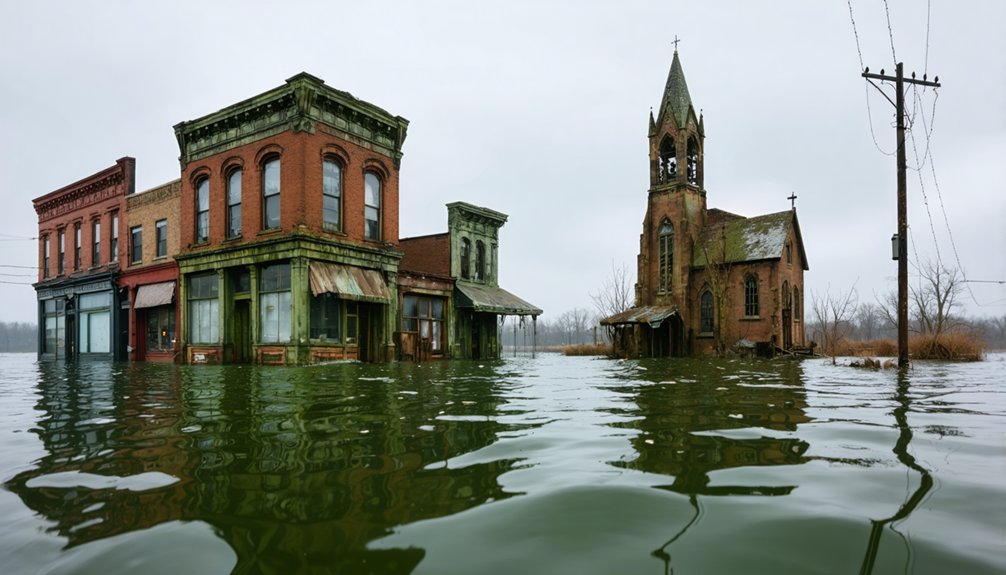
You’ll find six submerged communities beneath Lake Red Rock, Iowa’s largest reservoir constructed between 1960-1968 by the U.S. Army Corps of Engineers. Coalport, Dunreath, Fifield, Red Rock, Cordova, and Rousseau were systematically purchased, evacuated, and demolished for flood control infrastructure managing a 12,320-square-mile drainage basin. Archaeological remnants—foundations, street grids, and five deliberately preserved cemeteries—remain beneath 15,520 acres of water, occasionally visible during low-water periods when fluctuating lake levels expose the physical evidence of these sacrificed settlements and their exhaustive documentation challenges.
Key Takeaways
- Six Iowa towns—Red Rock, Fifield, Cordova, Dunreath, Coalport, and Rousseau—were deliberately submerged beneath Lake Red Rock during 1960-1969.
- Lake Red Rock, Iowa’s largest reservoir at 15,520 acres, was constructed for flood control by the U.S. Army Corps of Engineers.
- Communities were systematically evacuated, demolished, and cemeteries exhumed before the lake filled in 1969, with Red Rock Cemetery remaining above water.
- Red Rock, established in 1842, was the oldest settlement among the submerged towns and served as a regional trading post.
- Underwater archaeological remnants include foundations, street grids, and structural debris from the demolished towns beneath the reservoir.
The Creation of Lake Red Rock and Its Impact
Following catastrophic flooding events along the Des Moines River in 1947, Congress authorized the construction of an all-encompassing flood control infrastructure through the Flood Control Acts of 1938 and 1944.
You’ll find that the U.S. Army Corps of Engineers constructed this $88 million rolled earth-fill embankment between 1960 and 1968, creating Iowa’s largest reservoir spanning 15,520 acres under normal conditions.
The project’s submerged architecture includes fourteen hydraulic sluice gates and five massive tainter gates controlling a 12,320-square-mile drainage basin.
Six communities—Red Rock, Fifield, Cordova, Dunreath, Coalport, and Rousseau—were systematically purchased, evacuated, and demolished.
During periods of low water, remnants of the original Red Rock town become visible, including old homes and the highway 14 bridge.
The dam was officially dedicated on September 6, 1969, concluding four days of festivities that marked this major infrastructure milestone.
Today’s lake ecology faces ongoing challenges from agricultural sediment accumulation and chemical runoff, progressively diminishing the reservoir’s original floodwater capacity while necessitating minimum pool elevation adjustments.
A Century of Devastating Floods Along the Des Moines River
The Des Moines River basin experienced catastrophic flooding events spanning over a century, beginning with the 1851 deluge that deposited a record 74.5 inches of rainfall and nearly destroyed the nascent settlement of Des Moines.
Subsequent major floods in 1903 (20.9 feet stage) and 1944 (levee breach of nearly 100 feet) demonstrated recurring vulnerabilities in communities lacking adequate flood control infrastructure. The 1944 flood caused particular devastation when levees failed at Riverview Park, inundating the area during early summer.
These escalating disasters culminated in the Great Flood of 1993, which recorded peak flows of 116,000 cfs and precipitated federal intervention across all 99 Iowa counties. Without the Saylorville Lake and Lake Red Rock reservoirs, flood damages would have exceeded $730 million by 2009, underscoring the critical role of modern flood control infrastructure.
Early 19th Century Disasters
During Iowa’s catastrophic 1851 flood season, precipitation totals reached 74.5 inches (191.5 cm)—a record that remains unbroken.
The deluge commenced in May, persisting over forty days with intermittent intensification. A cloudburst on May 21 between Fort Dodge and Fort Des Moines exacerbated saturated conditions, while eastern Iowa received ten inches within twenty-four hours in early August.
The Des Moines River rose twenty-three feet above low-water mark, devastating town infrastructure across Bentonsport, Bonaparte, Keosauqua, and Ottumwa.
You’ll find the river expanded to four miles wide in sections, rendering roads impassable and bridges ineffective.
Historical agriculture suffered complete crop destruction, with farms buried under drift-wood and debris. Floodwaters swept away fences and buildings while drowning livestock across the inundated farmland. The winter of 1850-51 brought extremely wet conditions that saturated the ground before spring rains arrived.
Without levees or substantial bridges, southeastern Iowa’s settlements experienced unprecedented isolation as mills, warehouses, and dwellings succumbed to the relentless current.
Mid-1900s Catastrophic Events
A century after Iowa’s 1851 deluge, hydrological conditions in June 1954 generated the most severe flooding event documented along the Des Moines River system to that date. You’ll find the technical records reveal unprecedented discharge rates that fundamentally altered floodplain agriculture across the watershed.
The catastrophic sequence unfolded as follows:
- Initial precipitation June 15-19 saturated north-central Iowa’s drainage basins.
- Secondary runoff June 20-22 produced record-breaking crests on Boone River tributaries.
- Confluent flows downstream created history’s greatest flood at Des Moines.
- Evacuation of thousands from Fort Dodge, Webster City, and Des Moines residential zones.
This event demonstrated the vulnerability of established communities despite existing infrastructure. Reservoir sedimentation and inadequate retention capacity compounded the disaster, forcing officials to reconsider floodplain development policies throughout Iowa’s river valleys. The disaster prompted reforms in dam safety and flood management practices, paralleling the engineering improvements implemented after other major American flood events of the era. Earlier regional floods like the June 1947 statewide inundation had already exposed Iowa’s susceptibility to extreme precipitation events, with rainfall that month averaging 10.33 inches across the state.
Federal Flood Control Response
Following June 1954’s devastating discharge volumes, congressional authorization of structural flood control infrastructure accelerated throughout the Des Moines River basin.
You’ll find the Flood Control Acts of 1936 and 1944 established federal responsibility, with the Pick-Sloan Plan coordinating Corps of Engineers efforts.
Saylorville Dam’s 1975 completion and Lake Red Rock’s operational deployment created tandem flood management capacity—reducing 1979 peak stages by 2.8 feet and preventing $48.4 million in damages in 1982.
The 1962 Upper Mississippi River Holistic Basin Study coordinated tributary interventions.
Modern operations integrate floodplain restoration and ecological flows through the 2015 Sustainable Rivers Project, supporting paddlefish and sturgeon populations.
You’re witnessing adaptive management that balances 6 million acre-feet flood storage capacity with natural flow regimes—prioritizing both infrastructure protection and watershed ecological integrity.
Ongoing water quality assessments track nutrient and sediment levels to ensure reservoir operations maintain adequate conditions for aquatic ecosystems.
These systematic improvements proved essential given that the June 1947 flood had already demonstrated the catastrophic consequences of inadequate flood management infrastructure.
Coalport: Iowa’s First Coal Mining Settlement
You’ll find Coalport’s establishment directly linked to L. W. Babbitt’s 1842 discovery of coal outcroppings along the Des Moines River.
Four-foot seams in accessible bluffs enabled extraction operations that supplied fuel to steamships and regional markets.
The settlement’s rapid growth through the 1850s-1870s resulted from railroad expansion creating demand for coal shipments to distant terminals, with Brown and Company operations transforming subsistence mining into commercial-scale production.
However, the 1903 flood catastrophically altered the river’s course by one mile, severing the town’s water access and eliminating the transportation infrastructure that sustained mining operations, causing immediate settlement abandonment.
Discovery and Early Development
When Brown and Company initiated coal extraction operations ten miles east of Fairfield in southeast Iowa, they established Coalport as the state’s first dedicated coal mining settlement.
You’ll find this pioneering venture capitalized on Des Moines River lowlands geology, where accessible four-foot coal beds enabled autonomous extraction without corporate oversight.
The discovery phase followed systematic resource assessment:
- Geological surveys identified workable seams extending two miles near Jamestown
- Drift mining techniques accessed horizontal coal deposits efficiently
- River proximity facilitated fuel distribution to Burlington markets
- Steam traffic operations consumed local output before rail expansion
Today, ancient artifacts and submerged flora mark these original excavation sites beneath reservoir waters.
Initial operations served local citizens’ heating requirements and riverboat fuel demands, creating economic independence from 1855 forward through decentralized energy production.
River Change and Demise
By 1857, Coalport had evolved into an extensive industrial center when William Welch platted the formal settlement structure, establishing multiple commercial operations that included a store, saw mill, grist mill, blacksmith shop, shingle factory, and pottery.
Brown and Company extracted a four-foot coal bed, shipping substantial output to Burlington via Des Moines River. However, floodplain ecology inherently destabilized lowland settlements.
The catastrophic 1903 flood forced residents to salvage possessions as rising waters threatened infrastructure. River sedimentation patterns shifted dramatically during this event, creating a new channel that replaced the meandering loop.
The waterway relocated from Coalport’s immediate access point to a distant position, eliminating transportation viability. You’ll find the settlement dissolved almost immediately afterward.
Coal Ridge Church and school served remaining farmers until the church burned in 1908.
Dunreath and the Red Rock Coal Mining Company
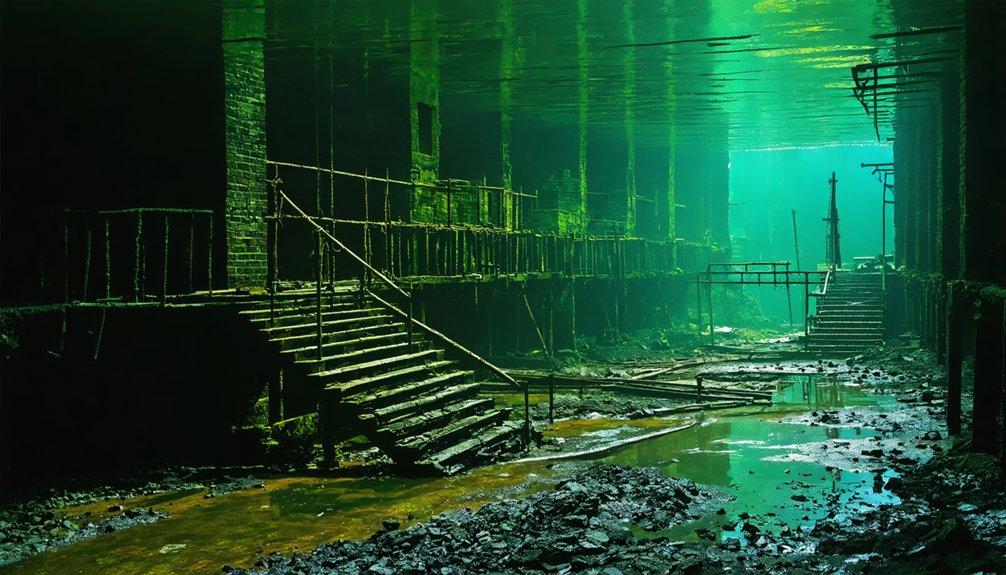
The Wabash Railroad platted Dunreath in 1882 as a purpose-built settlement to support coal extraction operations in Marion County, Iowa. The railroad established the Red Rock Coal Mining Company and constructed depot infrastructure for resource transportation.
You’ll find the settlement’s demographic expansion documented through census data:
- 1885 population: 214 residents
- 1890 peak population: 435 residents
Commercial infrastructure included a drug store, law offices, boarding houses, and a saloon.
Terminal operation: Casey’s General Store closed in the 1930s.
The town’s complete economic dependence on coal extraction determined its inevitable abandonment by the 1940s.
Lake Red Rock’s construction in the 1960s submerged remaining structures, creating submerged artifacts now accessible only through aquatic archaeology.
Dunreath Cemetery remains the sole terrestrial evidence of this industrial settlement’s existence.
Fifield: The Whitebreast Settlement That Vanished
Although Marion County settlers initially named it Whitebreast when they established the community in the 1840s, the settlement later became known as Fifield before its eventual submersion beneath Lake Red Rock.
From frontier settlement to vanished town, Whitebreast’s transformation into Fifield ended beneath the waters of Lake Red Rock.
You’ll find documented evidence of two general stores, a creamery that shipped butter via Wabash railroad, and a post office operational until May 1955.
The Whitebreast School functioned 108 years (1851-1959), demonstrating remarkable educational continuity.
Economic decline initiated in the 1930s, preceding the Army Corps of Engineers‘ dam project.
Residents relocated before 1969 flooding, though their cemetery remains submerged, unlike other relocated burial grounds.
Historical artifacts and community memories persist through photographic documentation of commercial structures and educational facilities, preserving technical knowledge of this agricultural settlement’s infrastructure beneath Iowa’s largest reservoir.
Red Rock: The Oldest Town Beneath the Waters
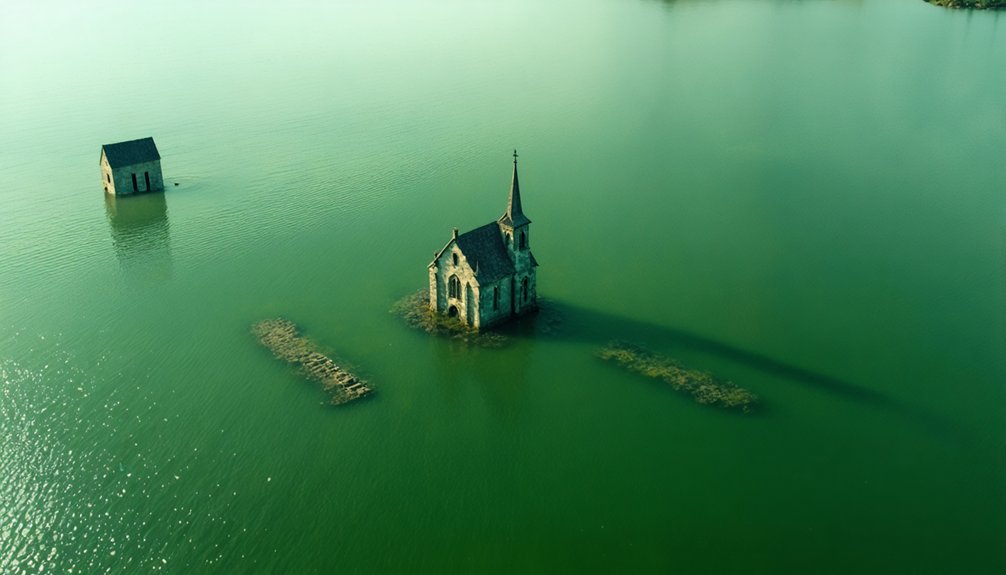
Where Iowa’s earliest frontier commerce emerged, Red Rock established itself as a trading post in 1842 near distinctive sandstone bluffs that served as geographical markers for both indigenous populations and white settlers guiding the Des Moines River corridor.
John Bedell’s 1845 survey formalized settlement patterns, predating other submerged communities by fifteen years. Urban preservation efforts couldn’t prevent the Corps of Engineers‘ 1960s acquisition below elevation 760.
Red Rock’s infrastructure included:
- Post office (1857) and century-spanning school facility
- Four operational sawmills supporting timber commerce
- 1890s Wabash Railroad spur accessing sandstone quarries
- Medical services, general merchandise, and ecclesiastical structures
Archaeological excavations remain impossible beneath Lake Red Rock’s minimum pool elevation of 742 feet.
Dam construction (1960-1968) submerged Marion County’s longest-existing settlement, creating Iowa’s largest reservoir for flood mitigation.
The Relocation Process and Final Days
Following passage of the Flood Control Act after the catastrophic 1954 Des Moines River flood, the U.S. Army Corps of Engineers initiated systematic property acquisition in 1960.
You’ll find the relocation process demonstrated remarkable community resilience, as residents received fair market compensation and relocated over several years without significant protest.
The Corps employed standard engineering protocols: structures were jacked from foundations and relocated when feasible, while others faced demolition. Cemeteries underwent systematic exhumation and reinterment, except Red Rock Cemetery which remained above projected water levels.
The floodplain agriculture communities of Coalport, Cordova, Dunreath, Fifield, Red Rock, and Rousseau prepared methodically for submersion.
Upon dam completion in 1969, Lake Red Rock filled within months rather than predicted years, permanently submerging cleared foundations and transforming the landscape into aquatic habitat.
What Remains Below: Exploring the Submerged Remnants
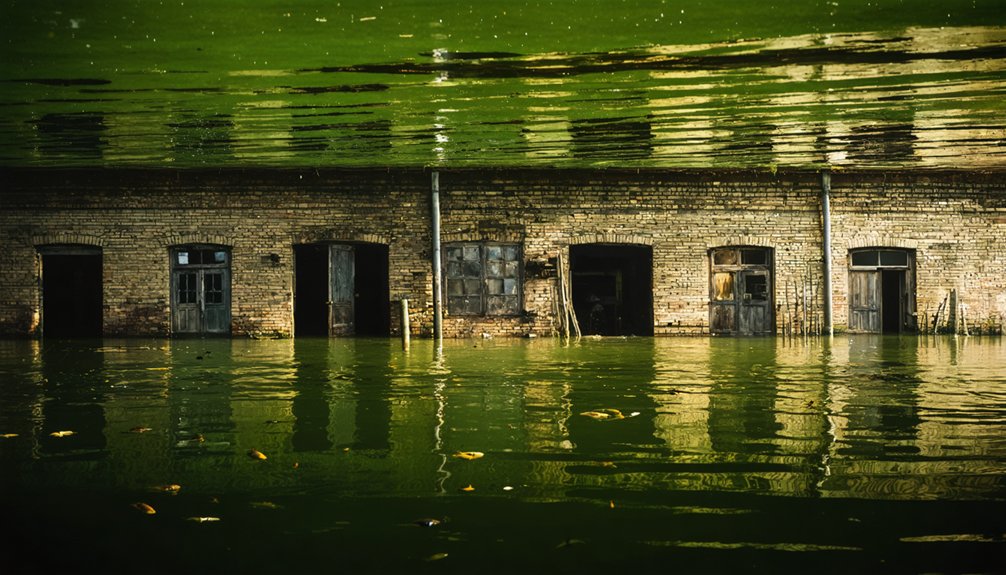
Beneath Lake Red Rock’s maximum depth of 55 feet, the physical remnants of six communities constitute a preserved archaeological landscape documenting mid-20th century floodplain settlement patterns.
You’ll find underwater artifacts and submerged architecture distributed across the lakebed, though most structures underwent demolition before the 1969 flooding.
Though demolished before inundation, architectural remnants and artifacts from six communities persist across Lake Red Rock’s submerged landscape.
The evidence remains:
- Foundation systems from Red Rock, Cordova, Dunreath, Fifield, Coalport, and Rousseau
- Five submerged cemeteries representing deliberate preservation of burial grounds
- Original street grids maintaining pre-flood community configurations
- Structural debris occasionally protruding above waterline, identifiable by roosting seagulls
Water clarity variations and seasonal depth fluctuations determine accessibility.
Low-water conditions periodically expose town layouts, while all-encompassing documentation requires scuba diving. You’re witnessing tangible evidence of communities sacrificed for flood control infrastructure.
The ghost towns of Indiana reveal stories of resilience and loss as nature reclaims what was once vibrant. Each remnant of these forgotten places serves as a reminder of the impact of human decisions on the landscape. Exploring these sites offers a haunting glimpse into the past and sparks curiosity about the lives once lived here.
Frequently Asked Questions
Can You Scuba Dive to See the Submerged Town Ruins Today?
You can scuba dive to explore the submerged ruins, though you’ll need proper certification and equipment. Follow diving safety guidelines carefully, as underwater archaeology sites present navigation hazards from former infrastructure. Legal restrictions aren’t clearly documented for recreational access.
Were There Any Deaths During the Rapid Flooding of the Lake?
No deaths occurred during the lake’s filling. Despite haunted legends and local folklore that embellish the story, you’ll find zero documented fatalities. The controlled, planned evacuation and systematic demolition guaranteed complete safety before inundation commenced in 1969.
What Happened to Residents Who Refused to Leave Their Homes?
No documented holdouts existed. You’ll find systematic property acquisitions preceded flooding, with residents’ nostalgia insufficient to override eminent domain protocols. All abandoned homes underwent demolition before submersion—technical records confirm zero non-compliant occupants remained during Lake Red Rock’s formation.
Are There Maps Showing Exact Locations of Submerged Town Structures?
You’ll find historical cartography through Iowa PBS and Rural History Buffs’ interactive maps, pinpointing submerged architecture locations. Marion County resources provide precise coordinates for all six towns’ foundations, though exact structure positions require bathymetric surveys for complete accuracy.
Has Drought Ever Lowered the Lake Enough to Expose Buildings?
Buildings won’t resurface from the depths—they’re demolished ghosts. Historical droughts haven’t exposed structures since all were razed pre-flooding. However, lake sedimentation and lowered pool levels have revealed foundation remnants and roadbeds you can explore.
References
- https://khak.com/six-buried-towns-lake-red-rock/
- https://www.onlyinyourstate.com/nature/iowa/lost-towns-lake-red-rock-ia
- https://www.survivingateacherssalary.com/off-the-beaten-path-the-lost-towns-under-lake-red-rock-iowa/
- https://www.youtube.com/watch?v=bnQDcZ9b-tw
- http://www.iowapbs.org/education/findiowa/media/9571/lost-towns-red-rock
- https://marioncountyiowa.gov/files/maps/lost_towns_of_lake_red_rock_rural_history_buffs_brochure_96639.pdf
- https://www.ruralhistorybuffs.org/lost-towns
- https://www.youtube.com/watch?v=ff2sKvaWLQ0
- http://mitchnichelsh.blogspot.com/2012/02/lake-red-rock-past-present-future.html
- https://www.notesoniowa.com/post/iowa-history-daily-september-6-rise-of-red-rock