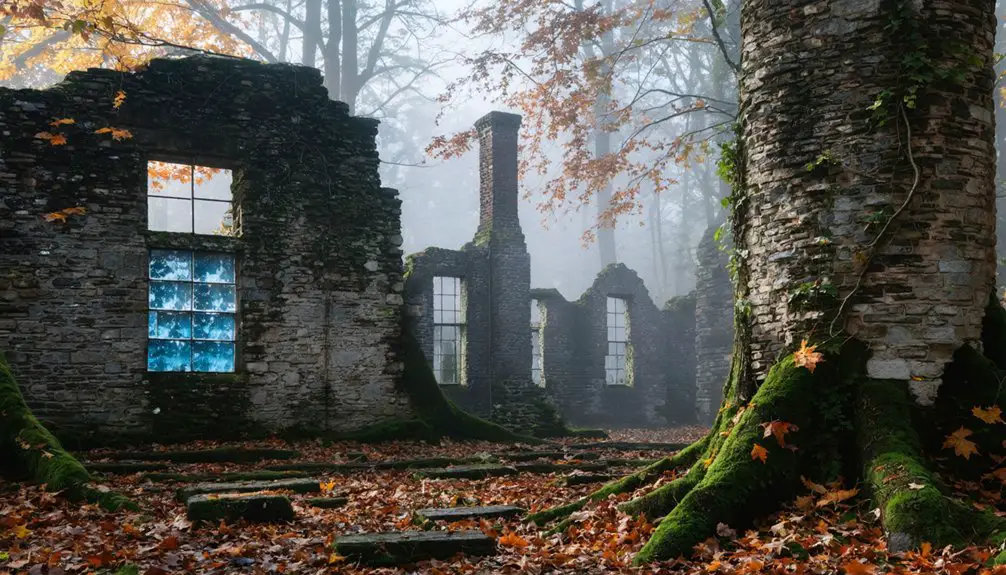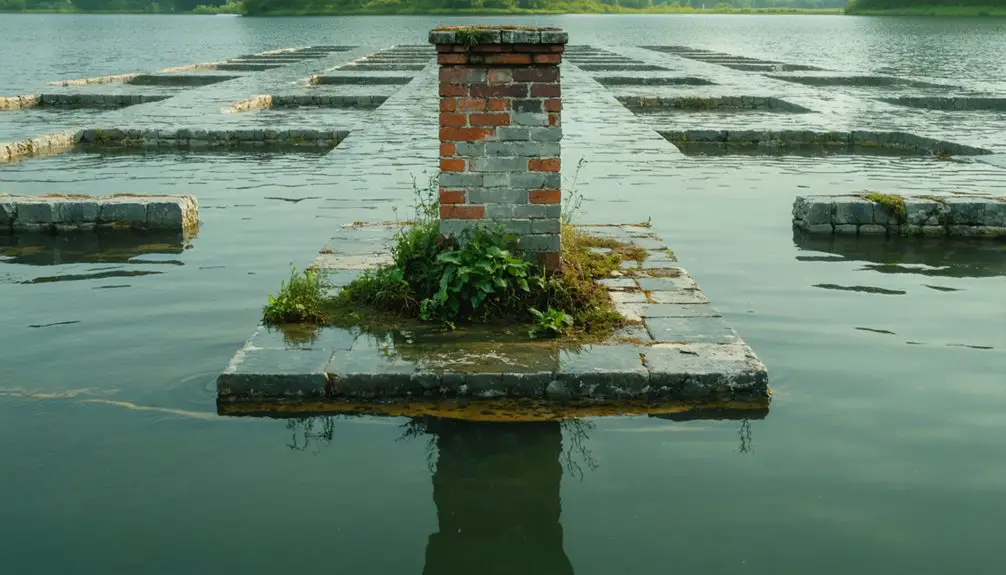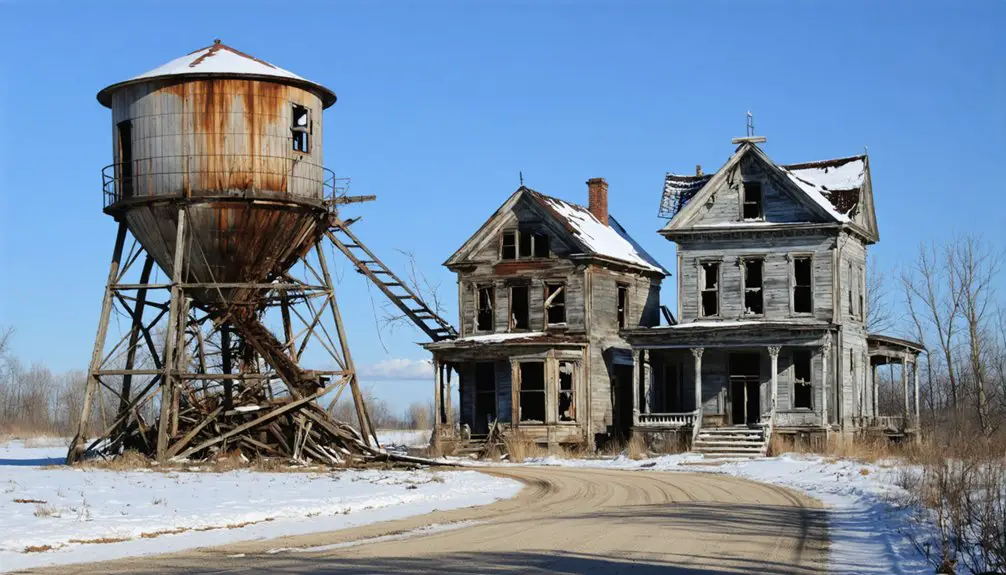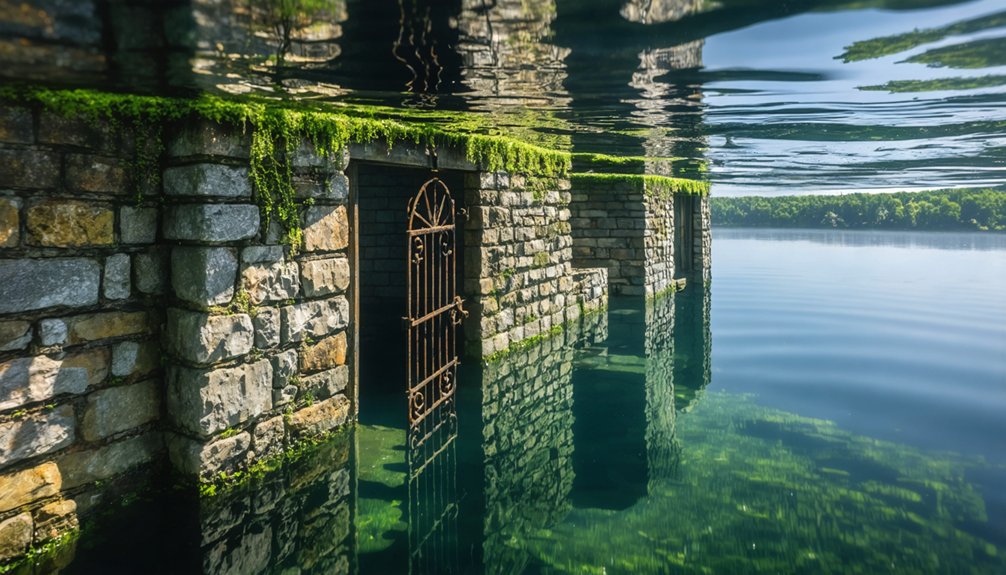
You’ll find four submerged towns—Enfield, Dana, Prescott, and Greenwich—beneath the Quabbin Reservoir in Massachusetts. Between 1933 and 1938, these Swift River Valley communities were systematically demolished under eminent domain, with all 3,400 residents relocated and 7,000 graves exhumed. The controlled destruction cleared 60,000 acres before flooding created an 82-acre reservoir storing 412 billion gallons, now serving 2.7 million people. Foundations and road traces remain visible on higher elevations, marking where these communities once thrived before Boston’s water demands sealed their fate.
Key Takeaways
- Four Massachusetts towns—Enfield, Dana, Prescott, and Greenwich—were demolished and flooded between 1933 and 1938 to create Quabbin Reservoir.
- The Swift River Valley communities housed 3,400 residents in 1850, declining to 2,400 by 1922 before forced displacement.
- All buildings were burned and demolished, with over 7,000 bodies exhumed and relocated to Quabbin Park Cemetery.
- The reservoir now covers 82 acres, storing 412 billion gallons of water for 2.7 million Massachusetts residents.
- Remnants like foundations and roads remain visible on higher elevations as physical markers of the submerged towns.
The Growing Demand for Water in Early Boston
As Boston’s population surged from 84,400 in 1840 to 192,318 by 1865, the city’s rudimentary water infrastructure buckled under unprecedented demand. You’ll find that daily consumption skyrocketed from projected estimates of 2.5-3 million gallons in 1834 to 17 million gallons by 1870.
Jamaica Pond’s polluted supply proved woefully inadequate, triggering epidemics that threatened public health. The 1848 Cochituate Aqueduct, designed for 10 million gallons daily, reached capacity within two decades as population growth accelerated. The system drew from Lake Cochituate, formed by impounding a tributary of the Sudbury River across a 17-square-mile watershed.
Per capita use climbed to 72 gallons daily—exceeding Philadelphia’s 56 and rivaling New York’s 70. Peak hourly demands of 160,000 gallons depleted night reserves. Boston’s 1825 report had initially suggested a minimum of 147.5 gallons per family for all uses, but actual consumption patterns soon exceeded early projections.
This water crisis forced authorities to seek distant sources, ultimately submerging entire communities beneath new reservoirs.
Four Towns Destined for Submersion
Boston’s desperate search for water supplies ultimately led officials 65 miles west to the Swift River Valley, where four small towns—Enfield, Dana, Prescott, and Greenwich—occupied the precise topographical basin required for reservoir construction.
Four towns stood exactly where Boston needed water—geography sealed their fate before any vote was cast.
These communities faced complete obliteration despite legal challenges to the Massachusetts Supreme Judicial Court.
The state’s exercise of eminent domain displaced approximately 2,500 residents who’d built their lives on farmlands and forests.
The sacrifice demanded total erasure of Cultural Heritage:
- All buildings systematically demolished between 1933-1938
- Deceased residents reinterred at Quabbin Park Cemetery
- Complete vegetation removal through strip-burning operations
- Final disincorporation executed April 28, 1938 at 12:01 a.m.
The Ecological Impact was absolute—60 hills vanished beneath 82 acres of engineered flooding, transforming inhabited valleys into Massachusetts’s largest inland water body.
Massive infrastructure including Windsor Dam and Goodnough Dike secured the valley’s boundaries, creating what became one of the world’s largest unfiltered water sources serving Boston’s growing population.
Dana, incorporated in 1801, had previously served as a popular rural summer destination for travelers seeking respite from urban life.
Life in the Swift River Valley Before the Flood
Before the reservoir’s construction, you’d have found 3,400 residents across the four valley towns in 1850.
Though this number declined to 2,400 by 1922 as land-taking discussions created uncertainty. The economy rested on agricultural foundations supplemented by approximately 14 mills producing textiles, hats, and wood products.
Enfield’s Swift River Company and Minot Manufacturing Company anchored the valley’s industrial output.
These communities maintained connectivity through the Athol Branch railway line and two state highways, enabling commerce despite their rural character. The Prescott Methodist Church later became the Prescott Museum and was relocated to New Salem to preserve the towns’ history.
The region had been home to the Nipmuc, who called the area “Qaben,” meaning “place of many waters,” before settlers acquired the land through grants in the 1740s.
Rural Communities and Population
The Swift River Valley‘s demographic trajectory reveals a classic pattern of rural New England decline that preceded the reservoir project by decades. You’ll find these four towns reached their zenith in 1850 with 3,400 residents, then hemorrhaged over one-third of their population by 1890.
The railroad’s arrival in the 1870s failed to reverse isolation, while industries relocated and farming became economically unviable against cheaper imported produce.
Key Population Indicators:
- 1900 baseline: Dana (790), Enfield (1,036), Greenwich (491), Prescott (380)
- 1922 decline: Populations plummeted as reservoir rumors chilled investment
Environmental impact: Natural resource extraction (soapstone quarries) shaped local economies.
Local folklore: Communities celebrated simplicity and natural beauty despite economic stratification.
The valley’s indigenous heritage stretched back millennia, as the Pocumtuck/Nipmuck Indians had inhabited the region since 4,000 BC, sustaining themselves through the area’s abundant game, fish, and crops. The geographic features of the valley, with its natural bowl enclosed by hills 400-600 feet high, would later prove ideal for damming and impoundment.
Economy and Daily Life
Small farms anchored the Swift River Valley‘s economy throughout the 19th century, though this agricultural foundation had already begun cracking decades before reservoir planners arrived.
You’ll find that Western competition had devastated local agriculture prices, forcing farmers to abandon properties rather than adapt.
Valley mills couldn’t compete with centralized urban factories accessible by rail, triggering industrial exodus long before official displacement.
Historical architecture housing these enterprises would vanish beneath the reservoir.
The 1927 Swift River Act collapsed property values instantly, freezing commercial investment.
Local merchants watched their customer base evaporate as families departed and uncertainty prevented expansion.
By the 1920s, the valley showed visible decline with unpaved roads and no electricity reaching most homes.
The region’s prosperity had earlier included diverse social and religious groups alongside local businesses and social clubs that defined community life.
Modern environmental efforts now preserve what documentation remains of this lost economic landscape, though the communities themselves dissolved years before floodwaters rose.
Legal Battles and Forced Relocation
When Maritime Underwater Surveys discovered a wrecked vessel off Wellfleet’s coast in November 1982—submerged beneath 14 feet of water and 5 feet of sand—the company couldn’t have anticipated the jurisdictional quagmire that would follow.
Their admiralty claim seeking title collapsed when courts upheld Commonwealth authority. Massachusetts asserted dominion through G.L. c. 6, § 180, declaring state ownership of all underwater archaeology meeting specific criteria: abandoned properties over 100 years old, valued above $5,000, or historically significant.
The regulatory framework now requires:
- Salvage permits from the Board of Underwater Archaeological Resources before any recovery operations
- Compliance with 312 CMR 2.0 standards governing exploration and excavation
- State oversight of all salvage activities in coastal waters
- Mandatory reporting of discovered resources to maintain non-public inventories
Federal admiralty law yielded to state sovereignty, fundamentally restricting salvage rights.
Clearing the Valley: Demolition and Preparation
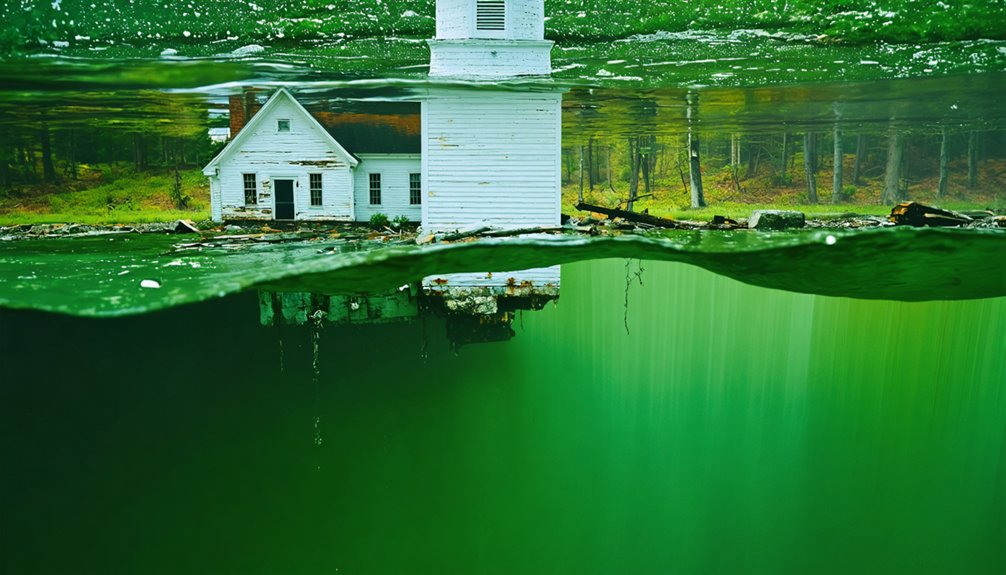
After legal proceedings concluded, you’d witness the systematic destruction of four complete towns between 1933 and 1938. Workers demolished 14 mills, dismantled the railway system, and razed every structure across 40,000 acres.
Most buildings burned rather than salvaged. The valley burned for months, leaving a barren moonscape stripped of all trees, topsoil, and vegetation before the 1939 flooding commenced.
Complete Demolition of Buildings
- Structures removed systematically across all four towns, creating deliberate destruction.
- Cellars remained intact underground, serving as permanent markers of lost communities.
- Some Dana buildings on higher elevations survived, maintaining physical evidence.
- Original roadways remained traceable to reservoir’s edge, preserving access patterns.
This engineering approach prioritized water purity over cultural preservation, eliminating citizens’ property rights through eminent domain authority.
Burning the Barren Landscape
Following the systematic demolition of structures across the Swift River Valley, the Metropolitan District Water Supply Commission implemented an extensive burning protocol to eliminate all remaining organic material from the landscape. You’ll find that controlled fires consumed stripped farmland, cleared vegetation, and debris remnants across Dana, Enfield, Greenwich, and Prescott.
This scorched-earth approach erased centuries of Cultural Heritage, transforming inhabited valleys into barren ground suitable for impoundment.
The burning operations preceded the seven-year filling period beginning in 1935, ensuring no organic interference would contaminate your future water supply.
Today, these fires complicate Archaeological Discoveries beneath Quabbin Reservoir—the intentional destruction eliminated physical evidence of settlement patterns, making underwater documentation nearly impossible.
What survives exists only through historical records and memories of displaced communities.
Building the Dams That Changed Everything
When the Massachusetts General Court established the Metropolitan Water Board in 1895, engineers identified the Swift and Ware river watersheds as essential sources for Boston’s growing water demands.
By 1927, Chief Engineer Frank E. Winsor initiated construction of infrastructure that would forever alter the landscape. The engineering challenges demanded innovative solutions: Winsor Dam became the largest earth-filled dam east of the Mississippi, standing 295 feet high and stretching 2,640 feet.
Key construction achievements:
- Hydraulic fill method deposited embankment material through flowing water streams
- Goodnough Dike extended protection over 2,000 feet alongside Winsor Dam
- Maximum water depth reached 150 feet behind the dam structure
- Two baffle dams and regulating structures controlled water routing
The ecological impact was irreversible—your freedom to inhabit these valleys disappeared as 60,000 acres vanished beneath engineered necessity.
The Flooding Process and Final Submersion
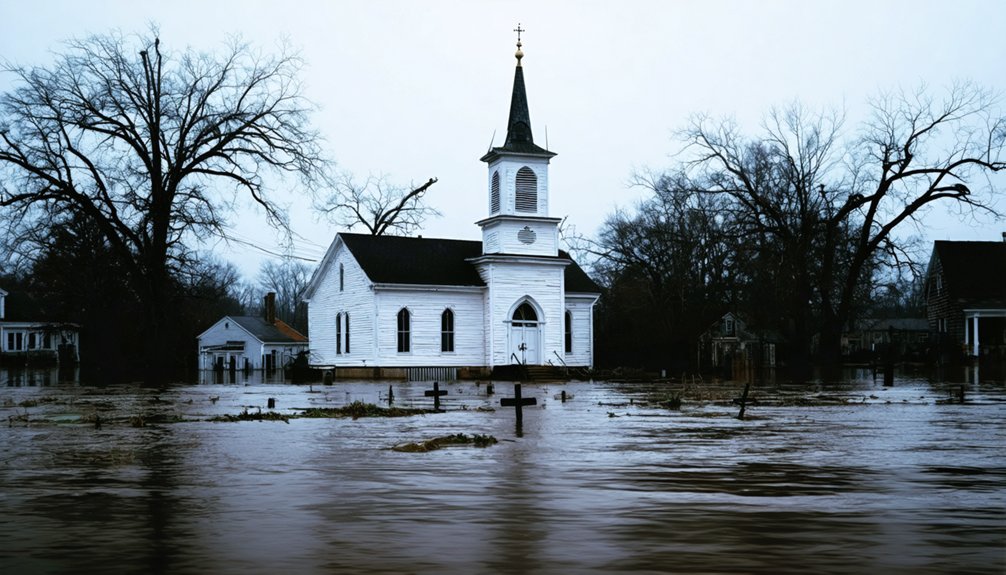
By 1926, engineers had constructed a tunnel connecting the Wuset Reservoir to the Ware River, initiating the systematic diversion that would drain the Swift River Valley and prepare it for its transformation into Massachusetts’ largest inland body of water.
Following dam completion in April 1935, the seven-year filling period began—a gradual submersion engineers couldn’t fully predict. Topographical changes reshaped the landscape as water claimed Route 21 by 1939, severing connections between Belchertown, Enfield, and Dana.
The environmental impact proved irreversible. Over 7,000 bodies were exhumed and relocated to Quabbin Cemetery in Ware, while demolition crews systematically razed structures to prevent underwater debris.
How the Quabbin Reservoir Serves Massachusetts Today
The sacrifice of four Swift River Valley towns created Massachusetts’ most essential water infrastructure asset. You’re looking at infrastructure that prevents urban expansion from compromising water security for 2.7 million residents across greater Boston.
The reservoir’s 412 billion gallons deliver pristine drinking water through stringent quality monitoring by DCR and MWRA.
Critical Infrastructure Specifications:
- 39 square miles of surface area with 181 miles of protected shoreline
- Daily water level monitoring and continuous data archiving since 2005
- All-encompassing watershed management protecting water transparency and purity
- Zero participation from watershed communities in MWRA allocation decisions
You’ll find this remains Massachusetts’ largest inland water body, yet drought conditions recently dropped levels more than 10 feet below capacity—demonstrating why those displaced communities matter to your water supply today.
Remnants and Remembrance of Lost Communities
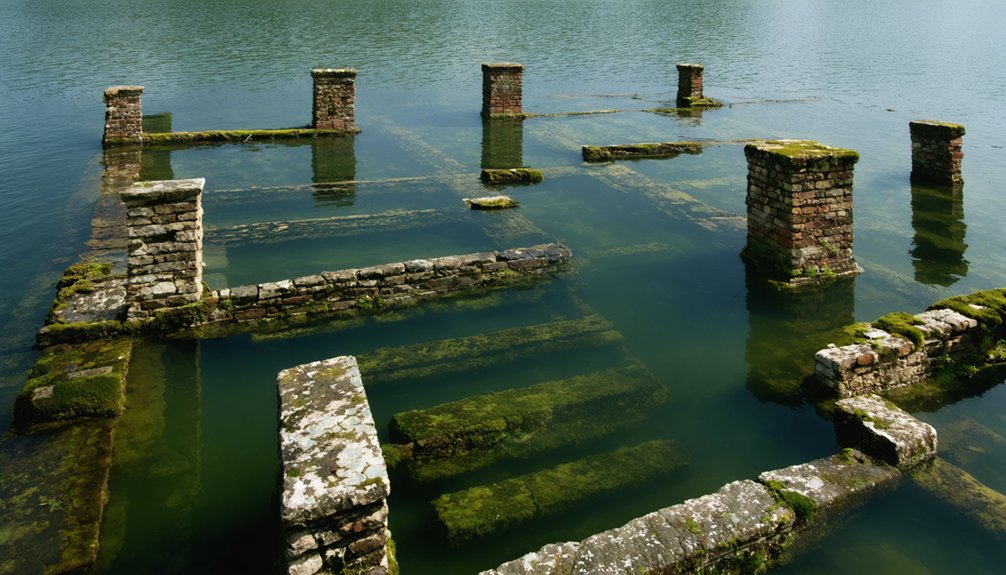
Beneath the reservoir’s surface and along its protected shoreline, physical evidence of four dissolved communities persists through cellar holes, traceable road networks, and transformed geography.
You’ll find Prescott Peninsula where Prescott Ridge once stood, while approximately 60 submerged peaks remain hidden underwater. The Massachusetts Department of Conservation and Recreation maintains accessible trails where Dana’s streets connected neighbors—now serving as pathways to ancient artifacts and foundations that survived demolition crews in the 1930s.
At Quabbin Park Cemetery in Ware, 7,613 relocated graves honor displaced residents, while memorial plaques document what 2,500 citizens sacrificed.
Though no underground tunnels connected these communities, descendants preserve photographic archives, ensuring the involuntary displacement of 1938 remains documented—a testament to individual liberty’s fragility when state infrastructure demands compliance.
Frequently Asked Questions
Can You Scuba Dive or Explore the Submerged Towns Underwater Today?
You can’t scuba dive there—Massachusetts bans it to protect water quality for Boston’s drinking supply. Underwater archaeology remains off-limits, and scuba diving safety concerns take precedence. You’ll find access strictly restricted to preserve this essential resource.
What Happened to the Schools and Churches From the Four Towns?
Swept away like sandcastles, you’ll find no historical preservation succeeded—authorities demolished all schools and churches before flooding. Zero architectural remnants survived the systematic razing; the state relocated cemeteries but erased these institutional buildings entirely by 1939.
Are There Any Ghost Stories or Paranormal Reports About the Flooded Towns?
Haunted legends circulate locally, but no documented spectral sightings exist. The New England Legends Podcast explores possible “haunts” from displacement trauma, yet verifiable paranormal reports remain absent. You’ll find folklore overshadows evidence in this preservation story.
How Much Money Did Residents Receive as Compensation for Their Properties?
You’d receive fair-market value through the compensation process if you sold voluntarily. Property valuation reflected 1930s prices when officials acquired homes. However, if you refused, eminent domain forced sales. Businesses received nothing—a stark loss of autonomy.
What Wildlife and Fish Species Now Inhabit the Quabbin Reservoir?
You’ll find diverse aquatic ecosystems thriving in underwater habitats: lake trout, brown trout, rainbow trout, landlocked salmon, smallmouth bass, largemouth bass, chain pickerel, yellow perch, and bluegill—all supported by preserved coldwater and warmwater zones.
References
- https://wokq.com/massachusettss-largest-lake-has-4-ghost-towns-underneath-it/
- https://wbsm.com/massachusetts-town-dana-hiking-trail/
- https://app.ar-tour.com/guides/stories-of-submerged-towns-1/the-lost-towns-of-quabbin-valley.aspx
- https://www.youtube.com/watch?v=sZGMqwtMeLw
- https://en.wikipedia.org/wiki/Quabbin_Reservoir
- https://www.bwsc.org/sites/default/files/2023-02/History of the Water and Sewer Works of the City of Boston 1630-1978.pdf
- https://www.mwra.com/your-water-system/water-system-history
- https://www.mwra.com/sites/default/files/2023-11/040314-water-history-umass.pdf
- http://www.waterworkshistory.us/tech/consumption.htm
- https://www.bwsc.org/sites/default/files/2023-02/The Water Supply System of Metropolitan Boston – 1845-1947 – MDC – 1985.pdf