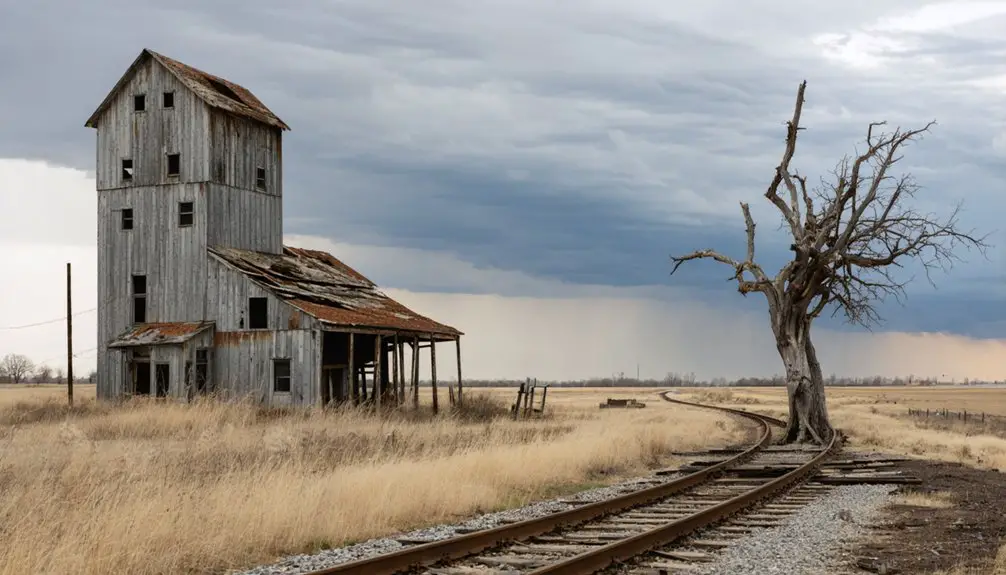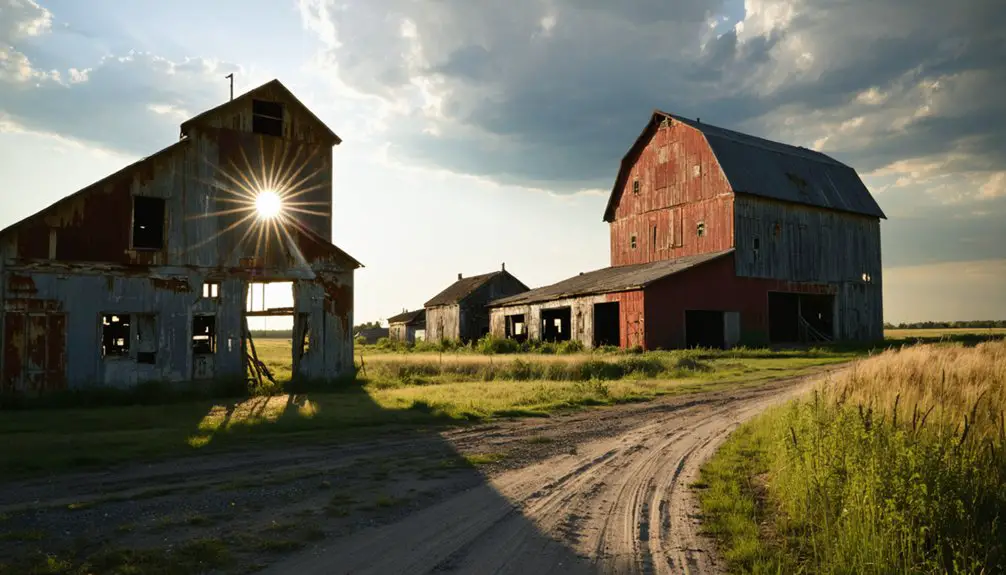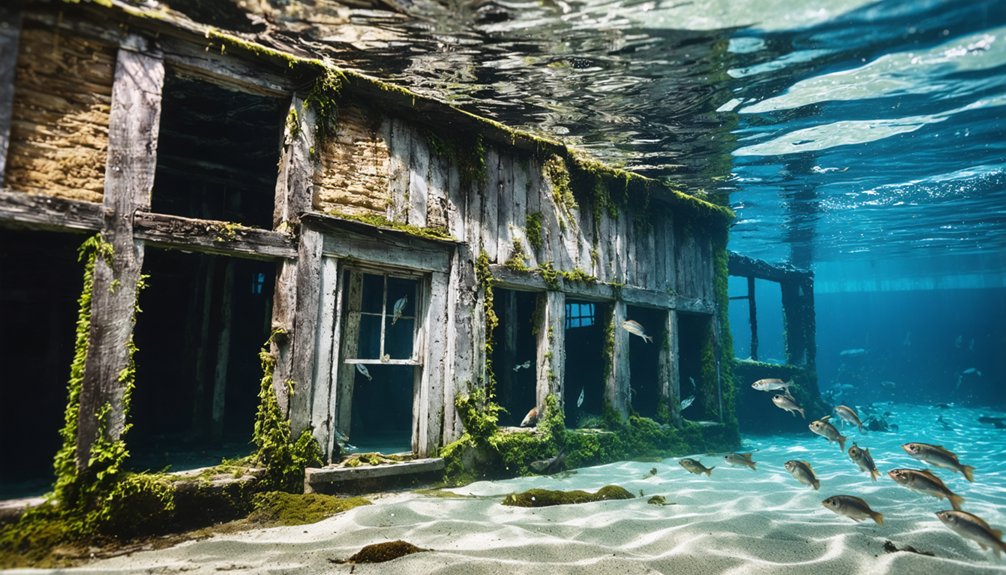
Minnesota’s underwater ghost towns emerged from a combination of catastrophic flooding and economic collapse along the Minnesota River Valley. You’ll find submerged remnants of San Francisco, Minnesota—a former county seat platted in 1854 that vanished after the 1863 floods—and Carver Rapids, once a steamboat terminal now beneath the Minnesota Valley National Wildlife Refuge. Tazaska’s 524 burial mounds near Lake Minnetonka mark another lost settlement, while Bloomington Ferry disappeared after infrastructure changes in the 1890s. These sites preserve archaeological evidence accessible through interpretive trails and underwater exploration that reveals the region’s volatile settlement patterns.
Key Takeaways
- Carver Rapids, a former 1852 steamboat terminal, now lies submerged within the Minnesota Valley National Wildlife Refuge with accessible interpretive trails.
- San Francisco, Minnesota, platted in 1854, was abandoned after 1863 floods; archaeological remnants and underwater wrecks remain beneath farmland and lakes.
- Tazaska, proposed as territorial capital in 1857, declined by the 1890s and now exists as submerged ruins with underwater wrecks.
- Major floods in 1863, 1952, and 1965 caused town abandonments, transforming communities like Lilydale and Little Italy into submerged archaeological sites.
- Underwater archaeology at Lake Minnetonka reveals well-preserved mining-era artifacts, with scuba excursions accessing submerged ghost town remnants.
Carver Rapids: Where the Minnesota River Forced a Bustling Stop
When Glacial River Warren retreated over 10,000 years ago, it carved the Minnesota River Valley into existence, depositing layers of clay, sand, gravel, and fine silt across what would become Carver County.
You’ll find Carver Rapids where hard limestone outcroppings resisted erosion—the old channel bypassed this area 1.5 miles northeast, leaving the rock intact. This geological barrier created a two-foot fall at Little Rapids’ Jordan sandstone ledge, with another foot-drop upstream.
Low water exposed these ledges, blocking river navigation entirely. Higher stages submerged them, allowing passage.
This natural bottleneck determined Carver’s 1852 founding as a strategic steamboat terminal. The town served commercial traffic between navigable sections until railroads arrived in 1871. Steamboat traffic had peaked between 1855-1865 before rail transport offered faster alternatives. The community’s name appears across multiple references in regional history, from geographical designations to commemorative uses.
Today, historic landmarks including St. Nicholas Catholic Church stand as evidence of this forced-stop economy.
San Francisco’s Brief Reign as County Seat
You’ll find San Francisco platted strategically below Carver Rapids on the Minnesota River, where it served as the county seat until 1856.
The town’s administrative status ended when Minnesota territorial authorities relocated the seat following documented governance challenges and jurisdictional disputes.
Recurring seasonal flooding from the Minnesota River ultimately submerged the settlement’s remaining structures, erasing physical evidence of its brief institutional role.
Similar to the 1906 San Francisco earthquake that caused extensive regional damage and infrastructure loss in California, natural forces proved decisive in the town’s abandonment.
The settlement shared its name with the California city that experienced rapid population growth from 1,000 to 25,000 residents between 1848 and 1849.
Platted Below Carver Rapids
In 1854, William Foster—a Pennsylvania-born carpenter and Donner Party survivor—platted a village along the Minnesota River’s Carver Rapids, approximately 30 miles southwest of Minneapolis at coordinates 44°41′52″N 93°42′08″W.
He positioned the settlement in south-eastern Carver County, directly across from a major fur trading post. Foster named it after San Francisco, California, where he’d worked before venturing west.
First settlers arrived that year, including the Bevens brothers, Marvin White, William Sanford, Thomas Wells, Louis Stevenson, and John Chilstrom.
The settlement initially served as the county seat, but flooding and other issues prompted officials to relocate governmental functions to Chaska in 1856.
Today’s archaeological findings reveal minimal structural remnants—a township hall converted from a schoolhouse, scattered farmland, parkland, and one abandoned farmhouse. The California city that inspired the name had transformed from Yerba Buena just seven years earlier in 1847, shortly after becoming American territory.
These sites now support wildlife habitats where spring floods once destroyed commercial infrastructure, fundamentally altering the landscape’s human occupation patterns.
County Seat Loss 1856
Although William Foster’s riverside settlement attracted early pioneers, its viability as Carver County’s administrative center proved remarkably short-lived. You’ll find the first board of county commissioners convened at San Francisco in 1855, utilizing Foster’s warehouse for official proceedings. However, this urban planning achievement dissolved rapidly when voters reassessed their administrative needs.
The October 14, 1856 general election documented San Francisco’s decline through three critical metrics:
- Total voter participation: 525 ballots cast countywide
- Chaska support: 303 votes favoring relocation
- Decision timeline: County seat transferred within months
Chaska’s superior accommodations eclipsed San Francisco’s rudimentary infrastructure.
This historical preservation case study demonstrates how frontier communities depended on practical advantages rather than geographical priority. Minnesota’s San Francisco became a consolidated city-county in the same year it lost its administrative function, paradoxically achieving municipal status at the moment of its decline. Following the county seat relocation, spring floods accelerated the settlement’s final abandonment. You’re witnessing authentic governance mobility—administrative centers shifted wherever citizens demanded functional efficiency over sentimental attachment.
Flooding Destroyed the Town
Within seven years of San Francisco’s establishment, the Minnesota River’s 1863 spring floods obliterated the settlement that had briefly served as Carver County’s administrative hub.
You’ll find no evidence of flood mitigation strategies in the township’s planning—Foster’s carpenter-founded community simply positioned itself directly along rapids without elevation protection.
The downtown district sat vulnerable at river level while higher ground remained undeveloped several hundred feet above.
This catastrophic failure of settlement resilience destroyed commercial infrastructure and forced complete abandonment.
The mile-wide chasm carved by ancient glacial overflow should’ve warned planners, yet they’d built across from a fur trading post in flood-prone bottomlands.
Spring surges devastated everything.
Historical flood patterns throughout the region demonstrated how rapid river rises could transform landscapes within hours, as seen when the Black River rose 25 feet in 1847 before receding within a single day.
Today, you’re looking at farmland and federally protected parkland where Minnesota’s shortest-lived county seat once stood.
Taconite Harbor: The Company Town That Disappeared in a Generation
The Erie Mining Company constructed Taconite Harbor during the 1950s as a purpose-built company town to house workers operating a taconite loading facility on Lake Superior’s North Shore. Twenty-two prefabricated homes arrived in 1957, creating a self-contained settlement that processed 10-11 million tons of taconite pellets annually through the Great Lakes’ fastest ore-loading dock.
Industrial decline devastated this autonomous community within three decades. The operational timeline reveals:
- Peak prosperity (mid-1950s to mid-1980s): 20-22 occupied homes with complete civic infrastructure
- Economic collapse (early 1980s): Workforce reduction to 100 employees triggered mass departures
- Complete abandonment (1988): LTV Steel Mining terminated residency, initiating community relocation
You’ll find minimal remnants today—deteriorating roads, singular streetlight, basketball court foundations—marking where an entire generation built and abandoned their industrial homeland. The Cross River Heritage Center in Schroeder now preserves the community’s history through exhibits and reunions, keeping alive memories of the red taconite dust that once colored daily life in this vanished settlement.
Tazaska: The Lake Minnetonka Settlement Lost to History

You’ll find Tazaska’s origins in an 1857 proposal by Civil War sharpshooter William F. Russell, who petitioned Colonel Stevens to designate this northwest Crystal Bay location as Minnesota’s territorial capital through public referendum.
The settlement occupied what’s now the Lafayette Club site on Lake Minnetonka’s “Big Peninsula,” platted during the period when steamboat access and railroad expansion drove resort development across the lake’s shores.
Unlike neighboring communities such as Excelsior (1853) and Wayzata (1854), Tazaska failed to sustain economic viability beyond the 1890s resort decline, leaving no physical remnants after the shift to private estates erased its footprint.
Early Recognition and Platting
- 524 mapped burial mounds along the lakeshore.
- Dating range from 300 BCE to 100 CE.
- Third-largest concentration in Minnesota after Lake Mille Lacs and Red Wing Valley.
Governor Alexander Ramsey officially designated the lake “Minnetonka” in 1852, marking the transformation from sacred Dakota territory to settler landscape.
Geographic Location and Layout
Approximately fourteen miles west of Minneapolis, Lake Minnetonka’s 14,500 acres of irregular shoreline concealed the settlement of Tazaska within its Upper Lake section near present-day Mound.
You’ll find this location positioned along the north shore, strategically situated between Wayzata and Excelsior on opposing banks. The lake topography reveals multiple peninsulas, bays, and islands—geographical features that initially earned it the designation “Peninsula Lake.”
Shoreline features include Spirit Knob peninsula and Enchanted Island, both holding ceremonial significance for the Mdewakanton Dakota.
Tazaska occupied territory transferred through the 1851 Treaty of Mendota, encompassing two million acres.
Today, the settlement’s physical remnants rest on the lake bottom alongside 48 documented wrecks, preserved by cold freshwater conditions that maintain underwater artifacts in pristine archaeological states.
Economic Collapse and Disappearance
While Tazaska’s exact founding date remains undocumented, the settlement’s emergence coincided with the broader Euro-American occupation of Lake Minnetonka’s shores following the 1851 Treaties of Traverse des Sioux and Mendota.
The settlement’s economic decline accelerated when the 1867 railroad terminus established at Wayzata redirected commercial traffic and tourist infrastructure away from smaller lakeside communities.
Tazaska’s transformation into a ghost town resulted from three critical factors:
- Railroad accessibility concentrated development at Wayzata, eliminating economic viability for peripheral settlements
- Tourism infrastructure investment bypassed agrarian communities lacking direct rail connections
- Resort economy displacement of farming eliminated traditional livelihood sustaining isolated settlements
You’ll find no physical remnants of Tazaska today—the waters reclaimed what economic forces abandoned, leaving only fragmentary historical records documenting its brief existence.
Bloomington Ferry: When the Bridge Made the Town Obsolete
The Bloomington Ferry crossing exemplifies how infrastructure replacement can erase entire settlement patterns from the landscape. You’ll find that historical ferry routes along the Minnesota River evolved from Native American crossings used for centuries before European settlement.
When Joseph Dean and William Chambers established a formal ferry in 1853, speculators promoted the “Town of Bloomington on the Minnesota” in 1857, anticipating growth around this critical river crossing.
The steamboat landing operated from 1860 to 1890, serving settlers staking claims since 1852.
However, the 1892 drawbridge rendered the ferry obsolete, eliminating the settlement’s primary economic function.
By 1996, engineers relocated US 169 upstream, bypassing the original crossing entirely.
You can’t find physical evidence of this once-vital community today—infrastructure evolution erased its existence.
Banning’s Sandstone Legacy in State Park Ruins
Unlike Bloomington Ferry’s gradual obsolescence, Banning emerged and vanished within two decades as a pure extraction economy.
You’ll find this ghost town’s sandstone preservation within what became a 6,237-acre state park, where quarry relics mark Minnesota’s industrial archaeology.
After the St. Paul and Duluth Railroad connected the outcrop in 1892, 500 workers extracted pink sandstone blocks until depletion by 1905.
The settlement’s rapid trajectory reveals extractive capitalism’s pattern:
- 1896-1900: Village platted, incorporated, peaked at 300 residents
- 1894-1912: Great Hinckley Fire losses, repeated blazes accelerated decline
- 1963-present: Legislative transformation from historical site to full state park
Today you’ll observe drill holes blasted into rock walls along the Kettle River’s 1.5 miles of Class IV rapids, where nature reclaimed what industrial demand abandoned.
Flooding: The Common Enemy of Minnesota River Towns
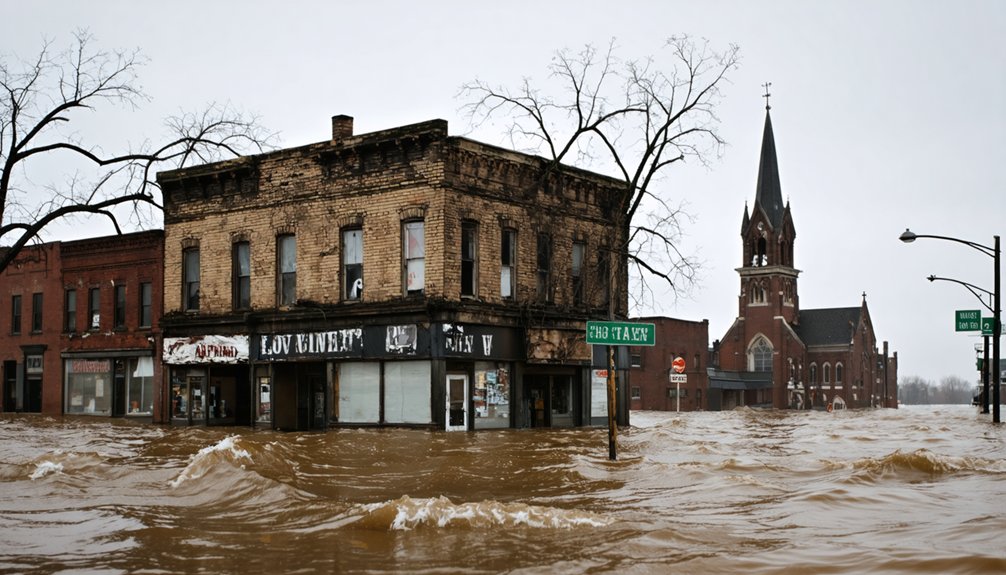
The Minnesota River Valley‘s geological formation created extensive floodplains susceptible to catastrophic inundation, with documented flood events dating to 1863 demonstrating the recurrent pattern of settlement displacement.
Historical records show major floods in 1881, 1908, 1916, 1951, and the 1965 “flood of record,” with subsequent events in 1969, 1993, 1997, 2001, and 2024 forcing permanent abandonment of low-lying settlements.
You’ll find that towns like Henderson, which experienced a 31.4-foot crest in 1965, required engineered levee systems to survive, while communities lacking infrastructure investment faced systematic depopulation and eventual ghost town status.
Swampy Valley Geography
Between 11,700 and 9,400 years ago, the catastrophic drainage of glacial Lake Agassiz carved the Minnesota River Valley into a geological anomaly: a massive trench reaching 5 miles wide and 250 feet deep, dwarfing the modest river that flows through it today.
This glacial erosion created ideal conditions for extensive wetland development through three distinct mechanisms:
- Shallow lake basins and potholes formed in depressions throughout the 487,015-acre Prairie Parkland ecoregion.
- Organic and mineral soils developed with water tables at or near surface, supporting wetland succession from shrub species (alder, willow, dogwood) to wooded swamps (tamarack, black ash, northern white cedar).
- Springs and seeps emerged from bluff bases, creating permanent moisture sources.
You’ll find Louisville Swamp exemplifies these bottomland features today.
1863 Flood Devastation
Glacial geology created Minnesota River Valley’s distinctive morphology, but seasonal hydrology determined which settlements would survive.
You’ll find Henderson’s 1965 crest at 31.4 feet forced 285 evacuations from 95 homes, establishing the flood of record. Historical flood mapping reveals cyclical devastation: 1881, 1908, 1916, 1951, culminating in 1965’s unprecedented discharge.
Floodplain agriculture amplified exposure when development sprawled across both riverbanks.
Granite Falls suffered 11.3 feet above stage in 1997, then 7.3 feet in 2001, compounding infrastructure losses.
June 2024’s stalled boundary dropped 8-10 inches across southern basins, pushing Henderson beyond its 1965 benchmark.
Large-scale floods average every 15 years, with clusters during 1951-52, 1965, 1969, and 1993.
Communities couldn’t withstand this hydrological assault pattern without federal intervention.
Abandoned Flood Plains
When flooding transformed from seasonal nuisance to existential threat, Minnesota River communities faced systematic abandonment of their most vulnerable neighborhoods.
You’ll find three distinct patterns of urban abandonment across these floodplains:
- Lilydale’s complete evacuation followed devastating 1952 and 1965 floods, with residents relocating by the late 1970s for park development.
- Little Italy’s forced exodus after 1952 waters devastated the Upper Levee neighborhood, closing schools and creating a Superfund site.
- Blaisdell Lake’s residential removal in the late 1980s converted failed housing developments into Bancroft Meadows open space.
These deliberate retreats from floodplain agriculture and residential zones represent rational responses to hydrological reality.
Communities chose strategic withdrawal over perpetual reconstruction, reclaiming dangerous areas as natural buffers rather than contested human territory.
Economic Downturns That Drowned Prairie Dreams
Minnesota’s ghost towns emerged primarily from economic collapse rather than natural disaster, with flooding serving as the final blow to communities already weakened by failed business models.
You’ll find Carver Rapids exemplifies this pattern—founded in the 1850s to serve steamboat passengers managing shallow rapids, it generated temporary revenue through hotels and restaurants. However, erosion hazards from the swampy Minnesota River Valley destroyed infrastructure repeatedly, accelerating settlement abandonment by 1860.
San Francisco faced identical circumstances when the county seat relocated to Chaska in 1856, eliminating visitor traffic. The 1863 flood washed away its warehouse and buildings, but consistent flooding merely prevented rebuilding an already economically defunct community.
These weren’t drowning victims—they were corpses the water claimed.
From Thriving Communities to Reclaimed Wilderness
Before European settlers arrived in the Minnesota River Valley during the 1850s, Sisseton and Wahpeton Dakota maintained a substantial village near Carver Rapids for millennia—a site that would later host one of Minnesota’s most short-lived European settlements.
San Francisco, Minnesota’s cultural heritage now lies beneath farmland, representing a pattern of rapid abandonment across the state. The archaeological significance of these ghost towns reveals three distinct phases:
- Initial prosperity (1850s-1860s): Steamboat traffic, hotels, schools, and elected officials
- Environmental catastrophe: Flooding destroyed infrastructure in 1863, forcing population exodus
- Natural reclamation: Private farmland absorbed the townsite within a decade
Similar trajectories occurred at Taconite Harbor (abandoned 1990), Banning State Park’s quarry town (declined post-1912), and Rice Lake’s logging settlements—all returning to wilderness after economic collapse.
Visiting the Remnants: What’s Left to Explore Today
Though decades or centuries have passed since Minnesota’s ghost towns thrived, physical evidence remains accessible across five distinct sites that offer varying levels of historical interpretation and visitor infrastructure.
Minnesota’s abandoned settlements preserve tangible history through accessible sites featuring reconstructed structures, underwater artifacts, and marked trails documenting frontier and industrial heritage.
You’ll find Carver Rapids within Minnesota Valley National Wildlife Refuge, where glacial terraces frame San Francisco’s remnants. Old Wadena Historic Park provides reconstructed buildings and interpretive displays documenting trade settlement patterns. Bohemian Flats‘ riverside location offers markers and trails where immigrant communities once flourished.
Cuyuna and Mesabi mine pit lakes enable underwater archaeology through guided scuba operations, where you’ll observe preserved mining-era artifacts in freshwater environments. Grey Cloud Island Kiln requires watercraft access due to private land restrictions.
River conservation efforts now protect these sites while maintaining public access for historical documentation and recreational exploration.
Frequently Asked Questions
Are Any Minnesota Ghost Towns Actually Submerged Underwater Today?
You won’t find Minnesota ghost towns permanently submerged today. Historic preservation efforts protect sites like Carver Rapids above water, though underground secrets remain hidden beneath seasonal floods. These locations experience periodic inundation rather than complete submersion.
In contrast, there are abandoned towns submerged in Illinois that tell haunting stories of relocation and lost history. Some of these forgotten places can still be traced on maps, while others lie completely concealed under lakes created by dam projects. The eerie silence of these underwater ghost towns invites curiosity and speculation about the lives once lived there.
Can Scuba Divers Explore Underwater Ruins of These Abandoned Towns?
Like searching for treasure in an empty vault, you’ll find no scuba diving opportunities at Minnesota’s ghost towns—none are actually submerged. Underwater exploration isn’t possible here, and scuba safety protocols don’t apply to these land-based historical sites.
Do Any Ghost Town Structures Remain Visible Beneath Lake Surfaces?
You’ll find structures remain visible during drought conditions when water levels drop. Historical artifacts like pottery fragments and foundations surface periodically, though local legends often exaggerate preservation quality. Most ruins stay submerged except during rare low-water events.
Were Bodies or Cemeteries Relocated Before Towns Were Flooded?
You’ll find no exodus of the departed here—these ghost towns weren’t drowned deliberately. Historical land surveys reveal natural floods, not flood control measures, scattered populations. No evidence exists of cemetery relocations; nature reclaimed these sites without reservoir creation or engineered inundation.
Which Minnesota Reservoirs or Lakes Cover Former Town Sites?
You’ll find Carver Rapids Ghost Town beneath Rapids Lake Unit, where historical preservation efforts protect the 1860s steamboat settlement. Environmental impact from Minnesota River flooding naturally submerged this site, unlike North Dakota’s reservoir-flooded towns with relocated cemeteries.
References
- https://www.fws.gov/story/ghost-town-carver-rapids
- https://www.cascadevacationrentals.com/6953/taconite-harbor-a-ghost-town/
- https://www.minnesotahistory.org/post/a-complete-guide-to-the-ghost-towns-of-hennepin-county
- https://www.carvercountyhistoricalsociety.org/ghost_towns.php
- https://www.cbsnews.com/minnesota/news/how-a-ghost-town-was-turned-into-a-minnesota-state-park/
- https://quickcountry.com/minnesota-ghost-towns/
- https://www.mnhs.org/mnopedia/search/index/place/ghost-towns-carver-county
- https://wjon.com/benton-co-history-the-ghost-town-of-watab/
- https://thievesriver.com/blogs/articles/ghost-towns-in-minnesota
- https://lowermnriverwd.org/waterandnaturalresources/rivers-and-streams/minnesota-river