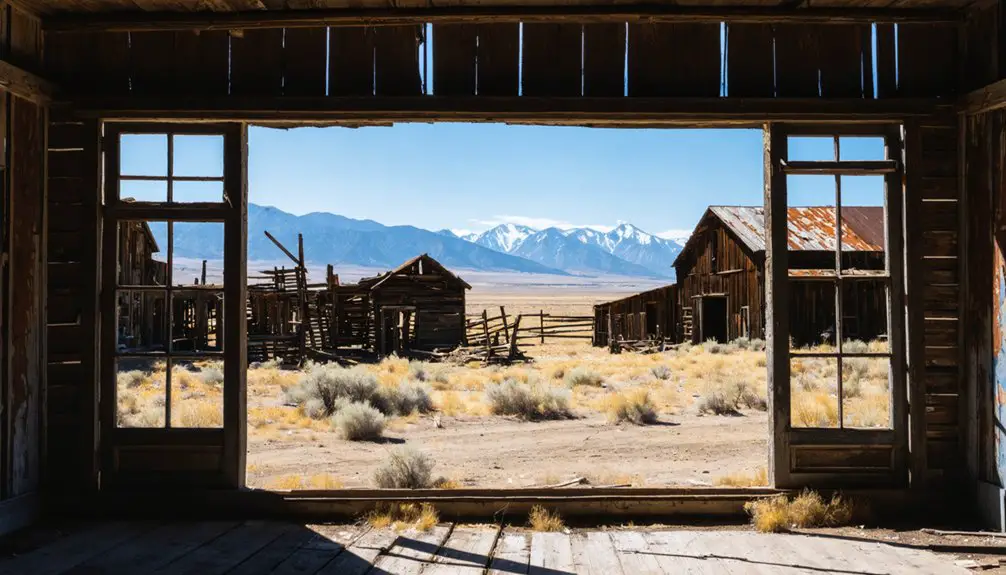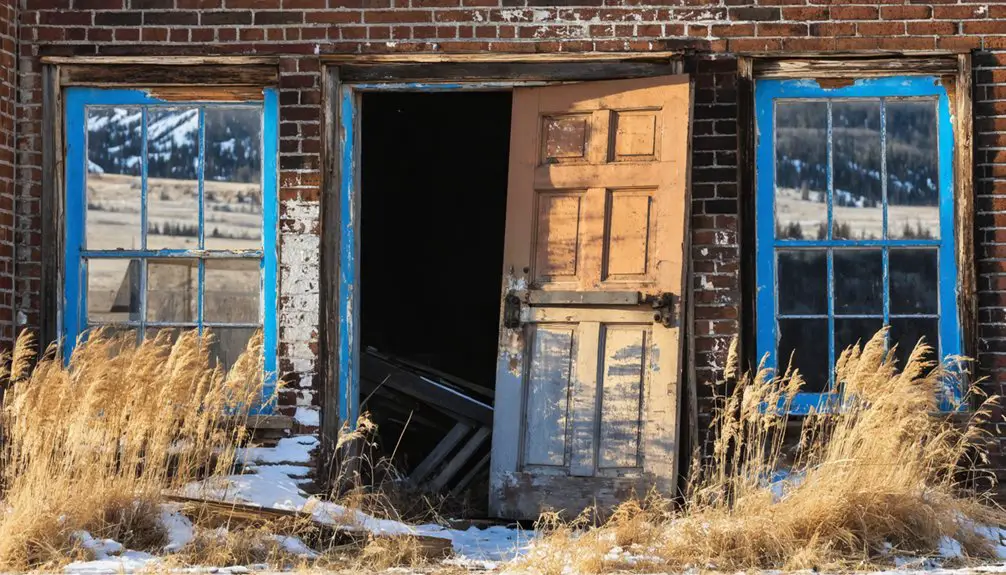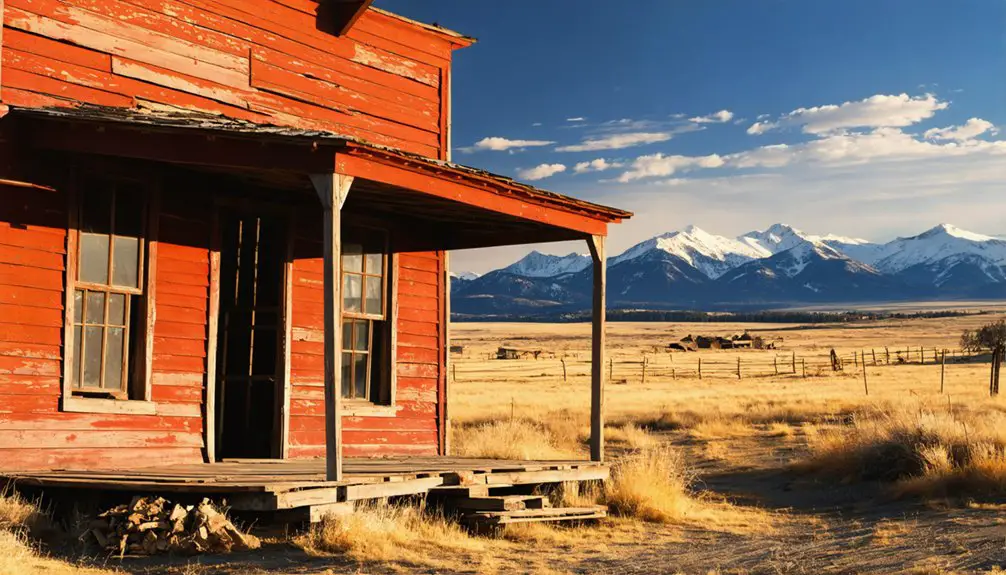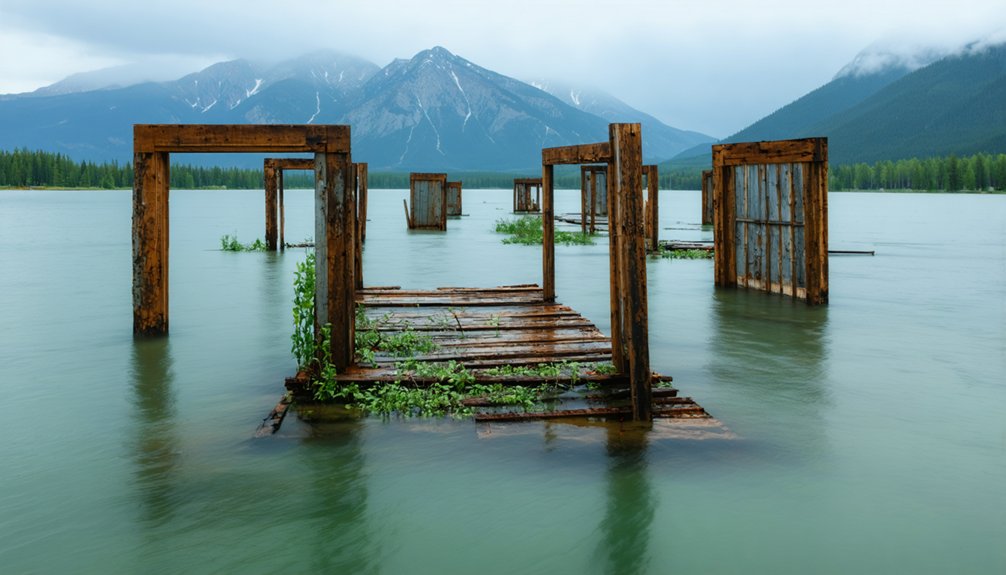
You won’t find permanently submerged ghost towns in Montana, but the state’s mining settlements experienced temporary submersion during the catastrophic Missoula Floods 15,000-13,000 years ago. When glacial ice dams failed, Lake Missoula released 530 cubic miles of water, creating an inland ocean that inundated lower elevations while settlements like Garnet, positioned at 6,000 feet, remained above the floodwaters. These jökulhlaups reshaped Montana’s landscape repeatedly, carving channels and depositing sediments that would later attract prospectors. The geological forces behind these floods reveal how ancient seas shaped modern communities.
Key Takeaways
- Montana has no permanently submerged ghost towns, but ancient seas once covered the region 1.5 billion years ago.
- The Missoula Floods temporarily inundated areas with catastrophic water releases, though no ghost towns existed at that time.
- Lake Missoula held 530 cubic miles of water, creating temporary inland ocean conditions before catastrophic drainage events.
- Garnet Ghost Town sits at 6,000 feet elevation, avoiding flood destruction and remaining preserved above historical water levels.
- Floodwaters reshaped Montana’s landscape multiple times, but ghost towns were founded millennia after these geological events ended.
Montana’s Ancient Seas and the Belt Supergroup Formations
Long before Montana’s plains stretched beneath open skies, the region lay submerged beneath an ancient sea that deposited what would become the thickest sedimentary succession on Earth. You’ll find the Belt Supergroup reaching depths of 18 kilometers—evidence of 1.5 billion years of accumulation within a massive rift basin.
These sedimentary structures reveal Montana’s Mesoproterozoic past, when mudstones, siltstones, and quartzites formed in environments ranging from deep water to mudflats. The succession’s four groups—Missoula, Piegan, Ravalli, and Lower Belt—preserve organic mineralization within their weakly metamorphosed layers. Despite their ancient age, sedimentary structures remain remarkably well-preserved, displaying features like cyclic bedding and stromatolites.
This intracratonic basin, periodically connected to the world ocean between 1470-1380 Ma, created depositional conditions without modern counterparts. The basin’s formation occurred during the rifting of Nuna, a supercontinent that began breaking apart approximately 1.45 billion years ago. You’re witnessing geology’s testament to Earth’s dynamic history.
The Missoula Floods: Creating an Inland Ocean
When a massive lobe of the Cordilleran Ice Sheet advanced southward from Canada approximately 15,000 years ago, it blocked the Clark Fork River in northern Idaho and transformed western Montana into an inland ocean. You’re looking at evidence of Glacial Lake Missoula—a 3,000-square-mile reservoir holding 530 cubic miles of water at depths exceeding 2,000 feet.
This wasn’t a stable system. The ice dam ruptured 40 to 90 times, releasing catastrophic floods every few decades. Each breach released two trillion tons of water at discharge rates reaching one million cubic meters per second, carving the Channeled Scablands across 630 miles to the Pacific. The water pressure from the growing lake repeatedly caused the ice dam to fail, sending floodwaters roaring over Eastern Washington at speeds up to 80 mph. These floods excavated and transported approximately 210 cubic kilometers of sediments, creating deep channels, coulees, and spillways that reshaped the regional topography.
Unlike gradual climate change or volcanic activity, these events reshaped landscapes in days, leaving giant ripples and house-sized boulders as evidence of nature’s unrestricted power.
When Ice Dams Transformed Western Montana’s Landscape
The Purcell lobe of the Cordilleran Ice Sheet didn’t merely create a barrier—it engineered a half-mile-high dam that transformed western Montana’s river valleys into a hydraulic pressure cooker.
This 2,500-foot ice dam blocked the Clark Fork River between 22,000 and 13,000 years ago, ponding 500 cubic miles of water across 200 miles of wilderness.
When hydrostatic pressure wedged beneath the ice, catastrophic failures released floods at 65 miles per hour—draining the entire lake in 48 hours.
Flood erosion carved steep-walled canyons through bedrock, created kolks that ground rock into submission, and rafted car-sized boulders 500 miles downstream. Floodwaters stripped topsoil and disturbed bedrock, leaving streamlined landforms across the channeled scablands. The torrent carved the Columbia River Gorge as waters funneled toward the Pacific Ocean.
This cycle repeated dozens of times, each jökulhlaup reshaping the landscape you traverse today, leaving sediment-enriched valleys and scabland testimony to nature’s unrestrained power.
Garnet Ghost Town: Gold Rush Settlement Now Preserved Above Water
High in Montana’s Garnet Mountain Range, at 6,000 feet elevation, Garnet Ghost Town occupies terrain that escaped the catastrophic flooding that reshaped lower valleys. You’ll find this historic preservation success story 40 miles east of Missoula, where mining heritage remains intact rather than submerged.
Founded in 1895 and reaching nearly 1,000 residents by 1898, Garnet’s gold rush boom featured:
- 13 saloons and 4 hotels serving miners extracting gold-bearing quartz.
- Nancy Hanks Mine’s 1898 discovery triggering peak population growth.
- 82 buildings across 134 acres now protected on the National Register.
The Bureau of Land Management and Garnet Preservation Association manage this accessible site, drawing 16,000 annual visitors.
A devastating 1912 fire burned nearly half the town, which was never rebuilt afterward, marking the beginning of Garnet’s gradual decline. The population plummeted from over 1,000 residents to just 150 by 1905, with the town becoming fully abandoned by 1940.
Unlike underwater settlements, you’re free to explore restored structures including J.R. Wells Hotel and Dahl’s Saloon year-round.
The Geological Forces That Shaped Montana’s Mining Communities
Montana’s mining communities sprouted from extraordinary geological events spanning 100 million years, beginning when the Farallon Plate collided with North America during the mid-Cretaceous period.
You’ll find that Sevier and Laramide orogenies thrust up the Ruby, Highland, and Madison ranges through folding and overthrust faulting. The 74.6 Ma Butte Granite underwent gneiss transformations under intense pressure, while the Boulder Batholith’s hot metalliferous brines carved pathways through fractured rock, depositing copper sulfides in Revett sandstones.
Volcanic slickensides and Oligocene-Miocene ash deposits buried earlier landscapes after erosion stripped 10,000 feet of strata. These forces created ore bodies stretching 70 miles long and 12,000 feet deep—geological treasures that built Butte’s 10,000 miles of underground workings and yielded 21.5 billion pounds of copper. The veins formed along Northern Rocky fault lines, establishing vertical continuity exceeding 4,500 feet that would later earn Butte its reputation as the “Richest Hill on Earth.” The Boulder Batholith, a massive granite and granodiorite pluton formed approximately 70 million years ago during the Cretaceous, provided the fundamental geological structure underlying Helena’s mineral-rich landscape and contributed to widespread mineral deposits throughout the region.
Frequently Asked Questions
Are There Any Actual Ghost Towns Currently Submerged Underwater in Montana?
Beneath Montana’s reservoir surfaces, you’ll find Canton Ghost Town submerged in Canyon Ferry Lake and Armstead under Clark Canyon Reservoir. These sunken settlements aren’t tourist attractions requiring historical preservation—they remain freedom from commercialization, accessible only through diving expeditions.
Another intriguing location is the history of silver bow ghost town, which offers a glimpse into the past life in Montana’s mining boom. Visitors can explore the remnants of buildings and streets, scattered amongst the rugged landscape. Revealing stories of hardship and resilience, these ghost towns serve as important reminders of the state’s rich heritage.
Can Divers Explore Submerged Mining Structures in Montana’s Reservoirs or Lakes?
You can’t freely explore submerged mining structures without federal permits. Underwater archaeology regulations protect these sites, and diving technology requirements—plus limited visibility—make access challenging. Contact the Army Corps of Engineers before attempting any reservoir exploration.
Which Montana Ghost Towns Were Flooded by Dam Construction Projects?
Canton’s the primary Montana ghost town you’ll find submerged by Canyon Ferry Dam’s 1949-1954 construction. Historic preservation wasn’t prioritized then, unlike today’s swamp ecosystems protection. You’re free to explore its underwater remains through diving expeditions.
How Do Underwater Ghost Towns Compare to Above-Ground Preservation Sites?
Locked beneath water’s vault, you’ll find historical preservation impossible compared to accessible above-ground sites. Virginia City and Bannack thrive as tourist attractions with ranger programs and exploration freedom, while submerged Canton remains archaeologically sealed and visitor-restricted.
What Happened to Residents When Montana Towns Were Intentionally Flooded?
You’d witness residents forcibly relocated through eminent domain, with minimal historical preservation considerations. The environmental impact displaced hundreds of families—80% at Fort Berthold—while graves, buildings, and heritage sites vanished beneath reservoirs, sacrificing community autonomy for federal dam projects.
References
- https://www.garnetghosttown.org/history.php
- https://roamingmontana.com/montana-underwater-history/
- https://www.youtube.com/watch?v=JnIIQymTY3w
- https://www.mountain-home.com/blog/vacation-planning/guide-montana’s-ghost-towns
- https://saltandstoneadventurephoto.com/2025/07/22/montana-ghost-towns-near-glacier/
- https://www.distinctlymontana.com/three-snapshots-underwater-montana
- https://en.wikipedia.org/wiki/List_of_flooded_towns_in_the_United_States
- https://fwp.mt.gov/stateparks/granite-ghost-town
- https://en.wikipedia.org/wiki/Belt_Supergroup
- https://www.isu.edu/digitalgeologyidaho/belt/