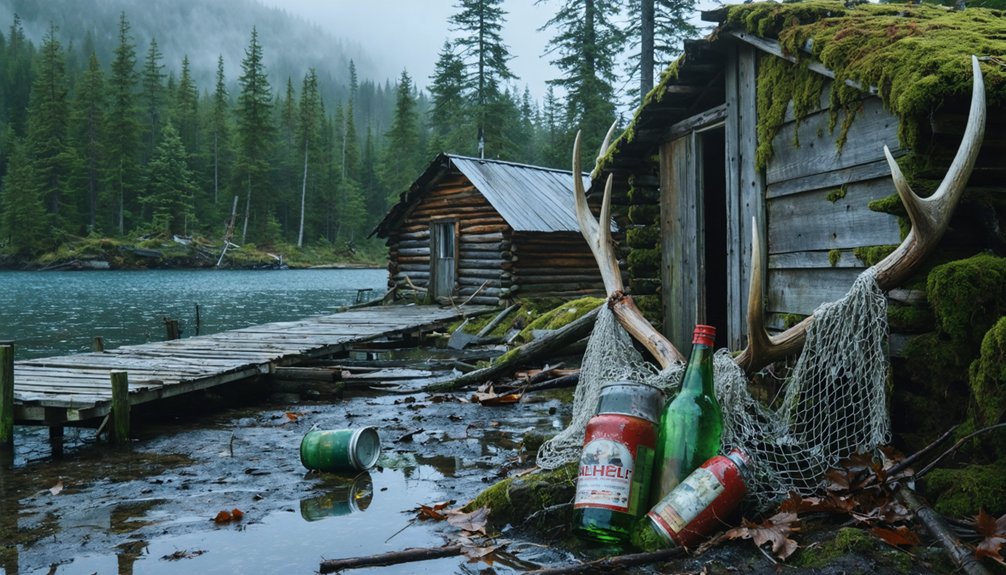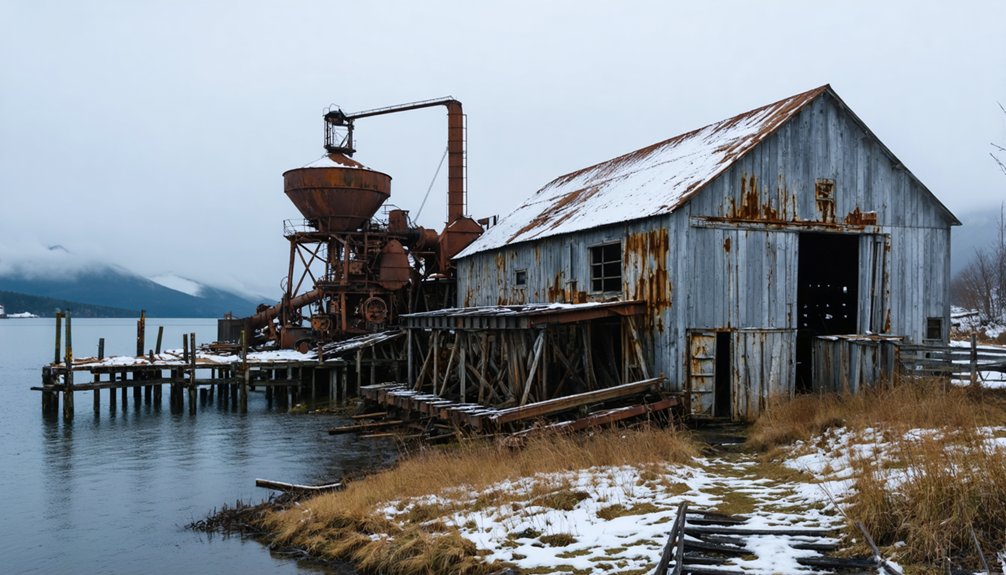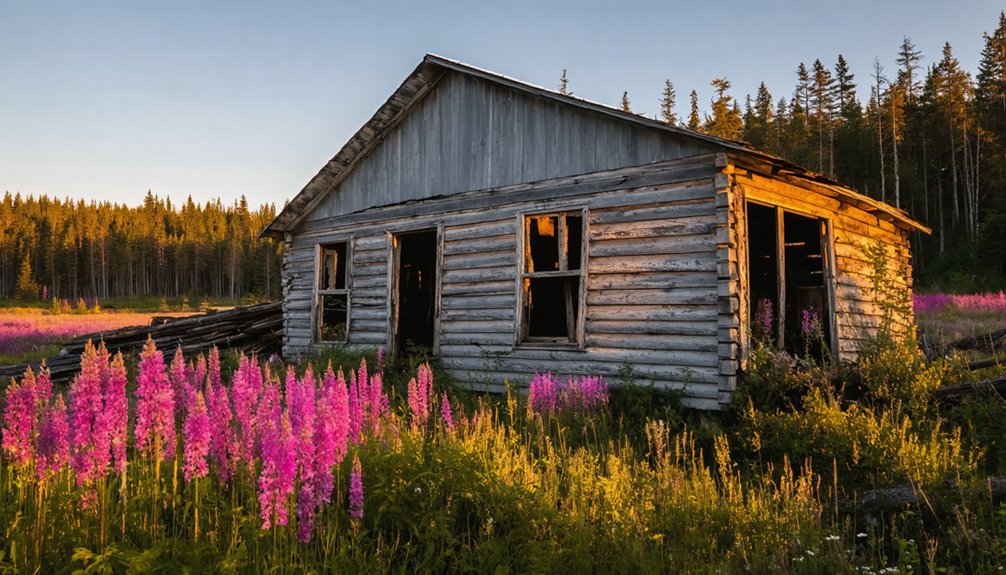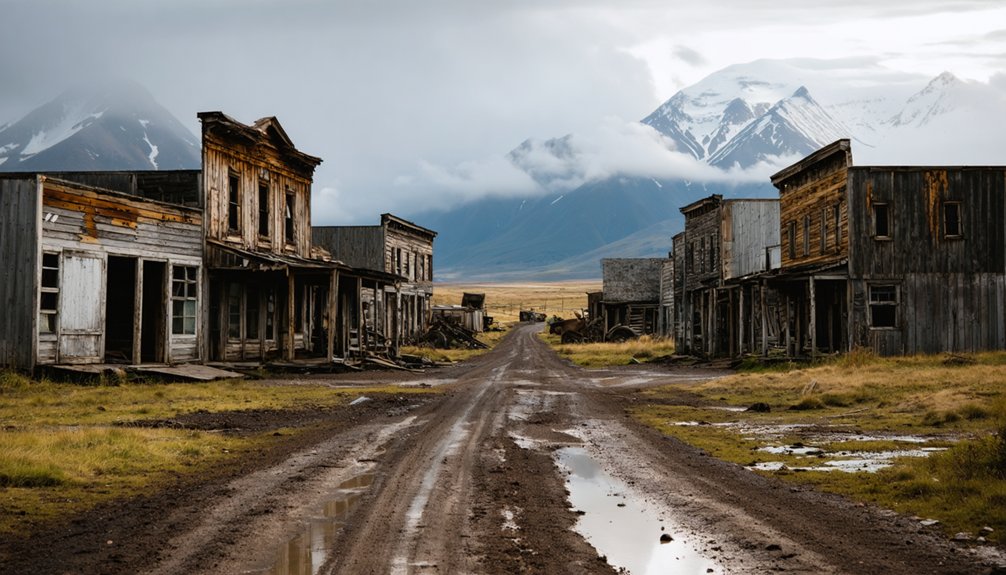
You’ll find Alaska’s ghost towns serving as authentic film backdrops, particularly Kennecott’s abandoned copper mining structures perched on steep ridges overlooking glaciers, though their remoteness limits production access. Near Cantwell, filmmakers recreated the weathered *Magic Bus 142* for *Into the Wild*, capturing rust and decay while maintaining safety. McCarthy’s preserved wooden buildings offer photogenic historical settings, while Stampede Trail’s antimony mine relics provide rugged wilderness atmosphere. These forgotten communities balance preservation efforts with cinematic storytelling, transforming deteriorating structures into curated historic landmarks that reveal Alaska’s compelling visual narratives.
Key Takeaways
- Kennecott ghost town features decaying copper mining structures overlooking glaciers but remains largely unfilmed due to remote location and logistical challenges.
- McCarthy’s preserved wooden structures evoke historical mining era and offer photogenic scenery, though filming is limited by difficult access.
- Abandoned antimony mine relics along Stampede Trail provide authentic wilderness backdrop near the Into the Wild filming replica location.
- Ghost town sites are increasingly preserved as tourism attractions and cultural exhibits rather than active filming locations.
- Remote Alaskan mining communities require specialized equipment, safety protocols, and location services, complicating film production despite atmospheric authenticity.
Valdez: The Desolate Setting for Insomnia’s Psychological Thriller
Nestled between the Chugach Mountains and Prince William Sound, Valdez provided Christopher Nolan’s *Insomnia* with a stark, unforgiving backdrop that became inseparable from the film’s psychological tension.
You’ll recognize Columbia Glacier from the opening aerial sequence, while Richardson Highway’s waterfall scene remains identifiable to contemporary visitors. Though Valdez isn’t technically a ghost town, its remote character and dramatic terrain created the isolated atmosphere essential to the detective’s descent into sleeplessness and moral conflict.
The production’s three-month commitment to on-location filming—rather than studio recreation—delivered authenticity that contributed to the film’s $113.8 million worldwide gross. The town’s unpredictable weather conditions added natural tension that enhanced the story’s psychological complexity. The thriller’s cast featured Al Pacino, Robin Williams, and Hilary Swank, bringing star power to the remote Alaskan location.
Today, film tourism draws visitors to these accessible locations, demonstrating how authentic environmental storytelling preserves cinematic geography without requiring formal historical preservation efforts.
Cantwell’s Wilderness: Recreating Chris McCandless’s Final Journey
You’ll find the replica bus constructed specifically for *Into the Wild* positioned along Jack River Canyon Road near Cantwell, 50 miles from the actual Stampede Trail location that proved too remote and dangerous for filming crews.
The production team scouted the original 1940s Fairbanks city bus via snowmachines in 2006 but selected this accessible Ahtna Country site to capture authentic Alaskan wilderness without risking treacherous river crossings.
This location delivered the visual isolation essential to McCandless’s story while offering practical terrain for equipment transport and a distant view of Mt. McKinley absent from the real bus site.
McCandless arrived in Healy near Denali National Park in April 1992, expressing confidence despite his lack of wilderness experience before making his way to the Stampede Trail.
The actual Bus 142 that sheltered McCandless was relocated in 2020 to the Museum of the North in Fairbanks after numerous rescue operations for unprepared hikers attempting to reach it.
Replica Bus Construction Details
When Sean Penn’s production team set out to film *Into the Wild* in 2007, they sourced two identical 1946 International Harvester K5 buses—the same model as the original Fairbanks City Transit System Bus 142 that Christopher McCandless inhabited during his final 114 days.
This bus construction respected the McCandless family’s wishes by avoiding the authentic site. The filming replica combined both vehicles into one functional unit, complete with a small metal cot, wood-burning stove, and torn mattress that mirrored the wilderness shelter’s interior. McCandless, who traveled under the pseudonym Alexander Supertramp, carried minimal supplies as he sought to live off the land in the Alaskan wilderness.
The original Bus 142 was originally part of a convoy of four buses used for construction work on the Stampede Trail in 1961, left behind after an axle break to serve as a shelter for moose hunters before becoming an iconic symbol of wilderness adventure.
You’ll find this replica positioned at 49th State Brewing Company in Healy, ten miles from Denali’s entrance, adorned with McCandless’s story photos inside. Unlike the graffiti-covered original—now at University of Alaska Fairbanks Museum—this version captures a deliberately pristine moment of solitary existence.
Authentic Alaskan Isolation Captured
While the authentic Bus 142 sat isolated 28 miles west of Healy on the treacherous Stampede Trail, Sean Penn’s production team established their filming base at Jack River Canyon Road in Cantwell, AK 99729—a strategic location 50 miles from McCandless’s actual death site.
You’ll find this Cantwell setting captured the raw wilderness without urban development’s interference, offering vehicle access where the real location demanded dangerous 20-mile hikes and river crossings.
The team replicated McCandless’s 113-day ordeal amid rocky canyons, tundra expanses, and distant Mt. McKinley views—ironically absent from the actual bus site. Penn’s crew constructed a replica of Bus 142 for filming, as the original 1946 International Harvester remained too remote and environmentally sensitive for full production access.
The production also hired locals to check the real bus in winter conditions on the Stampede Trail before committing to the safer Cantwell alternative.
This desolate landscape, positioned at Denali Highway’s entrance, now draws freedom-seekers as one of Alaska’s unconventional tourist attractions, where Penn filmed the protagonist’s realization that happiness demands human connection amid nature’s indifferent vastness.
Juneau’s Remote Terrain as Antarctic Horror Backdrop
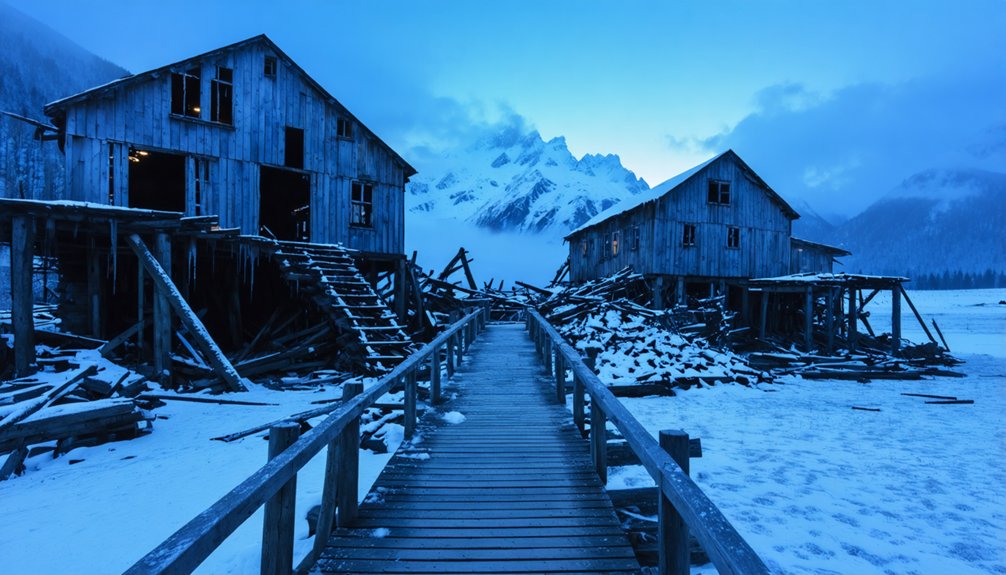
The logistical demands were significant—specialized cold-weather equipment, safety outfitters, and location services coordinated access to Herbert and Lemon Glaciers.
Southeast Alaska’s fjords and dense forests created the claustrophobic wilderness atmosphere central to the film’s terror.
Juneau’s harsh weather conditions and perpetual winter twilight enhanced suspenseful sequences, proving remote Alaskan terrain could authentically simulate Earth’s most inhospitable environments. The endless daylight conditions characteristic of Alaska’s Arctic and coastal settings can create disorienting psychological effects similar to those depicted in survival thrillers. The production also faced challenges with fogged camera lenses and equipment malfunctions caused by the freezing temperatures.
Knik Glacier: A Frozen Frontier for Star Trek Adventures
Stretching over 25 miles long and 5 miles wide across the northern Chugach Mountains, Knik Glacier transformed into the Klingon prison planet Rura Penthe for Star Trek VI: The Undiscovered Country in 1991. This marked Star Trek’s first production outside California, with Paramount Pictures capturing Captain Kirk and Dr. McCoy’s dramatic rescue amid stunning ice formations and glacier dynamics.
Experience this otherworldly terrain through:
- Three-hour jet-boat tours steering the 25-mile Knik River to the glacier face
- Aerial excursions revealing Lake George’s massive glacier-dammed expanse
- Overland safaris departing twice daily from Mile 7, Old Glenn Highway
- Self-guided viewing from Knik River Road’s accessible vantage points
You’ll need layered clothing, waterproof boots, and sunglasses for Alaska’s raw glacial environment—where Hollywood discovered an authentic alien landscape.
Chugach State Park’s Untamed Landscapes in Science Fiction Cinema
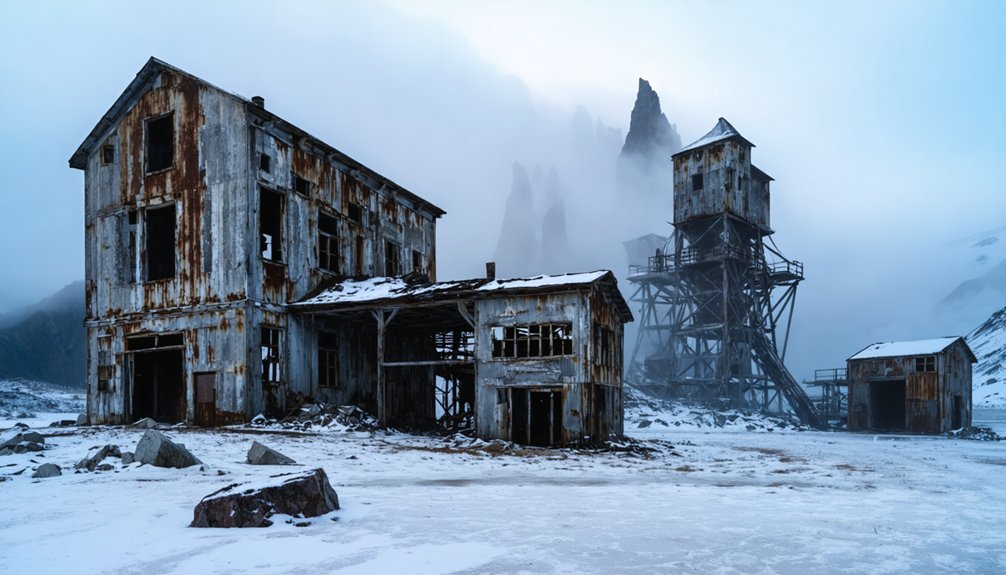
Beyond the glacier’s frozen expanse, Chugach State Park’s 495,204 acres of wilderness supplied Star Trek VI with diverse alien terrain that cameras couldn’t capture in California studios. You’ll find the park’s untamed mountains and valleys transformed into fantasy landscapes representing distant planets, where Kirk and crew filmed groundbreaking sequences during the franchise’s first Alaskan production.
Chugach State Park’s half-million acres delivered Star Trek VI’s alien worlds that California studios couldn’t replicate for the franchise’s Alaskan debut.
Directors chose these raw environments specifically because they needed futuristic imagery without CGI dependence—the glacial backdrops and weather-battered ridges provided authentic otherworldly visuals that studio sets couldn’t replicate.
The three-month shoot utilized the park’s isolation and dramatic scale to depict remote planetary surfaces, with aerial cinematography capturing sweeping vistas that became iconic to non-Trek viewers.
This location choice marked a pivotal shift toward on-location science fiction filming.
Fairbanks: Gateway to Into the Wild’s Authentic Alaska Experience
You’ll find the authentic Magic Bus 142—a 1946 International Harvester K5—permanently displayed at the University of Alaska Fairbanks Museum of the North since September 2020, after the Alaska Army National Guard airlifted it from the remote Stampede Trail.
The film’s September 21, 2007 premiere outside Fairbanks cemented the city’s connection to Chris McCandless’s story, though Sean Penn’s crew actually shot the bus scenes 50 miles south near Cantwell using a replica constructed on the Jack River bank.
UAF’s exhibition allows you to safely view the shelter that served Yutan Construction mining crews in the 1960s and became McCandless’s final home in 1992, without the dangerous trek that once lured unprepared tourists to the original wilderness site.
Film Premiere and Legacy
The film’s enduring legacy includes:
- Eddie Vedder’s 11 original songs creating an unforgettable soundtrack of liberation
- Bus 142’s preservation at UA Museum of the North since September 24, 2020
- Replica bus attraction near Healy drawing freedom-seekers to Alaska’s backcountry
- Two-year filming odyssey across 35 locations capturing America’s untamed spirit
Bus Display at Museum
Since its dramatic helicopter airlift from the Stampede Trail in June 2020, Bus 142 has occupied a climate-controlled engineering facility at the University of Alaska Fairbanks, where you’ll find it elevated on a viewing platform accessible during weekday hours at no cost.
Bus restoration efforts have prioritized authenticity over polish—conservators installed new wheels while deliberately preserving decades of rust and weathering.
Preservation methods include systematic documentation of every interior and exterior graffiti mark, treating these inscriptions as essential historical records.
The Institute of Museum and Library Services’ Save America’s Treasures grant funds this multi-year conservation process.
You’re currently viewing the 1940s-era vehicle through protective wrapping, but the museum’s developing a $375,000 outdoor pavilion featuring security fencing, surveillance systems, and a companion virtual exhibit app for unrestricted exploration.
Connection to Stampede Trail
While Bus 142 now rests safely behind museum walls, its original home on the Stampede Trail remains Alaska’s most sought-after wilderness destination for Into the Wild pilgrims.
You’ll find Fairbanks serves as your gateway to this legendary route, positioned 40 miles north of Healy where Stampede Road begins its journey into backcountry solitude.
What awaits on this historical preservation site:
- Eight miles of maintained gravel road before civilization yields to raw wilderness
- Deteriorated trail traces where McCandless walked toward complete autonomy
- Abandoned antimony mine remnants showcasing Alaska’s urban decay heritage
- Stampede Creek’s remote airstrip marking civilization’s furthest reach
The real trail—unlike Cantwell’s filming location—demands genuine preparation for its near-20-mile push through unforgiving terrain where freedom-seekers still test their limits.
Abandoned Mining Settlements Featured in Modern Film Productions
Perched on a steep mountain ridge overlooking a glacier, Kennecott’s abandoned copper mines create the kind of stark, otherworldly backdrop that filmmakers dream about but rarely find intact. Despite one filmmaker’s declared intention to shoot their next production here, no confirmed Hollywood projects have materialized as of 2020.
The century-old settlement’s remote location—300 miles east of Anchorage and accessible only by trek—presents logistical challenges that preservation efforts can’t overcome. While Kennecott preservation work by the National Park Service maintains roofs, foundations, and walls for ghost town tourism, the isolation that makes it cinematically compelling also limits practical filming operations.
You’ll find McCarthy nearby, another mining relic where wooden structures decay against snow-capped peaks, equally photogenic yet similarly underutilized for commercial productions.
Preserving Alaska’s Forgotten Communities Through Cinematic Storytelling
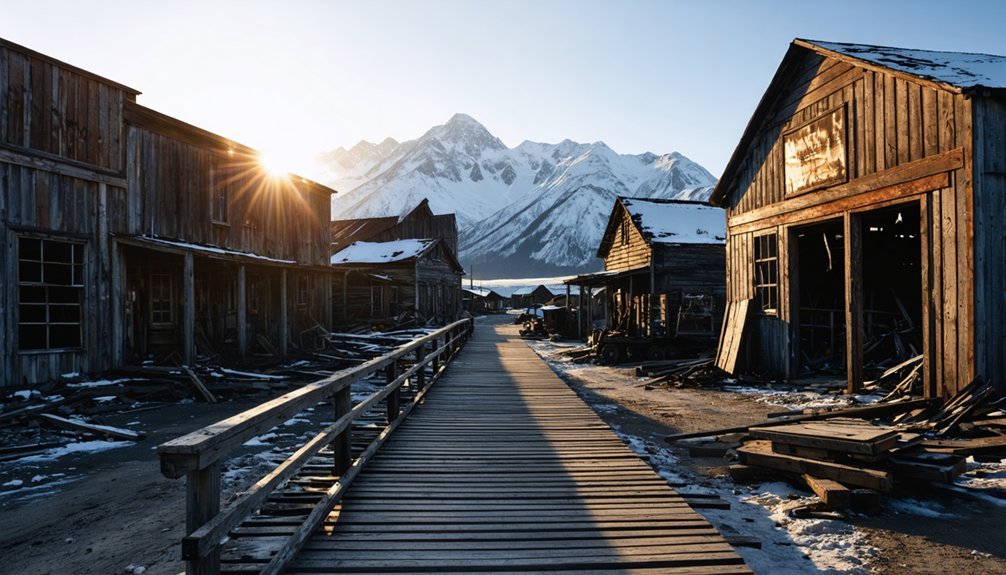
- Visual documentation capturing decay details before wilderness consumes them entirely
- Cultural significance transforming forgotten structures into protected museum exhibits
- Authentic replicas preserving architectural details “down to rust spots” for future reference
- Controlled access replacing dangerous pilgrimages with curated experiences
You’re witnessing remote sites shift from deteriorating relics into maintained historical narratives, ensuring these freedom-emblematic locations endure beyond their physical wilderness existence.
Frequently Asked Questions
Which Alaska Ghost Towns Are Accessible Year-Round for Independent Film Productions?
You’ll find Adak Island accessible year-round via charter flights, offering dystopian visuals with abandoned Cold War infrastructure. However, you must navigate historical preservation regulations and minimize environmental impact while coordinating logistics through limited transportation options in this remote subarctic location.
Do Filmmakers Need Special Permits to Shoot in Abandoned Alaskan Settlements?
Yes, you’ll navigate Alaska’s permitting process before shooting abandoned settlements. Local regulations demand Special Use Permits for state lands, NPS authorization for federal sites, and environmental assessments—ensuring your creative freedom doesn’t compromise these wild, desolate locations.
What Safety Precautions Are Required When Filming in Remote Ghost Towns?
You’ll need thorough wildlife encounter protocols and weather preparedness plans. Pack bear deterrents, satellite communications, and cold-weather gear. Establish evacuation routes, monitor changing conditions constantly, and guarantee your crew’s trained for Alaska’s unpredictable wilderness challenges.
How Do Production Crews Transport Equipment to Isolated Alaska Ghost Towns?
You’ll charter bush planes or helicopters to fly gear into remote ghost towns, coordinating with local community support for landing zones. Historical preservation guidelines dictate equipment placement, ensuring you’re not damaging fragile structures during load-in.
Are There Accommodation Options Near Alaska’s Ghost Town Filming Locations?
You’ll find limited accommodations near ghost town sites, but nearby towns offer hotels, lodges, and camping. Local legends and haunted history add intrigue to your stay while you’re exploring these atmospheric filming locations independently.
References
- https://www.enjoytravel.com/us/travel-news/famous-for/famous-movies-filmed-alaska
- https://movie-locations.com/movies/i/Into-The-Wild.php
- https://giggster.com/guide/movie-location/where-was-into-the-wild-filmed
- https://www.loveexploring.com/gallerylist/73233/filming-movie-locations-usa
- https://study.com/academy/lesson/into-the-wild-locations.html
- https://en.wikipedia.org/wiki/Into_the_Wild_(film)
- https://emergefilmsolutions.com/country/alaska/
- https://www.onlyinyourstate.com/state-pride/alaska/movie-filming-small-town-ak
- https://giggster.com/guide/movie-location/where-was-insomnia-filmed
- https://www.latlong.net/location/insomnia-locations-1951