You’ll find Maine’s coastal ghost towns like Round Pond and Milbridge have served as ready-made film sets for horror productions such as *Island Zero* and *Black Rock*, where weathered docks, salt-corroded buildings, and foggy harbors provide authentic maritime decay without expensive set construction. Abandoned logging camps house entire film crews in existing bunkhouses, while remote islands and inland settlements like Georgetown offer natural desolation perfect for supernatural narratives. These locations’ genuine rust, empty fish houses, and overgrown roads create eerie atmospheres that filmmakers leverage extensively throughout the state’s varied landscape.
Key Takeaways
- Maine’s coastal ghost towns provide authentic maritime decay, weathered docks, and fog-shrouded harbors for films like *Island Zero* and *Black Rock*.
- Historic settlements like Round Pond and Milbridge offer natural isolation and rustic architecture, reducing set construction costs for horror productions.
- Abandoned logging villages house film crews in existing infrastructure while providing desolate wilderness backdrops for supernatural storytelling.
- Island locations such as Mount Desert Island deliver remote, haunted atmospheres with natural rock formations ideal for Stephen King adaptations.
- Rural towns like Camden and Rockport double as fictional ghost towns, leveraging overgrown structures and seasonal communities for authentic decay.
Historic Abandoned Settlements That Became Film Backdrops
Maine’s weathered landscapes and authentic period architecture have transformed the state into a filmmaker’s resource for capturing eerie, isolated settings without extensive set construction.
You’ll find historic landmarks like Mount Hope Cemetery in Bangor serving as Pet Sematary’s iconic burial ground, while Camden’s coastal structures doubled as Casper’s Friendship, Maine.
The Dead Ones leveraged urban decay through an abandoned inner-city school, where director Jeremy Kasten captured raw atmospheres without Hollywood interference.
These locations offer production teams cost-effective alternatives to constructed sets.
Recent productions like Ghost Trap utilized Rockland and Owls Head’s existing coastal infrastructure, demonstrating how Maine’s naturally isolated communities provide ready-made backdrops.
Marshall Point Lighthouse, located an hour south of Augusta, became another memorable filming location when Tom Hanks’ character stopped during his iconic cross-country run in Forrest Gump.
The state’s diverse filming locations spanning from northern regions to coastal areas allow filmmakers to create distinctive visual worlds within a single production.
You’re witnessing filmmakers exploit authentic deterioration rather than fabricating it—real locations delivering genuine atmosphere that studio lots can’t replicate.
Coastal Ghost Towns Featured in Horror Productions
When filmmakers scout horror locations along Maine’s jagged coastline, they’re hunting for authenticity that production designers can’t fabricate—the weathered docks, salt-corroded buildings, and fog-thick harbors that transform functional fishing villages into cinematic vessels of dread.
Round Pond’s isolation anchored *Island Zero’s* stranded narrative, where ferry-dependent residents face mounting bodies. Milbridge’s coastal remoteness intensified *Black Rock’s* killer-on-shore survival tension.
Geographic isolation transforms working fishing villages into perfect horror settings where distance from rescue becomes the ultimate antagonist.
Southwest Harbor doubled as Stephen King’s fictional Little Tall Island in *Storm of the Century*, where supernatural legends invade through winter gales.
These locations weren’t abandoned settlements but working communities whose geographic vulnerability creates eerie atmosphere on camera. Their authentic maritime decay—rusting equipment, empty fish houses, storm-battered piers—delivers horror’s essential ingredient: places where help won’t arrive, and the ocean guarantees you can’t leave. The 2015 independent horror film *Pod* utilized Round Pond’s Maine coast setting to craft its X-Files-style narrative of a PTSD-afflicted veteran discovering something sinister in the surrounding woods. Camden and Rockland’s mid coast towns provided authentic Maine landscapes for the Oscar-nominated drama *In the Bedroom*, capturing regional ambiance that translates powerfully to screen.
Preserved Mining Communities Transformed Into Movie Sets
Unlike coastal villages that leverage atmospheric decay for horror films, Maine’s preserved mining communities remain conspicuously absent from production schedules—not because they lack cinematic potential, but because they’ve largely vanished beneath cemeteries, oil tanks, and forest reclamation.
The mining decline that emptied these settlements also erased their physical evidence, leaving ghost town preservation as a documentation challenge rather than a film location opportunity.
Why Mining Ghost Towns Never Became Sets:
- Ligonia Village disappeared under Calvary Cemetery and petroleum infrastructure, eliminating accessible structures.
- Askwith Mining Cemetery evolved from settlement to burial ground, with overgrowth obscuring remnants.
- Perkins Township restricts access on Swan Island for historical preservation, preventing commercial filming.
Unlike romanticized Western mining towns, Maine’s industrial sites collapsed into wilderness before anyone thought to film them. While Stephen King’s adaptations like *Pet Sematary* explored mysterious cemeteries deep in Maine woods, actual mining settlements offered no such preserved locations. Riceville’s mysterious disappearance—whether from the 1905 fire or disease outbreak—left no standing structures for future productions.
Deserted Island Locations Captured on Camera
Stephen King’s 1995 miniseries *Storm of the Century* transformed Mount Desert Island into the fictional Little Tall Island. This demonstrated how Maine’s coastal geography solves a persistent production problem: creating believable isolation without leaving the continental United States.
Maine’s islands deliver authentic isolation for film productions—remote enough for horror, accessible enough for Hollywood budgets.
You’ll find filmmakers consistently exploiting these island locations because they’re accessible enough for crew transport yet remote enough to sell supernatural narratives.
Mount Desert Island’s ambiguous character allowed directors to embed hidden island secrets into frames without explaining them—the landscape does that work itself.
Local legends permeate these filming sites naturally; you don’t manufacture atmosphere when communities already possess documented histories of shipwrecks and disappearances.
Camden’s harbor doubled for fictional coastal towns, while Acadia’s dramatic rock formations provided essential visual anchors that confirmed viewers weren’t watching soundstage fabrications. Camden also contributed to the coastal Maine aesthetic for the 1995 film *Casper*, which was set in the fictional town of Friendship, Maine. The island setting reappeared in King’s short story “Home Delivery”, reinforcing Mount Desert Island’s recurring role in his Maine-based narratives.
Remote Logging Villages Serving Film Crews
Maine’s abandoned logging camps solved a critical production challenge that coastal locations couldn’t: housing dozens of crew members in territories where the nearest hotel sat forty miles away on deteriorating access roads.
These remote outposts transformed into self-contained production bases where independence-minded crews operated beyond studio constraints:
- Bunkhouse conversions provided sleeping quarters for 30-50 personnel, eliminating daily transportation costs and schedule delays.
- Existing mess halls became catering facilities with industrial kitchens already equipped for feeding large work groups.
- Equipment storage sheds secured cameras, lighting rigs, and generators overnight without expensive security transport.
Logging camps offered something money couldn’t buy elsewhere: total creative isolation. Productions sometimes modified original sites beyond their historical footprint, constructing temporary structures like diners or altering buildings to match script requirements, just as coastal shoots had done with boat home ports and townhomes.
You’ll find these weathered structures deep in Maine’s backcountry, where productions gained authentic wilderness backdrops while crew accommodations stood ready-made, requiring minimal renovation to support week-long shoots in territories most filmmakers abandoned as logistically impossible.
Forgotten Maritime Towns in Cinema
While inland logging camps offered wilderness isolation, coastal ghost towns delivered something equally valuable to filmmakers: ready-made nautical atmosphere where centuries of maritime decay created authenticity no set designer could replicate.
Southwest Harbor’s working waterfront transformed into Stephen King’s fictional Little Tall Island, with Acadia’s mountains and commercial docks providing genuine maritime character. You’ll find the Drydock Inn at 357 Main St still standing where storm scenes unfolded. The town’s historic sites and seaside vistas contributed essential coastal charm to the production’s authentic Maine setting.
Ligonia Village’s remains beneath South Portland’s Calvary Cemetery and oil terminals showcase how urban decay reclaimed entire shipbuilding communities. Tarratine Village disappeared completely, its maritime settlement consumed by overgrowth.
Bucksport’s Mt. Hope Cemetery became Pet Sematary’s burial ground—a working tourist attraction where Jonathan Buck’s haunted tombstone adds legitimate eeriness. These abandoned coastal settlements offered filmmakers authentic New England maritime atmosphere without constructing elaborate sets.
Rustic Wilderness Settlements as Character Locations
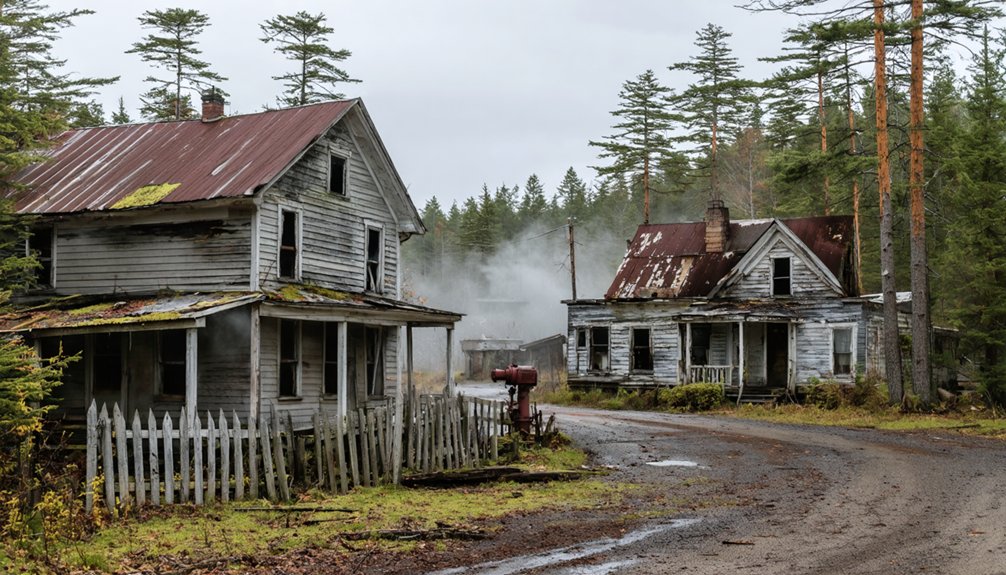
You’ll find Maine’s coastal villages and forest settlements transformed into eerie character backdrops where isolation becomes the story itself. Camden’s seafront doubled as the haunted Friendship locale in *Casper* (1995), with producers selecting its rustic authenticity over the actual town.
While locations like Spruce Head Point and Owls Head provide the wilderness-locked harbors for *Ghost Trap* (2024). These remote settings—from Acadia’s rocky expanses in *Pet Sematary* (1989) to Phippsburg’s coastal isolation in *Head Above Water* (1996)—capture abandonment without requiring actual ghost towns, leveraging Maine’s existing rural character to evoke supernatural desolation.
Isolated Coastal Village Settings
Along Maine’s rugged coastline, filmmakers have transformed working fishing villages and remote seaside settlements into cinematic backdrops that blur the line between inhabited communities and abandoned landscapes.
You’ll find these coastal locations offering distinct advantages for production:
- Camden and Rockport’s dual identity – These villages substituted for fictional Friendship in *Casper* (1995). Their authentic harbors and weathered docks captured local fishing traditions without requiring extensive set design.
- Marshall Point Lighthouse in Port Clyde – Featured in *Forrest Gump* (1994), this isolated structure provided instantly recognizable maritime imagery. It also maintained remoteness from tourist-heavy seaside festival scenes.
- Spruce Head Point and Owls Head – *The Ghost Trap* (2024) utilized these secluded communities. Their aging infrastructure and sparse populations create naturally eerie atmospheres without abandonment.
These working villages offer production-ready isolation you won’t find in developed coastal regions.
Abandoned Rural Film Backdrops
Maine’s inland wilderness settlements have provided filmmakers with naturally decaying rural backdrops that require minimal set dressing to evoke abandonment and isolation. You’ll find Bethel and Andover served The Myth of Fingerprints (1996), where Roy Scheider navigated familial drama against remote woodland seclusion.
Durham inspired Stephen King’s cursed Jerusalem’s Lot, a fictional avoided settlement bordering Portland that captures urban decay transplanted to rural settings. South Bristol and Stonington in Signs of Life (1988) offered rustic community frameworks with Kathy Bates exploring maritime decline.
Georgetown’s sparse landscape amplified isolation in Gray Havens (1996), functioning as modern ghost towns without active abandonment. These locations deliver authentic desolation—weathered structures, overgrown roads, and minimal infrastructure—allowing directors to craft atmospheric narratives without extensive production budgets or permits restricting creative vision.
Remote Forest Community Scenes
- Acadia National Park’s dramatic rock formations provided Pet Sematary’s essential clifftop sequences.
- Morgan Bay’s rustic barn structures offer authentic agricultural decay for horror productions.
- Camden and Rockport’s coastal forests doubled as Casper’s Friendship township approach roads.
Signs of Life (1988) captured South Bristol and Stonington’s island isolation, while Creepshow 2 utilized Bangor-area woodlands for anthology terror segments.
This proves Maine’s forested settlements deliver unmatched authenticity for stories demanding genuine remoteness.
Seasonal Communities Standing in for Fictional Places
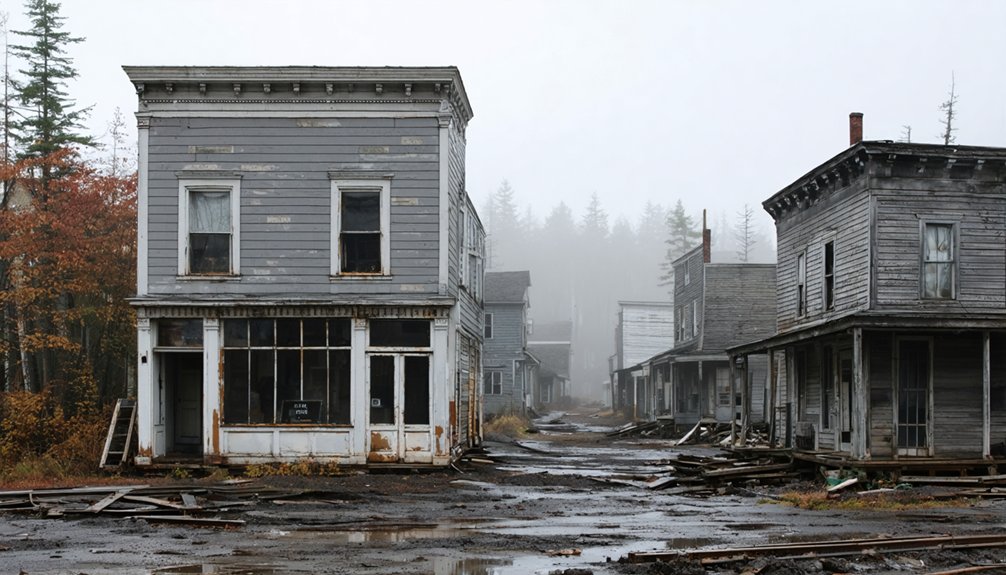
When Hollywood scouts search for filming locations, they often prioritize visual appeal over geographic accuracy, leading Maine’s seasonal communities to portray entirely different places on screen.
Camden, a coastal resort town thriving on seasonal tourism, stood in for the quaint fishing village of Friendship in the 1995 film *Casper*. Producers chose Camden’s picturesque downtown over the actual location, citing its superior photogenic qualities for fictional recreation.
Rockport supplemented these scenes, adding authentic coastal Maine aesthetics. You’ll recognize Mariners Restaurant and Camden’s distinctive church in aerial shots.
Similarly, Popham Beach transformed into a summer cottage setting for *Message in a Bottle* (1999), while Old Orchard Beach provided the backdrop for the TV pilot *Boomers* (1996).
These seasonal destinations offered filmmakers ready-made charm without extensive modifications.
Frequently Asked Questions
What Permits Are Required to Film in Maine’s Abandoned Locations?
You’ll need local film permits from municipal authorities and written permission respecting private property rights from landowners. Even abandoned sites require proper authorization, plus liability insurance and special activity permits if you’re using drones or creating traffic disruptions.
How Do Production Crews Access Remote Ghost Town Filming Sites?
You’ll access remote ghost towns like Casper’s Camden shoots using coastal roads and boat transport, while historical preservation permits and environmental impact assessments guide your route selection through Maine’s protected abandoned sites, balancing authenticity with ecological responsibility.
Are Original Ghost Town Structures Safe for Film Equipment and Cast?
You’ll need professional structural integrity assessments before filming. Original ghost town buildings often harbor safety hazards like unstable floors, rotting beams, and collapsing roofs. Don’t risk your crew—hire engineers to evaluate each structure you’re considering.
Which Maine Ghost Towns Offer Accommodations for Visiting Film Crews?
Need authentic backdrops without compromising crew comfort? Maine’s ghost town tourism infrastructure remains limited for filming logistics. You’ll find better accommodations in nearby active towns like Bangor or Portland, requiring daily transportation to your abandoned location shoots.
Do Local Historical Societies Restrict Filming in Preserved Ghost Towns?
You won’t face filming restrictions from historical societies in Maine’s ghost towns. These sites lack active historical preservation oversight, so you’ll coordinate directly with property owners through standard permits, giving you creative freedom without regulatory barriers.
References
- https://filminmaine.com/films-made-in-maine/
- https://findthatlocation.com/blog/where-was-casper-filmed
- https://roadtrippers.com/magazine/filming-locations-stephen-king-movies/
- https://www.wickedhorror.com/top-horror-lists/famous-fictional-towns-based-on-real-places/
- https://www.youtube.com/watch?v=ocH_3bCWHqA
- https://giggster.com/guide/movie-location/where-was-it-filmed
- https://q1065.fm/three-maine-movie-locations/
- https://www.peerspace.com/resources/great-movies-filmed-in-maine/
- http://wickedhorror.com/top-horror-lists/famous-fictional-towns-based-on-real-places/
- https://www.pressherald.com/2024/09/30/maines-a-spooky-place-here-are-11-films-that-prove-it/