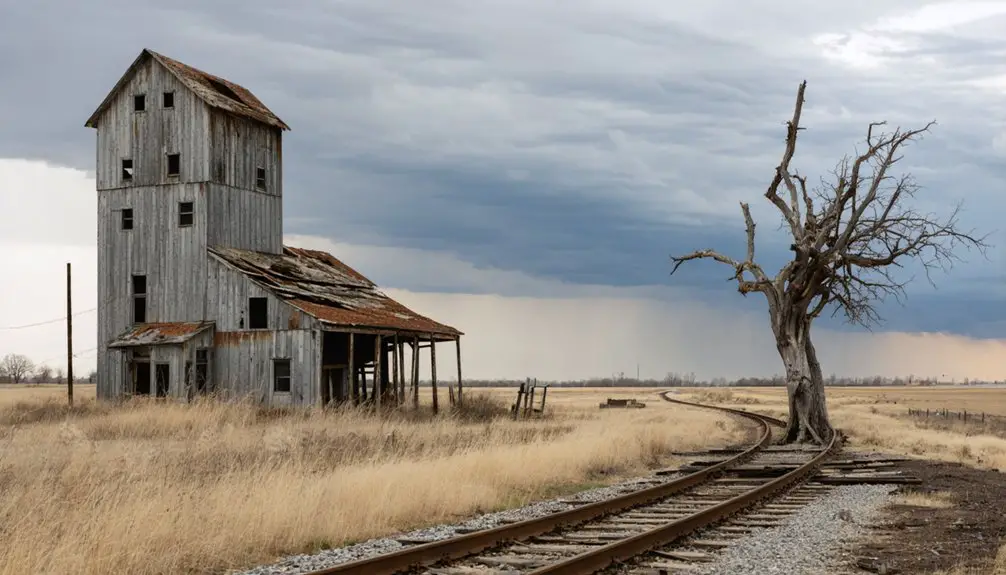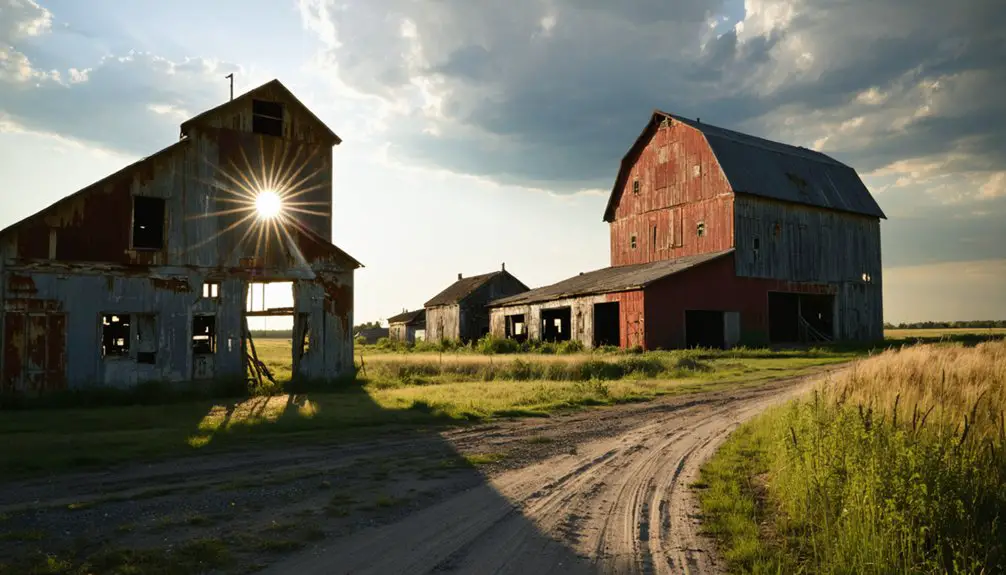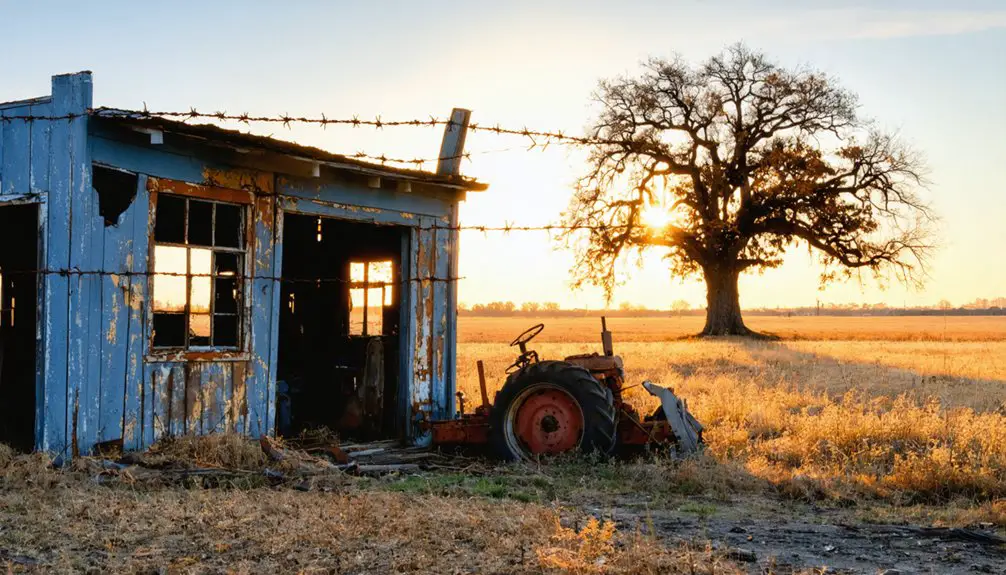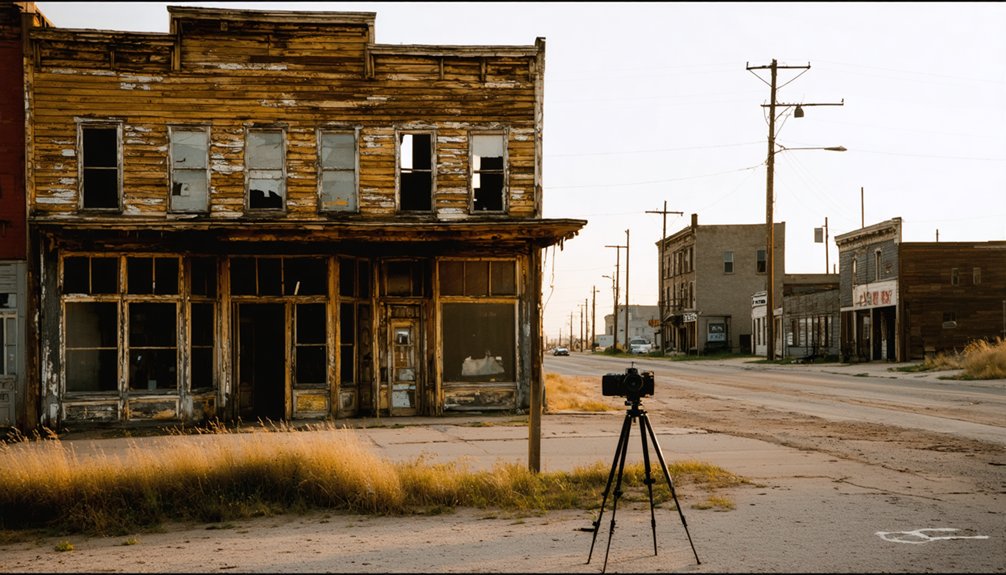
You’ll find Minnesota blends atmospheric ruins with preserved settlements rather than traditional ghost towns in film production. Fergus Falls State Hospital‘s abandoned Kirkbride asylum, with its dark corridors and haunted reputation, appeared in paranormal documentaries before access restrictions in 2012. Forestville State Park offers authentic 1800s buildings for guided tours and small productions, while Finland’s stripped military foundations serve photography projects. Unlike Hollywood’s typical abandoned sets, these locations provide genuine decay and historical architecture—from the asylum’s symmetrical towers to Forestville’s preserved storefronts—creating visually compelling backdrops that merge Minnesota’s haunted heritage with cinematic storytelling opportunities explored throughout this guide.
Key Takeaways
- Forestville State Park preserves 1800s buildings as an authentic ghost town experience, offering guided tours and historical filming backdrops.
- Finland features stripped interiors and military foundations, providing atmospheric photography locations while supporting heritage preservation efforts.
- Fergus Falls State Hospital’s abandoned Kirkbride architecture, with dark corridors and haunting legends, creates distinctive period filming opportunities.
- Faribault’s Victorian-era downtown, Minnesota’s second-largest historic district, offers preserved storefronts but lacks significant film tourism development.
- Silver Bay’s Palisade Head cliffs replaced Massachusetts locations in *The Good Son*, showcasing Minnesota’s dramatic natural landscapes.
Fergus Falls and the Abandoned State Hospital From Real Haunts 3
When Third Minnesota State Hospital for the Insane opened its doors on July 31, 1890, over 100 transfer patients from St. Peter arrived within days, filling the Kirkbride-designed facility immediately.
Within days of opening in 1890, over 100 patients from St. Peter filled the newly built Kirkbride facility to capacity.
You’ll recognize its horseshoe-shaped wings spanning a quarter mile along Interstate 94’s skyline—haunted architecture that served 40,000 patients by 1970.
The complex peaked at 2,000 residents during the 1930s-1940s, operating 22 specialized wards across 120 acres.
Real Haunts 3 captured this location’s eerie legends before demolition began in 2018.
While mid-century buildings vanished, the Kirkbride tower’s spires remain visible in 2023.
Architect Warren B. Dunnell designed the structure, which earned placement on the National Register of Historic Places for its phenomenal detailed architecture.
The building incorporated Beaux Arts, Romanesque, and Chateauesque architectural styles that reflected the era’s institutional grandeur.
You can explore remnants during summer concerts at the repurposed amphitheater, where horseshoe wings now host 2,000 concert-goers annually.
Minneapolis Urban Landscape in Jingle All The Way
You’ll find downtown Minneapolis transformed into a bustling holiday battleground throughout *Jingle All the Way*, where Arnold Schwarzenegger’s frantic search for Turbo Man takes him through specific corridors and landmarks.
Nicollet Mall serves as the primary artery for chase sequences, capturing crowds maneuvering the pedestrian thoroughfare between 5th and 12th Streets during peak shopping chaos. The historic State Theatre at 805 Hennepin Avenue appears prominently during the parade scene, adding authentic Minneapolis character to the holiday festivities.
The IDS Center’s distinctive Crystal Court and 57-story tower appear in multiple establishing shots, anchoring the film’s urban geography at 80 South 8th Street in the heart of the city’s skyway system. The climactic competition unfolds at the radio station KKQ92 located at 360 Wabasha Street, serving as one of the film’s most recognizable Minneapolis landmarks.
Downtown’s Festive Film Role
As the primary urban canvas for *Jingle All the Way*’s most memorable sequences, downtown Minneapolis transformed its commercial corridors into a bustling holiday spectacle that anchored the film’s festive atmosphere. You’ll recognize Nicollet Mall‘s strategic layout accommodating the climactic parade sequence, while Hennepin Avenue connected multiple filming sites throughout the entertainment district.
The State Theatre at 805 Hennepin Avenue provided architectural authenticity dating to 1921, its historic facade complementing holiday decorations and cityscape lighting that defined the production’s visual identity.
Mickey’s Diner in downtown St. Paul delivered Minnesota’s regional character, particularly during Schwarzenegger’s memorable out-of-gas scene. The Palace Theatre backdrop captured a tender moment between Howie and Jamie, where Jamie’s Turbo Man commercial spiel unfolded against Christmas decorations adorning the non-operational venue.
Summit Avenue expanded filming locations beyond Minneapolis, though downtown’s pedestrian-friendly infrastructure ultimately supported the large-scale logistics required for capturing authentic urban holiday celebration.
Nicollet Mall Chase Scenes
Since Nicollet Mall‘s pedestrian-friendly infrastructure positioned it as the film’s central urban canvas, the chase sequences here capture Howard Langston’s increasingly desperate pursuit of the elusive Turbo Man action figure through Minneapolis’s holiday-decorated downtown corridor.
You’ll recognize the W 5th Street running sequence at 0:50:33, where crowd choreography transforms everyday shoppers into obstacles for Howard and Myron’s frantic dash.
The mall’s exposed brick walls and skyline backdrop create authentic urban ambiance that’s remained recognizable 27 years after the 1996 release.
Festive vendors and holiday decorations amplify the Christmas chaos as pedestrians navigate the pursuit.
The Hennepin Avenue Bridge connects this downtown filming location to other iconic Minneapolis landmarks featured throughout the movie.
The vibrant downtown energy connects seamlessly to nearby State Theatre filming locations on Hennepin Avenue, establishing Nicollet Mall as your accessible hub for exploring Twin Cities shooting sites through public transport or car.
IDS Center Icon Moments
The IDS Center’s 23,000-square-foot Crystal Court transforms into a glass-enclosed pressure cooker during Jingle All the Way‘s most visually striking urban sequences, where Arnold Schwarzenegger’s Howard navigates the multi-level atrium’s cascading waterfalls and holiday-frenzied shoppers.
You’ll recognize the film’s wide-angle shots capturing hurried pedestrian traffic beneath the soaring glass ceiling, with city lights reflecting off transparent surfaces to amplify the urban chaos.
The Crystal Court’s architectural design—connecting office towers through walkways and retail corridors—creates natural bottlenecks perfect for depicting shopping pandemonium.
This central hub embodies Minneapolis’s 1990s architectural prominence while establishing a festive atmosphere that contrasts indoor sophistication with outdoor Minnesota grit.
Fans visiting today can trace Howard’s frantic path through this intact landmark, experiencing the same expansive space that defined the film’s metropolitan energy.
Wabasha’s Role in the Grumpy Old Men Film Series
While Wabasha lent its name and spirit to the beloved Grumpy Old Men film series, the actual production unfolded across multiple Minnesota locations far from this Mississippi River town. Screenwriter Mark Steven Johnson drew inspiration from his grandfather Gilbert’s Wabasha experiences, infusing the 1993 Christmas release with authentic small-town character.
You’ll discover the Wabasha charm primarily through:
- Slippery’s Bar & Grill at 10 Church Avenue, renamed Chuck’s Bait Shop on-screen and filled with film memorabilia
- Ice fishing scenes shot at Lake Rebecca in Rockford, though credited to Wabasha waters
- Sets constructed by Wabasha native Blaine Marcou, incorporating local authenticity despite St. Paul’s Hyacinth Avenue serving as the main filming street
Today, you can explore Slippery’s restored ice shanty through Ragetti’s Restaurant window, connecting you to Walter Matthau and Jack Lemmon’s legendary rivalry. The film showcased Minnesota’s picturesque Midwestern towns through various scenic locations that captured the region’s natural beauty and historic character. The motel entrance features painted benches depicting Max Goldman and John Gustafson, serving as a lasting tribute to the beloved characters.
Faribault’s Historic Streets in North Country
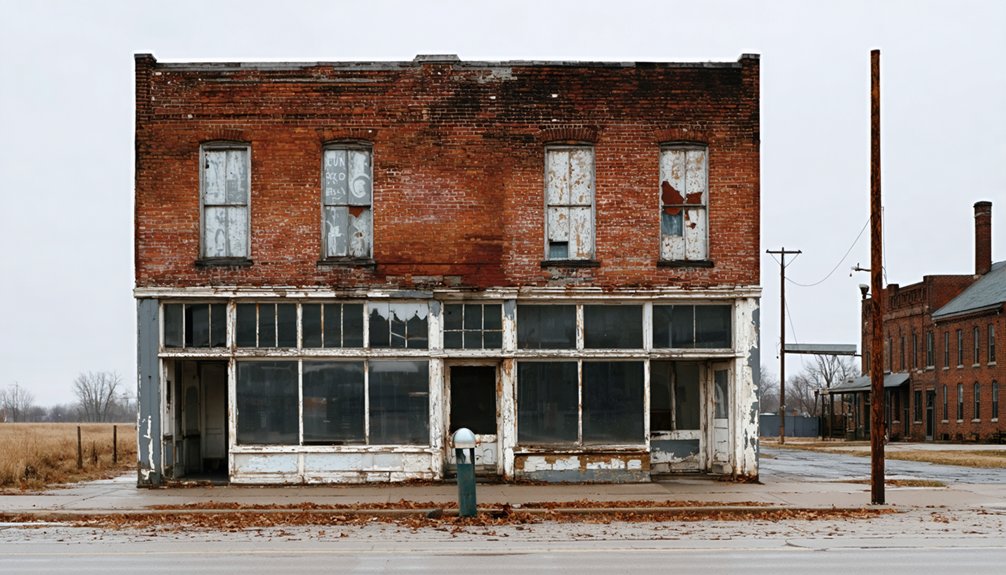
Faribault’s downtown district never hosted filming for *North Country* or served as a backdrop for major motion picture productions, despite its well-preserved historic architecture along Central Avenue and Division Street. You won’t find film tourism markers here celebrating Hollywood moments.
The city’s revitalized Main Street showcases authentic Victorian-era buildings and architectural details that remain untapped by location scouts. While Faribault maintains its historic integrity through preservation efforts, it hasn’t attracted the production crews that transformed other Minnesota towns into cinematic destinations. The downtown stands as Minnesota’s second-largest historic district, yet this distinction hasn’t translated into film industry recognition.
The district’s period-appropriate storefronts, brick facades, and vintage streetscapes possess unrealized potential for filmmakers seeking authentic Midwestern settings. Historic landmarks including Ochs Department Store, Theopold Block, Wolf Building, and Batchelder’s Block represent architectural styles from the Classical Revival to Italianate periods. You’re exploring genuine small-town heritage here, unaltered by movie industry influence, where history stands on its own merit rather than manufactured nostalgia.
St. Paul’s Como Park and Cathedral Hill in Classic Films
You’ll find St. Paul’s Como Park and Cathedral Hill neighborhoods captured authentic Minnesota settings in 1990s productions, though neither qualifies as a ghost town.
The Half Time Rec at 1013 Front Avenue near Como Park served as the bar location for the heated confrontation between Jack Lemmon and Walter Matthau in *Grumpy Old Men*, filmed in early 1993.
Cathedral Hill’s Victorian mansions and Como’s residential streets provided filmmakers with ready-made period architecture and small-town charm within five miles of downtown Saint Paul.
Cathedral Hill’s Historic Architecture
Perched majestically on Cathedral Hill, the Cathedral of Saint Paul commands sweeping views of downtown and the State Capitol. Its copper-clad dome rises 186 feet above the granite-walled structure.
Emmanuel Masqueray’s Classical Renaissance design incorporates Gothic Revival elements alongside Baroque and classical features, creating cinematic backdrops you’ll recognize from classic films.
Key Architectural Features:
- Materials: Rockville granite exterior walls from St. Cloud; American Travertine interior from Mankato
- Dome Specifications: 76-foot diameter, copper-clad construction modeled after French churches
- Architectural Detailing: Greek Cross floor plan with marble columns and unobstructed sightlines
The surrounding Summit Hill neighborhood offers 373 Victorian-era mansions along Summit Avenue, including James J. Hill’s 1891 Romanesque residence.
These authentic period settings have attracted filmmakers seeking historic American landscapes.
Como Park Zoo Scenes
While Cathedral Hill provides architectural grandeur for period pieces, Como Park Zoo‘s 17-acre landscape offers filmmakers a different visual palette.
Though documented evidence of its use in classic cinema remains elusive, you’ll find the zoo’s historic architecture and naturalistic settings present intriguing filming possibilities. Yet no verified records confirm its appearance in classic films.
The facility’s evolution from a 1897 establishment to a modern wildlife conservation center suggests potential for period productions, but concrete documentation doesn’t exist.
If you’re researching Minnesota filming locations, you’ll need to explore beyond Como Park Zoo for confirmed classic cinema sites.
The zoo’s current focus on wildlife conservation and visitor experiences, rather than film production, explains this gap in its historical record.
Additional archival research would prove necessary.
Urban Film Setting Appeal
- Architectural diversity – Spiral staircases, cathedral domes, and historic pavilions adapt seamlessly from Victorian mysteries to fantasy sequences.
- Reduced CGI dependency – Real stonework and rooftop access enable authentic stunt integration across 10+ major productions since 1962.
- Streamlined permissions – Dedicated cathedral applications and proximity clustering allow combined location shoots.
The iconic silhouette provides instant setting recognition, eliminating exposition while atmospheric interiors create dramatic tension through echoes and scale.
Heritage status elevates production prestige without restricting creative freedom across genres.
Silver Bay’s Tettegouche State Park Cliffs in The Good Son
The volcanic cliffs at Palisade Head rise 335 feet above Lake Superior’s waters, formed from rhyolitic lava that erupted 1.1 billion years ago during the Mesoproterozoic era. These lava formations created 200-foot-thick hardened rock walls within Tettegouche State Park, two miles east of Shovel Point.
The cliffs’ geology attracted director Joseph Ruben for The Good Son‘s 1993 climactic sequence, where Macaulay Culkin’s psychopathic character Henry confronts cousin Mark, played by Elijah Wood. You’ll find this Minnesota location served as the film’s sole non-New England shooting site, replacing primary locations in Camden, Gloucester, Annisquam, and Manchester by the Sea, Massachusetts.
The dramatic lakeside precipice provided an uncontrolled natural backdrop—no extensive barriers restrict cliff-edge access, though fatal falls occurred in 2010 and 2017.
Exploring the Haunted Asylum Architecture of Fergus Falls
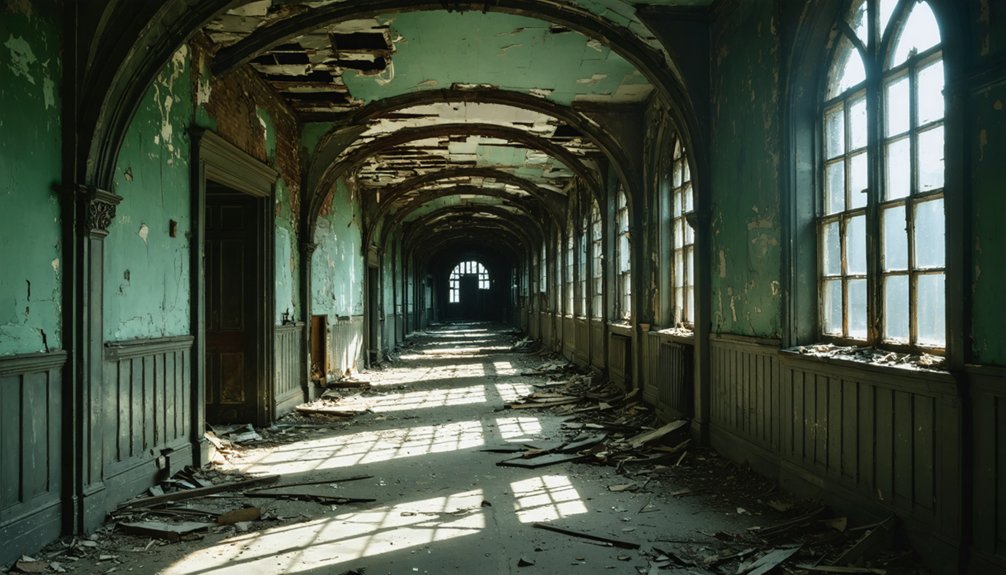
You’ll find the imposing Kirkbride Plan asylum in Fergus Falls, a sprawling brick complex with towering spires visible from Interstate 94 that treated over 40,000 patients before its 2007 closure.
The symmetrical wings cascade from the central administration tower, where the most severely ill patients once occupied the wards furthest from the entrance—a design detail that now fuels paranormal investigation tours through the darkened corridors.
This National Register site, constructed between 1888 and 1912, remains Minnesota’s only fully intact linear Kirkbride structure. Its bare façades and empty treatment rooms preserve a century of institutional history.
Abandoned Hospital’s Dark History
Rising from the prairie landscape since 1890, Fergus Falls State Hospital stands as one of America’s last intact Kirkbride-design asylums—a tribute to 19th-century therapeutic architecture that believed light and ventilation could cure mental illness.
Yet these abandoned structures harbor haunted lore that contradicts their healing mission.
You’ll discover a cemetery where unclaimed patients rest beneath numbered iron stakes—no names, no dates, just forgotten souls.
The facility’s dark reality emerges through:
- 1,700 patients crammed into overcrowded wards during peak 1930s-1940s occupancy
- Over 40,000 total patients treated across 115 years of operation
- Anonymous burials marking those who died unclaimed and unremembered
The central tower’s cascading wings once segregated patients by illness severity, creating isolation within supposed sanctuary before closure in 2005.
Paranormal Investigation Activities Today
Since the city sealed the Kirkbride building in 2012, paranormal investigation opportunities at Fergus Falls have vanished entirely.
You won’t find access to those basement tunnels where Midwest Paranormal Files split up during their marathon sessions, nor will you explore the three-spired main complex where investigators once documented spiritual activity until 6:30 AM.
The Friends of the Kirkbride connections that facilitated those June and July investigations no longer grant entry. No EVP recordings echo through those corridors designed for moral treatment anymore.
The 120-acre property stands locked down, its bare façade and Kirkbride-plan architecture preserved but inaccessible.
That adjacent cemetery with numbered wrought iron stakes remains visible from outside, but you’re effectively barred from investigating the site’s paranormal reputation firsthand.
Active Film Locations Versus True Abandoned Sites
Minnesota’s film locations are divided into two distinct categories: thriving urban centers where crews transform active streetscapes into movie sets, and genuine ghost towns where decay tells its own story without Hollywood intervention.
You’ll find Minneapolis and St. Paul hosting productions like Jingle All The Way and Untamed Heart, where fake storefronts overlay functional businesses. These urban settings provide controllable environments with renovation flexibility.
Contrast that with authentic abandonment:
- Forestville requires guided tours through preserved 1800s buildings within state park boundaries.
- Finland displays stripped house interiors and demolished military base foundations for wildlife photography enthusiasts.
- Elcor demands sturdy footwear while exploring mining-era artifacts across rugged terrain.
True ghost towns offer urban decay without permits or power hookups. Faribault bridges both worlds—accessible historic features supporting drama productions while Wasioja’s seminary ruins remain film-free, protected heritage sites where you’ll explore independently.
Paranormal History at the Fergus Falls State Hospital
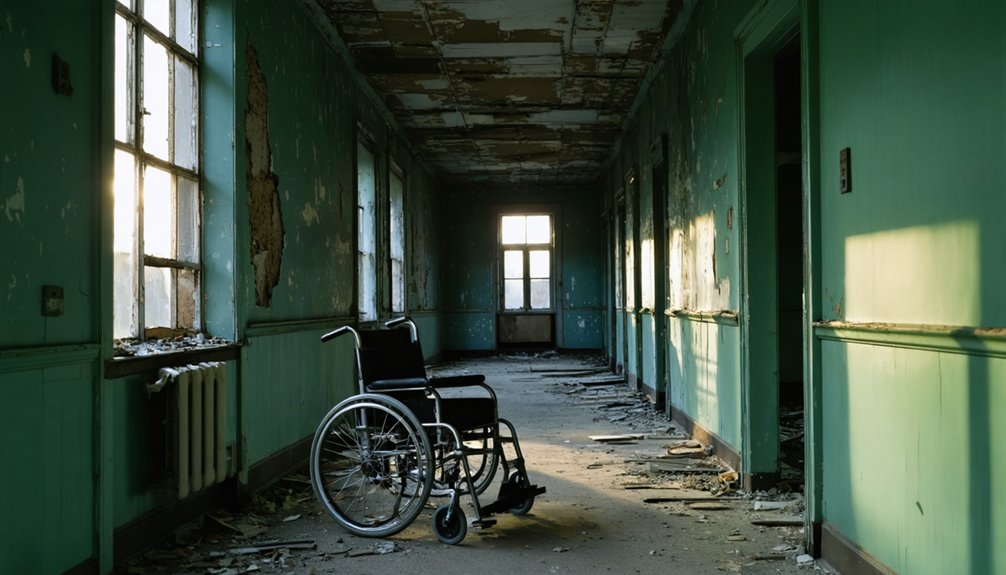
The Fergus Falls State Hospital opened its doors on July 31, 1890, following a four-year construction period that left architect Warren B. Dunnell’s Kirkbride Plan design incomplete—only the West Detached Ward stood ready.
You’ll find this sprawling 120-acre campus became home to over 40,000 patients by 1970, creating layers of haunted history within its Gothic Revival walls.
Within these Victorian corridors, over four decades of institutional care left an indelible mark on thousands of troubled souls.
The facility’s peak population reached 2,005 souls in 1950, many subjected to insulin shock treatments, metrazol injections, and electro-shock therapy.
Spirit activity reports emerged from decades of institutional life, with the main building’s recognition on the National Register of Historic Places in 1978 preserving its architectural significance.
The century-long operation ended when Minnesota finally closed this regional treatment center’s doors.
Minnesota’s Mix of Thriving Towns and Desolate Film Sets
While Hollywood scouts typically gravitate toward dramatic extremes, Minnesota delivers both ends of the spectrum—bustling metropolitan corridors and wind-swept ruins frozen in time.
You’ll find thriving locations like Minneapolis’s Nicollet Mall (*Jingle All the Way*) alongside genuine ghost towns where foundations crumble into prairie grass.
Minnesota’s Film Location Spectrum:
- Active Urban Sets – Downtown Minneapolis and St. Paul blend community engagement with cinematic landmarks you can still explore.
- Declining Commercial Sites – Eden Prairie Mall (*Mallrats*) underwent renovation but retains recognizable features for cult film devotees.
- Authentic Ruins – Forestville and Elcor offer historical preservation through scattered mining artifacts and abandoned company-town remnants.
This contrast lets you chase film history through vibrant neighborhoods or venture into desolate settlements where nature reclaims what industry abandoned, providing unmatched location diversity.
Frequently Asked Questions
Are Any Other Minnesota Ghost Towns Used in Horror or Thriller Films?
You’ll find the trail runs cold—no confirmed horror films have captured Minnesota’s ghost town mystery on location. However, haunted legends at Grey Cloud Island and Finland’s eerie abandonment offer untapped potential for thriller productions seeking authentic, decaying backdrops beyond studio sets.
Can Visitors Legally Enter the Abandoned Fergus Falls State Hospital Today?
No, you can’t legally enter the building’s interior due to legal restrictions and safety concerns like mold contamination. You’re welcome to explore the public grounds freely, but the abandoned hospital’s inside remains off-limits since its 2005 closure.
Which Minnesota Ghost Town Locations Are Safest for Independent Exploration?
Forestville’s maintained trails and Wasioja’s seminary ruins offer you the safest independent exploration with clear paths and structural stability. Follow basic safety precautions like wearing sturdy footwear, and use these exploration tips: stay on marked routes and avoid climbing fragile structures.
Have Film Productions Caused Damage to Abandoned Minnesota Historical Sites?
No documented evidence links film productions to damage at Minnesota’s abandoned sites. You’ll find vandalism concerns stem from unauthorized visitors, not crews. Historical preservation efforts focus on natural decay and trespassing—productions typically avoid fragile ghost town locations entirely.
Do Local Ghost Town Tours Include Behind-The-Scenes Filming Location Information?
No, you won’t find filming location leaks on standard tours. Local tour guides stick to historical narratives at Forestville, Wasioja, and Elcor, skipping movie production details entirely—leaving you free to discover cinematic connections independently.
References
- https://daytripper28.com/minnesotas-most-famous-movie-filming-locations/
- https://www.motionpicturevideo.com/top15locations
- https://thievesriver.com/blogs/articles/ghost-towns-in-minnesota
- https://www.youtube.com/watch?v=v9-6yiaNvl4
- https://www.youtube.com/watch?v=-eAg5yc3kkg
- https://www.exploreminnesota.com/seasons/fall/spookiest-places-minnesota
- https://mnfilmtv.org/made-mn-projects
- https://www.cbsnews.com/minnesota/news/the-musical-mission-behind-a-fergus-falls-abandoned-hospital/
- https://en.wikipedia.org/wiki/Fergus_Falls_Regional_Treatment_Center
- https://www.visitfergusfalls.com/explore/arts-history/regional-treatment-center/