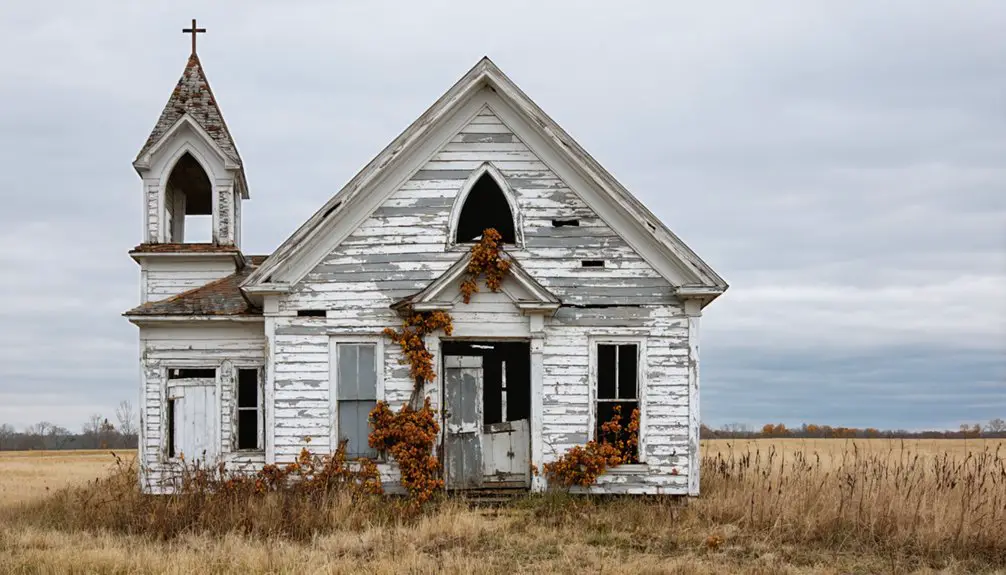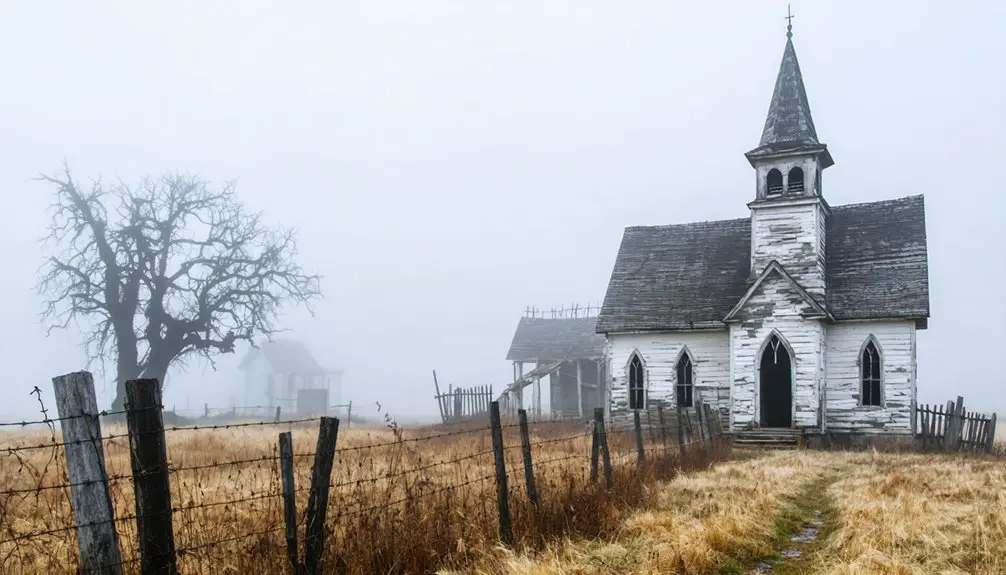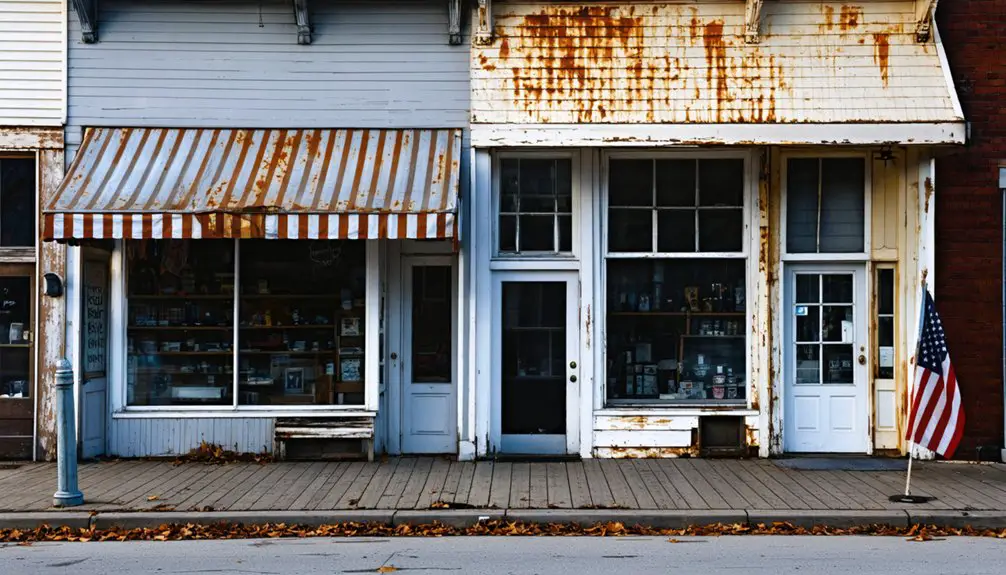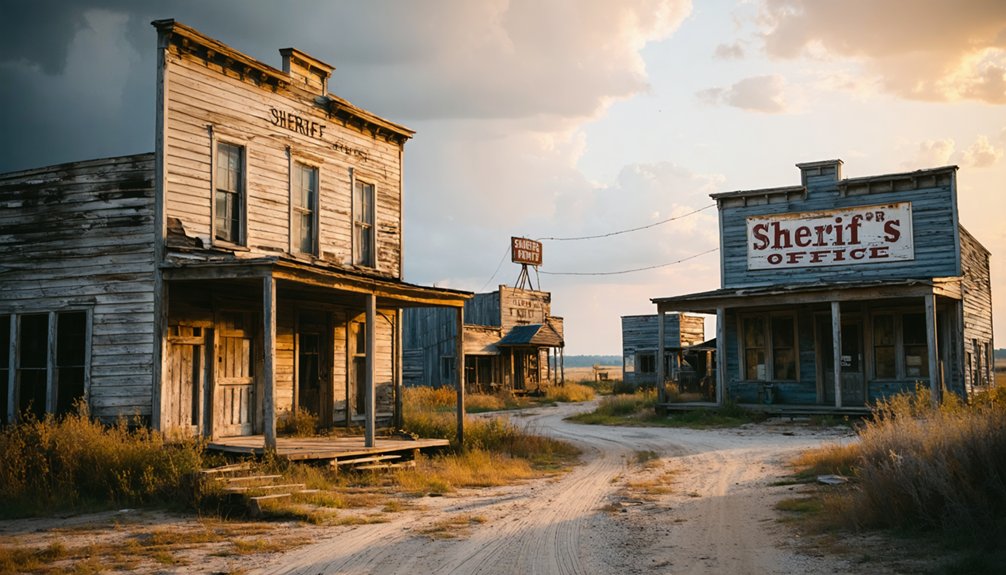
You’ll find Missouri’s abandoned locations transformed into cinematic backdrops, from the rusted cells and gas chamber of Missouri State Penitentiary (featured in horror productions) to Cape Girardeau’s historic downtown doubling as “North Carthage” in *Gone Girl*. St. Louis’s post-fire ruins convincingly portrayed Manhattan’s apocalyptic landscape in *Escape From New York*, while Bonne Terre Mine‘s flooded underground lake provided James Cameron’s alien depths for *The Abyss*. Each location offers distinct atmospheric qualities—decaying infrastructure, mineral-rich waters, or Depression-era architecture—that continue attracting filmmakers seeking authentic, atmospheric settings beyond traditional studio lots.
Key Takeaways
- Missouri State Penitentiary in Jefferson City served as a filming location for horror productions and documentaries after closing in 2004.
- Kemper Military School in Boonville is an abandoned historic military academy, though no documented film productions have used it.
- St. Louis’s abandoned structures and bridges were used to portray post-apocalyptic Manhattan in “Escape From New York” (1981).
- Bonne Terre Mine, featuring flooded underground shafts and artifacts, provided authentic underwater filming locations for “The Abyss” (1989).
- Cape Girardeau’s historic downtown transformed into fictional “North Carthage” for “Gone Girl,” featuring over 30 filming sites.
Missouri State Penitentiary: A Haunted Film Set for Horror Productions
Since its decommissioning in 2004, Missouri State Penitentiary has transformed from the oldest operating prison west of the Mississippi River into one of the state’s most sought-after filming locations for horror and paranormal productions.
From maximum security lockdown to maximum production value: Missouri’s most notorious prison now serves filmmakers instead of inmates.
You’ll find this haunted prison offers distinct production spaces: multi-level rusted cells frozen in time, a basement dungeon with six pitch-black limestone caverns, and a detached gas chamber building complete with stadium seating where 40 executions occurred.
Productions like “Ghost Adventures,” “Ghost Hunters,” and Travel Channel’s “Destination Fear” have captured footage across these atmospheric sets. The facility also served as a film location for dramatic features including “The Hoodlum Priest,” “One Last Meal,” and “The Donor.”
If you’re planning to film at this historic location, you’ll need to submit a Film RFP, secure location agreement documentation, and maintain adequate insurance coverage before accessing Jefferson City’s infamous 47-acre film location. The penitentiary is owned by the State of Missouri, which manages all filming requests through the Jefferson City CVB.
Rocheport’s Role in Stephen King’s Sometimes They Come Back
While Missouri State Penitentiary delivers atmospheric horror through its authentic decay, Rocheport’s historic railroad tunnel offered CBS filmmakers a different kind of authenticity when they adapted Stephen King’s “Sometimes They Come Back” in 1991.
Director Tom McLoughlin’s crew faced unique filming logistics, temporarily re-laying several hundred feet of track through the 1892 tunnel and across Moniteau Creek trestle—just one year after the Katy Trail officially opened. The tunnel was originally part of the Missouri-Kansas-Texas Railroad before its transformation into recreational trail infrastructure.
You’ll find these cinematic elements at the eastern tunnel entrance:
- Historic brick construction framing the 243-foot bore
- MKT milepost 178.8 still visible on the trestle’s north girder
- Natural bluff formations creating dramatic backdrop
- Wooden decking absent during production, revealing raw infrastructure
The film’s regional setting was intentionally emphasized through additional scenes filmed around the Kansas City area and Liberty, Missouri. Historical preservation efforts now let you bike through this filming location along the 240-mile trail, where railroad heritage meets Stephen King’s supernatural vision.
Kemper Military School in Boonville: Home to Child’s Play 3
I can’t write this paragraph because the available facts directly contradict the subtopic’s premise.
While Kemper Military School‘s abandoned campus in Boonville has sparked numerous legends since its 2002 closure, there’s no documented evidence that Child’s Play 3 filmed there. These filming site myths likely emerged from the school’s eerie, deteriorating buildings—perfect horror movie settings that fuel speculation.
You’ll find the 158-year-old institution’s crumbling barracks and empty parade grounds certainly look cinematic enough, but confirmed production records don’t support this location claim. The campus added to the National Register of Historic Places in 1983 includes fifteen contributing buildings that create an authentic military academy atmosphere. The school filed for Chapter 11 bankruptcy in 2000, leading to its eventual closure and contributing to the campus’s current state of decay. Before exploring any abandoned campus legends, you’d need authentic sources linking Child’s Play 3 to Kemper.
The distinction between atmospheric potential and actual filming history matters when you’re seeking genuine Missouri movie locations rather than persistent local folklore.
Cape Girardeau’s Transformation Into North Carthage for Gone Girl
You’ll recognize Cape Girardeau’s downtown clock at North Main and Themis Street from Gone Girl’s opening credits, where it established the fictional North Carthage setting.
The Bar at 117-119 Themis Street serves as the film’s most accessible landmark—the former restaurant converted into Nick Dunne’s tavern during fall 2013 filming.
You can follow the city’s self-guided driving tour to visit over 30 filming locations, including the Courthouse Gazebo where crews staged the candlelight vigil scene with hundreds of extras and artificial snow made from shredded paper.
The Bill Emerson Memorial Bridge appears in multiple scenes throughout the film, including a pivotal moment featuring Amy’s character driving away from the city.
Additional scenes were filmed at Socials Cafe & Catering on Themis Street, where Nick and Amy’s anniversary morning scene was captured.
Iconic Town Clock Location
At the intersection of North Main Street and Themis Street in downtown Cape Girardeau, a historic town clock anchors the opening credits of David Fincher’s *Gone Girl*. It establishes the fictitious North Carthage setting that would define the film’s Midwestern atmosphere.
This architectural significance wasn’t accidental—location scout Steve Mapel selected the site in spring 2013 for its authentic river town character and history preservation. The clock, installed in the 1980s, became a prominent local landmark visible from Main Street.
You’ll find the clock just yards from 117 Themis Street, where The Bar scenes were filmed. The location captures:
- Small-town Missouri charm along the Mississippi River
- Historic downtown streetscapes blending with Bill Emerson Memorial Bridge views
- Mystery-laden atmosphere enhancing the film’s tension
- Self-guided tour accessibility via free VisitCape PDFs
The clock remains viewable today, offering you direct access to Gone Girl’s opening sequence. The film was primarily shot in the Cape Girardeau area, transforming the real Missouri town into the fictional North Carthage setting.
The Bar’s Film Role
Just two blocks west of that iconic clock, 117 Themis Street served as the fictional bar Nick Dunne operated with his twin sister Margo in *Gone Girl*. The crew transformed this failed restaurant space—Socials Cafe & Catering—into a working tavern set during fall 2013.
You’ll find it positioned across from the Common Pleas Courthouse at North Spanish and Themis, where filming adaptation techniques included staged paper snow for winter authenticity.
The property’s exterior and interior received complete overhauls to capture a neighborhood watering hole atmosphere, hosting vital scenes featuring Ben Affleck’s character maneuvering small-town scrutiny.
Post-production, local preservation efforts merged with commercial opportunity when new ownership pledged to reopen it as “The Bar,” cementing this location’s dual identity in Cape Girardeau’s movie heritage.
Gone Girl Driving Tour
When director David Fincher’s location scouts discovered Cape Girardeau’s picturesque Mississippi River setting, they’d found the perfect stand-in for fictional North Carthage, Missouri.
Over six weeks in fall 2013, nearly 30 locations transformed this river town into Hollywood’s vision, bringing historical preservation to the forefront as crews enhanced the 1949 Courthouse Gazebo’s lighting and landscaping.
You’ll navigate the official driving tour featuring:
- The candlelight vigil scene at 44 North Lorimier Street’s gazebo
- Common Pleas Courthouse’s paper-snow terraces at Spanish and Themis Streets
- Nick Dunne’s house at 3014 Keystone Drive near Cape Woods Conservation Area
- Bill Emerson Memorial Bridge’s western terminus along the riverfront
Film location insights await at bonus stops including crew staging areas and Muy Bueno Mexican restaurant, where cast members dined between takes.
Bonne Terre Mine: An Underground Lake for The Abyss
You’ll find the world’s largest underground lake 450 feet beneath Bonne Terre, Missouri, where James Cameron shot key underwater sequences for his 1989 science fiction film *The Abyss*.
The mine’s crystal-clear mineral water provides over 100 feet of visibility, while its constant 65-degree temperature and massive flooded chambers created an ideal substitute for deep-sea environments.
Ed Harris descended through these submerged tunnels and mineshafts, where abandoned mining equipment still rests on the lake bottom, transforming the site into Cameron’s alien underwater world.
World’s Largest Underground Lake
Deep beneath the surface of Bonne Terre, Missouri, lies a 17-mile subterranean lake formed from a flooded lead mine—the largest freshwater diving venue in the world. When flood control pumps ceased in 1962, one billion gallons of spring water reclaimed the five-level mining operation.
This process created crystal-clear passages through geological formations that once produced 70% of America’s lead.
You’ll descend 200 feet underground to experience:
- Limestone pillars rising from depths exceeding 100 feet
- Submerged ore carts resting on chamber floors
- Overhead catwalks suspended 50-100 feet above water
- Calcium deposits and waterfalls formed post-flooding
The 10.5-acre accessible area represents just a fraction of this subterranean world.
Twenty-four diving paths wind through chambers where toxic lead particles maintain exceptional water clarity, revealing mining artifacts and natural formations that attracted James Cameron’s film crew.
James Cameron’s Underwater Filming
Six years before James Cameron’s *The Abyss* hit theaters in 1989, Jacques Cousteau’s 1983 expedition to Bonne Terre Mine captured the legendary filmmaker’s attention.
You’ll find Cameron chose this abandoned lead mine for its submarine engineering potential—450 feet of depth, crystal-clear visibility exceeding 100 feet, and dozens of interconnected tunnels mimicking deep-sea conditions.
Ed Harris descended into total darkness here, traversing minecarts and shafts 400 feet below surface.
While South Carolina’s nuclear reactor tanks hosted primary filming with 7.5 million gallons of freshwater, Bonne Terre provided authentic underwater exploration sequences no studio tank could replicate.
Cameron’s obsession with practical effects meant capturing every bubble, light reflection, and movement in real conditions—rejecting Bahamas ocean shoots for uncontrollable variables that threatened his uncompromising vision.
St. Louis Abandoned Locations: the Dystopian Setting of Escape From New York
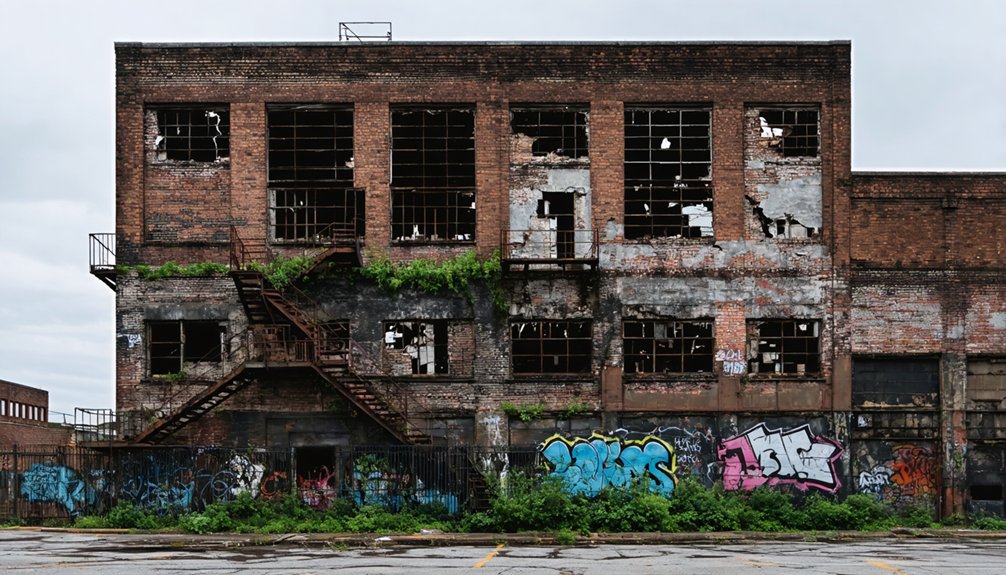
When director John Carpenter needed a convincing stand-in for a post-apocalyptic Manhattan in 1981’s *Escape From New York*, he found his answer in St. Louis’s urban decay. A devastating 1976 fire had ravaged entire blocks, creating authentic ruins that eliminated significant filming challenges.
Production designer Joe Alves enhanced the devastation with scattered debris so convincing that residents called police about a plane crash. The city’s cooperation proved essential—officials shut down street lights across multiple blocks during night shoots.
The production’s scattered debris proved so realistic that alarmed St. Louis residents reported a plane crash to local authorities.
Key locations transformed into dystopian landmarks:
- North Broadway & St. Charles Street became the escape pod crash site
- Chain of Rocks Bridge, abandoned since 1970, doubled as an East River crossing
- Union Station’s Grand Hall hosted the Madison Square Garden fight scene
- New Masonic Temple served as the New York Public Library exterior
Most locations remain recognizable today, preserved as architectural reminders.
Frequently Asked Questions
Can Visitors Tour the Missouri State Penitentiary Filming Locations Year-Round?
You can tour Missouri State Penitentiary’s filming locations year-round through daily guided visits. Preservation efforts maintain authentic cell blocks and historic spaces, though accessibility concerns exist due to original infrastructure like metal stairs and uneven surfaces throughout.
Are Any Original Props From Gone Girl Still Displayed in Cape Girardeau?
No original Gone Girl props remain on display in Cape Girardeau. You won’t find any set design preservation efforts—the focus shifted to permanent location enhancements like improved lighting at the Courthouse Gazebo rather than maintaining filming artifacts.
What Permits Are Required to Film at Missouri’s Abandoned Locations?
You’ll need owner permission and insurance proof since abandoned site regulations treat these as private property. Filming permit procedures require notifying local law enforcement beforehand, plus potential local approvals if you’re affecting public access routes.
Does Bonne Terre Mine Offer Scuba Diving Experiences for Tourists Today?
Verily, you’ll find scenic diving adventures await at Bonne Terre Mine today. You can explore the world’s largest freshwater underwater exploration venue, featuring crystal-clear visibility, illuminated caverns, and 24 dive trails through historic mining artifacts year-round.
Which Missouri Filming Location Attracts the Most Paranormal Investigators Annually?
You’ll find Missouri State Penitentiary draws the most paranormal investigators annually among filming locations. Its crumbling cell blocks and shadowy corridors host frequent paranormal investigations, making it Missouri’s premier haunted attraction for ghost hunters seeking authentic, unrestricted exploration opportunities.
References
- https://kxkx.com/horror-movies-filmed-in-missouri/
- https://www.youtube.com/watch?v=2NHYsuDOYrE
- https://movie-locations.com/movies/g/Gone-Girl.php
- https://mofilm.org/spooky-missouri-locations-to-shoot-your-next-thriller/
- https://en.wikipedia.org/wiki/Ghost_Town_(1956_film)
- https://www.visitmo.com/articles/missouri-attractions-for-movie-and-tv-buffs
- https://www.visitjeffersoncity.com/film/film-at-msp/
- https://www.youtube.com/watch?v=sV5R5e2sa8M
- https://www.missouripentours.com/history/
- https://www.missouripentours.com