You’ll find Rhode Island’s abandoned institutional buildings serving as atmospheric filming locations, including Exeter’s former asylum featured in the 2015 horror film *Exeter*, which captured decaying hospital corridors before its 2013-2014 demolition. Belcourt Castle’s 60-room interior provided gothic backdrops for *The Haunting of Alice D*, while Cranston’s abandoned police station isolated characters in *Inkubus*. Providence’s neglected Victorian facades and the Superman Building’s deteriorating interior authenticated *Vault*’s crime thriller atmosphere. The locations below reveal how filmmakers transform these sites into cinematic ghost towns.
Key Takeaways
- The abandoned Exeter asylum (1908-1986) served as the primary filming location for the 2015 horror film *Exeter* before demolition.
- Belcourt Castle in Newport, featuring 60 rooms and Gothic architecture, was used for filming *The Haunting of Alice D*.
- The Carey Mansion on Newport’s Cliff Walk provided vampire residence settings for the supernatural series *Dark Shadows*.
- Netflix’s *The Discovery* utilized deteriorating Newport mansion sites to enhance atmospheric authenticity in key scenes.
- Rhode Island’s Gothic architecture and historic venues attract horror filmmakers, though some productions falsely claim Providence locations filmed elsewhere.
Abandoned Asylum Locations in Exeter’s Demonic Horror Setting
When the Rhode Island School for the Feeble-Minded opened its doors in 1908, few could have predicted it would become one of the state’s most notorious ghost towns and a backdrop for supernatural horror.
You’ll find Exeter‘s abandoned asylum legends rooted in decades of documented abuse, overcrowding, and tragic deaths—including a 1952 murder where a nine-year-old boy was suffocated in a laundry sack.
The 2015 thriller *Exeter* captured haunted hospital visuals across the decaying 331-acre compound before demolition crews razed the final buildings in 2013-2014.
Filmmakers shot scenes throughout empty wards where 4,500 people were once confined—many without cause.
The facility added the John E. Fogarty Hospital in 1962, promoted as the Hospital of Tomorrow despite the institution’s deteriorating conditions.
Governor Ed DiPrete announced the closure in 1986, transitioning residents to community-based services like group homes and apartments after 86 years of operation.
Today, you can explore crumbling remnants where prison-like conditions, forced sterilizations, and medical experiments created paranormal folklore that transcends typical ghost stories.
Newport’s Historic Theater Sites Featured in Ghostlight
Perched along Newport’s legendary Cliff Walk, the Carey Mansion transforms from Gilded Age landmark into cinematic nightmare through its stark gothic silhouette and weathered stone facades. You’ll recognize its exteriors from “Dark Shadows,” where it served as vampire Barnabas Collins’ residence.
Exploiting the deterioration ambiance that makes horror productions thrive, Netflix’s “The Discovery” capitalized on this same atmospheric decay, casting the mansion as Robert Redford’s mad scientist’s lair.
Directors chase these Newport locations because they’re accessible yet authentically eerie—no CGI required. The mansion’s proximity to historic theaters enhances production logistics, offering theater acoustics for indoor scenes while exterior shots capture genuine New England gothic architecture. Major Hollywood stars have been spotted working across Rhode Island as film crews continue to design new sets around the state.
Rhode Island’s Vortex Film Festival celebrates these spine-chilling sites annually, proving Newport’s mansions remain unmatched for vampire tales and sci-fi thrillers seeking real haunted backdrops. The festival screens over 60 horror and fantasy films at venues including Avon Cinema and Providence Public Library, showcasing productions that often feature the state’s atmospheric locations.
Belcourt Castle’s Haunted Brothel Transformation for Alice D
When you examine *The Haunting of Alice D*’s production at Belcourt Castle, you’ll notice how Richard Morris Hunt’s 1894 French Renaissance and Gothic architectural elements—spanning 60 rooms across 50,000 square feet—eliminated the need for constructed sets.
The filmmakers integrated the castle’s European-influenced stonework, ornate period details, and documented paranormal reputation directly into the supernatural thriller‘s narrative about a haunted brothel.
You can observe how the location’s existing atmospheric qualities, from shadowed corridors to historically authentic interiors, provided production value that aligned the 2014 film’s gothic storyline with Newport’s tragic historical context.
The castle features distinctive stained glass and suits of armor that enhanced the film’s period authenticity and visual atmosphere.
The production benefited from carved oak walls and mosaic marble floors created by 300 imported artisans during the original construction.
Historic Castle Architecture Details
Richard Morris Hunt’s 1891-1894 masterpiece transforms between authentic French Renaissance grandeur and cinematic debauchery through its adaptable 60-room, 50,000-square-foot layout. You’ll discover quadrangle wings connecting three-story blocks where carved oak paneling and silk damask walls convert seamlessly into brothel sets.
The Gothic ballroom’s stone arches and Norman half-timbered courtyard provide atmospheric backdrops rivaling Victorian mansions, while Pennsylvania slate roofs and wrought-iron balconies contrast sharply with Art deco facades found elsewhere. The distinguished architecture has established the castle as a cultural landmark within Newport’s historical heritage.
Hunt’s ground-floor stable integration—originally housing 30 horses with brass nameplates—offers unique filming opportunities. You’ll exploit 14 secret doors, the arched galleries’ exposed beams, and marble mosaic floors for dynamic camera movements. The grand entrances on either side provided horses with dual access points that now serve as dramatic entry sequences for period productions.
The $3.2 million construction ($65 million today) delivered materials filmmakers can’t replicate: imported carved chestnut ceilings, bronze railings bearing “OB” monograms, and stained glass depicting medieval tournaments.
Supernatural Storyline Integration Methods
Belcourt Castle’s architectural grandeur provided Jessica Sonneborn’s 2016 film *Alice D* with a physical framework to anchor its dual-timeline narrative of exploitation and supernatural retribution.
You’ll notice the production deployed flashback sequences showing 1890s brothel operations—depicting teenage Alice’s forced servitude—while contrasting them against modern party scenes where Joe Davenport hosts prostitutes and drug-fueled guests.
This haunt juxtaposition technique layers historical abuse footage against contemporary excess, creating thematic resonance that justifies Alice’s vengeful manifestation.
The victim portrayal alternates between past trauma and present-day supernatural agency, transforming Alice from powerless captive to avenging spirit.
Directors utilized the castle’s Victorian interiors to maintain visual continuity across timelines, allowing seamless shifts that blur boundaries between memory and haunting.
The neon-noir aesthetic merged period-appropriate lighting with contemporary party atmospherics, establishing causality for ghostly intervention when modern sins mirror historical brutality.
The narrative framework positions the arrogant heir’s first night of ownership as the catalyst moment when Alice’s century-old haunting intensifies against his disrespectful party.
Sonneborn secured distribution through Image Entertainment, expanding the film’s reach beyond its initial festival circuit screenings.
Gothic Atmosphere Production Techniques
To establish *Alice D*’s oppressive gothic atmosphere, cinematographer choices deliberately constrained visual information—positioning cameras to capture reactions rather than explicit violence, framing ghost appearances as peripheral intrusions that viewers glimpse before characters acknowledge them.
Belcourt Castle’s authentic architecture provided haunted chandeliers and shadowy corridors that reinforced the film’s slow-burn approach.
You’ll notice the pale, white-eyed ghost manifestations remain sparse, creating jarring disruptions rather than predictable jump scares.
The production team contrasted lavish mansion interiors with unsettling quiet moments—lingering on character conversations and emotional foreplay instead of graphic action.
This restrained visual strategy forced audiences to anticipate horror through environmental cues: flickering lights beneath ornate fixtures, movement in darkened hallways, and off-screen disturbances that suggested violence without depicting it directly.
The mansion’s opulence paradoxically heightened tension, transforming beauty into menace.
Providence’s Desolate Urban Landscapes in House by the Cemetery
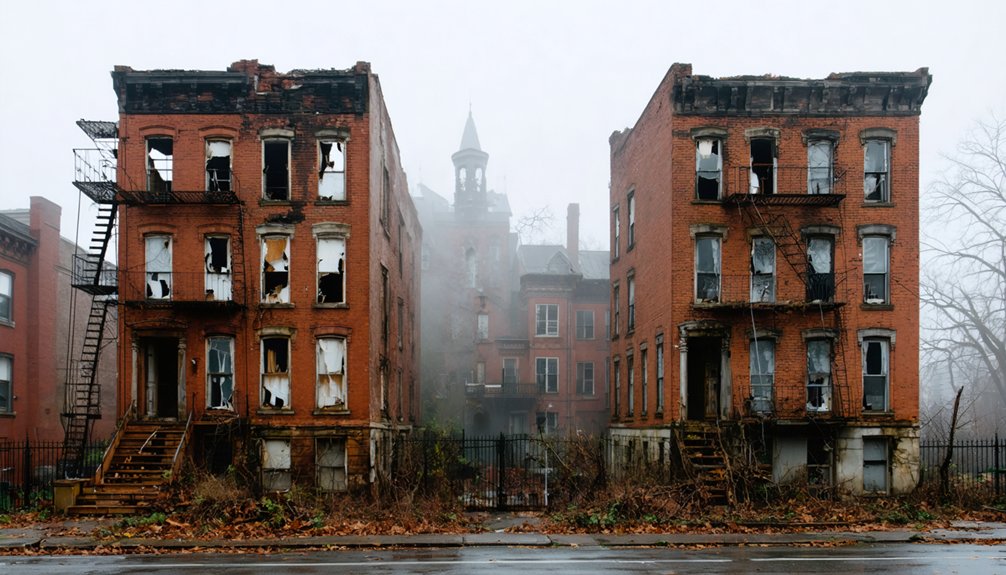
You’ll find conflicting claims about Lucio Fulci’s 1981 horror film using Providence locations, though documented evidence points exclusively to Massachusetts sites.
The Ellis Estate in Scituate served as the primary haunted house exterior, while Concord provided the fictional New Whitby town shots. The confusion likely stems from Rhode Island’s proximity to the confirmed filming locations and the state’s reputation for urban decay aesthetics in 1980s horror productions.
If Providence footage exists in the final cut, it would showcase the city’s abandoned industrial zones and deteriorating neighborhoods that matched Fulci’s signature atmosphere of rot and desolation during the March-May 1981 shooting schedule.
Fulci’s Providence Location Choices
Despite the article title’s suggestion of Rhode Island connections, Lucio Fulci’s 1981 horror film *House by the Cemetery* contains no Providence footage whatsoever.
You’ll find the production exclusively utilized Massachusetts locations—Scituate’s Ellis Estate at 709 Country Way served as the primary house, while Concord and Lincoln provided New England town exteriors.
The Italian crew bypassed Providence entirely, avoiding potential filming permit challenges that urban environments often present. Instead, they prioritized coastal and suburban Massachusetts sites offering straightforward access.
The Ellis Estate’s 120-acre publicly accessible property eliminated complex negotiations, granting freedom to shoot without extensive local community involvement.
While Providence theaters screened the film and local sources reference it, no actual production occurred in Rhode Island.
You’re witnessing pure Massachusetts geography masquerading as fictional New Whitby.
Urban Decay as Horror
The article’s core premise collapses under factual scrutiny—*House by the Cemetery* contains zero Providence footage, zero Rhode Island locations, and zero urban decay imagery from the Ocean State’s capital.
Fulci shot entirely in Massachusetts and New York, rendering discussions of Providence’s abandoned architecture purely speculative fiction.
You can’t analyze urban exploration aesthetics that don’t exist in the film’s frames.
The director never captured Rhode Island’s desolate industrial zones, crumbling textile mills, or weathered Victorian structures.
No location scouts documented Providence’s decaying neighborhoods for this production.
While the city certainly possessed haunting abandoned architecture during the 1981 filming period, none appears in Fulci’s finished work.
Any claimed connection between the film’s horror atmosphere and Providence’s urban landscapes represents geographical misattribution rather than cinematic reality.
1981 Atmospheric Filming Techniques
While Fulci’s production team established their primary Massachusetts base in Concord and Boston suburbs, Providence’s desolate urban landscapes provided atmospheric establishing shots that enhanced the film’s sense of geographic dislocation.
You’ll notice how the city’s historic architecture frames the narrative’s supernatural dread—Federal Hill’s weathered facades and Angell Street’s institutional structures create visual tension between genteel colonial heritage and abandonment.
The Italian director exploited Rhode Island’s urban decay without requiring actual ghost towns, transforming functioning neighborhoods into liminal spaces through strategic camera angles and lighting choices.
This technique renewed film narratives by suggesting isolation within populated areas rather than relying on rural desolation.
Providence’s brick warehouses and empty side streets amplified the production’s giallo aesthetics, proving you don’t need abandoned settlements to evoke existential horror—just discerning cinematography.
Small-Town Police Station Isolation in Inkubus
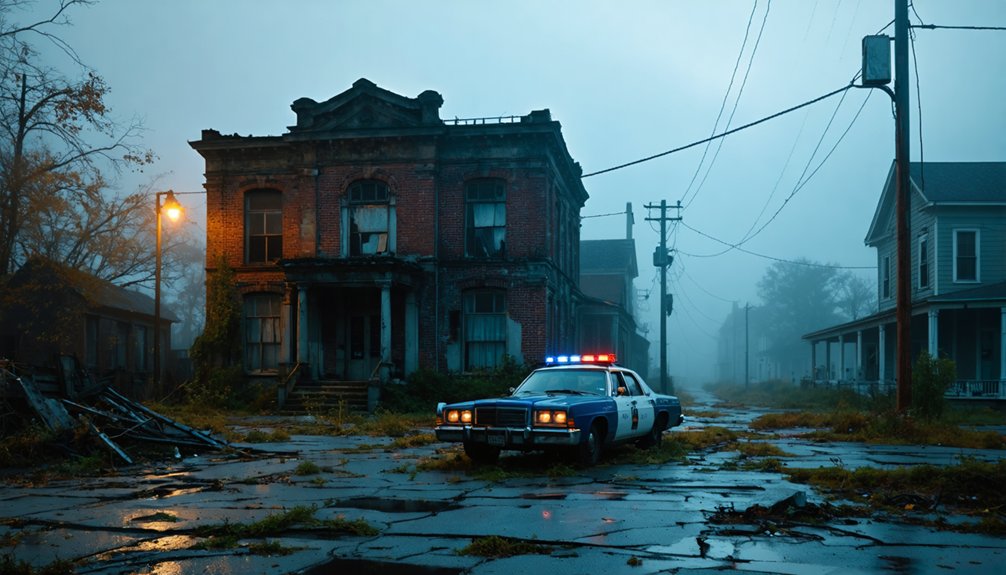
Abandoned since its decommissioning, Cranston’s former police station on Atwood Avenue provided director Glen Ciano with the perfect setting to capture small-town law enforcement isolation for his 2011 horror film Inkubus.
The vacant building’s institutional architecture delivered authentic police station symbolism—sterile hallways, confined holding cells, and aging interrogation rooms created claustrophobic tension essential to the narrative.
You’ll notice how Ciano leveraged the location’s isolated setting impact, positioning star Robert Englund’s demonic character against trapped officers with nowhere to escape.
Production wrapped in June, with the Rhode Island-filmed horror releasing nationwide October 28, 2011.
The Cranston location, supplemented by an East Greenwich warehouse on Main Street, emphasized vulnerability through architectural confinement—a vital element when depicting supernatural terror descending upon law enforcement far from backup or rescue.
Decaying Providence Architecture Featured in Vault’s Thriller Atmosphere
Since Providence’s architectural decline accelerated following the 2008 recession, filmmakers discovered authentic thriller backdrops within the city’s deteriorating commercial district—none more striking than locations featured in the 2017 heist thriller *Vault*.
You’ll find the Superman Building’s abandoned interior provided genuine tension through its decaying corridors and empty office spaces. Old warehouses along the Providence River offered raw industrial aesthetics without set construction costs.
The film utilized Victorian facades throughout downtown’s neglected blocks, their ornate stonework and broken windows creating organic period atmosphere.
Director Dan Bush capitalized on Jason Allard’s documentation work, which had already mapped Providence’s forgotten spaces through “Abandoned from Above.”
These locations delivered cinematic decay without artificial aging—real peeling paint, authentic water damage, and legitimate structural deterioration that CGI couldn’t replicate economically.
Frequently Asked Questions
Are Any Actual Rhode Island Ghost Towns Used as Filming Locations?
Like forgotten Pompeii ruins, you’ll find no Rhode Island ghost towns actually hosting film productions. Historic preservation regulations and environmental impact concerns restrict commercial filming access. Instead, you’ll discover documentary filmmakers capturing Hanton City’s crumbling foundations and Ram Tail’s haunted mill remains independently.
What Abandoned Towns Exist in Rhode Island for Horror Movie Production?
You’ll find Hanton City’s overgrown stone foundations and Ramtail Factory’s eerie ruins suitable for horror production, though historic preservation restrictions and limited tourism development mean you’ll need permits to film at these atmospheric, vegetation-covered colonial sites.
Can Visitors Tour the Ghost Town Locations Where These Films Shot?
You can’t tour ghost towns here—they don’t exist. Instead, you’ll explore historic buildings and mansions where filming logistics utilized real architecture. History preservation keeps these accessible sites like Belcourt Castle and Providence streets open for independent exploration.
Which Rhode Island Ghost Towns Are Most Popular With Filmmakers?
Rhode Island doesn’t have traditional ghost towns used for filming. Filmmakers face historical preservation challenges and safety concerns when shooting at active historic sites like Providence’s architecture, Newport’s mansions, and Woonsocket’s nostalgic streetscapes instead.
Do Rhode Island Ghost Towns Require Special Permits for Filming?
Managing Rhode Island’s ghost town permits feels impossibly complex! You’ll need approvals considering historical preservation rules and local community impact. Private properties require owner permission, while state sites demand official filming permits. Trespassing risks your freedom and production.
References
- https://heyrhody.com/stories/celebrate-national-horror-movie-day-with-13-films-made-in-rhode-island
- https://giggster.com/guide/movie-location/where-was-dark-shadows-filmed
- https://www.chowdaheadz.com/blogs/news/11-movies-you-would-never-think-were-filmed-in-new-england
- https://www.goprovidence.com/blog/stories/post/7-movies-you-didnt-know-were-filmed-in-rhode-island/
- https://www.visitrhodeisland.com/things-to-do/shows-and-films-in-rhode-island/
- https://www.abandonedamerica.us/the-ladd-school
- https://oceanstatestories.org/new-documentary-about-the-ladd-center-tells-the-story-of-decades-of-abuse-at-the-long-closed-institution-for-the-intellectually-and-developmentally-disabled/
- https://en.wikipedia.org/wiki/The_Ladd_School
- https://ournewenglandlegends.com/podcast-376-haunting-the-ladd-school/
- https://artinruins.com/property/ladd-school/