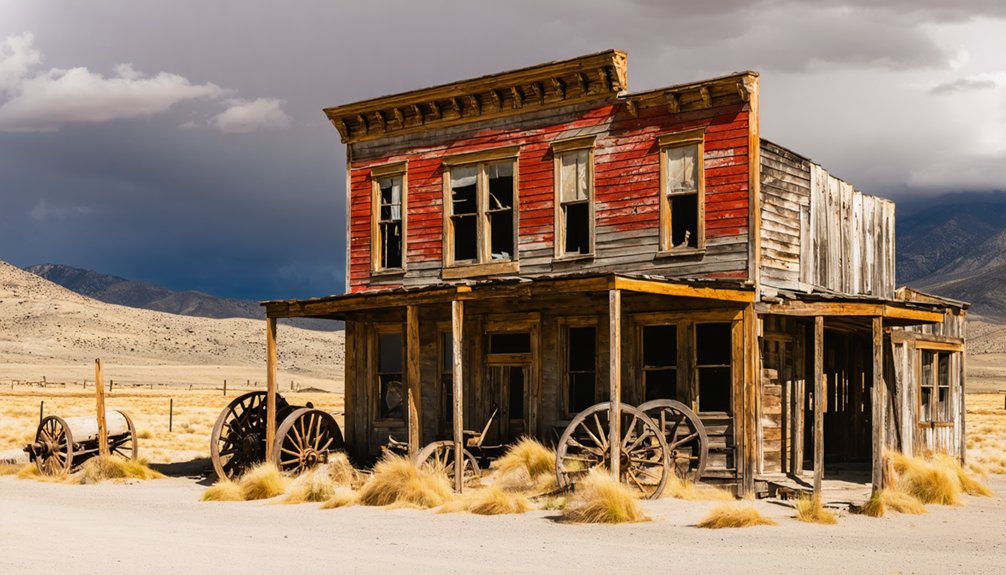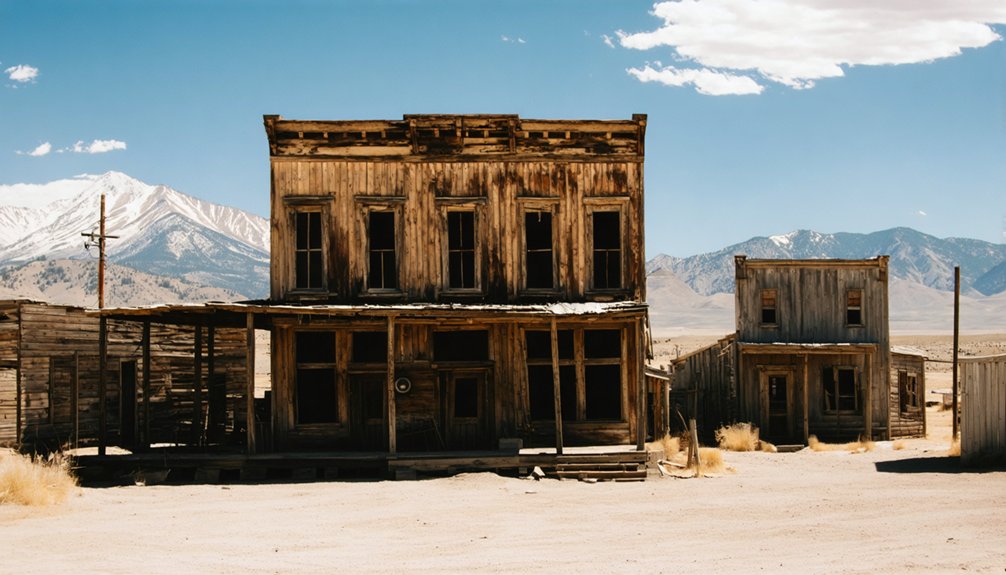
You’ll find authentic ghost town filming locations concentrated along California’s Highway 49 Gold Country corridor—Columbia, Jamestown, and Sonora—where preserved 1850s structures and operational steam railroads have hosted productions since the 1950s, including *Back to the Future Part III*. Paramount Ranch in Agoura Hills served as a purpose-built Western set across 2,700 acres before the 2018 Woolsey Fire, while Utah’s Paria ghost town near Kanab and Pioneertown in California’s Mojave Desert offer crumbling authenticity that’s shaped countless films from the genre’s earliest days through *Westworld*’s recent seasons.
Key Takeaways
- Paramount Ranch in Agoura Hills hosted over 130 films with Western architecture before the 2018 Woolsey Fire devastated structures.
- Columbia State Historic Park preserves authentic 1850s Gold Rush buildings used extensively for Western film production since the 1950s.
- Jamestown’s Railtown 1897 provided operational steam locomotives for westerns including the train featured in *Back to the Future Part III*.
- Paria ghost town near Kanab served Western films starting with *Buffalo Bill* (1943) before flash floods destroyed sets.
- Alabama Hills’ granite formations and Cerro Gordo’s 1871 mining structures offer authentic Western backdrops without elaborate set construction.
Paramount Ranch: Hollywood’s Cowboy Town in Agoura Hills
Nestled in the chaparral-covered hills of Agoura Hills, California, Paramount Ranch sprawls across former Spanish land grant territory that Paramount Pictures transformed into a 2,700-acre movie-making facility in 1927.
Paramount Pictures converted 2,700 acres of historic Spanish land grant territory into a sprawling movie ranch in the chaparral hills of Agoura Hills.
You’ll discover Western architecture meticulously constructed to capture Hollywood history—frontier saloons, trading posts, and dusty main streets that’ve hosted over 130 films.
The studio built extensive infrastructure including headquarters with utilities, production facilities, and storage buildings.
William Hertz’s 1953 Western Town became the ranch’s centerpiece, drawing productions from Dr. Quinn, Medicine Woman to Westworld.
Between 1956 and 1957, the ranch briefly operated as California’s first purpose-built road racing course, designed by Ken Miles with a distinctive figure-of-eight layout before fatal accidents forced its closure.
Though the 2018 Woolsey Fire devastated structures, the National Park Service continues managing this unique cinematic landmark at 2903 Cornell Road, where you can explore remnants of America’s only federal movie-making site.
Phase 1 construction between 2024-2025 will introduce four new structures including a pavilion, prop shed, barn, and restrooms as part of the ongoing rebuilding efforts.
California’s Gold Country: Living Ghost Towns of Columbia, Jamestown, and Sonora
You’ll find California’s Gold Country preserves three interconnected mining towns along Highway 49—Columbia, Jamestown, and Sonora—where operational steam trains, preserved brick storefronts, and authentic 1850s architecture have attracted filmmakers since the 1950s.
The Sierra Railway in Jamestown provided the steam locomotive and period depot for *Back to the Future Part III*.
While Columbia’s forty brick buildings doubled as western town settings in *High Noon* and *Pale Rider*.
These towns maintain working railroads with original roundhouses and repair engines, offering filmmakers functional nineteenth-century transportation systems within geographically accurate Gold Rush landscapes.
Columbia State Historic Park, established in 1945 as a state park, preserves California’s best collection of Gold Rush-era structures at 2,100 feet elevation in the Sierra foothills.
The town features operating businesses including a vintage blacksmith shop and museums that provide authentic period settings for productions.
Historic Railroads Attract Hollywood
Three interconnected Gold Rush towns in California’s Sierra Nevada foothills—Columbia, Jamestown, and Sonora—transformed from 1850s mining camps into Hollywood’s go-to railroad filming locations during the 1940s and 1950s.
You’ll find Jamestown’s Railtown 1897 State Historic Park operating authentic steam locomotives that powered countless westerns, including shows like Laramie. The historic train routes wind through preserved ghost town architecture, offering filmmakers period-authentic backdrops without constructing expensive sets.
Columbia’s stagecoach operations and Mark Twain-connected cabins complemented the railroad scenes, while Sonora’s proximity to Jamestown made the entire cluster easily accessible from Hollywood. Sonora’s underground tunnels from its gold mining past added another layer of authentic frontier atmosphere to the filming locations.
You could drive up, shoot authentic Gold Rush-era trains against genuine 1850s buildings, and return—all within days. Pioneertown, built as a Wild West movie set in the 1940s outside Yucca Valley, served a similar purpose with its replica Out West buildings and Pappy and Harriets saloon.
This filming ecosystem preserved California’s frontier heritage while giving productions the freedom to capture real western landscapes.
Back to the Future III
When Robert Zemeckis needed an authentic 1885 Old West backdrop for *Back to the Future Part III*, his crew transformed Jamestown’s Railtown 1897 State Historic Park and the surrounding Red Hills into Hill Valley’s time-displaced setting.
You’ll find Steam Locomotive No. 3—the “Movie Star”—still operating on its original turntable at the historic roundhouse where railroad sequences rolled.
The adjacent Red Hills provided additional exterior shots matching the 1885 Hill Valley set.
Today, you can experience time travel adventures through Back to the Future-themed celebrations at Columbia State Historic Park’s Fallon Theatre, featuring trilogy screenings and DeLorean sightings.
The Gold Country trio of Columbia, Jamestown, and Sonora preserves this filming legacy through festivals supporting the Michael J. Fox Foundation, complete with stagecoach rides and gold panning demonstrations across authentic Gold Rush terrain.
Visitors exploring the railroad remnants can still discover original railroad ties and steel tracks partially covered by dirt and fallen grass, along with vintage railroad nails that serve as authentic souvenirs from the historic filming locations.
Beyond *Back to the Future Part III*, Jamestown served as a filming location for Petticoat Junction, *The Wild Wild West*, and *Green Acres*, establishing its reputation as a versatile Old West filming destination.
Mark Twain’s Authentic Cabin
Off Highway 49 near Tuttletown, a primitive replica cabin sits behind an iron fence on Jackass Hill—the spot where Samuel Clemens spent winter months in 1864-65 and emerged as Mark Twain.
You’ll find California Historical Landmark No. 138 approximately one mile northwest of Tuttletown, accessible via Jackass Hill Road’s dead-end turnoff.
The 1920s reconstruction incorporates the original chimney and fireplace where Twain penned “The Celebrated Jumping Frog of Calaveras County” at his writing desk. He heard the jumping frog tale in an Angels Camp saloon, which sparked the story that launched his literary career in 1867. The short story’s 1865 publication propelled Twain to national fame.
This literary history landmark measures roughly 1½ Chevys in size, maintaining its frontier authenticity within Tuolumne County’s Gold Country foothills.
The site connects you to pioneer heritage along the Bret Harte Trail, one hour from Modesto via Highway 4, where authentic western storytelling began.
Paria Ghost Town: Utah’s Desert Filming Paradise
Nestled along a dusty turnoff between mileposts 30 and 31 on US-89, Paria Ghost Town sits 37.2 miles east of Kanab and 39.3 miles northwest of Page, Arizona.
Here, southern Utah’s painted cliffs frame one of the American West’s most photogenic ruins.
You’ll navigate 4.7 miles on dirt roads requiring high-clearance vehicles to reach crumbling foundations where Mormons settled in 1865.
Hollywood discovered this desert landscape, making it perfect for Western storytelling.
Film history transformed this abandoned townsite into cinema gold:
- *Buffalo Bill* (1943) inaugurated Paria’s screen debut
- *Gunsmoke* episodes captured authentic frontier atmosphere
- The Rat Pack’s Sergeants 3 (1961) built elaborate sets one mile west
- Clint Eastwood filmed The Outlaw Josey Wales (1975)
- Flash floods and vandal fires destroyed movie sets by 2006
Red-orange stratified cliffs surround weathered remnants managed by BLM.
Kanab Canyon’s Film Set Graveyard: Decades of Western Movie Remnants
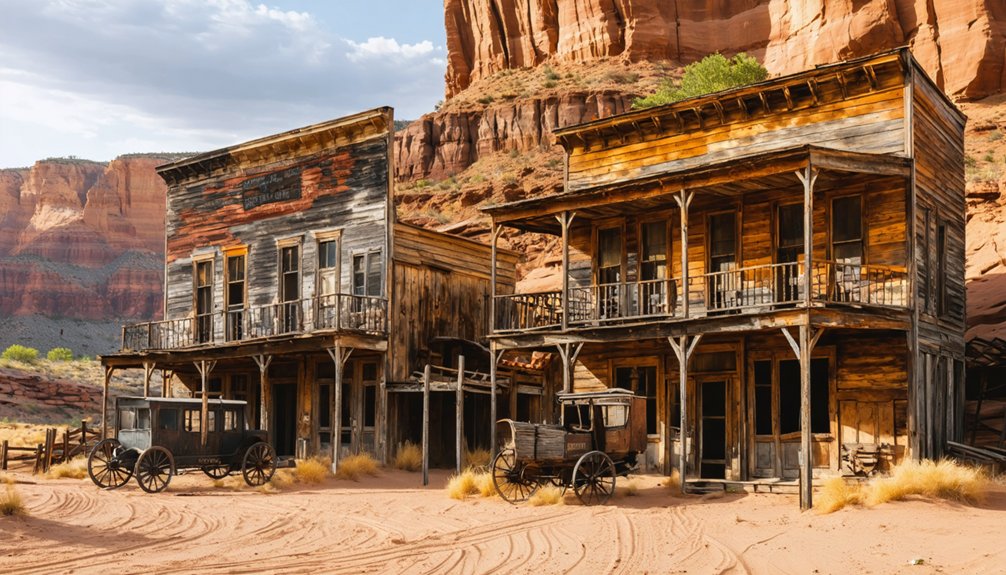
Movie artifacts lie scattered across Kane County, freely accessible to those who venture beyond standard tourist routes. The dilapidated structures risk collapse, making exploration a race against time and weather.
Cerro Gordo and the Alabama Hills: Eastern California’s Mining Town Locations
High in the Inyo Mountains, approximately 8,500 feet above Owens Lake, Cerro Gordo’s weathered structures cling to slopes where 4,000 miners once extracted $500 million in silver ore.
You’ll find authentic mining heritage preserved in the 1871 American Hotel, stone smelter ruins, and 300-foot shaft houses that’ve attracted filmmakers seeking untouched Western backdrops since the town’s 1879 decline.
Twenty miles southwest, Alabama Hills’ granite formations provided complementary locations:
- Dramatic boulder clusters framed countless Western shootouts from the 1920s forward
- Natural arches eliminated expensive set construction
- BLM management preserved landscapes without modern intrusions
- Railroad history connected through nearby Owens Valley narrow-gauge lines
- Proximity to Cerro Gordo created dual-location filming efficiency
Both sites remain accessible, offering cinematographers genuine ghost town aesthetics without reconstructed facades.
Truckee: High Sierra’s Century of Cinema
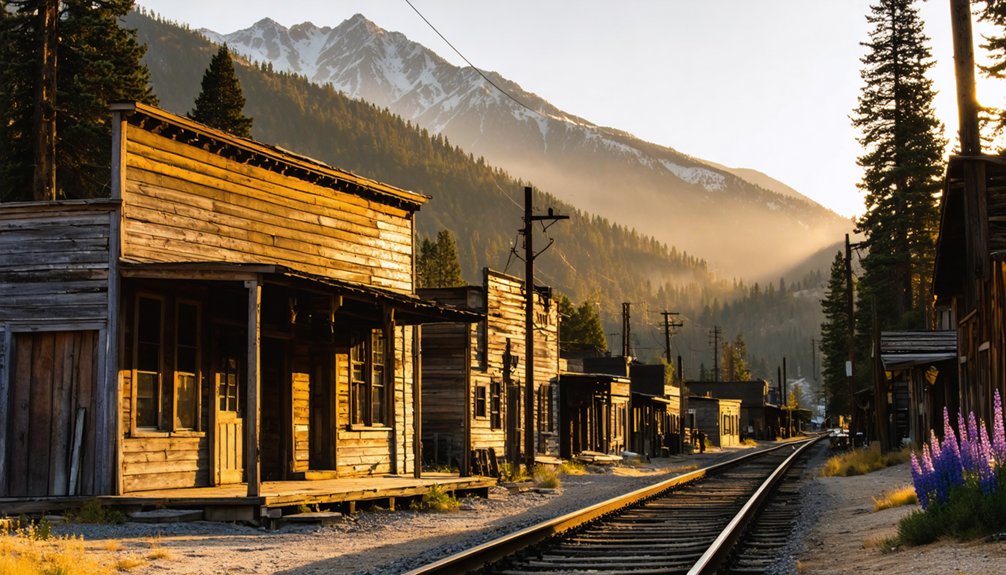
You’ll find Truckee’s cinematic legacy crystallized in Charlie Chaplin’s 1925 masterpiece “The Gold Rush,” where the director recruited over 600 Sacramento extras to trudge up Donner Summit’s ridge near today’s Sugar Bowl Ski Resort.
The Chilkoot Pass sequence transformed this High Sierra location into Alaska’s frozen goldfields, creating what critic Jeffrey Vance called the most spectacular image in silent-film comedy.
Chaplin’s crew spent the 1924-1925 production patronizing local businesses while Southern Pacific’s rail connections shuttled cast and equipment 120 miles from Sacramento studios.
Chaplin’s 1924 Gold Rush
- Donner Summit served as the primary base for operations.
- Palisades area between Mt. Disney and Mt. Lincoln provided the dramatic backdrop.
- Chilkoot Pass sequence utilized 600 extras climbing the 2,300-foot pass.
- Truckee Ski Club cleared paths through deep Sierra snow.
- Summit Hotel housed the crew during the grueling two-week shoot.
Severe weather ultimately forced Chaplin to abandon location filming, though the iconic climber scene survived the final cut.
Lake Tahoe Film Locations
Chaplin’s weather troubles at Donner Summit foreshadowed what would become a defining pattern for the Truckee-Tahoe region—filmmakers drawn to its dramatic Sierra landscapes despite production challenges.
Lake Tahoe’s filming history spans nearly 100 productions, transforming the old Truckee airstrip south of Interstate 80 into a cinematic workhorse. You’ll find Columbia Pictures claimed Dom Mosca’s Prosser Dam Road home for “St. Elmo’s Fire” in 1984, while Arnold Schwarzenegger’s “True Lies” crew descended in 1994.
“Jack Frost” showcased Donner Lake’s snowstorm authenticity in 1998, recruiting 200 elementary students for its opening sequence. The 57-member crews of early productions bunked at Donner Lake Lodge, establishing infrastructure that welcomed over 120 films.
Winter Carnival promotions initially lured silent-era directors; today’s productions chase that same untamed Sierra beauty.
Lake Tahoe’s Fallen Leaf Lake: Romantic Drama Backdrop
- 76-foot deep-water pier where Kevin Costner performed the iconic exploding boat rescue
- 2.74 waterfront acres providing privacy for intimate lakeside romance scenes
- Five bedrooms with Mount Tallac views
- Custom wood finishes throughout 1969 Paul Hamilton design
- Four-season accessibility for year-round production schedules
You’ll find this property listed at $7.995 million through Chase International.
Pioneertown: A Fabricated Ghost Town Built for Westerns
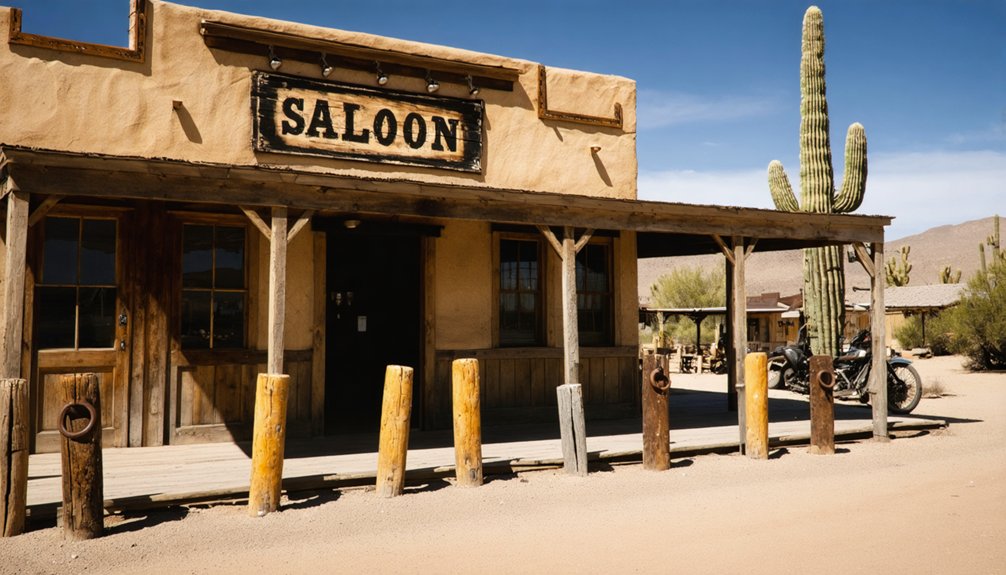
While Fallen Leaf Lake offered natural beauty for romantic cinematography, Hollywood’s western genre demanded something entirely different: a controllable, purpose-built frontier environment where production crews could work efficiently without the logistical constraints of remote locations.
You’ll find Pioneertown 125 miles east of Los Angeles against the Sawtooth Mountains—a fabricated 1880s settlement constructed in 1946 by Dick Curtis and eighteen Hollywood investors including Roy Rogers and Gene Autry. They transformed Iverson Ranch with three-sided false-front buildings housing modern amenities behind period facades: saloons concealing bowling alleys, jails masking ice cream parlors.
This $8,500 investment produced over 50 western productions, perpetuating Wild West myths through controlled authenticity. Today’s ghost town preservation efforts maintain those original facades where 600 residents now inhabit what began as Hollywood’s efficient answer to frontier storytelling.
Beyond the immediate preservation efforts, visitors are drawn to the allure of historic ghost towns in California, where the remnants of the past evoke a sense of adventure and nostalgia. These sites provide a tangible connection to history, allowing tourists to explore the stories behind each decaying building and dusty street. As people wander through these towns, they can almost hear the echoes of the pioneers and prospectors who once called this rugged land home.
Historic Railroads: Attracting Productions to Gold Rush Territory
As Hollywood’s western productions expanded beyond fabricated sets, filmmakers discovered that functioning historic railroads in California’s Gold Rush territory delivered both authentic period equipment and diverse terrain within practical shooting distance.
Railroad preservation efforts at Railtown 1897 State Historic Park in Jamestown created an all-encompassing filming location that’s hosted productions since 1919. You’ll find:
- Sierra Railroad’s vintage locomotives and rolling stock representing authentic 1800s-1900s western rail operations
- Diverse landscapes along the route from San Joaquin Valley through Tuolumne County forests, mimicking Midwest plains to Allegheny Mountains
- Sierra No. 3 locomotive featured in over 100 films including *High Noon* and *Pale Rider*
- Fillmore & Western Railway offering scenic train rides through citrus groves for early 20th-century Midwest sequences
- Operational facilities including turntables, depots, and maintenance yards providing production infrastructure
Westworld’s Multiple Western Filming Sites Across California and Utah
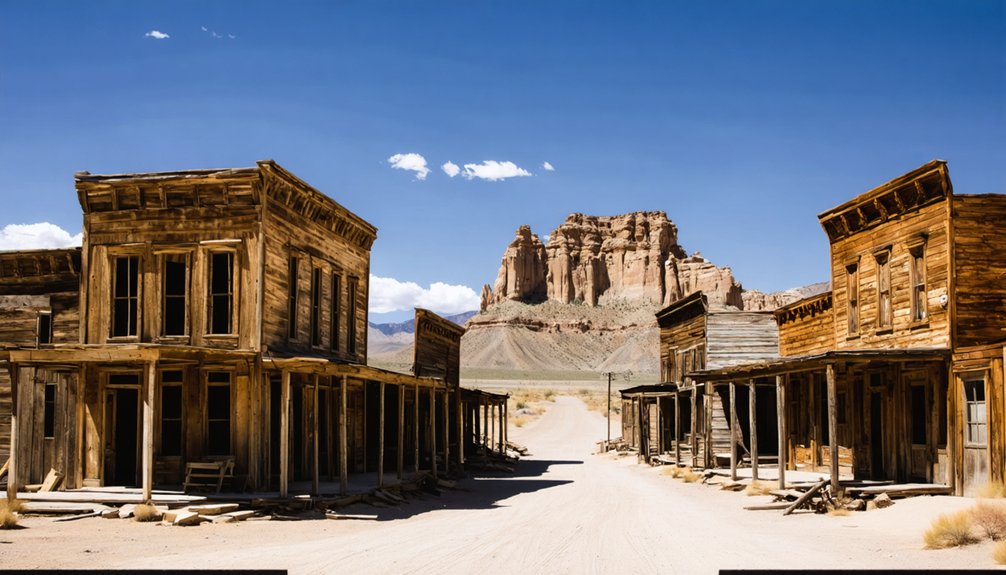
You’ll find Westworld’s sprawling frontier constructed across two states, with California’s Melody Ranch serving as the primary Sweetwater townscape.
Meanwhile, Utah’s Castle Valley and Monument Valley supplied sweeping desert vistas. The production transported set walls between locations to maintain visual continuity, combining Paramount Ranch’s Escalante church structure with Kanab Canyon’s dramatic rock formations.
This dual-state strategy let HBO blend authentic Western town settings with expansive public lands that California ranches couldn’t provide, creating a seamless dystopian theme park across 600 miles of terrain.
Paramount Ranch Church Structure
Though Paramount Ranch’s western town set spans multiple historic structures, the church building stands as the most recognizable element from Westworld’s first two seasons. This filming location significance centers on the white chapel constructed specifically for the show in 2016, hosting pivotal narrative moments in the town of Escalante.
Key aspects of the church architecture and accessibility:
- Built as a functional structure with accessible interiors before the 2018 Woolsey Fire.
- Steeple removed after filming wrapped to alter the building’s appearance between productions.
- Survived the devastating wildfire that destroyed most surrounding western town structures.
- Located alongside the also-surviving train depot in the Cornell Road facility.
- Remains standing as crews work to rebuild the historic movie ranch grounds.
You’ll find this chapel at 2903 Cornell Rd, open during daylight hours without admission fees.
Utah’s Kanab Canyon Landscapes
Southern Utah’s red rock country transforms into Westworld’s untamed frontier across five distinct filming locations near Kanab and Moab. You’ll find the Kanab Area Ruins—a dilapidated movie fort featured in season two’s pivotal episodes—with GPS coordinates guiding you to this film preservation site.
Coral Pink Sand Dunes State Park provided the backdrop for Akecheta’s Ghost Nation journey, where dramatic canyon geology meets sweeping desert vistas.
Glen Canyon and Lake Powell’s massive reservoir doubled as the valley where android bodies floated.
Dead Horse Point State Park’s cliffside panoramas captured the Man in Black’s brutal encounters, while Route 128 and Castle Valley‘s otherworldly terrain simulated the park’s entrance road.
You’re three hours from Las Vegas to explore these accessible locations yourself.
Authentic Western Town Settings
While Westworld’s sweeping desert panoramas belong to Utah’s red rock wilderness, the show’s detailed frontier town sequences root themselves in California’s purpose-built Western sets. You’ll find Sweetwater’s dusty streets at Melody Ranch in Santa Clarita, while Paramount Ranch’s Escalante church stands among desert flora that frames the iconic settlement.
Production crews transported set walls between states, merging California-shot interiors with Utah exteriors through strategic green screen placement.
The integration spans:
- Fillmore and Western Railway capturing guest arrivals via actual train sequences
- Veluzat Motion Picture Ranch hosting Fort Forlorn Hope’s Confederate stronghold
- Castle Valley’s five-day pilot shoot near Indigenous cultural sites
- Dead Horse Point providing dramatic control room backdrops
- Coral Pink Sand Dunes featuring Kiksuya’s distinctive horseback sequences
This geographic split gave filmmakers unrestricted creative control across diverse Western landscapes.
Frequently Asked Questions
Can Visitors Access These Ghost Town Filming Locations Year-Round?
You’ll find tourist access year-round at these Western ghost towns, with no seasonal closures restricting exploration. Paramount Ranch welcomes you daily until sunset, while Nelson, Paria-Kanab, and Polsa Rosa remain open for your unrestricted desert adventures anytime.
Do Film Productions Pay Fees to Use These Historical Locations?
You’ll find wildly different arrangements—free public sites like Paramount Ranch require zero filming fees, while state historic locations typically charge productions to support historical preservation. Private ranches negotiate individual rates, though specific costs aren’t publicly disclosed for these remote Western filming havens.
What Permits Are Required to Film at Western Ghost Towns?
You’ll need liability insurance, location permits from county authorities, and property owner authorization. Expect equipment restrictions on vehicles and generators, plus detailed shooting schedules. Processing takes 3-7 business days depending on your specific ghost town’s jurisdiction.
Are Original Props and Set Pieces Safe to Touch or Photograph?
You’ll find most ghost town props accessible for photography without restrictions, though prop safety varies by location condition. Fire damage at Paramount Ranch and weathered structures elsewhere mean you’ll want caution when touching deteriorating set pieces.
Which Ghost Town Location Has Hosted the Most Film Productions?
Bodie’s captured Hollywood’s imagination most frequently—you’ll find 65 saloons preserved through historical preservation efforts. Its tourist amenities and maintained structures have attracted countless productions, making California’s iconic mining camp the West Coast’s most-filmed ghost town destination for adventurous cinematographers.
References
- https://californiathroughmylens.com/paramount-ranch-old-movie-town/
- https://www.youtube.com/watch?v=6lbcHrWIPr0
- https://roadtrippers.com/magazine/kanab-utah-little-hollywood/
- https://www.youtube.com/watch?v=tZmA_VF6cm8
- https://www.youtube.com/watch?v=VR-t5w9wSeU
- https://californiahighsierra.com/trips/go-a-little-hollywood-in-the-high-sierra/
- https://iefilmpermits.com/library/ghost-towns/
- https://californiathroughmylens.com/pioneertown/
- https://npshistory.com/publications/samo/paramount-ranch-hist.pdf
- https://www.racingcircuits.info/north-america/usa/paramount-ranch.html