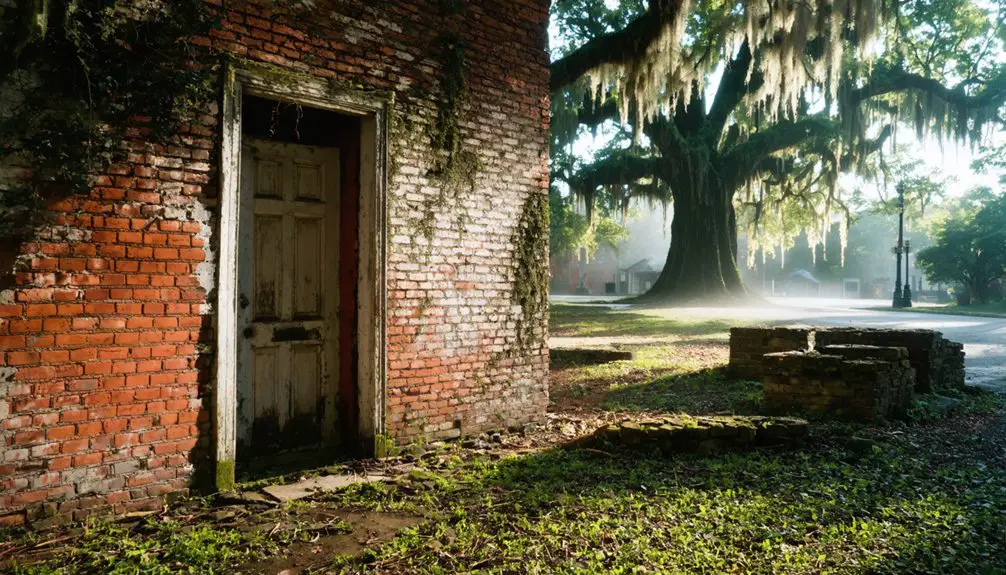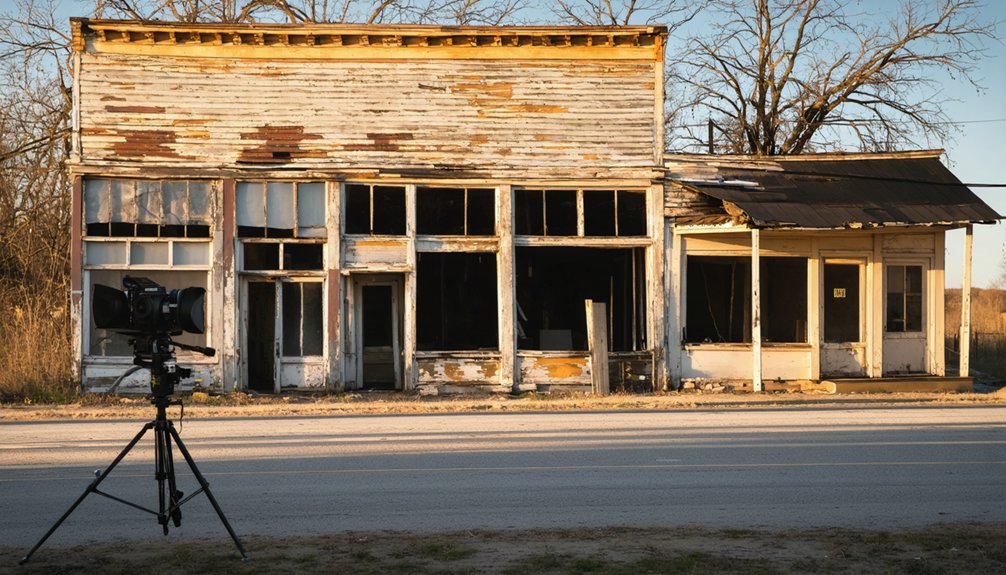
You’ll find Virginia’s abandoned towns like Pamplin City and Thurmond serving as authentic filming locations for productions including *Lincoln*, *Mercy Street*, and *Turn*. These ghost towns feature original 19th-century storefronts, brick streets, and weathered facades that eliminate set-dressing needs. Old Towne Petersburg offers over 250 preserved buildings, while Mountain Lake Lodge—famous for *Dirty Dancing*—maintains its 1936 sandstone architecture. The Public Gaol’s original walls and Colonial Williamsburg‘s reconstructed structures provide ready-made period environments. Your journey through Virginia’s cinematic ghost towns reveals how decay becomes Hollywood’s perfect canvas.
Key Takeaways
- Thurmond and Pamplin City feature abandoned storefronts, brick streets, and urban decay, providing authentic settings without requiring additional set dressing.
- Petersburg’s Old Towne contains over 250 preserved 19th-century buildings, used in films like *Lincoln*, *Mercy Street*, and *Turn*.
- Appalachian ghost towns offer weathered facades and historic streetscapes that authentically represent turn-of-the-century life for filmmakers.
- Abandoned Virginia districts eliminate modern intrusions, allowing productions to capture authentic historical decline and past prosperity.
- Film productions in these locations stimulate economic revitalization, transforming neglected towns into cultural assets and tourist destinations.
Pamplin City: From Thriving Town to Cinematic Backdrop
When Nicholas Pamplin donated land for the railroad in the 1850s, he transformed what had been Merriman’s Shop—a modest settlement anchored by a 1820s shoe shop—into a future transportation hub.
By 1874, Pamplin City thrived with flour mills, tobacco pipe factories, and four doctors serving a population far exceeding today’s 250 residents.
The 1909 fire changed everything, destroying businesses and mandating brick construction.
When pipe factories closed and automobiles replaced rail travel, Main Street emptied.
Williams Hardware and Grocery, once owned by Howard Williams, Sr., stood among the storefronts that defined the town’s commercial district.
The Pamplin Pipe Factory, established around 1880, once claimed to be the largest in the world, producing millions of pipes monthly.
Now you’ll find urban decay alongside stunning 19th-century brick architecture—so threatened that Preservation Virginia designated it most endangered in 2014.
Today’s architectural preservation efforts include the renovated depot housing the library.
You can explore abandoned storefronts along the High Bridge Trail, capturing history through your camera lens.
Colonial Williamsburg’s Transformation Into Multiple Historic Cities
While Pamplin City’s brick facades crumble into authentic decay, Colonial Williamsburg achieves historical authenticity through meticulous reconstruction—transforming its 301-acre Historic Area into whatever 18th-century American city a production requires. You’ll find Wetherburn’s Tavern, the Wythe Estate, and period-accurate artisan shops functioning simultaneously as tourism development infrastructure and production-ready sets.
HBO’s *John Adams* miniseries utilized this advantage in 2007, filming Revolutionary War sequences without modern redevelopment intrusions. Paul Giamatti starred as John Adams alongside Laura Linney as Abigail Adams in the production. The 1957 film *Williamsburg: The Story of a Patriot* demonstrated this versatility first, with Paramount Studios shooting entirely within the Historic Area using cutting-edge VistaVision technology. The film has been continuously shown since 1957, with only a brief pause during the pandemic.
Costumed interpreters maintain 24-hour character immersion, eliminating casting costs for background extras. You’re witnessing America’s largest living history museum double as Hollywood’s most authentic colonial backlot.
The Public Gaol: Where History Meets Hollywood
Standing thirty feet by twenty feet with two-story brick walls and authentic leg irons still mounted to the floor, Colonial Williamsburg’s reconstructed Public Gaol delivers the oppressive atmosphere that digital effects can’t replicate.
You’ll find prison architecture that’s functioned continuously from 1704 through 1910—original courtyard walls, food slots, and primitive sanitation intact. Film crews capitalize on documented inmate folklore: fifteen of Blackbeard’s pirates executed after confinement here, Henry Hamilton’s description of “mephitic air” in overcrowded cells, and accounts of gaol fever epidemics. The institution held a diverse population including debtors, runaway slaves, mentally-ill individuals, spies, prisoners-of-war, deserters, and traitors awaiting their fates. Strong timbers beneath cells were installed to prevent prisoners from mining their way to freedom through underground escape attempts.
The site’s reputation stems from actual executions along Capitol Landing Road. Directors seeking authentic colonial incarceration scenes access restored cells displaying period manacles and chains, while the building’s grim operational history provides ready-made narratives that resonate with audiences valuing historical authenticity over sanitized reconstructions.
Mountain Lake Lodge: A Ghost Town Resort Reborn Through Dance
Virginia’s colonial imprisonment sites gave way to mountain resort destinations by the mid-1700s, when Christopher Gist discovered Mountain Lake in 1751 during surveying expeditions for the Ohio Land Company.
You’ll find this 2,600-acre property transformed from Salt Pond cattle station to William Lewis Moody’s 1936 native sandstone lodge, constructed exclusively from on-site materials. The resort’s spectral legends intensified after Vestron Pictures filmed “Dirty Dancing” here in 1986, capturing the iconic lake-lift scene.
Mary Moody Northern’s strict preservation mandate—prohibiting television, logging, and hunting—created an isolated retreat where haunted architecture meets Hollywood nostalgia. The endowment she established in 1986 guarantees you can escape modern constraints while exploring this bird sanctuary resort that refuses commercial expansion, maintaining its historic 1930s authenticity through perpetual conservation. The mountain lake itself has remained mysteriously drained for over ten years, with water behavior that scientists cannot explain, adding to the site’s otherworldly atmosphere. Today’s visitors experience adventure activities including treetop ziplines, ATV tours, and clay shooting alongside the property’s cinematic heritage.
Old Towne Petersburg’s Preserved Architecture for Period Dramas
You’ll find over 250 buildings from the 19th and early 20th centuries within Petersburg’s 190-acre Old Towne Historic District, creating an authentic backdrop that’s attracted period drama productions.
The district’s Greek Revival to Victorian architecture—including 300 brick buildings erected between 1815-1817 after the Great Fire—offers filmmakers ready-made sets spanning multiple historical eras without modern intrusions. The octagonal Farmers Market, standing since 1879, has appeared in productions including *Lincoln*, *Mercy Street*, and *Turn*, showcasing its architectural distinctiveness.
Productions can shoot along High Street’s varied 18th-century houses, the 1879 Farmers Market Building, or Centre Hill Mansion (1823) while working within the Architectural Review Board’s preservation guidelines established in 1973. The district’s early worker cottages in the southwest portion provide additional filming locations for working-class period scenes.
Historic Buildings Attract Filmmakers
Old Towne Petersburg’s architectural treasury spans three centuries, offering filmmakers an authentic backdrop that few Virginia cities can match.
You’ll find 250 buildings across 190 acres, showcasing everything from Greek Revival to Victorian styles.
The 1879 Farmers Market Building—recognized among Virginia’s 100 most iconic structures—underwent a $2 million renovation, transforming decades of emptiness into a functional venue while preserving historic character.
Modern renovations like this demonstrate how urban redevelopment can serve both preservation and production needs.
The district’s 1838-1840 Classical Revival Courthouse and 1823 Centre Hill Mansion provide ready-made period settings.
Four manufacturing buildings from 1897-1930 expand location options.
Post-1815 brick construction dominates downtown, while frame double side-passage-plan houses from 1870-1910 line residential streets, giving you versatile shooting environments without extensive set modification.
Notable Productions Filmed There
Major productions filmed here include:
- *Turn: Washington’s Spies* – Revolutionary War drama’s final season
- Harriet (2019) – Underground Railroad biopic featuring preserved 18th-century architecture
- The Good Lord Bird – Emmy-nominated Showtime miniseries with 14 nominations
- Multiple productions at Berkeley Plantation and Three Lakes Park
Virginia’s reputation for period-authentic infrastructure continues attracting filmmakers seeking freedom from modern intrusions.
Wren Building and College Grounds as Harvard Stand-Ins
Standing as the oldest academic building in the United States, the Wren Building dominates the College of William & Mary campus where it’s anchored the western end of Old College Yard since its construction between 1695 and 1700.
You’ll recognize its colonial-era interiors from HBO’s 2008 John Adams miniseries, where the building doubled for Harvard’s interior spaces. The production transformed Colonial Williamsburg locations into colonial Boston, New York, and Philadelphia—the Public Hospital grounds portrayed Harvard Yard while maintaining cinematic authenticity throughout Tom Hanks’ Emmy-winning performance.
Historical preservation efforts by William & Mary made these shoots possible, providing filmmakers access to genuine 18th-century architecture. The nearby Public Gaol served as the post-Boston Massacre jail, demonstrating how Virginia’s surviving colonial structures offer productions period-accurate settings without Hollywood compromises.
Abandoned Main Streets: Perfect Settings for Historical Authenticity
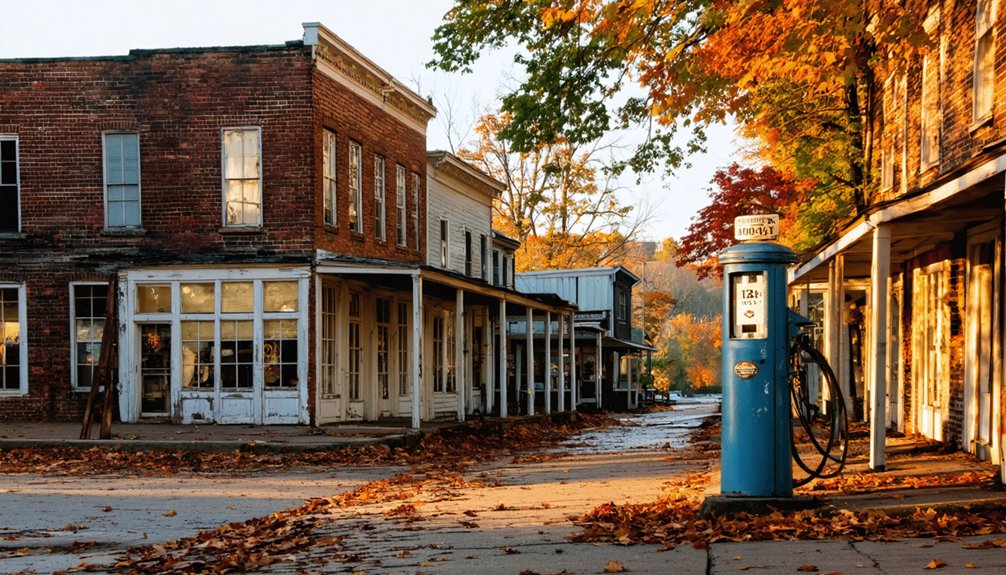
When production designers scout locations for period films, they’re searching for streetscapes that require minimal digital alteration—and Virginia’s abandoned Main Streets deliver exactly that.
Thurmond’s coal-era buildings and Pamplin City’s post-1909 brick district showcase how urban decay paradoxically preserves architectural authenticity.
Urban decay functions as unintentional historic preservation, freezing architectural details that prosperity would have modernized away.
Why Abandoned Main Streets Transform Historical Productions:
- Boarded storefronts eliminate modern signage that would break period immersion
- Uniform brick construction from single-era rebuilds creates cohesive visual timelines
- Population exodus leaves intact commercial districts frozen in specific decades
- Gabled houses and depot exteriors require zero set dressing for authentic atmosphere
Pamplin City’s brick-mandated reconstruction after its 1909 fire created streetscapes that filmmakers can shoot immediately.
Thurmond’s deteriorated structures housed Mary McDonnell’s *Matewan* boarding house without modification—proof that abandonment often preserves what renovation destroys.
Southwest Virginia’s Forgotten Communities on the Silver Screen
Though Thurmond sits 100 miles northeast of the West Virginia mining town that gave Matewan (1987) its name, director John Sayles chose this abandoned New River Gorge settlement for its cinematic authenticity.
You’ll find gabled boarding houses deteriorating on overgrown hillsides, while five surviving commercial buildings face railroad tracks that once served as the town’s main street.
The industrial ruins include empty lots where the C&O engine house and Lafayette Hotel stood during Thurmond’s 1910 peak, when 75,000 people passed through annually.
Urban decay provides production designers genuine turn-of-the-century Appalachian architecture—weathered facades impossible to replicate on constructed sets.
Access requires crossing a one-lane railroad bridge, the same dramatic approach that isolated residents until 1921.
New River Gorge National Park now preserves these structures for future filming opportunities.
Richmond’s Historic Districts Doubling as Other Locations
You’ll find Richmond’s Jefferson Hotel transforming into opulent East Coast establishments, its Beaux-Arts architecture and grand marble staircase creating period-appropriate backdrops from the 1890s through mid-20th century.
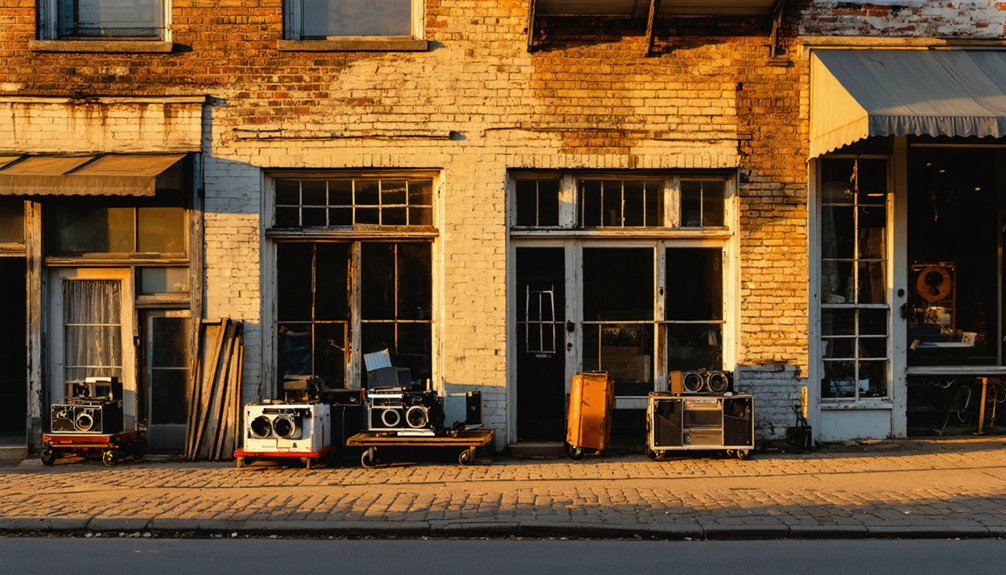
Shockoe Bottom’s cobblestone streets and 19th-century warehouses serve as production sites for Civil War-era sequences and Depression-era urban settings. These locations eliminate the need for extensive set construction, as their authentic architectural elements provide ready-made historical environments that cameras capture with minimal modification.
Jefferson Hotel’s Screen Appearances
Since its 1895 opening by tobacco baron Lewis Ginter, the Jefferson Hotel’s Beaux Arts architecture has doubled Richmond’s historic streetscapes for everything from 1860s Washington, D.C. to contemporary intelligence agency backdrops.
The venue’s filmography demonstrates how luxury hospitality merges with historic preservation:
- My Dinner with Andre (1981) – Louis Malle’s non-union crew transformed the shuttered Grand Ballroom during the hotel’s 1980 closure, capturing intimate conversation against marble grandeur.
- Lincoln (2012) – Spielberg utilized the building’s period details to recreate Civil War-era Washington.
- Homeland Season 7 (2017) – The lobby’s Thomas Jefferson statue framed intelligence operations.
- Gone with the Wind legend – Unconfirmed rumors persist about the 36-step marble staircase inspiring Rhett-Scarlett scenes.
You’ll find authentic 1890s craftsmanship that cameras can’t fake.
Shockoe Bottom Production Sites
Where else can cobblestone streets transport viewers from contemporary basketball courts to Civil War-era Washington within the same city block? Shockoe Bottom‘s authentic urban texture has doubled for multiple locations in productions like *Swagger*, *John Adams*, and *Iron Almighty*.
The district’s National Register-listed Main Street Station anchors filming operations. Meanwhile, historic facades enable period transformations without expensive set construction.
Modern contrasts define this production hub—restaurants and pubs operate alongside the African Burial Ground at 1554 E Broad St., creating visual layers directors exploit for storytelling depth.
Urban renewal hasn’t erased the cobblestones that attracted *Iron Jawed Angels* and *The Contender* crews.
Virginia Film Tours highlights Shockoe Bottom’s walkable radius connecting Rocketts Landing and Jackson Ward. This allows visitors direct access to explorable filming sites rather than closed studio lots.
How Virginia’s Ghost Towns Preserve America’s Cinematic Past
When filmmakers scout Virginia’s historic towns and abandoned streets, they’re discovering more than convenient backdrops—they’re tapping into architectural time capsules that authenticate American period dramas. Pamplin City’s post-1909 brick facades eliminate modern intrusions, while Colonial Williamsburg’s structures transform seamlessly into Revolutionary-era Boston for *John Adams*. These preservation challenges become production advantages.
Virginia’s cinematic heritage sustains history through:
Virginia’s film locations preserve architectural history more effectively than traditional conservation, transforming economic liabilities into cultural assets.
- Continuous cultural engagement – *Williamsburg: The Story of a Patriot* screening since 1957 reaches 30+ million viewers
- Authentic period architecture – Abandoned Main Streets require zero CGI alterations
- Modern tourism synergy – *Dirty Dancing* fans pilgrimage to unchanged Mountain Lake Lodge grounds
- Economic revitalization – Petersburg’s Old Towne attracts Spielberg productions, breathing life into dormant districts
You’ll find freedom exploring these unrenovated landscapes where Hollywood preserves what bureaucracy often destroys.
Frequently Asked Questions
What Permits Are Required to Film in Virginia’s Ghost Towns?
You’ll navigate the film permit process through local government offices and follow historic preservation regulations via Preservation Virginia. Contact the Virginia Film Office to determine specific requirements, as ghost towns often fall under multiple jurisdictions requiring coordinated approval.
Can Tourists Visit Ghost Town Filming Locations When Productions Aren’t Active?
You’ll happily discover that Virginia’s “abandoned” ghost towns aren’t actually off-limits—tourist accessibility remains surprisingly open at sites like Thurmond and Pamplin City. Ghost town preservation efforts coexist with your freedom to explore these atmospheric filming locations year-round.
How Do Filmmakers Protect Historic Buildings During Action Sequences?
Filmmakers employ safety precautions like removable padding, internal scaffolding, and CGI overlays to shield authentic structures. Historical preservation experts monitor shoots continuously, ensuring you’ll find these atmospheric locations intact for your own explorations between productions.
What Economic Impact Does Film Production Have on Nearby Communities?
You’ll see crews “slide into your DMs” seeking local services, delivering immediate economic boost through jobs and spending. Film production strengthens community engagement, attracting tourists post-release while creating infrastructure improvements that empower your town’s independent growth trajectory.
Are Local Residents Hired as Extras for Ghost Town Productions?
No evidence shows local residents were hired as production extras in ghost town films. You’ll find these abandoned locations lack populations—crews typically transport extras from populated areas, maintaining production control and meeting specific casting requirements.
References
- https://www.caseybarber.com/thurmond-wv/
- https://www.worldatlas.com/cities/5-virginia-towns-where-famous-movies-were-filmed.html
- https://icatchshadows.com/photographing-the-abandoned-ghost-town-of-pamplin-virginia/
- https://www.virginia.org/things-to-do/arts-and-entertainment/film/
- https://www.youtube.com/watch?v=m2guOUJ-27U
- https://www.abandonedcountry.com/2021/07/07/pamplin-city-the-ghost-of-a-railroad-boomtown/
- https://foxbaltimore.com/amazing-america/discover-pamplin-virginia-a-nearly-forgotten-ghost-town-with-stories-still-standing
- https://cbs4local.com/amazing-america/discover-pamplin-virginia-a-nearly-forgotten-ghost-town-with-stories-still-standing
- https://krcgtv.com/amazing-america/discover-pamplin-virginia-a-nearly-forgotten-ghost-town-with-stories-still-standing
- https://kunptv.com/amazing-america/discover-pamplin-virginia-a-nearly-forgotten-ghost-town-with-stories-still-standing