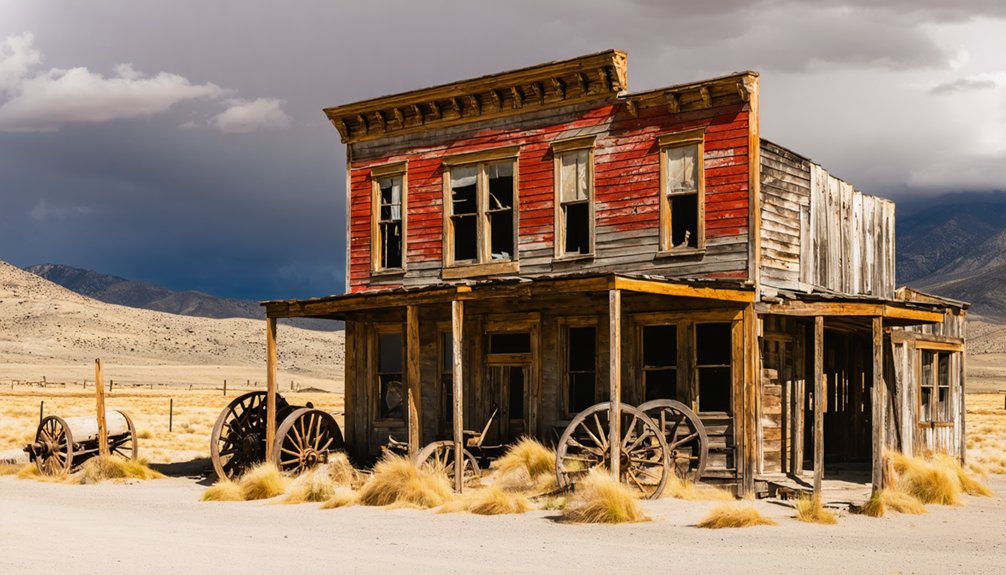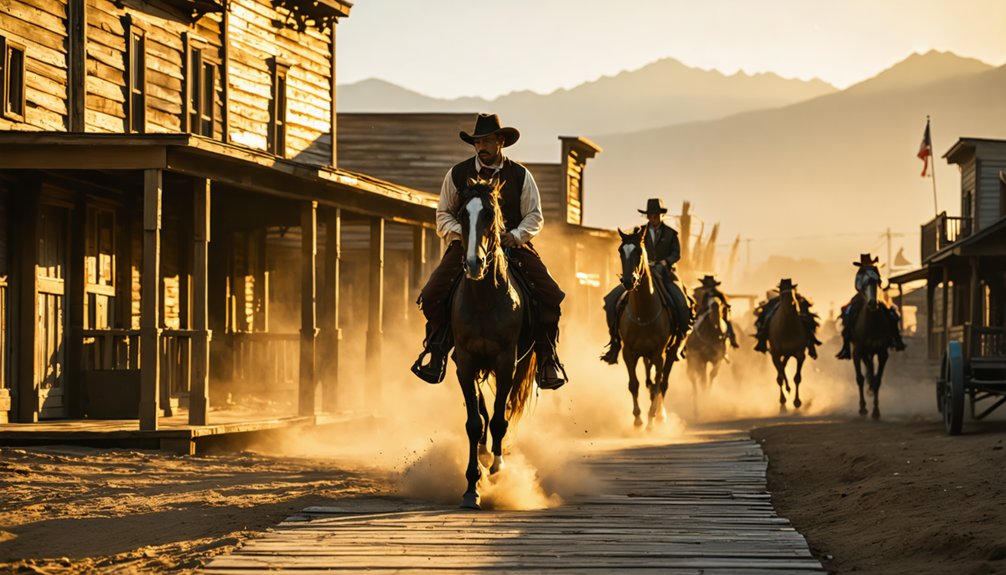
You’ll find America’s most immersive historical experiences at ghost towns hosting annual reenactments. Bannack, Montana celebrates its gold rush heritage each July with gunfights and period demonstrations, while Virginia City offers summer melodramas and Victorian balls. Calico, California transforms into both a Wild West stage and Civil War battlefield during its festivals, particularly President’s Day weekend. New Salem, Illinois recreates Lincoln’s frontier world through authentic trade demonstrations. These preserved settlements—ranging from Bodie’s arrested-decay mining camps to Virginia City’s restored Victorian architecture—provide historically accurate settings where costumed interpreters bring nineteenth-century frontier life, military tactics, and pioneer commerce vividly back to existence through carefully researched performances and hands-on activities.
Key Takeaways
- Bannack, Montana hosts Bannack Days each July with authentic gunfights, gold panning, blacksmith demonstrations, and period reenactments celebrating gold rush history.
- Virginia City, Montana features summer outdoor melodramas, Heritage Days, and the Grand Victorian Ball in August within preserved Victorian architecture.
- Calico Ghost Town, California holds Civil War reenactments on President’s Day weekend with authentic battles, artillery demonstrations, and Union-Confederate troop encampments.
- Calico also hosts Calico Days Festival featuring gunfight performances, Victorian theater, and educational activities showcasing California’s silver rush heritage.
- New Salem, Illinois offers annual frontier trade demonstrations, blacksmithing, and Lincoln-related reenactments in 23 reconstructed buildings from the 1830s era.
Bannack, Montana: Gold Rush Era Comes Alive Each July
When prospector John White pulled the first gold from Grasshopper Creek on July 28, 1862, he couldn’t have imagined that his discovery would still draw crowds more than 160 years later.
You’ll find Montana’s first major gold rush settlement transformed into a living museum each third weekend of July, when Bannack Days brings the 1860s roaring back to life.
This isn’t sanitized history—you’ll witness authentic gunfights, try your hand at gold panning, and explore 60 original structures standing exactly where miners left them.
Historic preservation efforts maintain this 2.7-square-mile National Historic Landmark while letting you experience genuine frontier independence.
The $5 admission grants you access to blacksmiths, period demonstrations, and horse-drawn wagon rides through streets where 10,000 fortune-seekers once chased their dreams unfettered by civilization’s constraints.
Throughout the townsite, live music performances echo the selections from Bannack’s heyday, providing an authentic auditory backdrop to your journey through Montana’s gold rush past.
The evening entertainment continues with storytelling sessions that bring to life the tales of miners, merchants, and notorious outlaws who shaped Bannack’s colorful history.
Virginia City, Montana: Summer Entertainment in a Living Ghost Town
Just 70 miles northwest of Bannack, Virginia City tells a different preservation story—one where intentional restoration rather than fortunate abandonment saved Montana’s territorial capital from oblivion.
Charles and Sue Bovey’s 1944 intervention rescued nearly 300 structures from dredge mining destruction, earning National Historic Landmark status by 1962.
The Boveys’ preservation work transformed Virginia City from mining casualty to National Historic Landmark within two decades.
You’ll find Victorian architecture frozen in time, untouched by remodeling when gold wealth vanished.
Summer brings entertainment that connects you with frontier authenticity. The Virginia City Players stage melodramas in outdoor theaters while Brewery Follies deliver adult-oriented comedy.
Heritage Days and the Grand Victorian Ball let you waltz in period costume each August.
Living history enactments resurrect the vigilante movement’s raw justice.
Historic streets showcase artifacts and notable sites including Cousin’s Candy Shop, Virginia City Creamery, and Montana’s oldest bar, Bale of Hay Saloon.
With 70,000 annual visitors, this living ghost town proves preservation creates economic freedom without compromising historical integrity. The year-round population of about 150 residents swells to around 300 during the summer tourist season.
Calico Ghost Town, California: Silver Rush Celebrations and Gunfights
You’ll find Calico Ghost Town’s reenactment calendar spans multiple events throughout the year, with Calico Days Festival serving as the primary celebration of its 1880s silver boom heritage.
The town’s Civil War Reenactment Weekend draws history enthusiasts to witness period-accurate military demonstrations, despite the settlement’s post-war founding in 1881.
Living history performers stage gunfights and portray original residents year-round, transforming Walter Knott’s restored buildings into an active theater of California’s mining past. The town features 500 mines that produced over $20 million in silver during its twelve-year boom period before declining in the mid-1890s. Walter Knott purchased the abandoned settlement in 1953 and began its restoration as a historical site, eventually transferring it to San Bernardino County Regional Park in 1966.
Annual Calico Days Festival
Since its establishment in 1881 as a booming silver mining camp, Calico Ghost Town has transformed from a nearly abandoned relic of California’s mineral rush into a living museum where history resurfaces each February during the Annual Calico Days Festival. You’ll encounter mining artifacts and historic architecture alongside authentic reenactments during this Presidents’ Day weekend celebration.
The festival runs 9 a.m. to 5 p.m., featuring gunfight performances by the “Scoundrels Alley” troupe, Victorian theater productions, and classroom sessions recreating 1880s education.
Compete in the Miner’s Triathlon, participate in costume contests, or explore educational displays explaining California’s Pony Express Trail and mining heritage. At its 1887 peak, Calico produced $86 million in silver. The town’s boom period also supported about 22 saloons alongside a Chinatown, red-light district, school, post office, and cemetery when the population reached 1,200 residents. The famous 21-Mule Team hauled silver and borax from Calico’s mines during the town’s prosperous years.
Today’s festival preserves that independent frontier spirit through interactive demonstrations and period-authentic experiences that connect you directly with California’s untamed past.
Civil War Reenactment Weekend
Against Calico’s rust-colored hills and silver-veined canyons, Union and Confederate forces clash each Presidents’ Day Weekend in a historical paradox—Civil War battles reenacted in a mining town that didn’t exist until 1881, sixteen years after Appomattox.
The American Civil War Society transforms this 1890s boomtown into a contested battlefield where you’ll witness authentic soldier drills, artillery demonstrations, and twice-daily mock battles at 11:45 a.m. and 2:30 p.m.
An Abe Lincoln re-enactor inspects troops in their Civil War uniforms before delivering the Gettysburg Address—a performance of democratic ideals against California’s wide-open desert.
Through encampment displays and brass band performances, you’ll observe how ordinary citizens navigated a divided nation. Of the approximately 17,000 Californians who participated in the War Between the States, volunteer regiments from the north were primarily dispatched to occupy Southern California rather than eastern battlefields.
This living history honors individual liberty while documenting America’s most transformative conflict. Calico offers 265 campsites with various hook-up options, where camping patrons receive up to six admissions per unit for the weekend event.
Living History Performances
Each September, Calico Ghost Town’s Silver Rush celebrations resurrect the frenetic energy of 1880s mining life through choreographed gunfights and period demonstrations that transform San Bernardino County’s rust-colored canyons into a living archive.
You’ll witness Oddessa Red’s Victorian Muse Theatre performing “The Mysterious Life of Sarah Winchester” and “Yesteryear Household Items” in Town Hall, where interactive storytelling merges historical research with theatrical interpretation.
Scoundrels Alley troupe stages Wild West street skits while schoolhouse sessions recreate frontier education. Calico Mountain Volunteer Gunfighters deliver choreographed shootouts alongside costume crafting demonstrations and butter churning displays.
This $20-million silver strike site, operational from 1881-1896, now operates as California’s designated Silver Rush Ghost Town. Walter Knott’s 1950s restoration preserved authentic structures where you’ll experience autonomous exploration without scripted tours.
Calico’s President’s Day Civil War Reenactment
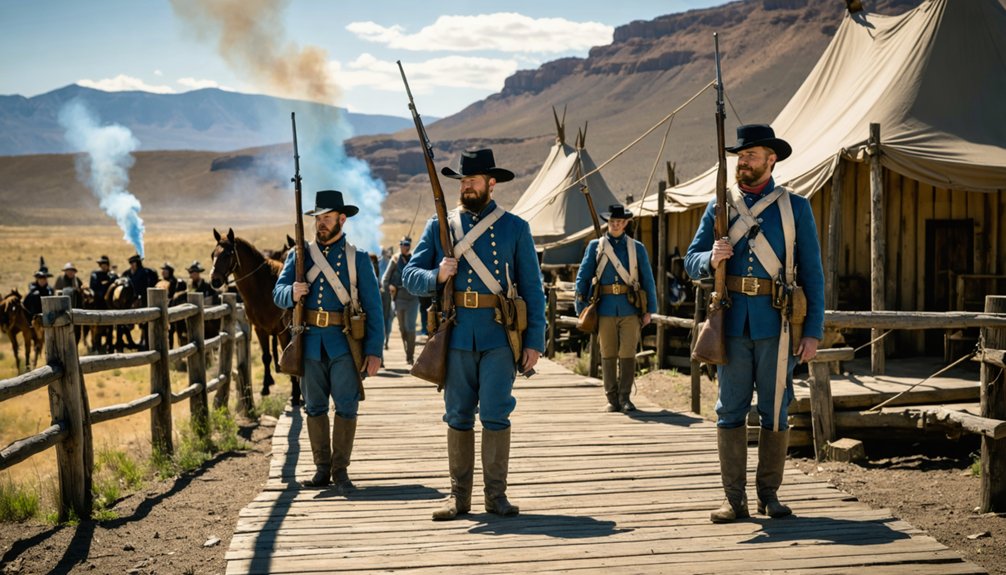
You’ll witness one of California’s most authentic Civil War experiences each President’s Day weekend, where Union and Confederate forces clash amid Calico’s desert mountains while President Lincoln himself inspects the troops.
The reenactment transforms this 1880s silver mining town into a 1860s battlefield, with period camps demonstrating soldier life between scheduled battles at 11:45 a.m. and 2:30 p.m.
This anachronistic blend creates a unique historical layering—Civil War military history performed against a backdrop that wouldn’t exist for another two decades.
Historic Civil War Battles
The Calico Ghost Town’s President’s Day Civil War Reenactment transforms this 1880s silver mining settlement into an unlikely battlefield where Union and Confederate forces clash twice daily at 11:45 a.m. and 2:30 p.m. throughout the February holiday weekend.
You’ll witness Civil War strategies unfold across Calico’s mountainous terrain as reenactors demonstrate authentic Union versus Confederate tactics through cannon fire and musket volleys at Artillery Point near the School House.
President Lincoln himself inspects troops at separate locations before battle commences, while brigade commanders deliver period-accurate dialogue explaining military decisions.
Artillery demonstrations punctuate each engagement, with The Gettysburg Address following battle sequences.
This immersive historical experience lets you explore authentic combat tactics that defined America’s most pivotal conflict, free from sanitized museum displays.
Period Camp Life Demonstrations
Beyond choreographed battlefield clashes, Calico’s Civil War reenactment reveals the unglamorous truth of soldier existence through meticulously reconstructed military encampments. You’ll witness reenactors in historical attire demonstrating campcraft skills that sustained armies—from cooking over open fires to maintaining equipment under harsh conditions.
President Lincoln himself conducts formal troop inspections at 11:15 a.m., evaluating both Union and Confederate units against period military standards.
Throughout the weekend, these living history displays showcase daily routines that defined 19th-century military life. Artillery crews demonstrate cannon operations at designated firing points, while brigade commanders engage in authentic Civil War dialogue.
You’re experiencing educational immersion rather than mere entertainment—each presentation connects visitors directly to the physical realities soldiers endured, stripping away romantic mythology to expose genuine historical experience.
Ghost Town Backdrop Experience
Against Calico’s weathered storefronts and abandoned mine shafts, Civil War reenactors transform an 1880s silver mining town into an improbable battlefield each Presidents’ Day weekend. You’ll witness this temporal collision as authentic costumes from the 1860s clash against historic architecture from two decades later, creating a surreal juxtaposition that questions rigid historical narratives.
The ghost town’s Main Street becomes your stage for alternative history, where Union and Confederate troops march past buildings that didn’t exist during their actual conflict. Artillery demonstrations near the School House and battles throughout the mountains leverage Calico’s preserved structures as unconventional props.
Between 9 a.m. and 5 p.m., you’re free to explore this anachronistic spectacle, where President Lincoln delivers the Gettysburg Address among silver-rush relics, proving history’s malleability when unshackled from conventional interpretation.
Bodie, California: High Sierra Mining Town Preservation
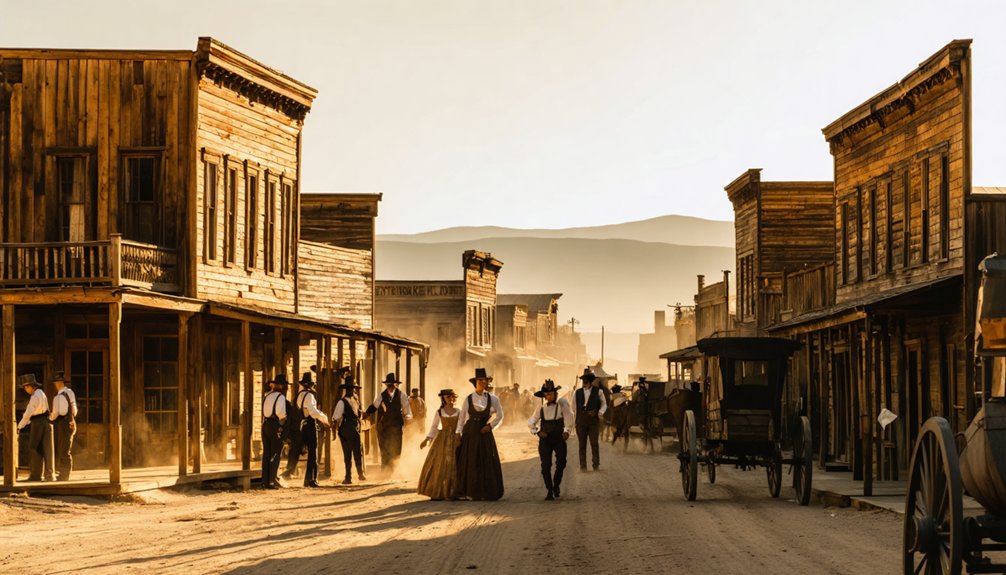
Perched at 8,379 feet in California’s High Sierra, Bodie stands as the nation’s most authentic preserved mining boomtown, a windswept tableau frozen in 1880s decline. You’ll find approximately 110 buildings maintained in “arrested decay”—no restorations, no improvements, just raw preservation of ghost town architecture as abandonment left it.
This preservation relies on this hands-off philosophy: interiors remain stocked with goods, furniture scattered where miners left them, decay progressing naturally under ranger supervision.
This wasn’t always desolation. Nearly 10,000 fortune-seekers swarmed here by 1880 after the Standard Company struck paydirt. Today, you’ll walk those same deserted streets among 200,000 annual visitors, peering through weathered windows at the Methodist church’s dusty pews and Boone Store’s century-old dynamite.
One dwelling—Miller House—opens for exploration, offering unfiltered glimpses into boomtown existence without interpretive interference.
New Salem, Illinois: Pioneer Life in Lincoln Country
Unlike Bodie’s philosophy of arrested decay, New Salem exists as America’s most ambitious ghost town resurrection—23 reconstructed log buildings rising from foundations where Abraham Lincoln spent his formative years between 1831 and 1837.
You’ll find historical preservation meets reconstruction here, where the Civilian Conservation Corps rebuilt an entire 1830s frontier village during the Depression era.
The early settlement thrived briefly after its 1829 platting, then vanished by 1840 when Petersburg claimed the county seat. Residents literally dismantled their homes and relocated them, leaving only pastureland.
Today’s interpretation offers you visceral connection to pioneer life—you can walk Lincoln’s surveyor routes, visit the Berry-Lincoln Store replica, and experience annual reenactments where interpreters demonstrate blacksmithing, coopering, and frontier commerce that shaped a future president’s character.
Planning Your Ghost Town Reenactment Visit
Strategic planning transforms your ghost town reenactment experience from casual observation into meaningful historical immersion. Research admission costs beforehand—Calico Ghost Town’s Civil War Reenactment charges $10 for adults, while Muster in the Mountains offers free public access.
Check event calendars meticulously; Ghost Town Alive! runs select June-August dates at Knott’s Berry Farm, whereas Calico Days occurs during specific September weekends.
Explore hidden pathways beyond main attractions to discover authentic craftspeople demonstrating tomahawk throwing or coppersmithing. Arrive early when parks open at 9 a.m. to secure prime viewing spots for gunfighting shows and theatrical performances.
Local eateries near sites like Barstow provide sustenance between activities. Book camping reservations through designated numbers for overnight immersion. Download venue apps for real-time showtimes, maximizing your autonomous exploration of 1800s frontier culture.
Frequently Asked Questions
Can I Participate in Reenactments or Are They Performers Only?
You can participate as a volunteer reenactor by researching period details, obtaining participant costumes, and pre-registering with groups. You’ll purchase your own gear, pay modest fees, and join semifraternal units—experiencing living history through authentic volunteer opportunities.
What Should I Wear to a Ghost Town Reenactment Event?
You’ll need period-authentic costume ideas matching the ghost town’s historical era. Research the specific time period for historical accuracy—authentic reproductions of clothing, footwear, and accessories are required. Modern items must remain concealed throughout the event.
Are Ghost Town Reenactments Appropriate for Young Children?
Remarkably, age appropriateness depends on your child’s temperament. While reenactments prioritize historical accuracy with gunfights and violence, school-age kids typically handle them well. You’ll want to skip these events with preschoolers who can’t distinguish performance from reality.
Do I Need to Purchase Tickets in Advance for Reenactment Events?
Ticket reservation depends on event scheduling—you’ll find freedom at Calico Days with walk-up admission, but Harrison Ghost Walk demands advance purchases due to sellouts. Research each reenactment’s archival patterns; high-demand tours require early booking while casual festivals don’t.
Are Pets Allowed at Ghost Town Reenactment Activities?
Like horses spooked by cannon fire, pets don’t belong at ghost town reenactments. You’ll find strict animal restrictions at Tombstone’s Helldorado Days and Deadwood’s street performances. Pet etiquette means leaving companions home—except certified service animals under ADA guidelines.
References
- https://koa.com/blog/historical-reenactments-worth-traveling-for/
- https://www.gonomad.com/232995-ghost-towns-of-montana
- https://backroadplanet.com/historical-war-reenactments-in-florida/
- https://parks.sbcounty.gov/calico-days/
- https://events.thehistorylist.com/organizations/calico-ghost-town-yermo-california
- https://www.loveexploring.com/gallerylist/67994/americas-eeriest-gold-rush-ghost-towns
- https://www.frrandp.com/p/ghost-towns-map.html
- https://californiahighsierra.com/trips/explore-ghost-towns-of-the-high-sierra/
- https://www.kxlh.com/brand-spotlight/montana-state-parks/7-reasons-youll-love-bannack-days-july-15-16
- https://visitusaparks.com/reliving-the-wild-west-bannack-state-park/