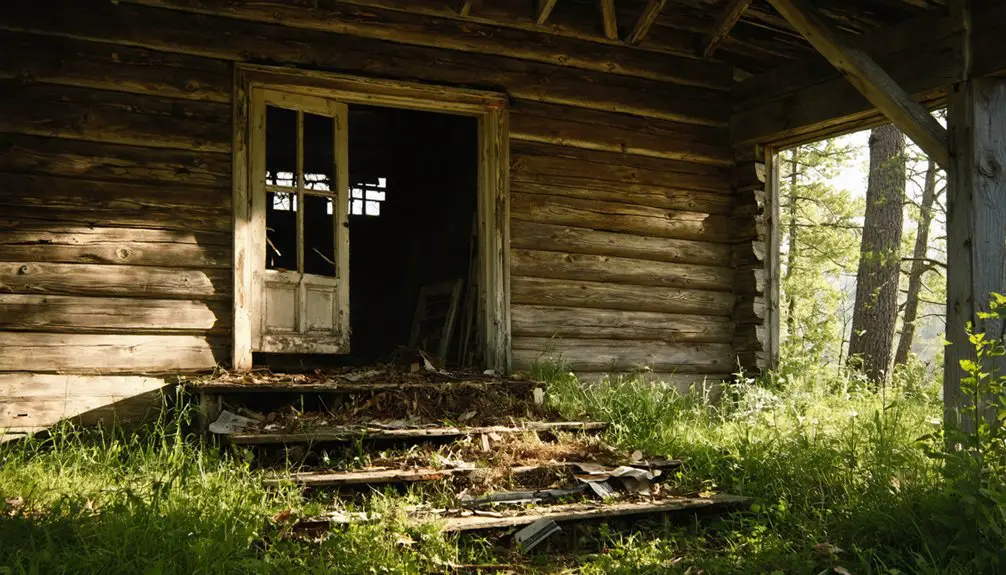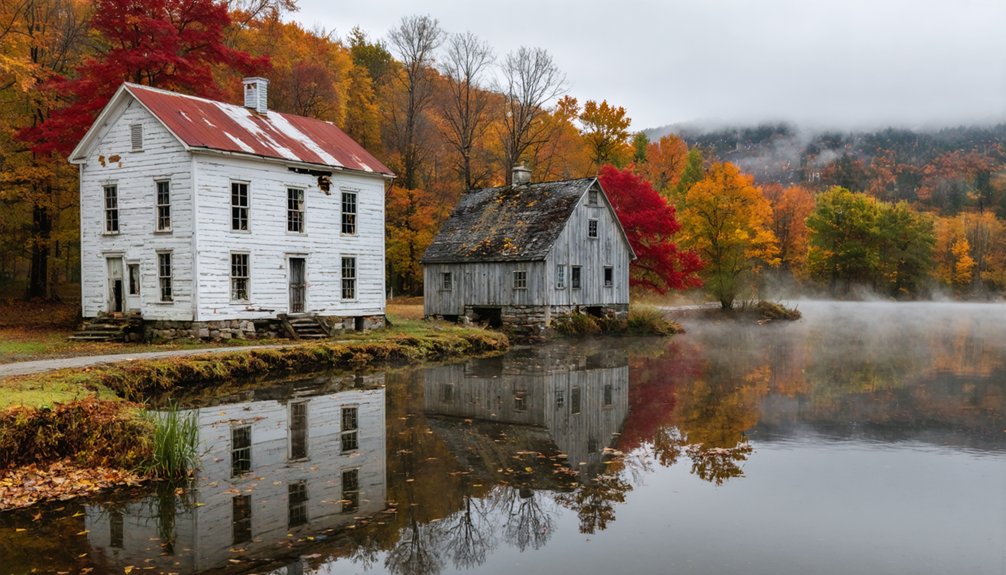
You’ll find Maine’s most atmospheric ghost towns transformed by autumn’s vivid palette from late September through mid-October. Perkins Township on Swan Island showcases 19th-century buildings amid Kennebec River scenery, while Flagstaff Lake’s submerged villages reveal eerie foundations when water levels drop. Riceville’s overgrown tannery ruins and Freeman’s scattered homesteads appear especially haunting beneath golden canopies. Madrid’s mining remnants and Ligonia Village’s industrial ruins gain dramatic character when framed by scarlet maples. Timing your visit for early October captures peak foliage alongside these abandoned settlements‘ compelling stories.
Key Takeaways
- Maine’s ghost towns feature abandoned 19th-century structures including Perkins Township, Riceville, Freeman, and submerged villages beneath Flagstaff Lake.
- Peak fall foliage occurs late September to mid-October, with northern sites coloring earlier than western locations like Freeman.
- Autumn transforms ruins with vivid colors: scarlet maples frame weathered foundations, chimneys, and industrial remnants throughout forested landscapes.
- Visitors can freely explore authentic structures, cemeteries, and foundations with minimal commercial interference at most abandoned sites.
- Notable locations include Swan Island’s preserved buildings, Flagstaff’s underwater ruins, Riceville’s cemetery, and Madrid’s mining settlement structures.
Perkins Township on Swan Island: Furnished Homes Amid Autumn Colors
Though Swan Island’s glory days ended nearly a century ago, the ghost town of Perkins Township still stands remarkably intact among the scarlet maples and golden birches of the Kennebec River.
You’ll discover eight preserved buildings scattered across 1,500 acres of wilderness, where shipbuilders and ice harvesters once carved out independent lives. The furnished homes offer an authentic glimpse into 19th-century Maine life—no sanitized museum experience here.
Historic preservation efforts have maintained the schoolhouse, cemetery, and remaining structures since the town’s 1918 disincorporation. Among these buildings stands the Tubbs-Reed House, the second oldest structure on the island, built by Major Samuel Tubbs and overlooking both channels of the Kennebec. The entire Swan Island Historic District was listed on the National Register of Historic Places in 1995, recognizing its exceptional historical value. Now protected as the Steve Powell Wildlife Management Area, this cultural heritage site welcomes you to explore freely.
You can camp, hunt, and fish while wandering through autumn-painted streets where 100 residents once thrived on farming, fishing, and lumbering.
Flagstaff Lake: Submerged Village Surrounded by October Splendor
When Central Maine Power flooded the Dead River valley in 1950, the thriving communities of Flagstaff and Dead River vanished beneath what became Maine’s fourth-largest lake.
You’ll find the submerged village remnants emerging during low water levels, where chimneys and foundations break the surface as haunting reminders of the 300 residents forced from their homes.
The Bigelow Mountains’ hardwood forests frame this man-made lake in October brilliance, creating a striking contrast between vibrant autumn foliage and the ghost town resting silently beneath the water.
Just one year before the flooding, residents gathered for their final Old Home Days celebration on July 4, 1949, uniting Flagstaff and Dead River with parades, music, and fireworks before their communities would disappear forever.
Today’s visitors enjoy snowmobiling and recreation on the lake’s surface, often unaware of the village history concealed in the waters below.
Underwater Ghost Town History
Beneath the crystalline waters of Flagstaff Lake lies a drowned world where two complete villages vanished in 1950, their streets and structures submerged to feed Maine’s hunger for hydroelectric power.
You’ll find submerged relics from Flagstaff and Dead River Plantation—communities dating to the 1800s when settlers claimed timber-rich land along the Dead River.
Central Maine Power purchased the territory in 1930, and despite fierce resident opposition, the state wielded eminent domain to force evacuation.
Crews razed buildings in 1948, though some families couldn’t agree on compensation and abandoned everything.
When Long Falls Dam‘s gates closed in 1950, floodwaters swallowed homes, mills, and memories.
Today’s underwater archaeology reveals chimneys and foundations during drawdowns—tangible proof that progress demanded sacrifice from those who built their lives here.
The flooding created Flagstaff Lake, Maine’s largest man-made lake, transforming the valley into a reservoir that continues to generate electricity for the state’s power grid.
Residents witnessed homes and chimney structures fall as families fled their childhood properties, leaving emotional scars that persisted for generations.
Best Lake Viewing Spots
Where autumn’s crimson maples meet the drowning grounds of lost villages, Flagstaff Lake transforms into Maine’s most hauntingly beautiful testament to sacrifice and seasonal splendor. You’ll find unmatched perspectives from Route 27’s Maine High Peaks Scenic Byway, where colors ignite by mid-September.
Jeff Hinman’s pontoon tours navigate shallow channels above submerged foundations while interpreting Benedict Arnold’s historic march and Bigelow’s reconnaissance missions.
For elevated vantage points, trek Bigelow Preserve’s mountain trails or follow the Appalachian Trail sections overlooking drowned settlements below.
Maine Huts & Trails connects Flagstaff and Stratton Brook huts through riverside paths perfect for mountain biking and river kayaking.
Peak colors blaze between September 25 and October 5, when bald eagles soar above waters hiding an entire civilization beneath autumn’s reflected glory. The quiet, magnificently peaceful atmosphere enhances wildlife encounters with loons gliding between islands that once stood as hilltops beneath the Bigelow range. The hydroelectric dam created in the 1950s not only flooded these historic villages but also established a reservoir that now powers the region while serving as a recreational hub.
Riceville in Township 39: Overgrown Ruins in a Forest of Color
Deep in Township 39 of Northern Hancock County, the overgrown remnants of Riceville emerge like specters from the surrounding forest. Their crumbling foundations are now half-swallowed by earth and vegetation.
This abandoned tannery town, established in 1879, met its end after a devastating 1905 fire destroyed the leather works that employed its 75+ residents. The Shaw brothers founded the original settlement and tannery operation that would give life to this remote community.
You’ll discover these haunting features among autumn’s brilliant colors:
- Massive cellar structure beneath the old main road, containing historical artifacts like a large stove piece
- Riceville Cemetery marked by a towering tree, though curiously lacking headstones
- Surviving building foundations scattered throughout privately-owned logging land
- Local legends of mysterious deaths, though historical records show residents simply relocated after economic collapse
The site’s remote location offers adventurous souls an authentic ghost town experience wrapped in fall’s spectacular display. Like other abandoned settlements across Maine and nearby regions, Riceville stands as a historical reminder of population shifts that transformed once-thriving communities into silent monuments of the past.
Freeman: Remote Remnants Along Vibrant Fall Drives
How does a thriving 19th-century agricultural hub fade into scattered foundations and silent cemeteries? Freeman’s story reveals the answer through its moss-covered remnants.
Once home to 838 residents managing Maine’s largest sheep farms, this 1808 township supported train stations, schools, and churches across cleared hillsides. You’ll find five partially-furnished 18th-century homes standing among stone foundations—silent witnesses to economic transformation.
The Civil War and Industrial Age drained Freeman’s population as young people abandoned agriculture for urban development opportunities.
By 1973, disincorporation was complete, leaving modern preservation efforts minimal.
Today, you can explore this ghost town’s creepy cemetery and architectural fragments along vibrant fall drives, where brilliant foliage frames a cautionary tale about rural isolation and the relentless pull of progress.
Ligonia Village: Cemetery Views With Coastal Foliage
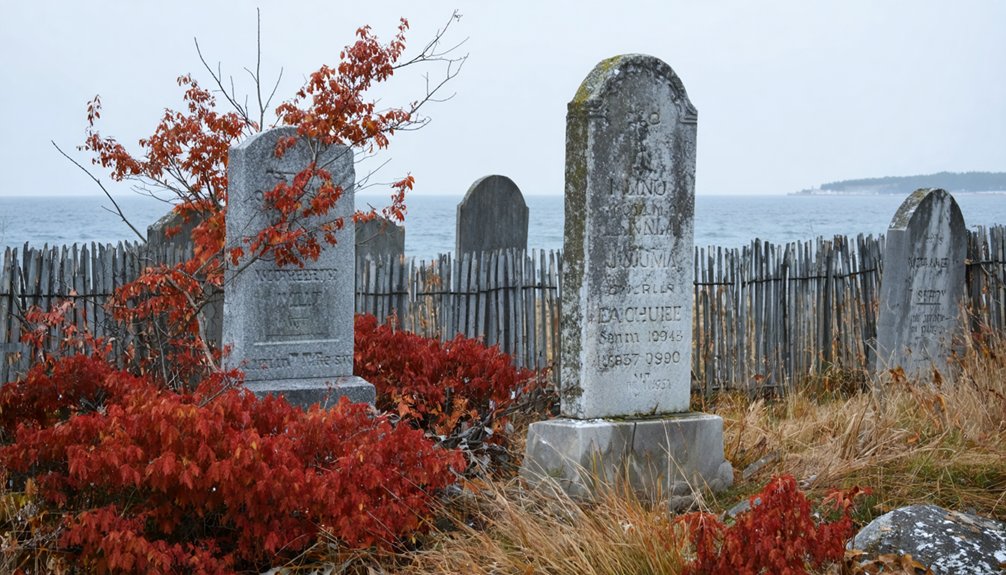
You’ll find Ligonia Village’s remnants where Forest City Cemetery now sprawls across what was once a thriving 19th-century industrial hub along South Portland’s Main Street corridor.
Early October transforms the coastal landscape here, painting the cemetery grounds and Fore River waterfront in vivid autumn hues that contrast sharply with the oil tanks and industrial ruins.
This former factory town—where the Portland Kerosene Oil Company and Rolling Mills once employed hundreds of Irish workers—has become an eerily beautiful ghost neighborhood.
Police dispatchers still use its forgotten name to refer to the area.
Historic Village Turned Graveyard
Along Lincoln Street in South Portland, autumn transforms what remains of Ligonia Village into a landscape where maritime history and mortality intertwine. Forest City Cemetery now occupies ground where 200 residents once lived among six brick factory buildings. The Portland Kerosene Oil Company’s 1859 industrial complex vanished, leaving oil tanks and gravestones as silent witnesses to Maine’s industrial past.
What You’ll Discover:
- Henry Bodge’s 1866 structure site, now South Portland Wine Company, marks the village’s commercial heart.
- Brown’s Hill farmland, dating to 1600s land grants, overlooks the cemetery-integrated area.
- Kerosene Corner at Main and Lincoln Streets, where fire-resistant brick buildings once produced naphtha.
- Sprague terminal’s industrial remnants framing coastal views toward Veterans Bridge.
Historic preservation efforts can’t resurrect this ghost town, but fall foliage honors its transformation from bustling industry to peaceful remembrance.
Early October Color Peak
When early October arrives at Forest City Cemetery, the ghost of Ligonia Village emerges through autumn’s palette—maples and oaks frame weathered gravestones where factory workers once walked cobblestone paths. You’ll find the color transformation reaches its zenith during this brief window, as coastal breezes from Fore River accelerate leaf changes across Brown’s Hill’s elevated terrain.
The autumn ambience intensifies where Lincoln Street meets the cemetery gates, with yellows, oranges, and reds replacing the industrial gray that consumed this 1800s settlement. Maine’s coastal moderation compresses the peak season here—visit too late and Atlantic winds strip branches bare.
Police still call this area Ligonia, directing you toward views where village remnants blend with vibrant canopies, creating landscapes that honor both natural cycles and forgotten communities.
Waterfront Industrial Landscape Today
The Sprague terminal’s rusted infrastructure stretches along Fore River’s edge, marking where Ligonia Village’s waterfront industrial corridor met its gradual decline—yet autumn foliage now softens what iron and commerce once dominated.
You’ll find scarlet maples reclaiming foundation stones where Henry Bodge’s 1866 mill once stood. Industrial decline left scattered remnants—crumbling walls and overgrown pathways—creating an atmospheric backdrop for October exploration.
Heritage preservation efforts reveal:
- Original mill foundations visible beneath vine-covered masonry and seasonal undergrowth
- Forest City Cemetery’s elevated position providing panoramic waterfront views through amber-leafed canopies
- Lincoln Street corridor’s mature trees framing what remains of Maine’s manufacturing past
- Few surviving structures documenting the 19th-century transformation from agricultural settlement to industrial center
This landscape offers freedom to discover forgotten history without commercial interference.
Madrid: Exploring Abandoned Settlements During Peak Season
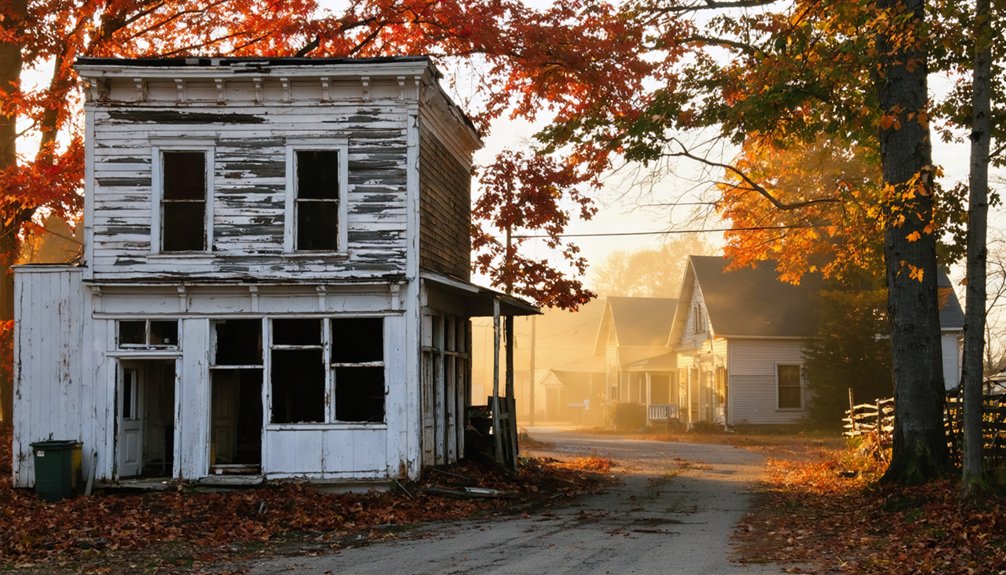
Nestled in Franklin County’s rugged terrain, Madrid stands as one of Maine’s most evocative ghost towns, where autumn’s brilliant foliage now reclaims what 19th-century miners once carved from the wilderness.
Where autumn flames consume forgotten foundations, Madrid whispers tales of miners who tunneled deep but vanished deeper still.
You’ll discover preserved architecture amid crimson maples and golden birches—stone foundations, abandoned homes, and accessible mine shafts that echo urban legends of fortune-seekers who never left.
Peak season transforms this settlement into a photographer’s paradise, where October light illuminates weathered structures against blazing hillsides.
The former railway lines now serve as hiking trails, guiding you through timber stands toward remnants of schools and businesses that thrived until 1959.
You’re free to wander these quiet grounds, where nature’s reclamation tells a haunting story of boom, decline, and the resilient traces of industrial ambition.
Best Times to Visit Maine Ghost Towns for Foliage
Maine’s abandoned settlements reward strategic timing, as foliage transforms these forgotten places between late September and mid-October depending on elevation and latitude. Northern ghost towns like Riceville burst with color first, while western sites including Flagstaff and Freeman hit their stride mid-October.
You’ll find early October delivers 80-90% peak vibrancy across most locations.
Optimal visiting strategies:
- Target late September for northern elevations before wildlife conservation restrictions limit access
- Schedule mid-October visits to Franklin County sites when seasonal photography conditions peak
- Plan weekday trips during the 10-14 day windows to avoid crowds
- Monitor dry September forecasts that extend vibrant displays, while rain shortens them by 3-5 days
Avoid post-mid-October inland visits when 50% leaf drop diminishes both photographic opportunities and the haunting atmosphere these settlements offer.
Combining Ghost Town Exploration With Leaf-Peeping Adventures
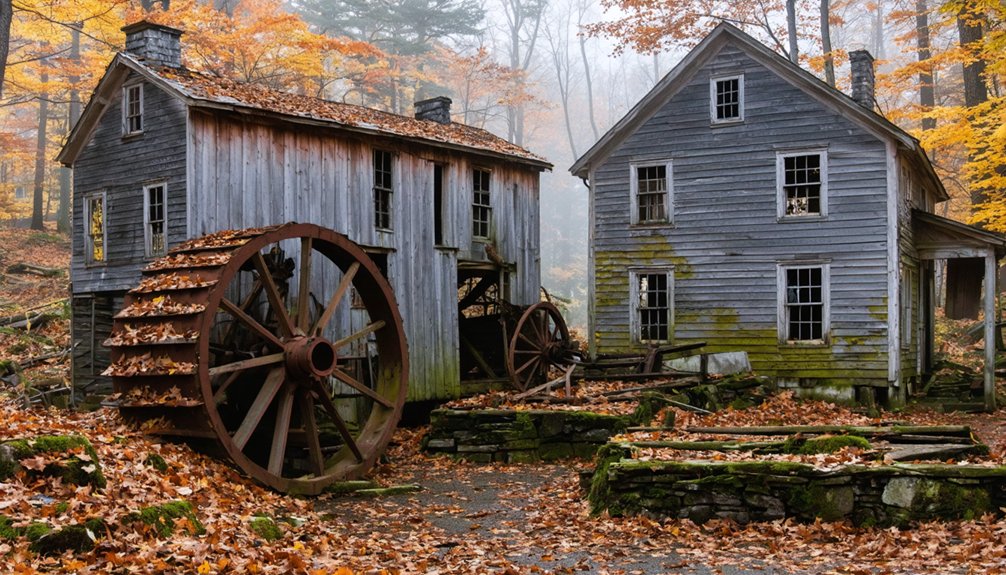
When abandoned settlements merge with autumn’s chromatic display, ghost town exploration transcends ordinary leaf-peeping into something far more evocative. You’ll find Perkins Township’s 18th-century homes framed by forest golds and crimsons, where urban legends about river pollution mingle with October’s brilliance.
Freeman’s mountain trails deliver classic New England colors alongside rural remnants, while Riceville’s forest-overgrown tannery site—where ghost hunters reported mysterious thicket growth—immerses you in dense autumn foliage.
Flagstaff Lake’s submerged streets create haunting reflections beneath Somerset County’s vibrant canopy.
Even Ligonia Village’s cemetery-overtaken grounds benefit from southern Maine’s late-season colors.
Preservation efforts remain minimal at these sites, granting you authentic freedom to photograph deteriorating structures against nature’s spectacular backdrop.
Pitch your tent at Perkins Township and watch moonlight filter through colored leaves above forgotten dwellings.
Frequently Asked Questions
Are Overnight Stays Permitted Near Any Maine Ghost Towns During Fall?
You’ll find overnight camping permitted at Swan Island’s ghost town, where 18th-century buildings stand amid historic preservation efforts. The riverside wildlife habitat creates an atmospheric autumn retreat, though you’ll need to respect the site’s archaeological significance and natural ecosystems.
What Safety Precautions Should Visitors Take When Exploring Abandoned Settlements?
You’ll need sturdy boots and first-aid supplies—70% of ghost town injuries involve falls through rotted floors. Prioritize historical preservation by not disturbing artifacts, maintain wildlife safety distance from bears, and always tell someone your exploration route beforehand.
Do Any Ghost Towns Require Special Permits or Guided Tours?
Most Maine ghost towns don’t require permits—you’re free to explore. However, respect private property boundaries and preservation regulations where posted. Swan Island needs ferry coordination through IF&W, but camping’s unrestricted in designated areas.
Which Ghost Towns Are Wheelchair Accessible for Foliage Viewing?
Unfortunately, you’ll find mobility challenges at these sites. Historical preservation hasn’t included accessibility upgrades—preservation challenges mean rugged terrain, water crossings, and uneven ground dominate. These ghost towns weren’t designed for wheelchair access, limiting your freedom to explore Maine’s autumn haunts independently.
Can Visitors Photograph Inside Abandoned Buildings at These Locations?
You can’t photograph inside most buildings due to private property access restrictions. At Perkins Township, you’ll peer through windows only. Photography permissions vary by location, so you’re best checking with local authorities before exploring interiors.
References
- https://newenglandwanderlust.com/maine-in-october/
- https://lovehardtraveloften.com/united-states/new-england-fall-foliage/
- https://jeff-foliage.com/2024/02/10/beyond-the-lighthouses-discovering-fall-foliage-along-maines-coastal-trails/
- https://heleneinbetween.com/2025/03/ultimate-one-week-fall-foliage-itinerary-for-new-england.html
- https://www.hoteles.com/go/usa/ghost-towns-maine
- https://en.wikipedia.org/wiki/List_of_ghost_towns_in_Maine
- https://strangenewengland.com/podcast/the-lost-village-of-riceville-maine/
- https://swanislandmaine.org/history
- https://historytrust.historyit.com/items/view/online-archives/6786907/biography
- https://www.maine.gov/ifw/docs/swan isl tour bk 12.pdf