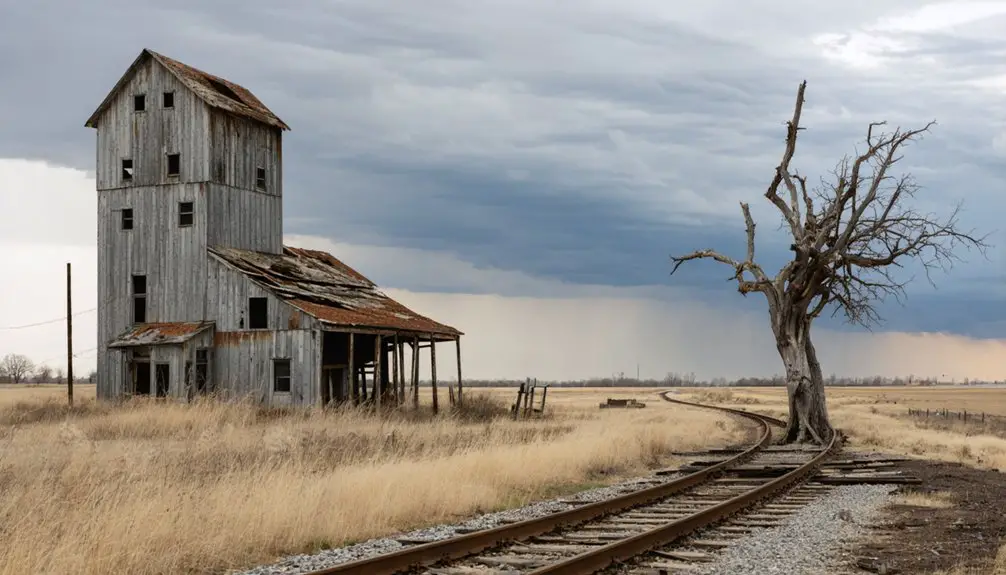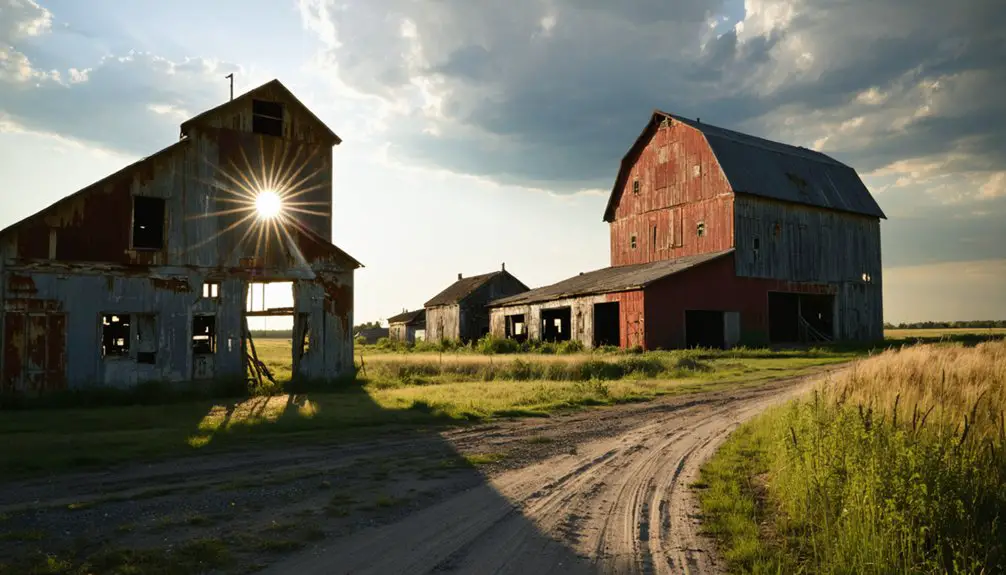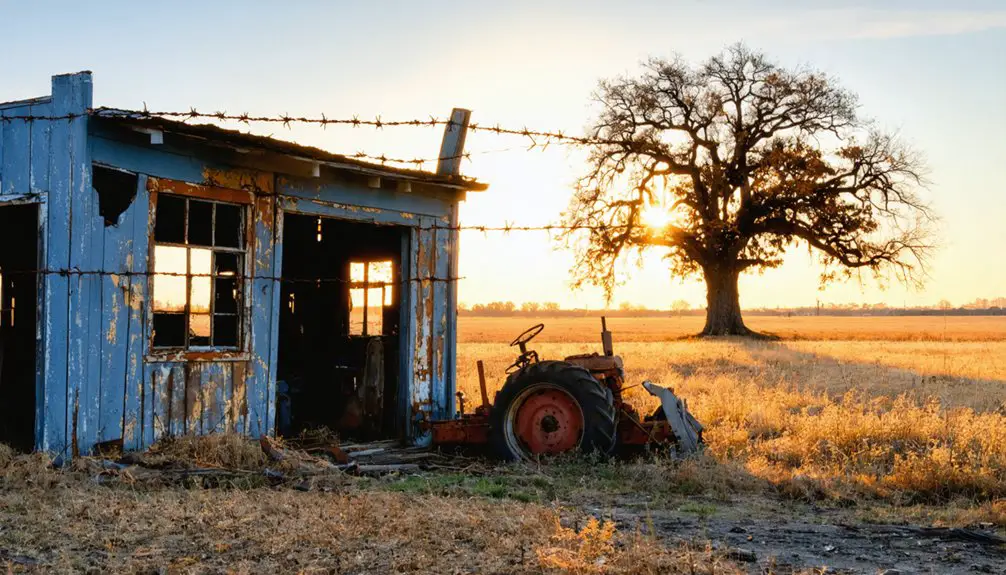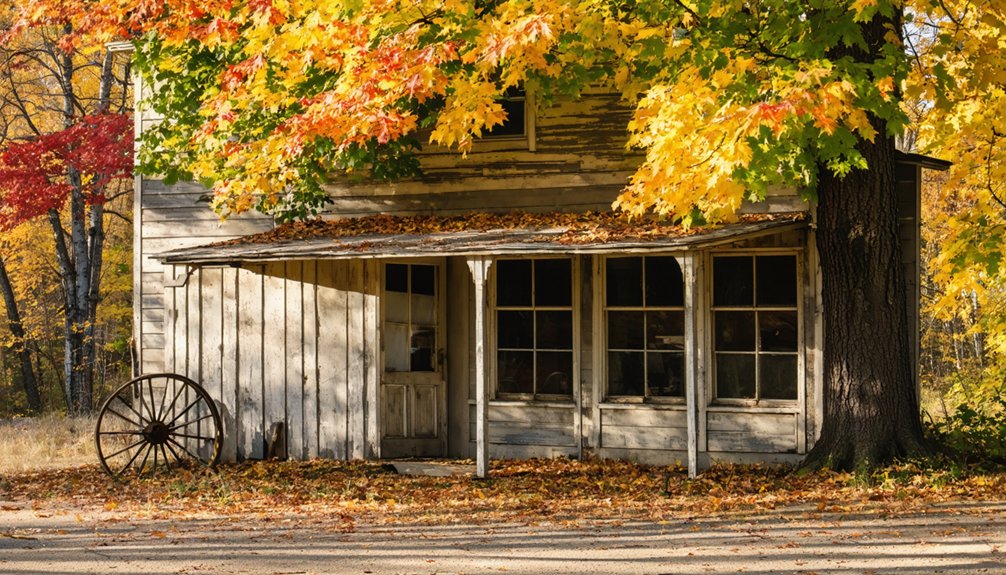
You’ll find Minnesota’s most photogenic ghost towns ablaze with autumn color each October, where Forestville’s 1890s storefronts stand preserved beneath golden maples and Old Crow Wing’s lone white house overlooks the Mississippi through crimson foliage. The Iron Range’s abandoned mining camps like Elcor hide moss-covered foundations within boreal forests, while Goodhue County’s sixty-plus forgotten settlements mark former Norwegian and Swedish communities now reclaimed by brilliant fall hardwoods. The state’s scenic overlooks between Two Harbors and Grand Marais reveal these vanished worlds through nature’s seasonal masterpiece.
Key Takeaways
- Forestville State Park preserves an 1890s ghost town with original structures, surrounded by vibrant maples and fall foliage in October.
- Old Crow Wing features a reconstructed boardwalk and historic sites where the Mississippi and Crow Wing rivers meet amid autumn colors.
- Elcor on the Mesabi Iron Range is now reclaimed by boreal forest with moss-covered ruins visible through fall foliage.
- Goodhue County has over sixty ghost towns marked by roadside signs, best explored during October’s peak fall color season.
- Scenic highways between Two Harbors and Grand Marais reveal vanished communities framed by aspens, birches, and seasonal autumn displays.
Forestville: A Perfectly Preserved 1890s Settlement
Where else can you step directly into an 1890s autumn tableau, complete with wooden sidewalks crunching underfoot and the scent of wood smoke drifting from original brick chimneys? Forestville stands frozen in 1899, defying typical urban decay through exceptional historic preservation.
You’ll wander past Thomas Meighen’s general store, still stocked with period medicines and goods, while costumed interpreters portray actual residents who lived here when the Southern Minnesota Railroad’s bypass sealed the town’s fate.
Unlike abandoned ruins, Forestville’s twenty structures remain intact within the state park—original sawmill, blacksmith shop, and homes where workers once paid rent in store credit. The nearby cemetery adds haunting authenticity to your exploration.
Come fall, when maples blaze against weathered clapboards, you’re witnessing history without barriers or restrictions. The town’s transformation from a bustling company town with 100 residents in 1860 to complete abandonment by 1910 tells the story of countless rural communities that couldn’t survive economic shifts. Robert Foster and Felix Meighen founded the settlement in 1853, hauling their first shipment of goods by steamboat up the Mississippi and oxcart to this Root River valley location.
Old Crow Wing: Northern Minnesota’s Haunting White House
You’ll find Old Crow Wing along the Historic Trail Loop in Crow Wing State Park, where the Mississippi and Crow Wing rivers merge in a sweep of autumn color.
The reconstructed boardwalk guides you past placard markers showing where thirty buildings once stood, while brilliant maples and oaks now reclaim the commercial district.
Rising above the forested trails, the Clement Beaulieu house—that haunting white mansion from 1849—stands as the sole survivor of a settlement that once rivaled modern Brainerd.
This multicultural community thrived as a critical stop along the Red River Trail trading route, drawing together Euro-American traders, Ojibwe leaders like Hole-in-the-Day, and Métis families who built a major hub by the 1840s.
The town’s fate was sealed by an 1867 treaty that relocated Ojibwe residents to White Earth Indian Reservation, leading remaining settlers to abandon the site for railroad opportunities in Brainerd.
Historic Trail Loop Access
The reconstructed boardwalk creaks beneath your feet as you wind through the ghost town’s skeleton, each weathered plank leading you deeper into Crow Wing’s vanished world. You’ll pause where Morrison’s trading post once buzzed with fur traders, where Father Pierz’s mission bell echoed across the confluence. Interpretive signage draws from firsthand accounts—traders’ journals, missionaries’ letters—anchoring you to moments when 700 souls called this place home.
The trail loops through stands of maple and oak, their October brilliance framing empty foundations where Ojibwe leaders once negotiated with Henry Rice. Historic preservation efforts maintain this haunting balance: wild enough to feel abandoned, structured enough to let you trace the lives lived here. The relocated Beaulieu house stands within the park, moved back in 1988 to serve as a tangible link to the fur trading families who shaped this multicultural settlement.
From the overlook, you’ll watch two rivers merge, understanding why settlers chose this spot—and why they couldn’t keep it. The Northern Pacific Railway’s decision to favor Brainerd in the late 1860s sealed Crow Wing’s fate, triggering an exodus that left the once-thriving trading post to the encroaching wilderness.
Last Standing White House
Standing sentinel above the Mississippi’s bend, Clement Beaulieu’s white clapboard house refuses to surrender to time’s appetite. Built in 1849, this Greek Revival structure witnessed Crow Wing’s transformation from thriving crossroads to silence—yet it’s the only building that stayed to tell the story.
You’ll find no urban decay here, just deliberate historical preservation. When the town emptied after 1871’s railroad bypass, Beaulieu’s nephews dismantled the house, moving it away from abandonment’s clutches.
A century later, those weathered sections returned home. Now reconstructed at the original site, it overlooks where the Crow Wing meets the Mississippi—the oldest frame house north of St. Anthony Falls, standing defiant against erasure while autumn maples blaze around its timeworn walls.
Leaf River: The Living Ghost Town of Wadena County
Nestled in section 22 of Leaf River Township, this peculiar settlement defies easy classification—it’s neither fully alive nor completely dead. You’ll find roughly 50 souls maintaining their independence here, alongside a restaurant, golf course, and weathered schoolhouse that whispers of busier times.
The town’s pulse once beat strong with logging camps and Great Northern Railway traffic. Now it exists in that liminal space—officially a ghost town, yet stubbornly inhabited. The community experienced significant population reduction from its peak activity, transforming it into one of Minnesota’s most distinctive settlements.
Conservation efforts have preserved Reaume’s 1792 trading post site, where archaeologists recently mapped forgotten foundations using ground-penetrating radar. The settlement shares its name with multiple Leaf River locations, requiring careful distinction for historians researching this particular Minnesota community.
Come during autumn, when rustling leaves honor the Ojibwa name *Gaaskibag-wajiwan*. You won’t find traditional festivals here—just the quiet dignity of people who refuse to abandon home, even as economic winds blow elsewhere.
Elcor: Mesabi Iron Range Mining Remnants
Deep in the Mesabi Iron Range, you’ll find Elcor’s crumbling foundations half-swallowed by brilliant autumn maples and birches— a mining town that fed America’s steel mills from 1897 until the ore ran dry in 1954.
The boreal forest has spent six decades reclaiming what Pickands Mather’s miners carved from these hills, transforming slag piles into mossy mounds where gold and crimson leaves now drift. At its height in the 1920s, the settlement supported a company store, school, and housing that made it a self-contained community in the wilderness.
When you walk through this abandoned settlement in fall, you’re tracing the ghost of a community that once housed 800 souls, now reduced to concrete footprints beneath your boots. The name “Elcor” itself serves as a disambiguation of sorts, shared by multiple entities beyond this forgotten mining town.
Mining Operations History 1897-1956
The thunder of pickaxes against ancient iron-bearing rock first echoed across the Mesabi Range in 1892, when miners cracked open what would become America’s most productive iron ore district.
You’ll find Elcor’s story woven into this narrative—a settlement born from eastern capital and immigrant sweat. Mining technology evolved rapidly here, transforming from underground tunnels to massive open pits by 1902.
John Rockefeller poured forty million dollars into operations, while Finnish, Italian, and Norwegian workers wielded the tools that fed Pittsburgh’s steel mills.
Labor movements ignited across these red-stained hills. In 1907, thousands struck for an eight-hour day, facing blacklisting and company resistance.
Complete Abandonment After Decline
When Corsica mine exhausted its richest veins in 1954, Elcor’s fate was sealed with a single company decree: vacate. You’ll find no second chances in company town economics—when the ore runs dry, everything else follows.
Residents who’d called these shacks and houses home for generations packed their lives within two years, watching neighbors disappear one by one until 1956’s final exodus.
Today, you can’t even walk Elcor’s streets. The Minorca mine consumed everything, transforming industrial decay into active extraction.
Land reclamation meant obliteration here—no romantic ruins, no weathered storefronts catching autumn light. The mining company reclaimed what it always owned, erasing this “location” as thoroughly as if those fifty-nine years never happened.
Freedom-loving wanderers seeking ghost towns must imagine Elcor beneath modern pit operations.
Exploring Iron Range Today
Scarred hillsides and water-filled chasms mark where Elcor once thrived, though you won’t find street signs or foundation stones amid the Mesabi Iron Range‘s continuing transformation.
You’ll hike through forested trails where autumn maples flame orange against rusted ore deposits, their roots gripping what miners left behind. The depressions pool with dark water—remnants of top-slice caving methods that collapsed underground chambers decades ago.
Your boots crunch over iron-stained gravel while modern pit operations rumble in the distance, processing taconite where soft hematite once filled railcars bound for Duluth. This Mining Heritage isn’t preserved behind museum glass; it’s living geology you can touch, photograph, and wander through freely.
The Mesabi Iron legacy surrounds you—raw, unmanicured, and remarkably accessible for those seeking unscripted adventure.
Goodhue County’s 60+ Abandoned Communities
Goodhue County harbors more than sixty ghost towns scattered across its farmlands and woodlands—communities that once bustled with Norwegian and Swedish immigrants, their children running between general stores and creameries, their voices filling dance halls on Saturday nights.
Sixty ghost towns slumber beneath Goodhue’s fields—echoes of immigrant voices that once filled Saturday night dance halls now fallen silent.
Now you’ll find only roadside signs marking where Belle Creek, White Rock, and Aspelund stood.
Take County Road 8 east of Cannon Falls through autumn-blazed valleys where these places survive as:
- Weathered white buildings—likely former creameries where farmers once sold cream
- Abandoned structures hinting at general stores or dance halls
- Clusters of homes refusing to vanish completely
The Historical Society’s preservation efforts combat urban legends with documented truth.
Roy W. Meyer’s 2003 book maps each vanished post office, each silenced main street—reminders that today’s corporate farmlands once teemed with human-scale dreams.
Best North Shore Locations for Autumn Colors Near Ghost Towns
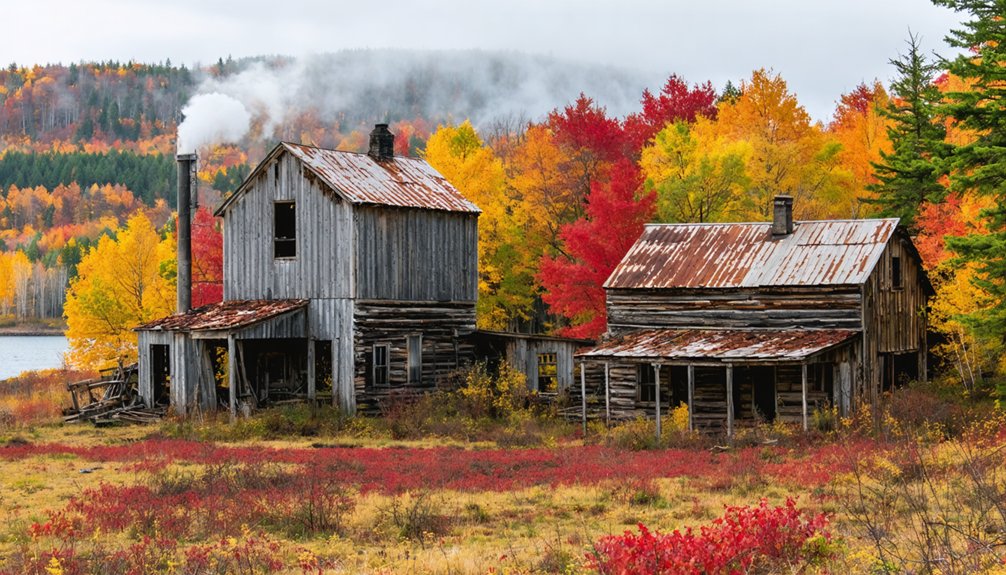
As you climb Highway 61 north from Duluth, the ghost towns hide themselves behind curtains of burning maples—crimson bleeding into October gold on the high inland ridges.
You’ll find forgotten logging camps where aspens shake silver-yellow closer to Superior’s shore, their leaves trembling like prospector’s hands. Hidden waterfalls mark old mill sites—water still tumbling through foundations nobody remembers.
The birches grow denser as you descend toward the lake, their white bark striped black like nature’s own coordinates leading you to abandoned settlements.
Scout the scenic overlooks between Two Harbors and Grand Marais; they’re not just photo ops but vantage points into history. Below those ridgetop maples, entire communities dissolved, leaving only autumn’s annual resurrection of color.
Planning Your Minnesota Ghost Town Fall Foliage Tour
When October transforms Minnesota’s backroads into ribbons of rust and gold, your ghost town expedition demands more than a full gas tank and good intentions. The DNR’s leaf color map becomes your compass, revealing peak foliage windows across forgotten valleys.
Autumn road trips through Goodhue County’s sixty-plus vanished settlements reward spontaneity—cornfields broken by amber groves where Belle Creek and White Rock once thrived.
Essential preparation includes:
- Booking guided tours at Forestville for preserved historical architecture amid wooded hillsides
- Packing bikes for Root River State Trail access through Whalan’s depot district
- Planning boat transport to Grey Cloud Island’s kilns on private riverfront land
Check roadside markers along County Road 8, watch for farm traffic, and pack hiking boots for steep trails near abandoned structures.
Frequently Asked Questions
Are Minnesota Ghost Towns Safe to Explore With Children During Fall?
You’ll find state-managed sites like Forestville perfectly safe for kids, where historical preservation meets adventure. Urban parks offer secure exploration, but avoid actual ruins—local legends tempt, yet crumbling structures and private property pose real dangers for families.
Do I Need Permission to Photograph Abandoned Buildings in Ghost Towns?
You’ll need permission before photographing abandoned buildings—many aren’t truly ownerless. Legal considerations include trespassing laws, while permission requirements protect you from fines. That weathered barn you’re eyeing? Someone likely still owns it, despite autumn leaves cascading through broken windows.
What Wildlife Might I Encounter While Visiting Minnesota Ghost Towns?
You’ll encounter white-tailed deer, bald eagles, and river otters near abandoned sites. Wildlife photography thrives here—I’ve spotted bobcats at dawn. Bird watching opportunities abound with loons calling across misty waters, while black bears roam distant forests freely.
Are There Overnight Accommodations Near Minnesota’s Ghost Town Locations?
Like autumn leaves drifting toward rest, you’ll find accommodations in nearby Lanesboro, Preston, and Wykoff. These havens offer respite after capturing photography tips among ruins, where haunted legends whisper through golden foliage, beckoning your wandering spirit homeward.
Can I Bring My Dog to Minnesota Ghost Town Sites?
You’ll find dog-friendly hikes at most Minnesota ghost towns on leashed trails. Follow pet safety tips: watch for rusty nails near old buildings, pack water, and respect private property boundaries while exploring autumn-colored ruins together.
References
- https://travelwithwildlynorth.com/15-best-spots-in-minnesota-to-see-fall-foliage/
- https://thievesriver.com/blogs/articles/ghost-towns-in-minnesota
- https://mnprairieroots.com/tag/ghost-towns/
- https://quickcountry.com/minnesota-ghost-towns/
- https://en.wikipedia.org/wiki/List_of_ghost_towns_in_Minnesota
- https://www.youtube.com/watch?v=5bCG6B2rzZY
- https://www.youtube.com/watch?v=SK_qpflb_ao
- http://www.onlyinyourstate.com/minnesota/ghost-towns-mn
- https://kdhlradio.com/forestville-named-the-creepiest-and-coolest-ghost-town-in-minnesota/
- https://www.mngoodage.com/voices/mn-history/2019/07/a-ghost-town-turned-history-site/