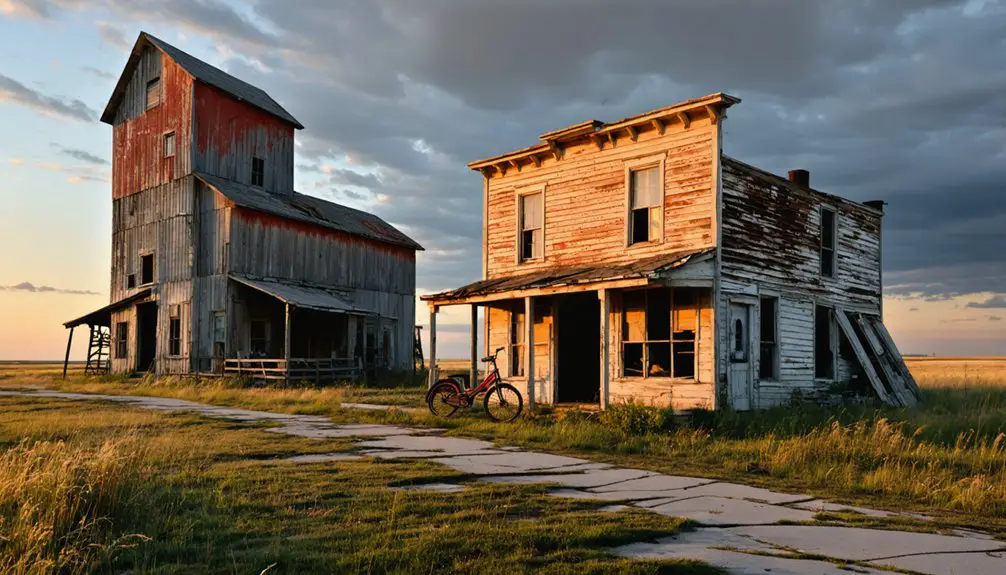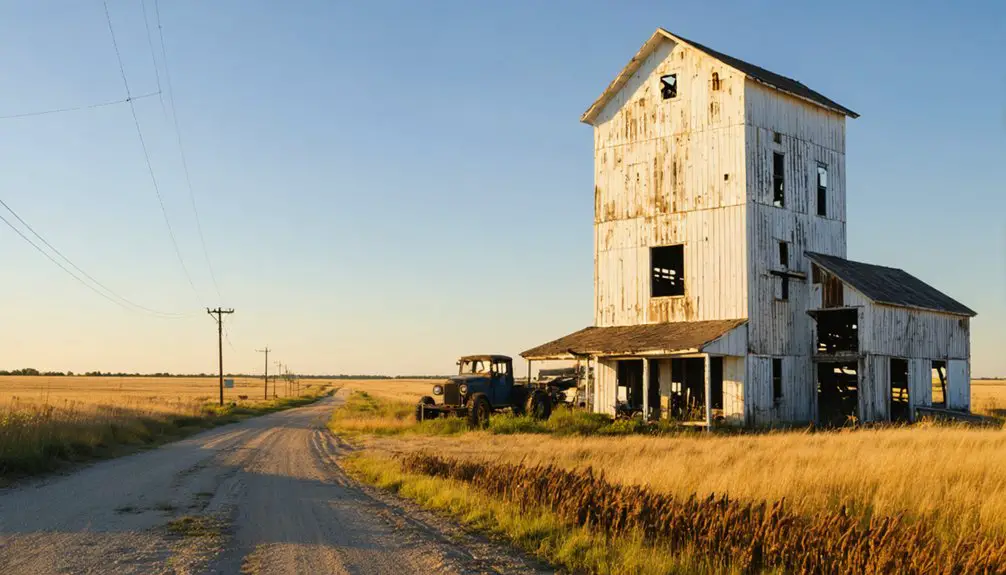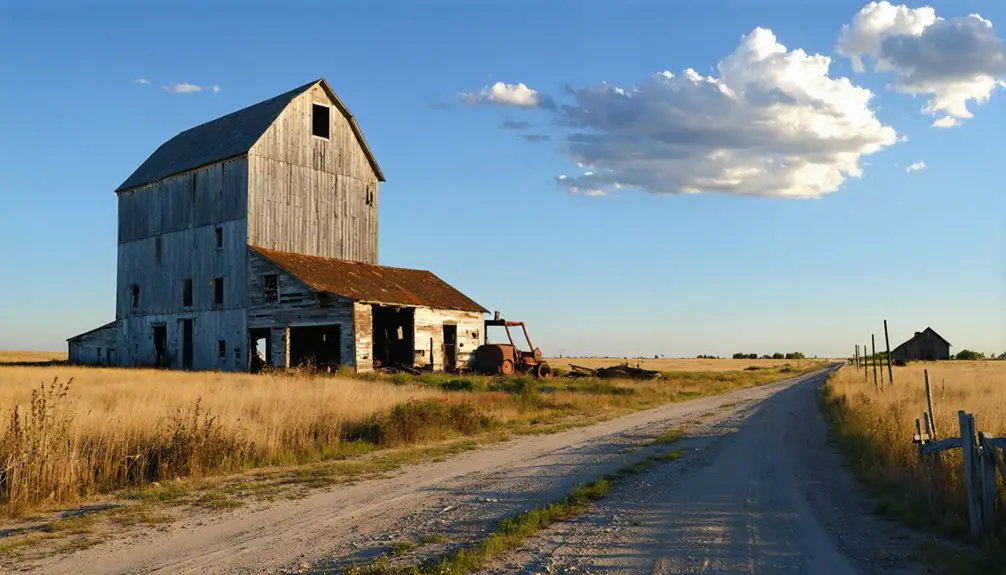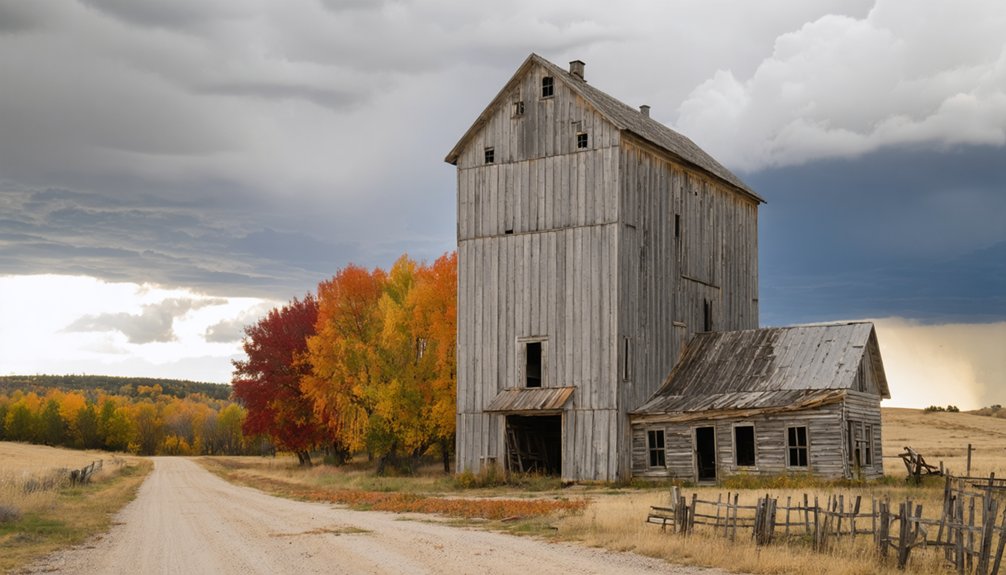
You’ll find North Dakota’s ghost towns most mesmerizing from late September to mid-October, when golden aspens and vibrant maples frame abandoned structures like Hesper’s submerged schoolhouses and Wheelock’s weathered church. The state’s peak foliage arrives around September 29, creating stunning contrasts between rust-colored prairie grasses and decaying grain elevators. Cool temperatures and accessible gravel roads make autumn ideal for exploring sites like Sherbrooke’s fieldstone foundations, where nature reclaims history amid a tapestry of reds, oranges, and yellows that enhance every photographer’s vision.
Key Takeaways
- Peak fall foliage in North Dakota occurs late September to mid-October, with aspens, cottonwoods, maples, and oaks creating vibrant colors.
- Hesper near Devils Lake features partially submerged weathered structures surrounded by dramatic tree-lined autumn scenery in mid-October.
- Wheelock offers over 100 abandoned structures including decayed homes, church, and cemetery framed by copper-colored prairie vegetation.
- Sherbrooke in Steele County contains fieldstone foundations and charred timbers nearly reclaimed by woodland displaying autumn foliage.
- Sims preserves its historic 1884 Lutheran church with original elements, providing striking contrast against seasonal fall surroundings.
Best Time to View North Dakota’s Fall Colors
North Dakota’s fall foliage season ignites in early September and climbs toward its spectacular peak by late September through mid-October, when aspens and cottonwoods blaze bright yellow across the prairie landscape. You’ll want to target the last week of September for prime viewing, as various tree species reach their vibrant crescendo between September 28 and October 9 across North Central Zone 4.
Foliage development intensifies as maples inject brilliant reds and oaks contribute warm oranges to the display. Weather patterns and temperatures directly influence timing—warmer-than-average conditions push peak colors later, while riverside trees transform faster. Trees along river bottoms in Theodore Roosevelt National Park provide particularly striking displays during the seasonal change. According to historical data and NOAA forecast, North Dakota reaches peak foliage by September 29, making it one of the earliest states to experience autumn’s transformation.
Monitor weekly prediction maps and regional reports to catch the perfect moment because waiting past mid-October means you’ll encounter mostly brown, past-peak leaves instead of nature’s fiery spectacle.
Why Autumn Is Perfect for Ghost Town Exploration
Autumn transforms North Dakota’s ghost towns into hauntingly beautiful destinations where crisp, comfortable temperatures let you wander abandoned streets for hours without summer’s oppressive heat or winter’s biting cold.
The vibrant golds of aspen groves and warm hues of prairie grasses create a striking backdrop that amplifies the visual drama of weathered buildings and rusted mining equipment.
This seasonal shift deepens the already eerie atmosphere—as golden leaves whisper past empty windows and cool breezes drift through skeletal structures. You’ll feel the weight of history more profoundly than any other time of year.
Modern luxury RVs provide the perfect base camp for these remote explorations, offering spacious interiors and self-sufficiency for comfortable off-grid stays near historic sites.
Late summer to early fall offers the ideal window for ghost town exploration, avoiding the hazards of snow-covered roads and unpredictable weather that can make remote sites inaccessible.
Crisp Weather for Wandering
When temperatures drop and prairie winds carry a bite, North Dakota’s abandoned settlements become ideal destinations for exploration. You’ll find cool temperatures hovering near freezing that create comfortable conditions for extended wandering through deteriorating structures.
Layer appropriately with wind-resistant outerwear, and you’ll appreciate how the crisp air preserves these fragile buildings while keeping you alert and energized.
Target early September through mid-October for advantageous access before winter weather arrives.
You’ll enjoy stable conditions and passable gravel roads leading to remote sites.
Autumn foliage shift reveals architectural details that summer growth conceals, while sparse vegetation frames silhouetted buildings against bare landscapes. Locations like Hesper showcase vibrant fall colors that enhance the stark beauty of grain elevators and abandoned schoolhouses against the prairie horizon.
The seasonal change provides predictable weather windows between summer storms and winter precipitation, letting you plan longer exploration sessions without interference. Towns like Wheelock offer interesting photo opportunities with their decaying houses, cemetery, and old shops scattered across the landscape.
Vibrant Colors Enhance Atmosphere
As mid-October arrives, brilliant reds, oranges, and yellows transform North Dakota’s ghost towns into otherworldly scenes where nature reclaims human ambition. You’ll find weathered structures in places like Hesper framed by explosive autumn colors, creating contrast that amplifies every cracked window and sagging roofline.
Leaf peeping becomes adventure when you’re exploring abandoned homesteads near the Turtle Mountains, where heavy forest growth paints backgrounds worthy of your camera’s attention.
Unlike crowded autumn festivals, these desolate sites offer solitary discovery among vibrant foliage. Tree-lined river valleys reach peak intensity mid-October, surrounding ghost towns with nature’s most dramatic palette.
You’re free to wander Wheelock or Balfour without schedules or crowds, capturing how autumn simultaneously highlights decay and celebrates renewal in North Dakota’s forgotten corners. Many of these settlements were once thriving railway hubs before being abandoned and reclaimed by the landscape. Among the remnants you’ll encounter are abandoned churches and schools that stand as striking testaments to early settlement patterns across the state.
Enhanced Eerie Ambience
North Dakota’s ghost towns shed their daylight ordinariness once October arrives, transforming into landscapes where silence becomes almost tangible. You’ll discover that crumbling structures in places like Sims and Arena create an amplified quietude that’s impossible to replicate in any other season. The state’s nation-leading collection of abandoned settlements offers you unmatched exploration freedom, where population-zero sites like Griffin provide authentic solitude.
Autumn wildlife rustles through tall grass surrounding Freda’s forgotten train depot, punctuating the eerie stillness with unexpected movement.
Historical preservation takes a backseat here—these aren’t sanitized museums but raw glimpses of abandonment. Churches stand isolated amid decay, their weathered exteriors intensified by seasonal dampness. Lincoln Valley’s former bar and ice cream parlor evoke nostalgic memories of a community abandoned since the 1970s. Pack sturdy closed-toe shoes to navigate uneven terrain safely as you traverse these deteriorating sites.
You’ll find indescribable beauty in places like Alkabo and Temple, where fall conditions accelerate nature’s reclamation of human spaces.
Hesper: Abandoned Structures Among Colorful Landscapes
You’ll find Hesper west of Devils Lake in Benson County, where well-preserved homes stand frozen in time against North Dakota’s autumn prairie.
This true ghost town reached zero population in 2011, yet several structures from its railroad heyday remain intact, including former post office quarters and grain elevator manager housing.
The remote setting accessed by minimally maintained roads creates a striking contrast as fall colors frame the abandoned buildings that once served a thriving 1901 railroad community.
Historic Buildings and Autumn Colors
When vibrant autumn hues frame the weathered structures of Hesper, this ghost town transforms into a photographer’s dream destination.
You’ll discover a red house once home to the A. Larson family standing prominently against colorful backdrops, while an abandoned school site speaks to educational history frozen in time.
These architectural styles reflect North Dakota’s settlement era, though historical preservation here means nature’s reclamation rather than restoration.
Tree-lined surroundings create dramatic frames for your shots during mid-October’s peak foliage season.
You’ll find several structures repurposed for storage, and remnants like mail delivery apparatus scattered among the ruins.
The brisk autumn air enhances the eerie ambiance as golden leaves contrast sharply with decaying wood, offering you unmatched visual storytelling opportunities in this designated ghost town.
Remote Location Near Devils Lake
Rising lake waters have transformed Hesper into one of Devils Lake basin’s most haunting casualties, with abandoned structures now standing as solitary sentinels approximately 13 kilometers west of the expanding shoreline. You’ll find this century-old settlement partially submerged, its remaining farmsteads rising above reclaimed wetlands.
Where fall foliage creates striking contrasts against weathered buildings, the flooding has consumed over 650 square kilometers since the 1990s, displacing hundreds of people.
Inadvertently, the flooding has created unique wildlife habitats among the ruins. Half a million submerged trees once painted these landscapes in autumn brilliance, though decomposing vegetation now drives insects inland.
Historical preservation efforts face impossible odds here, where nature’s reclaiming what settlers built. You’ll need determination reaching this remote location, but the haunting beauty rewards adventurous souls seeking North Dakota’s vanishing places.
Wheelock’s Seasonal Appeal for Autumn Adventurers
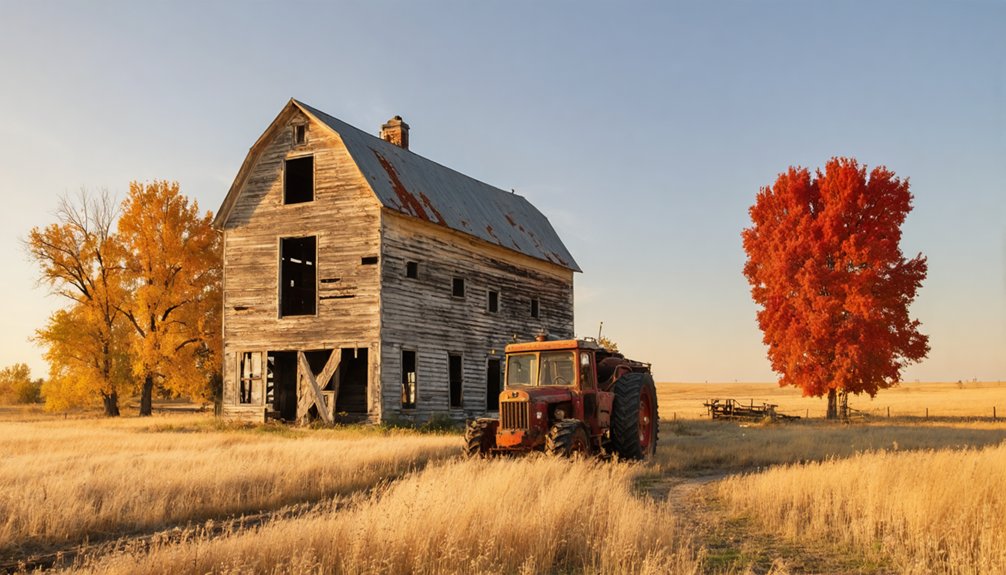
As autumn transforms North Dakota’s northwestern prairie, Wheelock’s crumbling landscape becomes an explorer’s dream destination. You’ll find over 100 abandoned structures scattered across this dissolved town, where seasonal food opportunities and themed photography await among the ruins.
The fall climate provides ideal conditions—no winter snow or summer humidity—for wandering through decaying homes, shops, and a weathered church overlooking the cemetery.
Your autumn exploration reveals:
- Weathered wooden schoolhouse walls framing golden prairie grasses
- Rust-streaked barns casting long shadows across abandoned farmsteads
- Cemetery headstones emerging from copper-colored vegetation
- Satellite dishes clinging to dilapidated shacks, marking stubborn residents
- Main street ruins stretching toward distant oil derricks near Ray and Tioga
This haunted atmosphere intensifies as fall light filters through collapsed roofs and empty window frames, creating the freedom every adventurer craves.
Sherbrooke: Complete Isolation in Steele County
Deep within Steele County’s agricultural heartland, Sherbrooke stands as North Dakota’s most authentically desolate ghost town—a settlement so thoroughly abandoned that nature has nearly reclaimed its existence from the prairie.
You’ll find this true zero-population site via gravel roads off Highway 6, where sherbrooke history echoes through field stone foundations and charred timbers.
Once the county seat from 1885 to 1919, Sherbrooke’s decline accelerated when residents literally moved their houses to Finley.
By the mid-1980s, everyone had left.
Today’s abandoned structures—including a collapsed two-story building and the former Arlene Carpenter home—wear cloaks of dead autumn foliage that clings to surrounding trees.
You’re free to explore these isolated ruins where woody overgrowth silhouettes decaying remnants under October’s quiet skies.
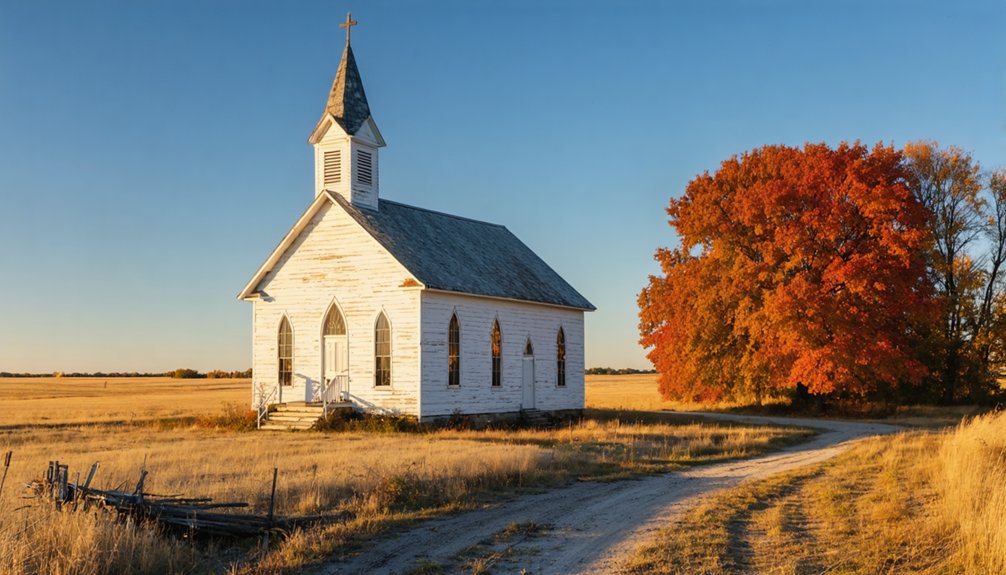
You’ll find something extraordinary in Sims—an active Lutheran congregation still holding services among the remnants of what was once a thriving coal town of over 1,000 residents.
The church, founded in 1884 as the oldest Lutheran congregation west of the Missouri River in North Dakota, stands as a living monument to the Scandinavian immigrants who settled this land.
With only about 50 members gathering for services every other Sunday, this historic sanctuary preserves both its original features and the heritage of those who built it from the prairie soil.
Active Church Among Ruins
While most of North Dakota’s ghost towns hold only crumbling foundations and weathered wood, Sims stands apart with its living heart—a white-steepled Lutheran church where worshipers still gather every other Sunday.
Founded in 1884 as the oldest Lutheran congregation west of the Missouri River, this historical architecture survives through dedicated community preservation. The congregation maintains roughly 50 members from surrounding areas like Almont, breathing life into emptiness.
Inside this prairie landmark, you’ll discover:
- A raised pulpit overlooking pews where livestock troughs once served as makeshift seating
- An organ whose notes echo through walls that witnessed services lit by candlelight before 1950’s electricity
- Frosted windows installed in 1944, filtering autumn sunlight across the altar
- The adjacent 1884 parsonage, now housing the Sims Historical Society Museum
- Evidence of frontier worship where hog troughs doubled as kneeling benches
Since September 30, 1884, when 35 charter members gathered for their first service, Sims Lutheran Church has preserved Norwegian and German immigrant traditions that shaped North Dakota’s prairie settlement.
You’ll discover authentic Scandinavian architecture in both the 1884 parsonage and 1896 church, crafted by skilled Norwegian builders Peter Hans Holmboe and Nicolai Ostreng.
Heritage preservation efforts between 2000-2007 restored these structures to their original appearance through grants from Save America’s Treasures and thousands of volunteer hours.
The parsonage now houses the Sims Historical Society Museum, where you can explore immigrant life on Dakota Territory’s frontier.
First Lady Laura Bush recognized this significance during her 2008 visit, calling it “America’s story.”
The 50-member congregation still gathers here, maintaining traditions their ancestors established nearly 140 years ago.
Ghost Towns Within 50 Miles of Bismarck
Bismarck’s surrounding countryside harbors six authentic ghost towns within an easy 50-mile radius, each offering a distinct glimpse into North Dakota’s pioneering past against a backdrop of autumn colors.
You’ll find Lark ten miles west of Flasher, Arena thirty-five miles northeast with its Lutheran church still standing, and Blue Grass northwest of Mandan where population reached twenty before railroad plans failed.
Industrial artifacts and ghost town legends await:
- Rusted grain elevators tower against golden cottonwoods at Arena
- Dogtooth’s railroad station remnants emerge from prairie grass near namesake buttes
- Brisbane’s abandoned storefronts echo with blacksmith hammers and merchant calls
- Weathered church steeples pierce October’s amber horizons
- Crumbling foundations hide beneath crimson sumac thickets
Submerged Settlements Beneath Lake Sakakawea
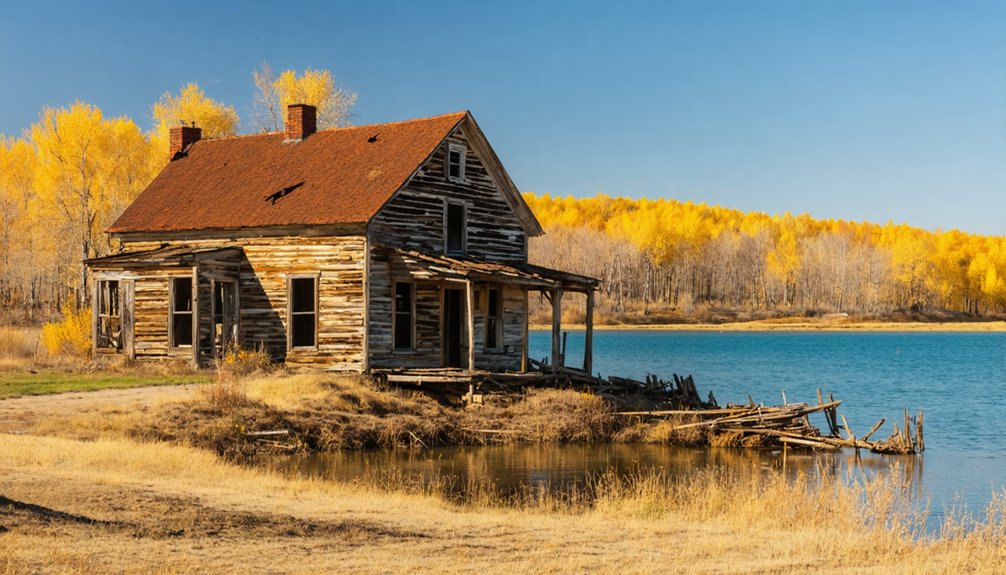
Not all of North Dakota’s ghost towns rest on windswept prairie—some lie entombed beneath 178 miles of reservoir waters.
Lake Sakakawea’s formation in 1953 forever altered the landscape and Native American history when Garrison Dam’s closure flooded nine communities from the Fort Berthold Reservation.
Elbowoods, the cultural heart of the Mandan, Hidatsa, and Arikara tribes, vanished along with Sanish, Van Hook, Red Butte, and five other settlements.
The reservoir formation displaced over 1,700 tribal members, drowning 155,000 acres of prime farmland, sacred sites, and centuries-old bottomlands.
Today, these submerged towns remain invisible monuments to communities sacrificed for flood control and hydroelectric power—ghost towns you’ll never glimpse through autumn’s golden leaves.
How Railroads Shaped North Dakota’s Abandoned Communities
The steel ribbons that crisscrossed North Dakota between 1883 and 1920 didn’t just connect distant cities—they conjured entire communities from empty prairie. Railway development followed a calculated pattern: towns platted every seven miles for best grain hauling.
Milwaukee Road’s 1907-1908 expansion birthed Gascoyne and Griffin, while Great Northern averaged 3.5 miles of track daily, reaching Williston by 1887.
You’ll find these remnants scattered across autumn landscapes:
- Weathered grain elevators standing sentinel over golden fields
- Abandoned water towers silhouetted against crimson sunsets
- Crumbling depot platforms where passengers once gathered
- Rusted rail spurs disappearing into orange-leafed coulees
- Ghost town main streets framed by yellowing cottonwoods
Economic history turned cruel when diesel engines eliminated water stops and farm consolidation shuttered elevators.
Planning Your Fall Ghost Town Road Trip
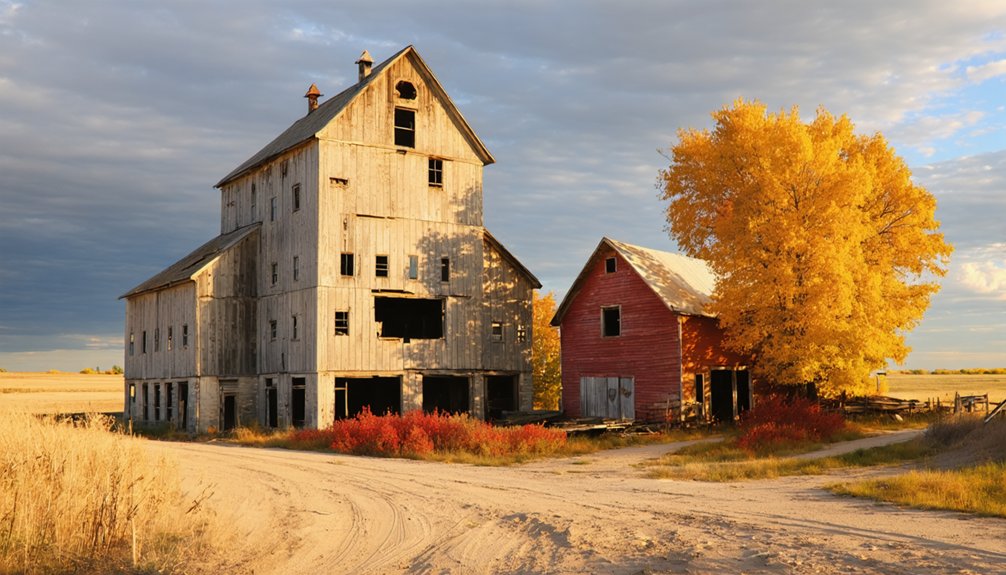
Check the Fall Foliage Prediction Map before departing, as wind can strip peak colors overnight.
From Minot, you’ll reach Tagus, Ruso, Bergen, Balfour, and Kief within 30-60 minutes on scenic backroads.
Hesper’s abandoned homes west of Devils Lake offer prime photo opportunities amid heavy forest growth.
Historical preservation remains minimal at remote sites, letting nature reclaim structures organically.
Early autumn coincides with bird migratory patterns, adding wildlife viewing to your exploration.
The Ghosts of North Dakota map provides GPS coordinates and driving directions.
Frequently Asked Questions
Are North Dakota Ghost Towns Safe to Explore During Fall Months?
You’ll find North Dakota ghost towns reasonably safe during fall, though you should watch for structural hazards in crumbling buildings and prepare for wildlife encounters during hunting season. Respect historical preservation efforts while embracing your adventurous spirit exploring these abandoned settlements.
Do I Need Permission to Visit Abandoned Ghost Town Properties?
Yes, you’ll need permission for most North Dakota ghost towns due to ownership rights and legal restrictions on private property. Always check for no-trespassing signs, verify land status through county records, and respect boundaries to avoid legal issues.
What Photography Equipment Works Best for Capturing Fall Ghost Towns?
You’ll want a full-frame camera with weather-sealing for unpredictable conditions, a wide-angle lens (16-35mm) for expansive compositions, and a sturdy tripod for stability. Adjust camera settings for golden hour lighting, and pack circular polarizers to enhance autumn colors.
Are There Guided Tours Available for North Dakota’s Ghost Towns?
You’re on your own for North Dakota’s ghost towns—no guided tours exist. You’ll self-navigate to sites like Hesper and Sims, discovering haunted stories independently. Preservation efforts remain minimal, letting you explore these abandoned places with complete freedom and authenticity.
Can I Camp Overnight Near Ghost Town Locations in Autumn?
You’ll find camping opportunities at nearby state parks and private campgrounds rather than directly in ghost towns. Practice autumn camping tips like packing warm gear, and prioritize camping safety since ghost town sites often sit on restricted private property.
References
- https://www.ndtourism.com/best-places/best-places-view-fall-foliage-north-dakota
- https://ghostsofnorthdakota892857007.wordpress.com/2012/10/02/autumn-in-hesper/
- https://www.theflashnites.com/blog/exploration-stories/the-ghosts-of-sherbrooke-north-dakota/
- https://www.onlyinyourstate.com/trip-ideas/north-dakota/ghost-town-autumn-trip-nd
- https://us1033.com/a-haunting-look-at-some-real-life-north-dakota-ghost-towns/
- https://northernsentry.com/2025/06/26/north-dakota-ghost-towns/
- https://www.youtube.com/watch?v=8GO57Im_dss
- https://en.wikipedia.org/wiki/List_of_ghost_towns_in_North_Dakota
- https://www.youtube.com/watch?v=59hzueQkmok
- https://www.afar.com/magazine/plan-your-fall-getaway-with-this-peak-foliage-prediction-map