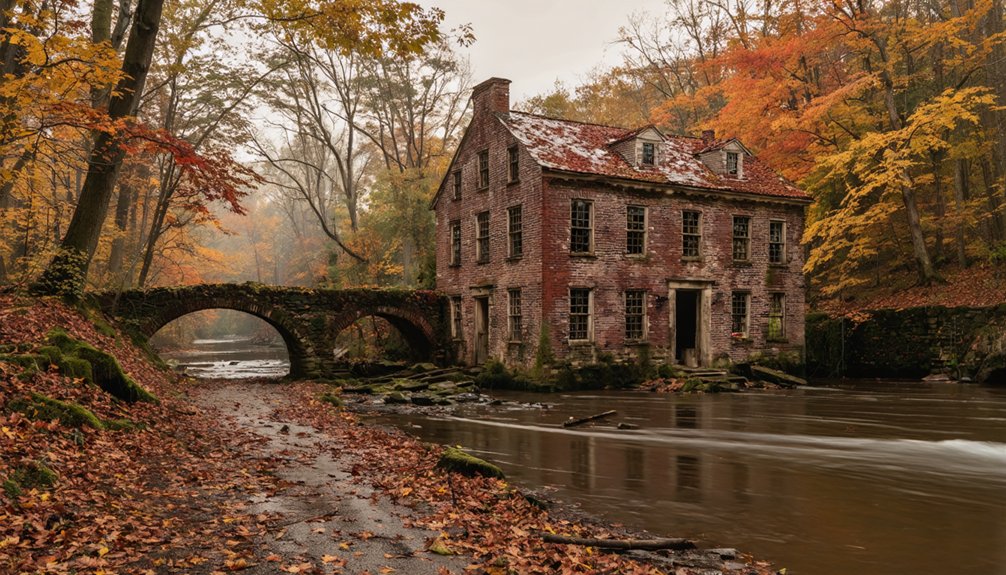
You’ll find Rhode Island’s most atmospheric abandoned settlements—Hanton City, Ram Tail Village, and Fort Mansfield—dramatically framed by fall foliage from early October through November. These sites feature Colonial stone foundations, crumbling military fortifications, and mill ruins reclaimed by forests of blazing red maples and golden oaks. Plan visits to Hanton City in early October, inland Foster sites mid-month, and coastal ruins by late October when foliage peaks align with each location’s historical architecture and the surrounding woodland’s vibrant transformation into living archives.
Key Takeaways
- Hanton City features stone foundations and artifacts from the 1730s, best visited early October via hiking trail at 70 W. Reservoir Rd.
- Fort Mansfield at Napatree Point offers crumbling concrete ramparts with coastal foliage views, optimal late October through early November.
- Ram Tail Village in Foster showcases haunted mill ruins and stone foundations, peak foliage mid-October along Rams Tail Road.
- Sites abandoned mid-1800s due to economic decline as residents moved to mills, leaving foundations reclaimed by nature.
- Plan 4-6 hour visits per site with GPS navigation, timing trips to Rhode Island’s foliage progression from early to late October.
Hanton City: A Colonial Settlement Lost to Time
Deep in Smithfield’s woodlands, stone foundations and crumbling walls mark what remains of Hanton City—a name far grander than the modest farming settlement it described.
Hanton City’s grandiose name belied its humble reality—a small farming community now reduced to moss-covered stones and fading memories.
English yeoman families—the Paines, Hantons, and Shippees—established this isolated community in the 1730s, possibly receiving land for service in King Philip’s War.
They built lives around tanning and boot-making, relying on individual craftsmanship before mills transformed Rhode Island’s economy.
You’ll find historical artifacts throughout: weathered stone walls, an old dam, and the Alfred Smith Cemetery with legible gravestones.
The Smith family gravestones document Alfred Smith (1770–1828), his wife Eliza (1785–1840), and Emor (died 1826), revealing residents who lived relatively quiet lives.
The settlement’s mysterious abandonment by mid-century spawned local legends of loyalists and outcasts, though economic reality tells a simpler story.
Mills along nearby rivers offered better wages, drawing residents away until the last Hanton died around 1900.
Explorers today navigate overgrown terrain and swamp conditions that ultimately reclaimed the site by the late 1800s.
Exploring the Overgrown Trails of Hanton City
Today’s visitors reach Hanton City via the Hanton City Hiking Trail, beginning at 70 W. Reservoir Rd in Smithfield. You’ll trek roughly three-quarters of a mile before encountering the first cellar hole in a clearing on your right.
The overgrown paths wind through wooded terrain where stone foundations and dilapidated walls emerge from dense vegetation. Trail safety requires proper footwear for traversing rocky, marshy conditions—summer brings mosquito swarms from surrounding wetlands. Among the ruins, you may discover a threshing rock once used by Native Americans and early settlers for separating grain. The settlement was likely founded by three English families—the Paines, Hantons, and Shippees—who may have received land grants for their service in King Philip’s War.
Urban legends about the “Lost City” or “Haunted City” persist among locals, though the site’s isolation stems from nineteenth-century economic decline rather than supernatural forces. Fall foliage transforms these forgotten homesteads into accessible historical landscapes, allowing you to explore cellar holes and foundations nature’s been reclaiming since the early 1900s without restrictive barriers.
Napatree Point and Fort Mansfield Ruins
While Hanton City disappeared through economic abandonment, Fort Mansfield met its end through military miscalculation and nature’s relentless advance. You’ll discover these abandoned structures hidden within dense brush at Napatree Point, where Dutch explorer Adriaen Block once observed heavy forests in 1614.
The US Government constructed this coastal defense fort in 1899, housing 228 personnel across three batteries—Wooster, Crawford, and Connell. By 1907, engineers identified a critical flaw: enemy ships could pass beneath shell trajectories.
The military abandoned the site, demolishing buildings by 1929. The 1938 hurricane accelerated the urban decay, pushing the beach back 200 feet and exposing Battery Connell at low tide. The Great Gale of 1815 had previously destroyed the forest cover that once blanketed the point. Following abandonment, the federal land was sold to a summer resort syndicate in 1926 for $365,000, though development plans were ultimately blocked by local community efforts.
Today, you’ll find crumbling concrete ramparts overgrown with vegetation—silent monuments to military ambition reclaimed by wilderness.
Ram Tail Village: Foster’s Forgotten Mill Town
Hidden within Foster’s dense woodlands, Ram Tail Village stands as Rhode Island’s most documented haunted settlement—the only location officially identified as such in the 1885 state census.
You’ll discover remnants of William Potter’s 1790 woolen mill operation along the Ponangansett River, where enchanted legends began after night watchman Peleg Walker’s 1822 suicide following financial ruin.
Workers abandoned the site when machinery mysteriously activated without power, reporting spooky encounters with Walker’s ghost. The mill ceased operations around 1850, and an 1873 arson fire—possibly intended to eliminate paranormal activity—destroyed remaining structures.
You can explore the foundation ruins via Rams Tail Road off Route 6, where stone walls emerge through brilliant autumn foliage. The scattered remains of a grist mill and sawmill lie hidden in the surrounding woods, testament to the village’s once-diverse industrial operations.
Foster incorporated in 1781, separating from Scituate to establish this remote settlement known for its rugged landscape. The forest has reclaimed this once-thriving settlement, preserving its unsettling history.
Best Times to Visit Rhode Island’s Ghost Towns
Rhode Island’s ghost town explorations reach their atmospheric peak during a concentrated three-week window from October 14–31, when autumn’s transformation overlays these abandoned settlements with layers of amber, crimson, and gold.
Optimal Visiting Strategy:
- Northwest sites first – Glocester and Foster’s abandoned settlements display earliest color changes, with crisp October days eliminating mosquitoes while enhancing historical preservation visibility.
- Mid-month immersion – Hanton City in Smithfield and Arcadia Management Area locations peak mid-October when wildlife habitats showcase peak vibrancy alongside stone foundations.
- Coastal conclusions – Napatree Point’s remnants extend viewing into late October with minimal crowds and delayed coastal foliage.
- Weekday advantage – Route 102 and rural back roads offer solitary encounters with history when most visitors crowd weekend destinations. Route 102’s scenic stretch winds through forests and small towns, providing access to several abandoned settlements between Exeter and North Smithfield. For waterfall enthusiasts exploring inland areas, the Ben Utter Trail leads to Stepstone Falls where cascading water complements the surrounding autumn foliage.
Cool autumn weather preserves both leaf intensity and your freedom to explore undisturbed.
Combining Leaf-Peeping With Historical Exploration
You’ll capture Rhode Island’s ghost towns at their most photogenic when you time visits between mid-October and early November, as peak foliage illuminates stone cellars and fort ruins with amber and crimson light.
Plan your route to begin at Hanton City’s 70 W. Reservoir Rd trailhead in morning hours when soft light enhances the tool markings on 1600s-era stonework, then photograph the contrast between weathered foundations and surrounding maple canopies.
Document these sites with attention to both architectural details—cellar steps, well structures, foundation patterns—and seasonal context, preserving visual records that connect colonial-era abandonment to New England’s natural cycles.
Best Seasonal Timing Tips
When planning expeditions to Rhode Island’s forested ghost towns, synchronize your travels with the state’s northwest-to-southeast foliage progression to maximize both chromatic displays and historical documentation opportunities.
Exploring ghost towns in South Carolina offers a unique glimpse into the past, showcasing forgotten histories and the remnants of once-thriving communities. From eerie landscapes to intriguing architecture, each site tells its own story waiting to be discovered. Plan your visits thoughtfully to capture the essence of these hauntingly beautiful locations.
Strategic timing enhances preservation efforts and deepens cultural significance:
- Early October (1st–14th): Target Hanton City ruins in Smithfield’s northwest woods when vivid foliage frames 1730s-era foundations, cellars, and stone structures with ideal natural lighting for documentation.
- Mid-October (14th–21st): Explore Arcadia Management Area’s 14,000 forested acres in Exeter as inland regions peak. Combine Ramtail investigations with Route 102’s woodland corridors.
- Late October (22nd–31st): Conclude at coastal ghost towns like Napatree Point when bay-adjacent sites display their brightest colors. Extend your exploration window through early November at Beavertail’s periphery.
This sequential approach respects nature’s timeline while capturing endangered heritage sites.
Trail Photography Opportunities
Before capturing Rhode Island’s ghost towns through your lens, understand that these forested ruins demand compositional strategies that honor both vanishing heritage and ephemeral autumn color.
At Hanton City, you’ll frame 1730s-era cellar steps against crimson maples three-quarters mile in, where wide-angle shots capture clearing compositions. The preserved stone well offers close-up textures—visible tool markings reveal archaeological techniques worth documenting before erosion claims them.
Fort Mansfield’s coastal fortifications provide layered ocean-and-foliage backdrops, while Ramtail’s mill foundations emerge through sequential trail perspectives ideal for dynamic storytelling.
Tread carefully around these wildlife habitats; your overgrown path shots shouldn’t disturb nesting areas.
Multiple visits across October’s progression let you chronicle both chromatic shifts and these vanishing settlements‘ quiet surrender to reclamation.
Planning Your Route
Strategic routing transforms scattered historical sites into coherent narratives of abandonment, where October’s chromatic calendar dictates discovery sequences across Rhode Island’s compact geography. Your 90-mile loop begins northwest in Smithfield’s Hanton City when northern elevations peak earliest, progresses through Foster’s Ram Tail mill remnants, then concludes at Westerly’s coastal Napatree Point fortifications.
This southwest trajectory follows the foliage wave while respecting wildlife habitats through dawn or dusk visitation windows.
Optimal timing considerations:
- Mid-October departure captures 70-90% statewide color peak across all elevations
- Weekday exploration reduces traffic on preservation-sensitive access roads
- 4-6 hour site allocation permits thorough documentation without rushed shifts
- DEM foliage reports provide weekly progression updates for precise scheduling
These preservation efforts maintain fragile ruins while your strategic planning honors both ecological rhythms and historical integrity.
What Remains: Foundations, Walls, and Burial Sites
How do centuries-old settlements leave their mark on Rhode Island’s landscape?
You’ll discover cellar foundations three-quarters of a mile into Hanton City’s trail, where stone steps lead to structures dating from the late 1600s.
At Napatree Point, Fort Mansfield‘s concrete battery foundations resist coastal erosion, while Ram Tail’s mill race walls trace former waterways through Foster’s woods.
Durfee Hill’s mining operation left stone walls and shaft outlines four air miles southeast of West Gloucester.
Tiverton preserves Butts Hill Fort’s remnants and Green End’s battery walls.
These sites inspire mythical legends while challenging preserve efforts.
You’ll find uncovered wells, Stonehenge-like structures with tool markings, and industrial debris marking where communities thrived before abandonment claimed them.
The Rise and Fall of Rhode Island’s Abandoned Communities
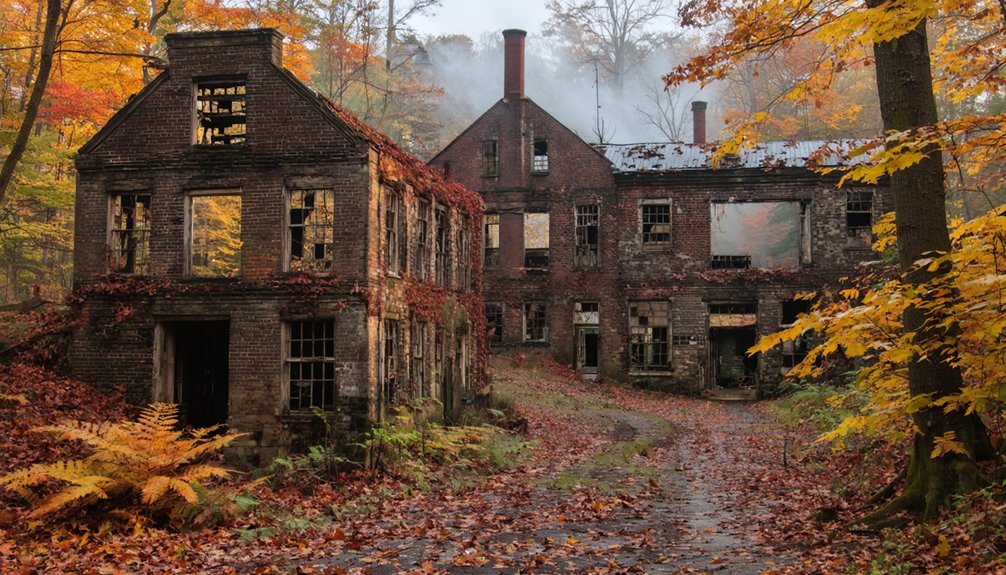
Deep in Smithfield’s woods, Hanton City emerged in the late 1600s as a rural trading stop linking Providence to Woonsocket.
Hidden between two bustling Rhode Island cities, Hanton City once served travelers before vanishing into the forest’s embrace.
Where poor tanners and bootmakers carved out modest livelihoods from stone quarries and handcrafted shoe production.
These communities thrived until economic forces rendered them obsolete:
- Quarry closures eliminated primary employment sources
- Factory mechanization destroyed handcrafting enterprises
- Highway rerouting isolated former trading hubs
- Impoverished residents abandoned properties throughout the early 1800s
Cultural significance extends beyond Hanton City to sites like Ramtail Mill, officially designated “haunted” in Rhode Island’s 1885 census after burning down.
Modern preservation efforts now protect these stone foundations and burial grounds—remnants documenting Rhode Island’s pre-industrial economy.
You’ll find similar ruins at Napatree Point’s Fort Mansfield and Durfee Hill Gold Mine, where autumn leaves frame forgotten enterprises that once promised prosperity.
Planning Your Ghost Town and Foliage Adventure
When planning your exploration of Rhode Island’s abandoned settlements, you’ll need to synchronize three critical elements: October’s ephemeral foliage window, the physical accessibility of deteriorating sites, and the preservation protocols that protect these vulnerable historical remnants.
Target mid-to-late October when foliage peaks at 50-75% color transformation, particularly around Smithfield’s Hanton City where native plant species create vibrant orange-red canopies.
Pack GPS devices for locating obscured foundations at Ram Tail and Mill Factory sites—these ruins now serve as wildlife habitats requiring minimal disturbance.
Equip yourself with sturdy boots for uneven terrain and flashlights for exploring visible cellars, but never enter structurally compromised buildings.
Document your itinerary before venturing into remote locations like Napatree Point, where October rains transform trails into treacherous passages through reclaimed forest corridors.
Frequently Asked Questions
Are There Any Safety Concerns When Exploring Rhode Island’s Abandoned Ghost Towns?
You’ll face structural hazards from decaying buildings and potential wildlife encounters while exploring. These abandoned sites aren’t maintained, so you’re responsible for your own safety. Always respect preservation efforts and tread carefully through historical ruins.
Can I Camp Overnight Near These Ghost Town Sites?
No, you can’t camp overnight—these whispers of history remain day-use only. Historical preservation rules and local legends protect Rhode Island’s ghost towns, keeping Hanton City, Napatree Point, and Ramtail accessible for exploration without overnight permits.
Are the Ghost Towns Wheelchair Accessible or Suitable for Young Children?
Neither site offers accessible pathways due to hiking trails and ruins without safety features. Young children face hazards from open wells and cellar holes. These aren’t family-friendly activities—you’ll need mobility and constant supervision in these preserved wilderness settings.
Do I Need Permits to Visit These Abandoned Historical Sites?
You won’t need permits for Hanton City, Napatree Point, or Ramtail Factory—no permitting requirements exist. However, respect conservation restrictions on fragile ruins, tread carefully around historic foundations, and always verify current land-use regulations before exploring these preservation-minded sites independently.
What Photography Equipment Works Best for Capturing Overgrown Ruins?
You’ll want wide-angle lenses with lens filters for enhanced colors, plus tripod stability for long exposures documenting architectural decay. Portable LED panels illuminate shadowed details, while mirrorless systems capture preservation-worthy imagery in challenging low-light conditions found throughout overgrown structures.
References
- https://heleneinbetween.com/2025/03/best-places-to-see-fall-foliage-in-new-england-towns-farms-leaves-festivals-and-more.html
- https://weird-island.simplecast.com/episodes/57-ghost-town-hanton-city-ky53imy0
- https://en.wikipedia.org/wiki/Hanton_City
- https://www.visitrhodeisland.com/things-to-do/haunted-rhode-island/
- https://www.youtube.com/watch?v=kpy7zlXYrAU
- https://en.wikipedia.org/wiki/List_of_ghost_towns_in_Rhode_Island
- http://freepages.rootsweb.com/~gtusa/history/usa/ri.htm
- https://www.onlyinyourstate.com/experiences/rhode-island/my-favorite-haunted-places-ri
- https://kids.kiddle.co/Hanton_City
- https://www.youtube.com/watch?v=3bFcmv7IH40