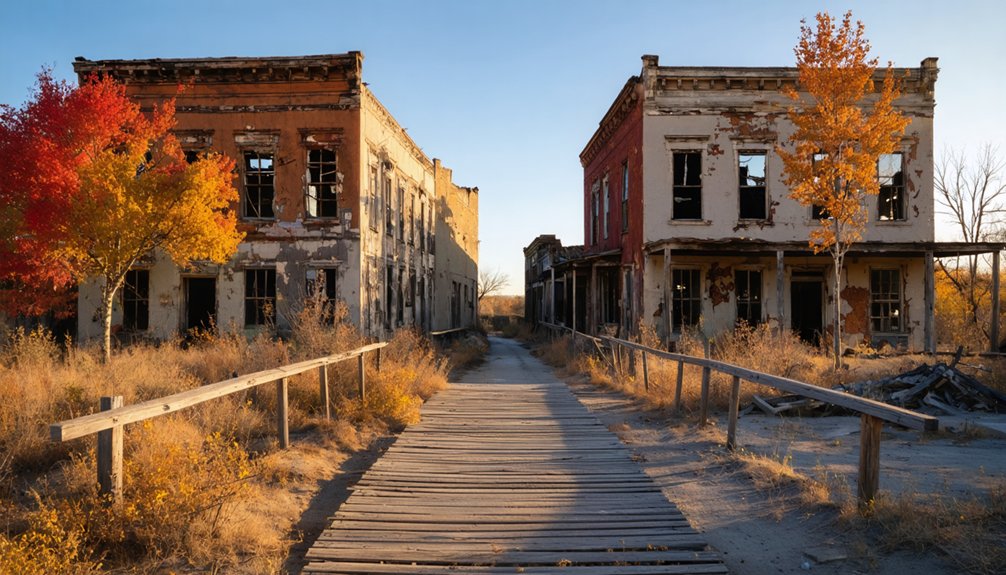
You’ll discover Texas’s most haunting ghost towns framed by surprising autumn colors—Terlingua’s crumbling adobe walls glow against burnt-orange desert hills, while Independence’s cemetery shelters Margaret Houston’s grave beneath oaks turning crimson each November. East Texas’s Fall Foliage Trail winds through abandoned settlements like Palestine, where 1,800 historic landmarks emerge amid sweetgums and cypress displaying peak colors from late October through November. Time your visit between early November’s East Texas brilliance and mid-November’s Hill Country transformation to experience these atmospheric ruins when seasonal landscapes amplify their storied past.
Key Takeaways
- Terlingua’s adobe ruins in West Texas display desert autumn hues of burnt ochre and dusty purple near the Rio Grande.
- East Texas Fall Foliage Trail features ghost towns like Palestine with 1,800 historic landmarks amid peak November colors.
- Independence offers Baptist church ruins and Margaret Houston House within live oak groves that change color in fall.
- FM 170 Rio Grande corridor combines scenic drives with ghost town exploration during cooler October weather.
- Peak foliage timing varies: late September in Guadalupe Mountains, early November in East Texas, mid-November in Hill Country.
Desert Ghost Towns: Terlingua’s Autumn Appeal
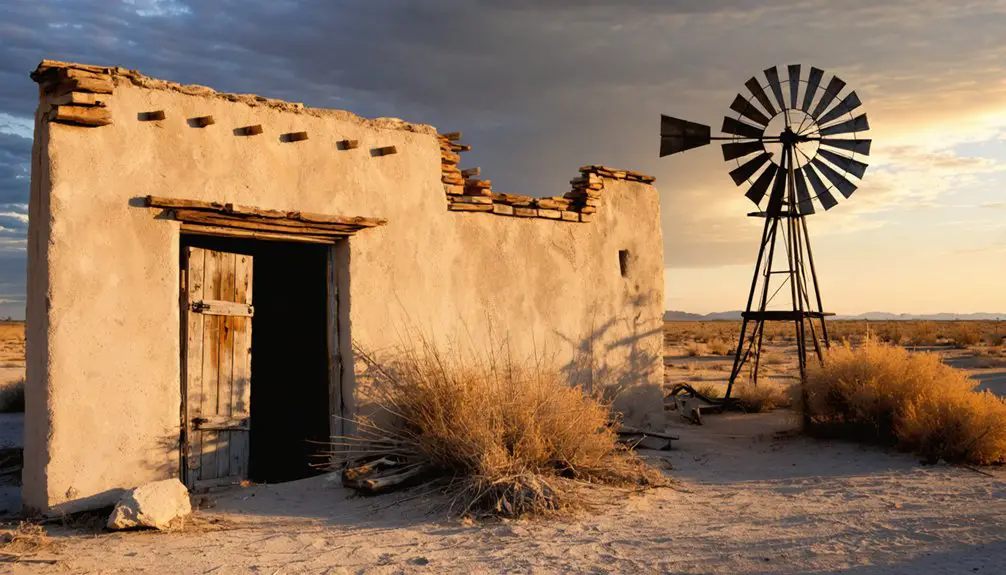
While most Texans chase brilliant reds and golds through the Piney Woods, Terlingua offers a different kind of autumn beauty in the stark Chihuahuan Desert of West Texas. You’ll find desert colors here—burnt ochres, dusty purples, and sun-bleached grays painting the weathered ruins of mercury mining structures from the 1880s.
Where Piney Woods fall colors give way to desert hues—burnt ochre, dusty purple, and sun-bleached gray among abandoned mercury mines.
The crumbling Howard Perry mansion and St. Agnes Church ruins stand as silent monuments along FM 170 near Lajitas. Built in 1906, Perry’s mansion once served as the centerpiece of the Chisos Mining Company, which grew to become the largest mercury producer in the United States. The mine closed in the 1940s, leading to rapid abandonment and transforming the once-thriving community into a ghost town.
November brings the famous World Championship Chili Cook-off, drawing 10,000 visitors to this remote ghost town. But visit during the quieter autumn days, and you’ll discover autumn solitude among the historic cemetery and abandoned buildings.
With just 78 permanent residents, Terlingua’s rugged terrain and mysterious allure create an unconventional fall destination where freedom-seekers escape crowded leaf-peeping trails.
East Texas Fall Foliage Trail and Historic Settlements
The Chihuahuan Desert‘s spare beauty gives way to something entirely different 500 miles eastward, where East Texas transforms into a riot of crimson, amber, and gold each November. You’ll find the Deep East Texas Fall Foliage Trail looping through Nacogdoches, Alto, and San Augustine—settlements where local folklore runs deep through centuries-old townsites.
Palestine offers 1,800 historical sites amid maple-lined streets, while Joinerville marks the East Texas Oil Field discovery. The scenic drive toward Athens features rolling hills and tree-lined streets that enhance the fall scenery. The Pineywoods’ preservation efforts shine at Daingerfield State Park’s Cathedral of Trees and along Boykin Springs’ trails through Angelina National Forest. Continue eastward on Highway 64 through Marshall to reach Caddo Lake State Park, where cypress trees draped in Spanish moss display peak foliage from late October through late November.
Download trail maps from Nacogdoches Visitors Bureau, then chase peak color mid-to-late November through woodlands where sweetgums and oaks blaze against pine forests, free from crowds.
Best Preserved Ghost Town Ruins for Seasonal Exploration
When October’s heat finally breaks across Texas, ghost town ruins emerge from their summer dormancy as prime exploration territory. You’ll find Terlingua’s adobe remnants scattered across desert wildlife habitats near the Rio Grande, where cultural festivals like Dia de los Muertos breathe temporary life into the abandoned mining village each November.
Independence preserves its Baptist church and Margaret Houston House among live oak groves that blaze with autumn color, while Belle Plain’s college ruins stand sentinel over prairie grasslands where 16-year-old Virgil Hill’s 1878 grave marks the cemetery’s oldest plot.
Toyah’s main street freezes a moment in time—original furnishings intact, population down to 90 souls.
Terlingua’s origins trace back to mercury mining operations that nearly vanished after the 1940s, leaving behind ruins now balanced by a small artist community.
Glenrio’s preserved structures straddle the Texas-New Mexico border, where the Little Juarez Diner and State Line Motel stand as monuments to Route 66’s golden era.
Even Lobo, completely abandoned since 1991, now hosts occasional film festivals after private restoration efforts.
Combining Scenic Drives With Abandoned Town Discoveries
Stationary ghost towns reward careful exploration, but Texas’s best-abandoned settlements reveal themselves through strategic driving routes that marry autumn scenery with historical discovery.
to truly appreciate the eerie beauty of these forgotten places, one might choose to explore abandoned Texas ghost towns. Each site tells a story waiting to be uncovered, from crumbling facades to rusted vehicles that once teemed with life. As the sun sets, the haunting landscapes transform, inviting explorers to contemplate the past and capture the essence of Texas history.
You’ll find Terlingua’s mercury mining ruins most compelling when approached via FM 170’s Rio Grande corridor, where yellow cottonwoods frame adobe walls and cultural festivals like Dia de los Muertos revive ghostly spaces.
The Pineywoods Autumn Trail delivers richer payoff by threading historic Caddo Mounds and Lobanillo Swales between crimson hardwoods and wildlife habitats near Palestine.
Marshall’s Old Stagecoach Road offers an 8-mile haunted corridor that channels both spectral legends and fall colors east of Dallas, bridging supernatural lore with seasonal drives.
Glenrio’s Route 66 remnants become more than roadside curiosities when paired with Panhandle plains drives.
Early November timing maximizes your visual rewards, as scenic backroads connecting these abandoned settlements reach peak color while avoiding weekend crowds. Each pairing transforms isolated ruins into contextual narratives—your windshield frames both vanished communities and the seasonal landscapes that outlasted them, creating freedom-oriented routes where history breathes through changing leaves.
Peak Timing for Ghost Town and Foliage Adventures
Timing your ghost town expeditions around Texas’s color peaks requires regional calibration—what works for Terlingua’s cottonwoods won’t match Lost Maples’ bigtooth spectacle.
Hit Guadalupe Mountains’ high-elevation ruins late September when aspens glow gold.
East Texas ghost settlements like Weches demand early November visits, when sweetgums and oaks frame abandoned structures in rust and amber.
Hill Country’s forgotten towns near Vanderpool shine mid-November—track Lost Maples’ weekly reports issued Thursdays to catch peak reds.
Cold fronts trigger rapid changes, so monitor forecasts like you’d scout wildflower blooms. Daily map updates account for real-time weather deviations, ensuring you have the most accurate foliage timing for your expedition.
Combine river excursions along the Frio or Guadalupe with nearby ghost sites for double rewards. Garner State Park’s bright orange cypress reflections on the Frio River make an ideal pairing with Hill Country ghost town exploration.
Colors linger into early December in milder pockets, giving you flexibility to explore on your own schedule without crowds.
Historical Background of Texas’s Most Atmospheric Ghost Towns
You’ll find Texas’s most haunting ghost towns rose from the ground wherever fortune promised quick riches—coal seams in Thurber, black gold in Desdemona, and cattle money in Tascosa.
These settlements exploded overnight as miners, roughnecks, and cowboys flooded in, building entire communities around a single economic lifeline.
When that lifeline snapped—exhausted coal mines, depleted oil fields, bypassed rail routes—whole towns emptied out, leaving behind the weathered bones of boom-time dreams beneath Texas’s autumn skies.
Mining Boom Settlement Patterns
Before the first prospectors ever struck silver in the Chinati Mountains, Spanish explorers had already scoured these rugged peaks for precious ores as early as the 1600s, though their efforts yielded little more than geological curiosity.
Mining history truly ignited in September 1880 when John Spencer discovered that silver-rich ledge, sparking a rush that’d transform empty desert into thriving communities.
Settlement patterns followed a predictable rhythm: first the prospectors, then the infrastructure.
You’ll find Shafter grew from Spencer’s single claim into a 4,000-person town by 1940, while Terlingua’s cinnabar deposits drew 2,000 mercury-seeking miners.
Thurber emerged alongside coal veins, becoming the region’s largest mining settlement between Fort Worth and El Paso—each town sprouting wherever fortune lay buried beneath Texas soil.
Economic Decline and Abandonment
While mining booms built Texas’s ghost towns, railroad routing decisions ultimately sealed their fates. You’ll find communities like Belle Plain collapsed when the Texas and Pacific Railway bypassed them for neighboring settlements.
When infrastructure modernization concentrated in larger hubs, these isolated towns lost their economic lifelines.
Understanding what killed these communities reveals patterns you’ll still recognize today:
- Transportation shifts – Railroad bypassing eliminated stagecoach routes, while improved highways later concentrated trade in regional centers
- Agricultural collapse – Cotton prices plummeted to 2 cents per pound, devastating single-crop economies during the Depression
- Post-war migration – WWII veterans chose urban renewal opportunities over struggling rural livelihoods, accelerating abandonment
Disease outbreaks, catastrophic fires, and service consolidation finished what economic isolation started, leaving these atmospheric ruins scattered across Texas’s landscape.
Frequently Asked Questions
Are Ghost Town Sites Accessible for Visitors With Mobility Limitations?
Most ghost towns lack accessible infrastructure, leaving you stranded without mobility assistance programs. You’ll find drive-up views at Glenrio or boat tours to Old Bluffton, but rugged terrain and private fences restrict your freedom elsewhere.
What Photography Equipment Works Best for Capturing Fall Colors in Ruins?
When renowned photographer Julia Dean captured Terlingua’s crumbling adobe against autumn cottonwoods, she used telephoto lenses to compress vibrant foliage with weathered textures. You’ll want wide-angles for sweeping ruins, polarizers for saturating colors, and yes, even film cameras create nostalgic magic.
Do Any Ghost Towns Offer Overnight Camping or Lodging Options Nearby?
Jefferson’s ghost town atmosphere offers nearby lodging where you’ll discover local legends at haunted historic sites. For camping amid historical preservation efforts, head to Daingerfield State Park, where autumn colors frame Texas’s untamed past perfectly.
Are There Guided Tours Available for Texas Ghost Towns During Fall?
You’ll find guided tours at Jefferson’s Grove on weekends, where operators weave historical anecdotes with ghost stories through Reconstruction-era rooms. Caddo Lake operators also lead bayou tours showcasing hanging cypress amid peak fall colors through November.
What Safety Precautions Should Visitors Take When Exploring Abandoned Structures?
Practice hazard awareness by testing floors before stepping, wearing sturdy boots and gloves. Implement security measures like telling someone your plans, carrying first aid supplies, and respecting posted boundaries—your freedom depends on responsible exploration.
References
- https://centorioutdoors.com/blogs/news/9-charming-towns-to-visit-to-see-texas-autumn-colors
- https://grechrv.com/ghost-towns-and-haunted-highways-to-explore-this-fall/
- https://www.hipcamp.com/journal/camping/texas-ghost-towns/
- https://texashighways.com/travel-news/5-of-the-most-haunted-locations-in-texas/
- https://www.southernthing.com/ruins-in-texas-2640914879.html
- https://texastraveltalk.com/local-haunts-to-visit-texas/ghost-town/
- https://www.youtube.com/watch?v=IECzqQ-jIEM
- https://www.legendsofamerica.com/tx-terlingua/
- https://www.dallasites101.com/blog/post/terlingua-texas-ghost-town-guide/
- https://www.youtube.com/watch?v=UniG4FbRwaw