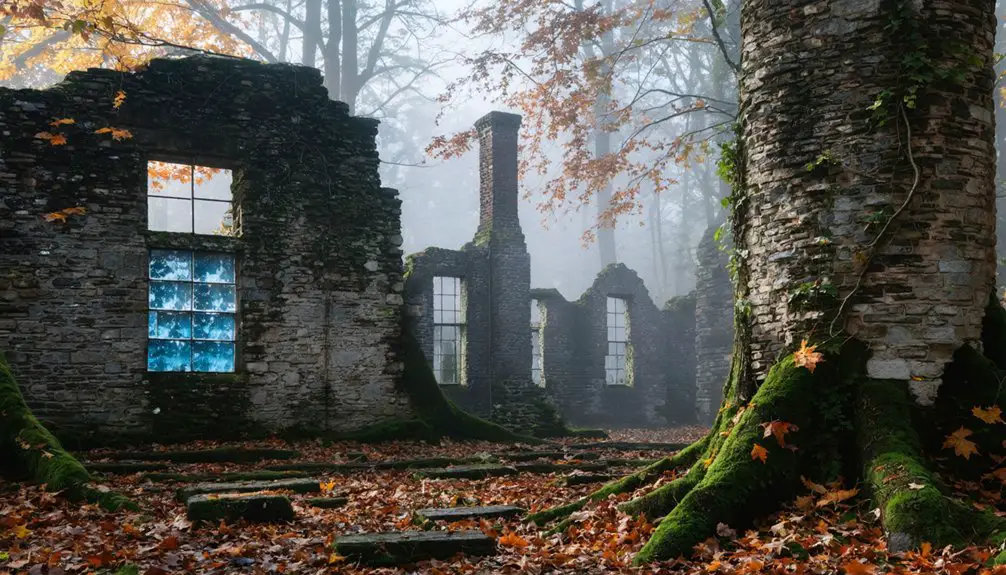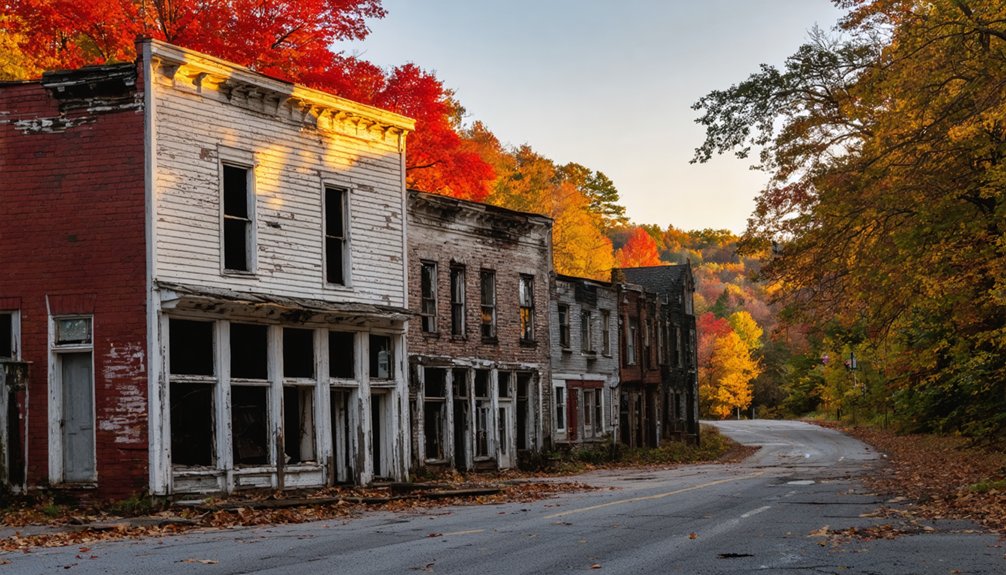
You’ll find Massachusetts’ most enchanting ghost towns beneath Quabbin Reservoir‘s waters, where four flooded villages rest under 412 billion gallons, and along Dogtown’s moss-covered trails in Gloucester, where witch legends echo through crimson-draped cellar holes. New Salem preserves empty streets ablaze with October color near the reservoir’s edge, while Pioneer Valley farmsteads hide behind golden forests. Peak viewing spans early to late October, with northern elevations igniting first and coastal areas following. The landscape ahead reveals how these haunted settlements merge autumn’s fiery palette with forgotten histories.
Key Takeaways
- Quabbin Reservoir submerged four towns (Enfield, Prescott, Greenwich, Dana) in 1938, creating underwater ruins visible during low water levels.
- New Salem preserves historic streets and cemetery monuments along Route 202, showcasing peak fall colors during mid-October’s Columbus Day Weekend.
- Dogtown in Gloucester features abandoned cellar holes, stone walls, and granite inscriptions amid moss-covered trails through dense autumn foliage.
- Peak foliage timing varies: northern elevations ignite early October, Berkshires mid-October, coastal areas late October based on elevation and microclimates.
- Historic settlements in Deerfield and Pioneer Valley reveal colonial foundation ruins and stone walls surrounded by golden birches and crimson maples.
The Submerged Towns of Quabbin Reservoir
Before the Quabbin Reservoir stretched its dark waters across 39 square miles of Massachusetts wilderness, four thriving Swift River Valley towns—Enfield, Prescott, Greenwich, and Dana—hummed with the ordinary rhythms of New England life.
Then came the Swift River Act of 1927, condemning these communities to extinction. By midnight on April 28, 1938, they’d ceased to exist legally—erased from maps to slake Boston’s thirst.
You can’t visit these ghost towns by walking their streets. They’re entombed beneath 412 billion gallons of water, their submerged history occasionally revealed through underwater archaeology.
Divers exploring in the 1990s discovered tombstones that escaped relocation and a mausoleum near Enfield’s former site—remnants of the 2,500 displaced residents whose churches, schools, and mills burned for months before the valley flooded. The night before Enfield’s legal dissolution, residents gathered for a Farewell Ball on April 27, 1938, marking their final hours with dancing, a moment of silence, and “Auld Lang Syne.” The 7,600 exhumed bodies from all four towns were reinterred at Quabbin Memorial Park in Ware, creating a consolidated cemetery for the lost communities.
New Salem: A Living Ghost Town Along Route 202
How does a town become a ghost without actually dying? New Salem exists in beautiful limbo along Route 202, where cars sit in driveways but streets remain hauntingly empty. You’ll find this eerie sanctuary on the Quabbin’s northwest side, offering unobstructed fall foliage views without power lines or crowds.
What awaits your exploration:
- Hill walk-ups from South Main Street revealing preserved village architecture
- Center Cemetery’s prominent Ballard family monument standing sentinel
- Routes extending directly to reservoir shores for extended hikes
- Columbus Day Weekend peak colors framing the deserted landscape
- Historical preservation maintaining small-town America’s frozen moment
Seasonal contrasts amplify the poignancy—brilliant autumn flames surrounding silent streets create profound solitude. After recent Route 202 closures, alternate paths wind through this living memorial, where Millington’s destruction echoes through architectural ghosts that refuse disappearance. The Orange Fire Department manages occasional traffic incidents that temporarily redirect visitors through the town’s timeless streets. While New Salem’s emptiness differs from Salem’s infamous history, Ghost City Tours operates year-round for those seeking more populated haunted destinations.
Dogtown: Gloucester’s Legendary Haunted Settlement
You’ll find yourself walking through a maze of mossy cellar holes where “Tammy” Younger, the Queen of the Witches, once demanded offerings of corn and fish from terrified children passing through. The woodland trails wind past Roger Babson’s Depression-era boulder inscriptions and glacial formations.
But it’s the whispered legends of shape-shifting dogs and cackling voices that make your skin prickle beneath the autumn canopy. These stories emerged 200 years after Salem, reflecting how witchcraft fears persisted well into the 19th century among the outcasts and healers who sought refuge here. Each numbered stone marking a vanished home tells the story of freedmen, vagrants, and accused witches who made this their final refuge before Dogtown fell silent in 1830. The settlement’s name itself came from the feral dogs that roamed among the widows of sailors and soldiers who remained after families abandoned their homes.
Witches and Ghost Legends
When autumn mist rolls across Cape Ann’s rocky highlands, the abandoned settlement of Dogtown reveals itself as Massachusetts’ most haunted ghost town—a place where centuries-old witch legends intertwine with crimson maple leaves and granite boulders carved with cryptic messages.
Unlike Salem’s hysteria, Dogtown’s accused witches—impoverished women squatting in abandoned homes—faced folklore rather than execution.
Historical preservation efforts reveal these “witches” were survivors, not practitioners of dark arts:
- Thomazine “Tammy” Younger, the self-proclaimed “Queen of the Witches,” lived near Alewife Brook
- Luce George, Molly Stevens, and Judy Rhines survived through fortune-telling and brewing remedies
- Wild dogs roamed freely among the ruins, their howls fueling supernatural tales
- Roger Babson’s Depression-era boulder inscriptions accidentally enhanced the eerie atmosphere
- Folklore authenticity remains debated following the 1984 teacher murder
These women often embraced their witch labels for economic survival, using the community’s fear to solicit food and money from Gloucester’s less puritanical fishing society. The last resident, Cornelius “Black Neil” Finson, was discovered with frozen feet in the abandoned settlement and died shortly after his relocation to a Gloucester poorhouse.
Trails Through Abandoned Woods
Beyond the witch legends and spectral folklore, Dogtown’s physical landscape tells a different story—one written in crumbling stone walls, sunken cellar holes, and forest trails that wind through what was once Massachusetts’ most isolated inland settlement.
You’ll navigate pathways where 80 homes stood in the 1750s, now reclaimed by vegetation succession that transformed open grazing fields into dense woodland. Each trail passes foundations where Revolutionary War widows once survived on foraged blueberries and bayberries.
The 1920s abandonment of cattle pastures triggered dramatic ecological shifts, creating diverse wildlife habitats throughout the former Commons Settlement. Hazardous terrain features like Granny Days Swamp, a treacherous bog adjacent to Dogtown Square, made livestock grazing particularly dangerous throughout the settlement’s history.
Stone remnants mark property lines along Cape Pond Brook, while natural landmarks like Whale’s Jaw punctuate your exploration of this genuine ghost town frozen between colonial history and wilderness rebirth. During the Great Depression, 36 inspirational phrases were carved into boulders throughout the trails by commissioned stone carvers working for Roger Babson.
Best Times to Visit for Peak Autumn Colors
You’ll catch Massachusetts ghost towns at their most spectral when mid-October paints New Salem’s abandoned streets in red-orange maples, while Columbus Day weekend frames the Quabbin Reservoir’s drowned villages in peak autumn fire.
Dogtown’s moss-covered ruins emerge through scarlet and rust woodlands throughout October, with the dense forest canopy intensifying the haunted atmosphere as temperatures drop.
Northern settlements like those near the Berkshires blaze first by mid-month, while coastal Gloucester’s witch-legend sites hold their colors into late October, giving you a three-week window to explore these forsaken places wrapped in fall’s dying glory.
October Peak Foliage Timeline
As October arrives, Massachusetts transforms into a patchwork of crimson, gold, and amber hues that shift across the landscape like a slow-burning flame moving from west to east. You’ll witness nature’s brilliance revealing forgotten settlements where forest regeneration meets historical preservation.
Your October Color Journey:
- Early October (1-10): Northern regions ignite first—Mount Greylock’s summit reveals 3,491 feet of blazing canopy.
- Mid-October (12-17): Historic Deerfield and Berkshire Mountains reach their zenith, perfect for exploring abandoned villages.
- Third Week (15-21): Boston’s Charles River Esplanade glows golden; coastal ghost towns awaken with delayed color.
- Late October (20-31): Mohawk Trail delivers inland intensity while ocean-proximate sites finally burst into flame.
Peak varies by one to two weeks depending on elevation and coastal influence.
Plan flexibly—Massachusetts rewards the wanderer.
Regional Color Variation Patterns
From the Berkshire summits to Cape Ann’s rocky shores, Massachusetts paints itself in distinct regional palettes that shift with the calendar and the land’s contours. You’ll find elevation dictating the show—Mount Greylock’s 3,491-foot summit blazes first with fiery maple reds, while eastern lowlands lag behind by weeks.
Sugar maples dominate the Mohawk Trail corridor in scarlet, birches and hickories gild Pioneer Valley farmland in gold, and oaks drench the rolling hills in burnt orange. Historic preservation sites near Lexington and Concord frame colonial structures against this seasonal display, where seasonal ghost stories feel most potent amid abandoned foundations and autumn’s twilight.
Interactive DCR maps predict peaks using past data, but crisp air and local tree species—beech, ash, cherry—create microclimates worth exploring yourself.
Architectural Treasures Among the Fall Foliage
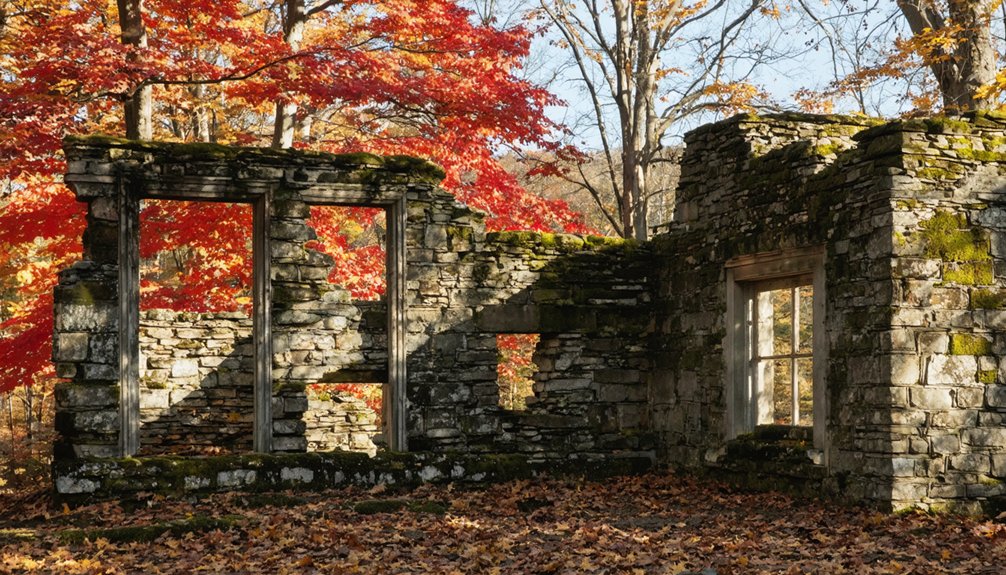
When October arrives in Massachusetts, the state’s historic architecture transforms into something more enchanting—Colonial churches, stone walls, and period homes emerge as frames for nature’s most dramatic color show.
You’ll discover authentic remnants of abandoned settlements where autumn scenery creates an otherworldly backdrop:
– Hawley’s forgotten foundations: Cellar holes and stone walls snake through Kenneth Dubuque Memorial State Forest.
150-year-old settlement markers are now surrounded by blazing maples.
- New Salem’s white church steeple: Rising above Main Street’s red and orange maples, this pointed tower anchors the village’s ecclesiastical character.
- Historic Deerfield’s shaded pathways: 18th-century colonial homes stand beneath ancient maples.
Their period architecture is preserved alongside seasonal transformation.
- Stockbridge’s rolling countryside: White steeples pierce hillsides adorned with classic New England buildings.
- Stone wall networks: Agricultural heritage is made visible through autumn’s revealing light.
Photography Opportunities in Abandoned Towns
Massachusetts’ abandoned settlements offer photographers a rare convergence of historical decay and natural beauty.
These forsaken places merge time’s erosion with wilderness rebirth, creating haunting tableaus where history surrenders to nature’s patient reclamation.
Where crumbling foundations become compositional anchors for landscapes reclaimed by wilderness. You’ll find Dogtown’s carved Babson Boulders emerging from autumn canopies, their inscriptions textured against vibrant foliage. Haunted legends enhance Long Point’s fishing shanty ruins, where golden light transforms weathered structures into atmospheric compositions.
Catamount Village’s elevated farmstead remnants provide unobstructed panoramas of mountain slopes ablaze with color. Pack your photography armor—sturdy boots and protective gear—for traversing overgrown trails where stone walls frame layered forest scenes.
Quabbin’s minimalist markers create poignant abstract studies reflected in reservoir waters. Whitewash Village’s skeletal frames contrast with soft dune grasses, accessible only by boat for truly isolated shoots capturing Massachusetts’ forgotten maritime history.
Exploring the Trails and Landscapes of Massachusetts Ghost Towns
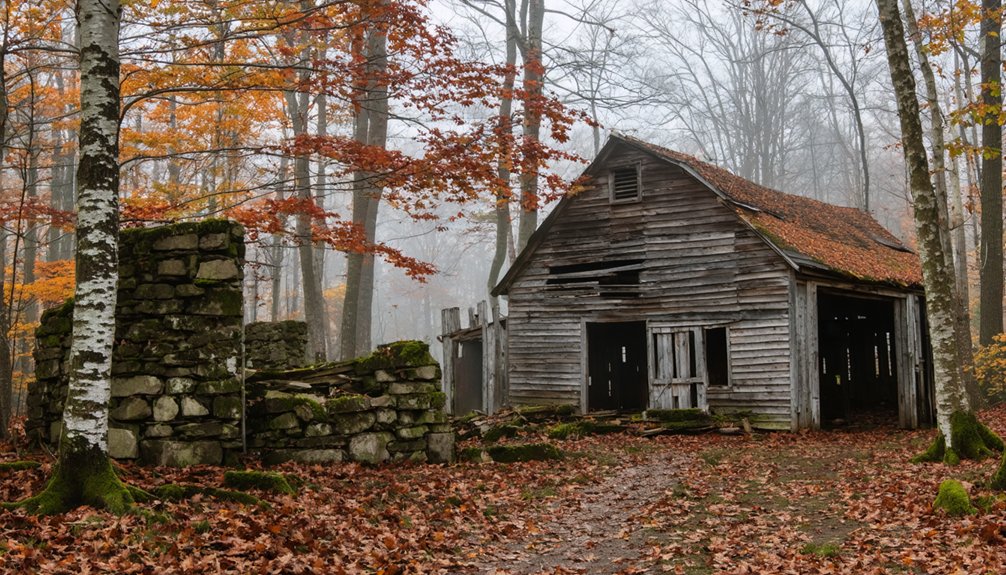
Beneath canopies ablaze with October’s transformation, Massachusetts’ ghost town trails draw you into landscapes where human ambition surrendered to forest reclamation.
You’ll traverse paths where local folklore whispers through moss-covered cellar holes and landscape preservation protects these haunting reminders of vanished communities.
- Dogtown’s boulder-marked ruins emerge through scarlet maples, where Granny Day’s cellar hole number 20 sits beneath dense woodland canopy.
- Quabbin’s submerged towns reveal themselves through hillside vantage points overlooking water where Enfield and Dana disappeared.
- Catamount’s Pioneer Valley overlooks showcase multi-colored forests swallowing abandoned farmsteads in rust oranges and amber.
- Berkshire paths wind through Norton Furnace foundations, where rolling hills explode in crimson by October 10th.
- Haywardville’s mill town remnants integrate with Middlesex Fells’ forested trails, offering mid-October color displays.
Planning Your Ghost Town Fall Foliage Tour
Your boots crunch through leaf litter as you stand at the trailhead, but spontaneity won’t serve you in these remote locations where cell service fades and abandoned settlements hide behind walls of crimson and gold.
Pack sturdy walking shoes for Mount Auburn’s 175 acres of rolling terrain, and bring your camera to capture New Salem’s maple-lined streets during late October’s peak.
Register early for Easthampton’s Fall Foliage Photo Walk, then carve your own path through Dogtown’s witch-haunted forests.
Time your visit around Salem’s Haunted Happenings Marketplace, where local crafts and seasonal fruit vendors line Derby Square.
Route 202 delivers you to Quabbin’s ghost towns, while Arnold Arboretum’s 265 acres welcome you free from sunrise to sundown—freedom measured in unscripted wandering.
Frequently Asked Questions
Are There Any Entrance Fees to Visit Massachusetts Ghost Towns?
You won’t pay entrance fees at Massachusetts ghost towns—they’re freely accessible through public trails and roads. You’ll find exceptional photography opportunities among crumbling cellars and historical preservation sites, where autumn leaves frame forgotten foundations beneath open skies.
Can You Camp Overnight Near Ghost Town Locations in Massachusetts?
You can’t pitch your tent at ghost town sites themselves—historical preservation protects these sleeping settlements—but you’ll find designated campgrounds like Lake Dennison nearby, where camping safety meets your adventure spirit under autumn’s fiery canopy.
Are the Ghost Town Sites Accessible for People With Mobility Limitations?
Most sites lack wheelchair accessibility and paved pathways, leaving you maneuvering rough woodland trails and uneven terrain. New Salem’s roadside viewing offers your easiest option, while Dogtown’s forest paths present challenging obstacles for mobility-limited exploration.
Do Any Restaurants or Facilities Operate Near These Ghost Town Areas?
No restaurants operate within the ghost towns themselves, but you’ll find dining and shopping in nearby Gloucester, Salem, and Newburyport. These areas honor historical preservation while sharing local legends about the abandoned settlements you’re exploring.
Are Guided Tours Available for Massachusetts Ghost Towns During Fall?
You’ll find guided tours scarce for Massachusetts’ true ghost towns—historical preservation focuses on Salem’s witch sites instead. You’re free to explore Quabbin’s ruins and Dogtown independently, discovering photography opportunities among abandoned streets painted with autumn’s fiery palette.
References
- https://heleneinbetween.com/2025/03/best-places-to-see-fall-foliage-in-new-england-towns-farms-leaves-festivals-and-more.html
- https://www.worldatlas.com/cities/2025-s-towns-in-massachusetts-that-come-alive-in-the-fall.html
- https://lovehardtraveloften.com/united-states/new-england-fall-foliage/
- https://jeff-foliage.com/2011/08/31/fall-foliage-in-new-salem-ma/
- https://en.wikipedia.org/wiki/List_of_ghost_towns_in_Massachusetts
- https://www.youtube.com/watch?v=T4yhm_S-dHc
- https://vitabrevis.americanancestors.org/2019/09/lost-towns-of-the-quabbin
- https://www.harvardmagazine.com/2023/08/quabbin-reservoir-lost-towns-elena-palladino
- https://quabbinhouse.com
- https://athollibrary.org/n/42308/Lost-Towns-of-the-Swift-River-Valley-Drowned-by-the-Quabbin