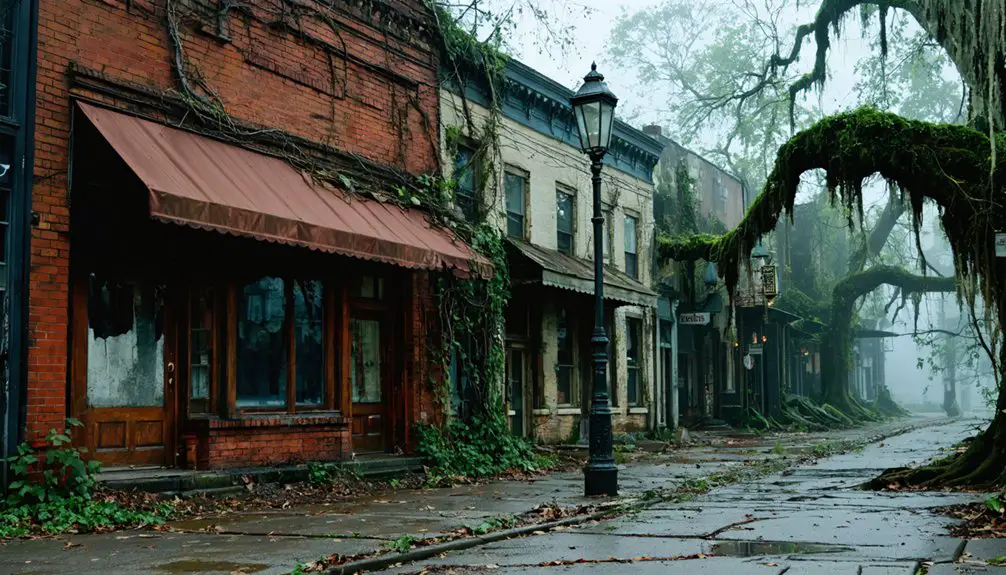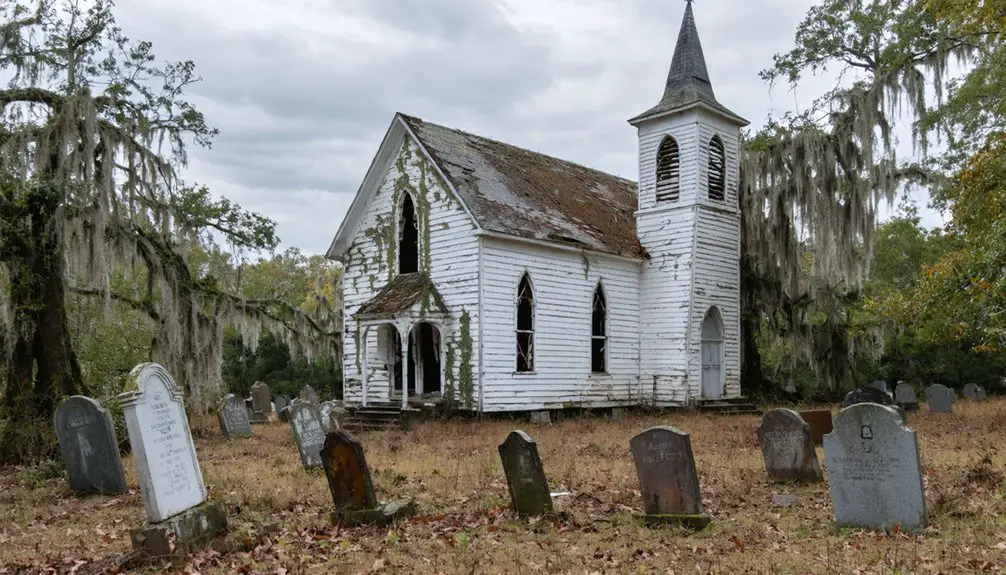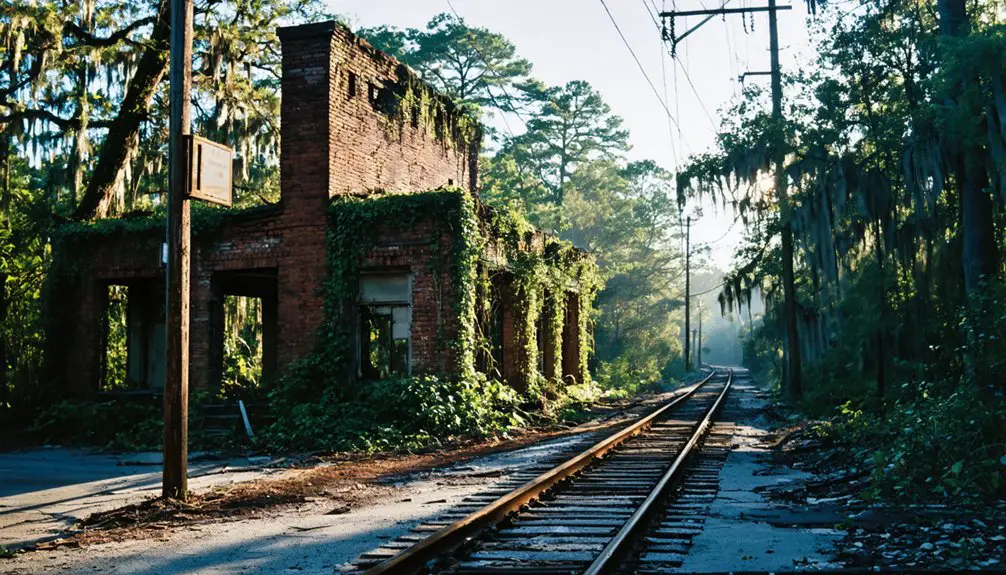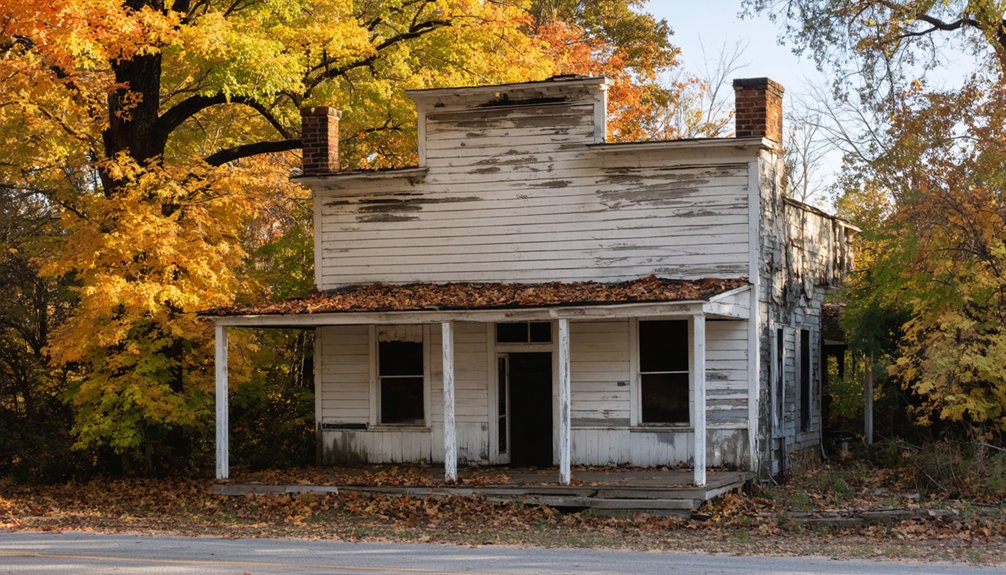
You’ll find South Carolina’s most atmospheric ghost town foliage at Ferguson, where rust-colored cypress needles frame submerged lumber mill ruins beneath Lake Marion’s surface each October. Paddle through dawn mist over sunken streets and brick kilns while bronze reflections shimmer around you. For a different experience, explore Oconee Station’s 210 scenic acres where Revolutionary-era structures stand among autumn hardwoods, or kayak Lake Hartwell’s underwater remnants of Andersonville’s 1888 cotton mill. The following sections reveal peak timing, hidden access points, and the haunting histories that transformed these communities into seasonal spectacles.
Key Takeaways
- Ferguson, a submerged cypress lumber town under Lake Marion, offers vibrant rust and amber fall foliage during October explorations.
- Peak fall colors occur mid-October to mid-November, with optimal viewing between October 27 and November 3 around ghost towns.
- Kayaking and canoeing at Ferguson reveal submerged industrial remains surrounded by colorful cypress groves and migrating waterfowl.
- Dawn visits provide misty landscapes with bronze cypress reflections, creating picturesque scenes at underwater ghost town sites.
- Lake Hartwell contains submerged communities with 400 acres of underwater structures accessible during autumn’s seasonal color display.
Musgrove Mill State Historic Site: Revolutionary War History Meets Autumn Beauty
When autumn paints the South Carolina backcountry in shades of amber and rust, the battlefield at Musgrove Mill transforms into a landscape where history and natural beauty collide. You’ll walk the same ridge where 200 Patriots ambushed 500 Loyalists on August 19, 1780.
Their Revolutionary strategies are still evident in the terrain. The tree-lined approach winds through 380 acres where Colonels Shelby, Clarke, and Williams orchestrated a feigned retreat that turned into a devastating victory—63 enemy killed against just 4 Patriot losses.
Today’s hiking trails follow the Enoree River, where Loyalists fled in chaos. The visitor center offers interpretive exhibits that provide context for the battlefield landscape. This rare Patriot victory came two days after Camden, when most fighters remained unaware of the devastating British successes elsewhere. Historical reenactments bring the one-hour battle alive, demonstrating how citizen-militia defied overwhelming odds.
Between mill ruins and autumn-blazed hardwoods, you’ll discover freedom’s price written across this sacred ground.
Oconee Station State Historic Site: Upstate Charm and Seasonal Splendor
Where the Blue Ridge foothills cradle South Carolina’s northwestern frontier, a two-foot-thick fieldstone blockhouse stands sentinel over stories spanning three centuries. You’ll discover Oconee County’s oldest structure here—a 1792 military outpost where Irish trader William Richards transformed frontier defense into commerce.
The adjacent 1805 Richards House, crafted in handmade brick with English bond patterns, served stagecoach travelers venturing into Cherokee territory. Richards ingeniously repurposed the blockhouse as his kitchen, connecting frontier military architecture to domestic life.
Historic preservation efforts protect these weathered stones and their folklore legends of frontier courage. When autumn ignites the surrounding 210 acres, you’re walking where South Carolina’s westernmost settlers once bartered furs and fortified against Creek raids.
Those narrow, deep-set windows framed more than seasonal color—they witnessed a young nation’s uncertain edge. A spur trail leads to Station Cove Falls, an impressive 60-foot waterfall cascading through the forested landscape. Free guided tours reveal what textbooks can’t: authentic wilderness grit.
Andersonville: A Sunken Textile Town Beneath Lake Hartwell
You’ll find Anderson’s textile legacy sleeping beneath Lake Hartwell’s surface, where the revolutionary Anderson Cotton Mills—the South’s first long-distance electrically powered mill—once hummed with 10,000-volt innovation from Portman Shoals eleven miles upriver.
The 1950s dam construction that birthed the lake swallowed those historic power stations and riverside communities, transforming a century of cotton manufacturing into an underwater ghost town. Founded in 1888, the Anderson Cotton Mills stood as the town’s first textile plant before eventually becoming part of the Abney Mills division.
Paddle your kayak across these autumn-burnished waters, and you’re gliding over the submerged foundations of the “Electric City’s” industrial birthplace, where William C. Whitner’s 1897 breakthrough changed Southern textile production forever. The mill’s operations powered by steam in 1890 gave way to Whitner’s pioneering electrical transmission system that would define the region’s industrial future.
Flooded Textile Community History
The murky depths of Lake Hartwell conceal a story that never quite unfolded the way local historians sometimes tell it. You won’t find documented evidence of “Andersonville” as a flooded textile community beneath these waters.
While Anderson’s mills—the Cotton Mill, Orr Cotton Mills, Gluck Textile Mill—dominated South Carolina’s industrial landscape from the 1880s onward, no records confirm sunken communities swallowed by the reservoir’s creation. This absence matters for those pursuing industrial archaeology with integrity.
The romantic notion of textile villages resting beneath the lake persists in local lore, but truth demands precision. Anderson’s actual textile boom began when first cotton mills were built on the city outskirts in 1890, with more mills encircling the city by 1900—all on dry land that remains accessible today. James Lawrence Orr, Jr. founded the Orr Cotton Mills in 1899 as the second cotton mill near Anderson, initially producing sheeting, shirting, and print cloths. Before you explore Lake Hartwell’s shores seeking remnants of vanished mill towns, understand that some ghost stories exist only in imagination, not in the flooded valleys where bass now swim.
Exploring Ruins by Kayak
Paddling toward Andersonville Island, your kayak cuts through water that swallowed an entire town six decades ago. You’ll launch from Portman Marina, following buoys LBC1 through LBC9 toward 400 acres of crumbling structures—the only remnants breaking the surface since Hartwell Dam’s 1962 completion.
Time your expedition during low water levels, when the lake drops toward its record 637.49 feet, exposing weathered highways and sunken boats. Divers practicing underwater archaeology report grave markers and building foundations still intact beneath you. The Army Corps of Engineers constructed the dam to generate electricity and control flooding along the Savannah River.
On the island itself, time-beaten roads lead past cemetery elements nearly claimed by erosion. The town’s decline began when railway systems replaced river transportation, causing gradual depopulation that preceded the eventual flooding.
Local haunted legends speak of phantom lights glowing beneath waves and ghostly figures wandering the shoreline—echoes of a textile community that refused to disappear completely.
Ellenton: The Abandoned Nuclear Evacuation Site
When golden autumn leaves drift across Highway 125, they settle on pavement that once formed Main Street of a town erased from existence. Ellenton’s 6,000 residents received notice on November 28, 1950—pack up, move out by March 1952. The government needed 300 square miles for plutonium production, and your ancestral home didn’t matter against Cold War urgency.
Nuclear history consumed this 70-year-old farming community whole. African-American sharecroppers and established farmers alike watched bulldozers level their churches and schools. Even 6,000 graves couldn’t rest in peace—they were relocated alongside the living.
Today, you’ll find scattered debris and lonely road markers where Ellenton thrived. The Department of Energy now offers walking tours through this contaminated ghost town, where evacuation stories echo louder than any reactor ever hummed.
Ferguson: Cypress Lumber Town Under Lake Marion
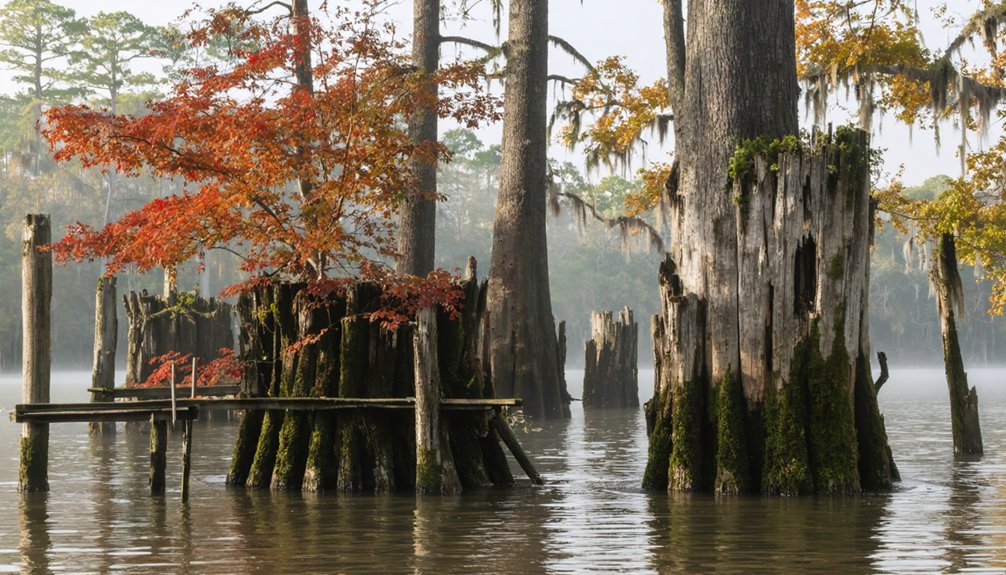
You’ll find Ferguson’s most haunting legacy beneath Lake Marion’s surface, where scrip coins once chained workers to a company store in a gilded logging camp that became an economic prison. Today, you can boat to Ferguson Island when drought drops the water level, revealing skeletal mill timbers and brick kilns that emerge like bones from the lake bed.
The surrounding shoreline blazes with October’s rust and amber, framing these industrial ruins in the same autumn palette that once colored the virgin cypress forests before the saws arrived.
Company Currency Trapped Workers
Deep in the cypress swamps where the Santee River carved through South Carolina’s interior, the Santee River Cypress Lumber Company built Ferguson in the 1880s—a settlement that would grow to 2,500 souls, all bound by a peculiar form of economic captivity.
You’d receive coins stamped “Santee Mercantile Co.” instead of dollars—company currency that transformed every worker into a permanent debtor. This scrip created absolute worker dependence:
- No cash payments meant you couldn’t purchase goods beyond company boundaries.
- Isolated location prevented access to competing merchants or alternative employment.
- 165,000 acres of timber empire at $2 per acre funded gilded cages with indoor plumbing.
- 34 years of operation trapped generations before Lake Marion swallowed the evidence in 1941.
Modern amenities masked medieval economics—paved streets leading nowhere but the company store.
Submerged Ruins and Access
Below the murky waters of Lake Marion, Ferguson’s skeletal remains wait in perpetual twilight—bricks scattered like broken teeth across the lakebed, mill foundations mapped in sediment, the geometry of paved streets still discernible where cypress once thundered into enormous saws.
You’ll find one kiln jutting defiantly above the waterline, a sentinel marking your destination. Launch from the nearest landing and paddle a few hundred yards following the old railroad bed—your pathway through time.
Underwater exploration reveals hospital walls, housing foundations, the industrial bones of South Carolina’s largest cypress operation. The submerged architecture speaks of ambitious Chicago lumbermen who built civilization where swamp met profit, then watched it sink beneath progress.
Canoe access grants you this privilege: witnessing a drowned monument to extraction, independence, and inevitable abandonment.
Autumn Colors at Lake
When October’s chill reaches the Santee basin, the same bald cypress groves that once fueled Ferguson’s roaring saws now ignite in copper and rust above the town’s watery grave.
You’ll navigate shallow waters where 350 workers’ homes vanished beneath waves, surrounded by botanical diversity that transforms each autumn.
The seasonal migration of wood ducks and waterfowl adds movement to your exploration.
Planning Your Autumn Lake Visit:
- Launch at dawn from Sparkleberry Swamp to catch morning mist rising through bronze-needled cypress
- Kayak the submerged streets where company scrip once changed hands beneath today’s autumn canopy
- Chart old railroad corridors visible as underwater formations between color-draped stands
- Anchor above the mill site and witness sunset filtering through rust-colored needles
Hamburg: Cotton Trade Hub Turned Forgotten Ruins
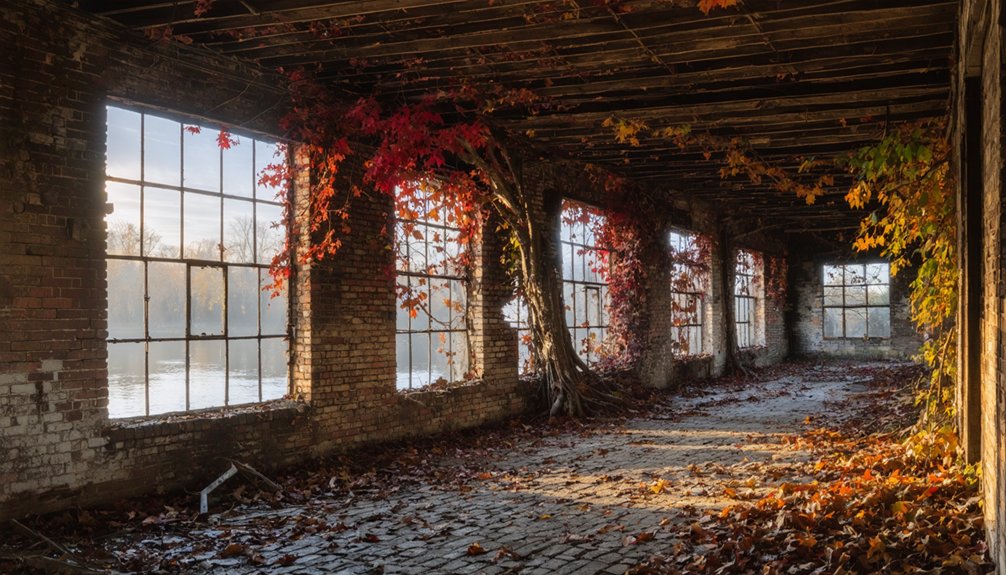
Along the rust-colored banks of the Savannah River, where autumn sweetgums now blaze crimson against crumbling brick foundations, Hamburg once stood as South Carolina’s audacious answer to Augusta’s commercial dominance.
Founded in 1821, this cotton empire processed 60,000 bales annually through America’s longest rail line—136 miles connecting Charleston’s merchants to upcountry plantations.
You’ll discover how German immigrant Henry Shultz transformed swampland into a $2 million trading hub, its brokers negotiating fortunes while wagons lined muddy streets.
But floods and Augusta’s canal destroyed Hamburg’s supremacy by the 1850s.
Today, sustainable tourism and historic preservation efforts struggle against encroaching vines reclaiming what remains.
Walk these forgotten pathways during October, when falling leaves blanket the ruins, and you’ll witness how nature reclaims even the mightiest commercial ambitions.
Planning Your Ghost Town and Foliage Adventure
Your ghost town expedition demands strategic planning that balances remote locations with South Carolina’s unpredictable autumn weather. Check state websites for current travel restrictions before venturing into abandoned settlements where seasonal photography captures nature reclaiming civilization.
Essential preparations for your journey:
- Base your exploration from Greenville – Position yourself 30 miles from Caesars Head via Route 276, accessing both foliage hotspots and forgotten settlements.
- Respect property boundaries – Campbell Covered Bridge trails cross private land; Chappells features locked gates on historic driveways.
- Research local folklore – Stories from Molly’s Rock and Cry Baby Bridge add depth to your discoveries.
- Pack backup provisions – Remote locations like Bald Rock Heritage Preserve’s panoramic overlook demand self-sufficiency and navigation tools for safe exploration.
Best Times to Visit for Peak Fall Colors
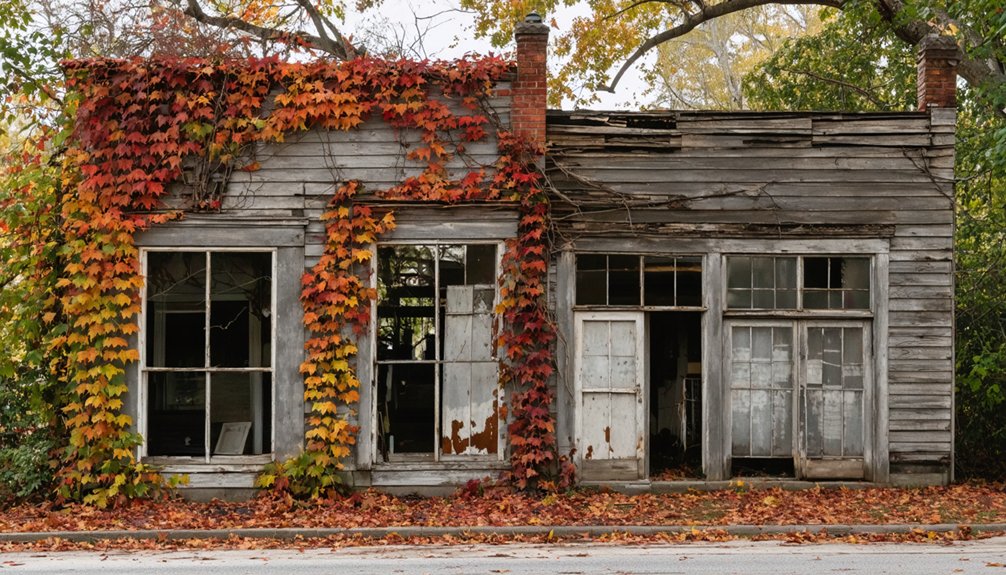
The abandoned settlements of South Carolina’s Upcountry burst into their most haunting beauty during a precise five-to-six-week window stretching from mid-October through mid-November, when scarlet and gold leaves frame weathered structures in a photographer’s dream.
You’ll find higher elevations near Caesars Head transforming first, with color cascading downward through late October. Target October 27 through November 3 for near-peak conditions across most ghost town sites.
York and Lancaster counties—home to several forgotten communities—reach their zenith during November’s first half.
Weather matters: adequate rainfall intensifies the display, while sunny days deepen those rust-red and amber tones that make seasonal hiking past historic landmarks unforgettable. Rain accelerates leaf drop post-peak, so don’t delay once conditions align.
Frequently Asked Questions
Are Guided Tours Available at South Carolina’s Ghost Town Locations?
You’ll find these ghost towns are sleeping beauties without official guardians—tour guide availability is nonexistent across South Carolina’s abandoned settlements. Historical preservation here means you’re free to explore independently, though access restrictions and boat requirements often limit your adventures.
What Safety Precautions Should Visitors Take When Exploring Abandoned Sites?
You’ll need sturdy boots for uneven terrain, awareness of wildlife hazards lurking in autumn brush, and respect for historical preservation laws. Always inform someone of your location, avoid unstable structures, and never trespass on gated properties.
Can You Camp Overnight Near Any of These Ghost Towns?
You’ll find heaven at Musgrove Mill State Historic Site, where camping regulations permit overnight stays amid crimson autumn leaves. Wildlife interactions enhance your experience as deer wander through morning mist. Unfortunately, Chappells and Newry offer no camping facilities for freedom-seeking explorers.
Do I Need Special Permits to Access Boat-Only Ghost Towns?
You’ll need boat launch permits for public ramps, but no special permits for steering public waters. However, verify the ghost town isn’t private property requiring permission—trespassing charges await those seeking freedom without legal access.
Are the Ghost Stories at These Locations Based on Documented Events?
Like whispers through autumn leaves, the ghost stories blur truth and imagination. You’ll find historical legends rooted in Revolutionary War events, but folklore authenticity remains elusive—these tales spring from anecdotal experiences rather than documented supernatural occurrences, keeping mystery alive.
References
- https://www.ghostsandgetaways.com/blog-1/fall-foliage-and-ghosts-in-south-carolina
- https://www.randomconnections.com/ghost-towns-of-south-carolina/
- https://www.southcarolinahauntedhouses.com/real-haunts/
- https://www.youtube.com/watch?v=KQOA3Q1z0Nc
- https://sctravelguide.com/2018/06/11/south-carolina-ghost-towns/
- https://en.wikipedia.org/wiki/List_of_ghost_towns_in_South_Carolina
- https://www.aol.com/lifestyle/small-town-south-carolina-comes-040000726.html
- https://www.onlyinyourstate.com/trip-ideas/south-carolina/spookiest-places-day-trip-in-sc
- https://en.wikipedia.org/wiki/Musgrove_Mill_State_Historic_Site
- https://www.carolana.com/SC/Revolution/revolution_battle_of_musgroves_mill.html