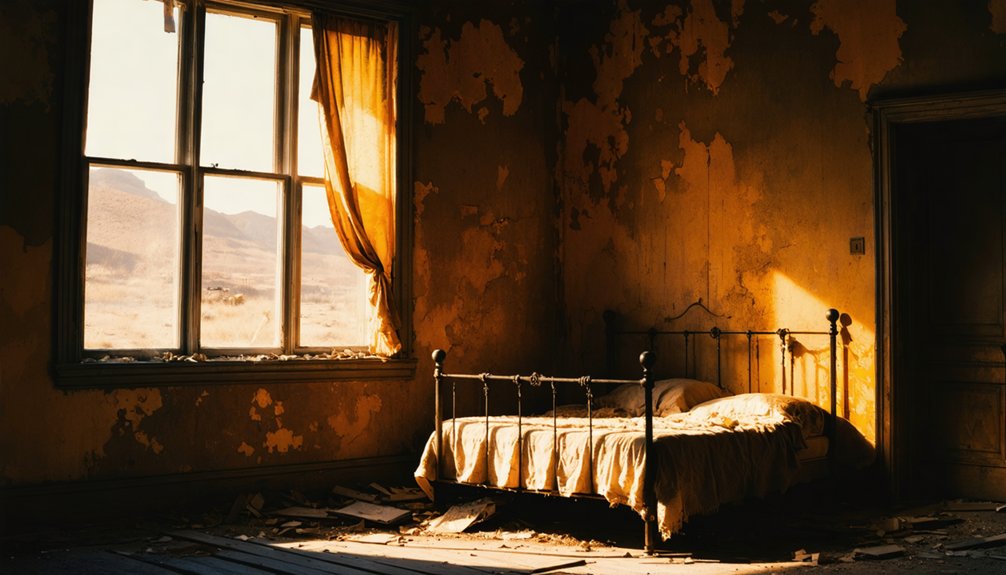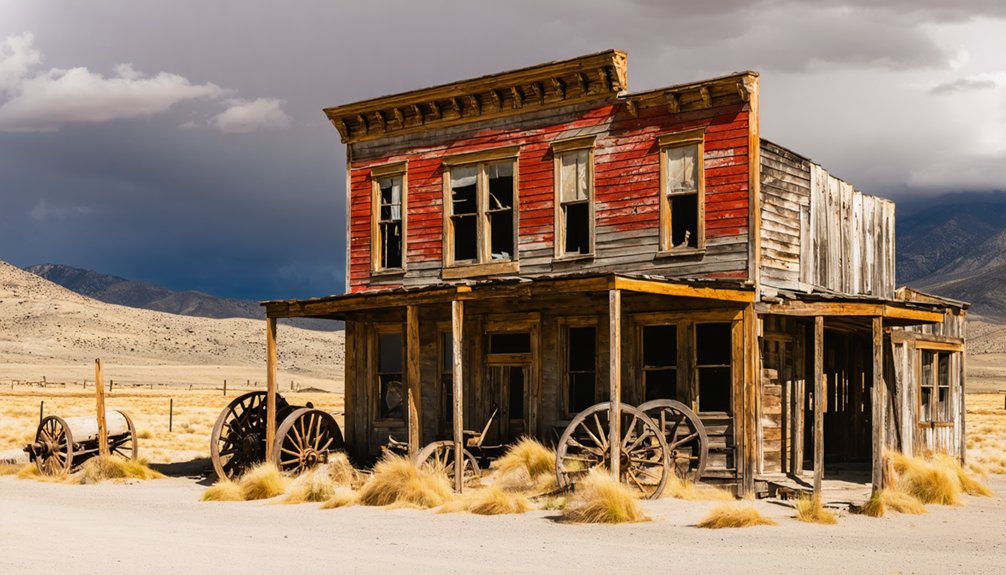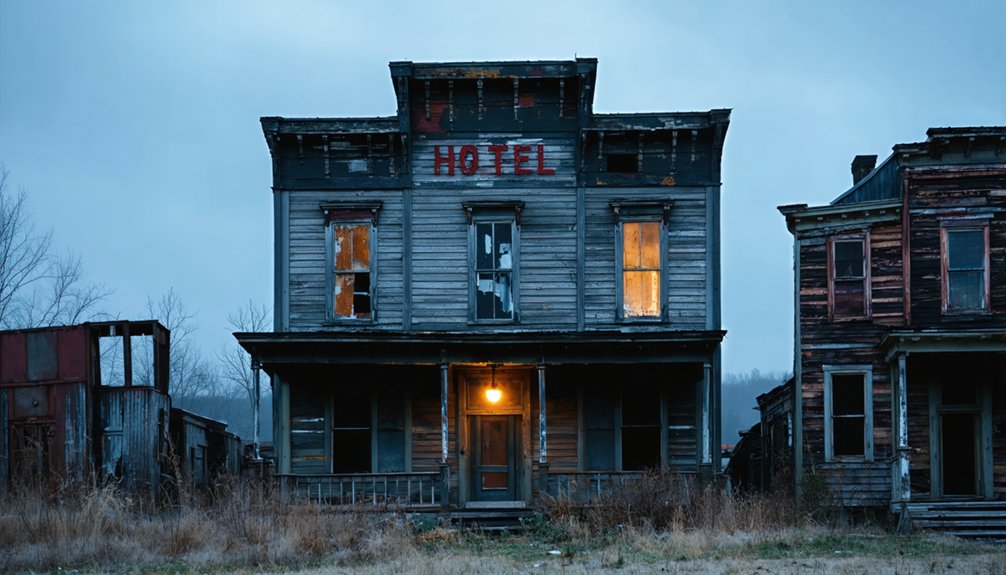
You can spend the night in the Northeast’s ghost towns at historic inns built on forgotten cemeteries and colonial ruins. The Red Lion Inn in Massachusetts has harbored spirits since 1773, while New Hampshire’s Notchland Inn sits atop pioneer graves near Crawford Notch. For a rawer experience, pitch your tent on Maine’s Swan Island among 18th-century settlement remains, or stay near Russell-Colbath House, gateway to the vanished Passaconaway village. Each location offers unique access to the region’s most haunting abandoned communities.
Key Takeaways
- Red Lion Inn (1773) offers overnight stays in haunted rooms, including Room 301 with unexplained paranormal activity and Revolutionary War history.
- Aurora Inn provides lakeside accommodations with reported sightings of a woman in white and shoreline apparitions since 1833.
- Notchland Inn allows guests to sleep in a granite mansion built over pioneer graves with mountain ghost stories.
- Swan Island offers remote tent camping among colonial ruins, abandoned cemeteries, and 1,755 acres of wilderness May through October.
- Russell-Colbath House interprets the vanished Passaconaway village with haunting stories of Ruth Colbath’s 42-year vigil for her husband.
Red Lion Inn: a Historic Berkshires Retreat With Spirited Guests
When Silas Pepoon transformed a modest corner tavern into a proper inn in 1773, he couldn’t have imagined the ghosts that would one day wander its halls—both literal and figurative.
You’ll find the Red Lion Inn standing at Pine and Main Streets in Stockbridge, Massachusetts, where 250 years of history seep through its historic architecture.
This wasn’t just another colonial stopover—revolutionaries plotted against England’s tyranny here in 1774, and Shays’ Rebellion commanders strategized within these walls in 1786.
Today, you’re free to explore 108 rooms where presidents once slept and authors penned their masterworks.
The inn’s antique furniture collection, gathered by Mrs. Charles H. Plumb in the 1870s, survived the devastating 1896 fire and still adorns the rooms today.
The 1896 fire that consumed the original structure only added to the paranormal legends that draw ghost hunters alongside history buffs, making your overnight stay both comfortable and deliciously unsettling.
Guests frequently report unexplained disturbances in Room 301, from bedsheets being tugged to the apparition of a tall man in a top hat who vanishes into mist.
Inns of Aurora: Finger Lakes Charm With Paranormal Appeal
Perched on the western shore of Cayuga Lake since 1833, the Aurora Inn commands attention with its three-story Federal-style brick facade and white-columned porches that have witnessed nearly two centuries of Finger Lakes history.
Standing sentinel over Cayuga Lake for nearly 200 years, this Federal-style landmark holds stories in every weathered brick.
Historic architecture reveals itself through eight restored fireplaces, original windows, and charred beams preserved from a 1919 fire that nearly consumed everything.
You’ll discover why freedom-seekers gravitate here—this boutique retreat blends early American antiques with modern luxury, offering lakeside veranda dining at 1833 Kitchen & Bar.
But nightfall transforms your stay into something unexplained. Paranormal experiences include a woman in white drifting through hallways and a mysterious figure walking the shoreline.
Some connect these apparitions to Wells College’s devastating 1888 fire, when the inn sheltered displaced students.
The inn closed in 2000 after falling into disrepair, but reopened in 2003 following extensive restoration efforts that preserved its historic character while adding modern amenities like marble bathrooms and high-speed Internet.
Colonel E.B. Morgan, the inn’s original builder, co-founded the *New York Times* before establishing this major stop on the Erie Canal route.
History refuses to rest quietly here.
Notchland Inn: Sleep Near Crawford Notch’s Forgotten Cemetery
Built from granite blocks in the 1860s, the Notchland Inn rises from soil where Abel Crawford and his wife Hannah rest in forgotten graves—a mansion constructed on the bones of New Hampshire’s pioneer hospitality.
You’ll sleep where haunted legends whisper through Gustav Stickley’s Arts & Crafts parlor, surrounded by 780,000 acres of White Mountain National Forest.
Dr. Bemis foreclosed on this sacred ground in 1850, erecting his estate atop the Crawford family’s 1792 tavern site—where historical preservation meets spectral unrest.
Your room’s wood-burning fireplace crackles as Davis Path beckons across the road, ascending toward Mount Washington’s summit.
Below, the Saco River carves through eight thousand feet of shoreline.
Four-course dinners by candlelight taste different when served above cemetery soil, each bite seasoned with frontier ghosts and mountain freedom.
The mansion has welcomed guests since the 1920s, transforming from private estate to inn while preserving its connection to Crawford Notch’s storied past.
Abel’s son Ethan earned the nickname “Giant of the Hills”, guiding early tourists and building the region’s first summit shelters in the 1820s.
Swan Island: Camp Among Maine’s 18th-Century Ruins
Explore historical ruins along seven miles of trails threading past Dr. Silvester Gardiner’s colonial grant.
The town cemetery whispers stories of ice cutters and shipbuilders.
A wildlife tower overlooks grassy fields where Kennebec hunters once harvested wild rice.
You’ll carry everything in, carry everything out—complete autonomy on 1,755 acres of haunted freedom.
An open-sided pavilion with fireplace offers shelter for overnight tent camping and daytime picnics.
Reserve your spot between May and October when the Maine Department of Inland Fisheries and Wildlife opens the island to campers.
Russell-Colbath House: Gateway to New Hampshire’s Vanished Village
Along the Kancamagus Highway, where logging railroads once hauled timber through a thriving valley, a solitary farmhouse stands as the last witness to Passaconaway’s vanished community. Built in 1832, the Russell-Colbath House anchors your exploration of this ghost town.
As you wander through the area, you will discover more hauntingly beautiful ghost towns in New England that tell stories of resilience and abandonment. Each site reveals remnants of a past life, where time stands still, and nature slowly reclaims its territory. Exploring these forgotten places offers a glimpse into the rich history and culture that once flourished in this region.
The house’s role goes beyond just being a historic building. Interpretive hosts in period clothing bring frontier life into focus through authentic household artifacts and weathered photographs. The US Forest Service acquired the property in 1961 and now operates it as a historic site and museum. A post and beam barn constructed in 2003 from rough sawn timbers houses educational displays and live demonstrations.
The home’s most haunting legacy involves Ruth Colbath, who placed a lamp in her window every night after her husband left in 1891, promising to return “in a little while.” He finally came back in 1933—42 years later.
This commitment to *community storytelling* and *historic preservation* transforms your visit beyond simple observation. You’ll walk the Rail N’ River Trail through vanished homesteads, stand in the old cemetery, and connect with New Hampshire’s logging heritage through tangible remnants of determined lives.
Frequently Asked Questions
What Should I Pack for an Overnight Ghost Town Stay?
You’ll need a sleeping bag, tent, headlamp, and sturdy boots—because nothing says “freedom” like freezing in abandoned historic landmarks while waiting for ghost stories to materialize. Pack layers, first-aid supplies, water purification tablets, and your skepticism.
Are These Locations Suitable for Families With Young Children?
Most locations aren’t ideal for young children. Haunted legends pervade these sites with paranormal themes and eerie atmospheres. You’ll need serious safety precautions maneuvering abandoned structures, remote grounds, and wildlife. Older kids craving adventure might embrace the spine-tingling experience, though.
Can I Visit Multiple Ghost Towns in One Weekend Trip?
You’ll cover 300-500 miles visiting 2-3 ghost towns per weekend! Historical preservation clusters like Adirondacks await your discovery. Practice camping safety while exploring Tahawus Mines Friday, then venture to Maine’s Swan Island Saturday—freedom through adventure.
As you delve deeper into the eerie realm of haunted locations in the Midwest, you’ll uncover spine-chilling tales that add a thrill to your travels. Each site carries its own history and stories that blur the lines between fact and folklore, making every visit an adventure. Pack your courage and prepare for ghostly encounters that linger long after the sun sets.
Among the diverse landscapes, ghost towns in New Mexico offer a hauntingly beautiful experience showcasing the remnants of historical settlements. Explore abandoned buildings and faded memories that whisper stories of the past, inviting you to imagine the lives once lived there. As dusk falls, the haunting shadows cast by the ruins create an atmosphere that is both eerie and enchanting, perfect for intrepid explorers seeking the unknown.
Do I Need Special Equipment to Experience Paranormal Activity?
You don’t need paranormal equipment at these haunted destinations—experiences happen naturally. However, basic safety precautions like flashlights for dark corridors and sturdy shoes for exploring crumbling structures will keep you secure while chasing supernatural encounters.
Are Pets Allowed at These Historic Overnight Accommodations?
Like Toto’s uncertain welcome in Oz, you’ll find pet policies mysteriously absent from these haunted havens. Accommodation restrictions remain unspecified at Red Lion Inn, Inns of Aurora, Yellow Dog Village, and Swan Island—contact each directly before adventuring with your four-legged companion.
References
- https://browneyedflowerchild.com/haunted-hotels-on-the-east-coast/
- https://theperennialstyle.com/2024/10/24/haunted-cities/
- https://www.visitwhitemountains.com/blog/post/spooky-stories-ghost-towns-and-historic-haunted-spots/
- https://fr.hotels.com/go/usa/ghost-towns-maine
- https://visitadirondacks.com/fall/abandoned-places-ghost-towns
- https://www.redlioninn.com/history
- https://usghostadventures.com/haunted-places/the-red-lion-inn/
- https://massachusetts250.org/the-red-lion-inn-a-patriots-refuge-in-the-berkshires/
- https://www.hospitalitynet.org/opinion/4096372.html
- https://www.historichotels.org/hotels-resorts/the-red-lion-inn/history.php