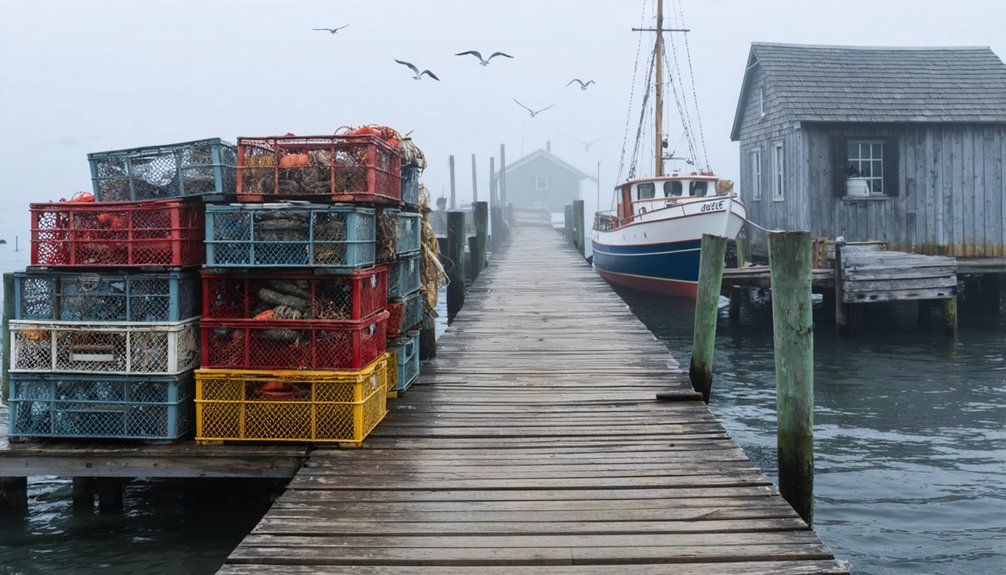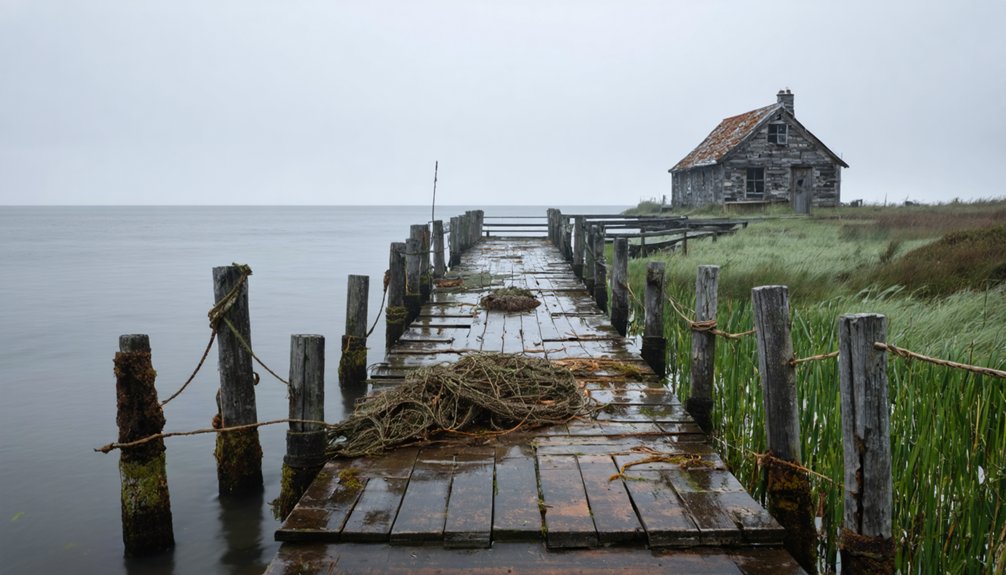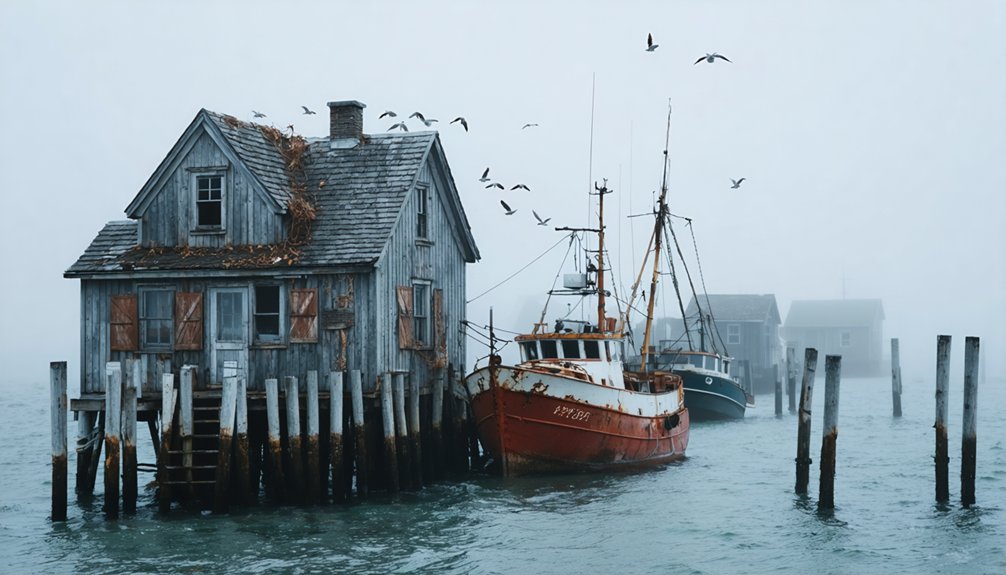
America’s coastlines harbor forgotten fishing communities like Perkins, Maine (abandoned 1918) and Whitewash Village on Cape Cod (deserted 1860s). You’ll discover settlements that surrendered to changing economies and harsh environments—from Port Oneida’s preserved structures to Florida’s fading Nature Coast hamlets. These maritime ghost towns tell stories of ingenious adaptation and ultimate surrender to nature’s power. Each weathered dock and tilting shanty holds secrets of the seafaring lives once lived there.
Key Takeaways
- Swan Island’s Perkins, Maine flourished as a maritime settlement until 1918, accessible now only by paddle or boat.
- Whitewash Village on Cape Cod’s Monomoy Island declined in the 1850s due to environmental changes and economic shifts.
- North Manitou Island hosted twin ghost settlements that thrived until the 1860s before declining from forest depletion.
- Florida’s Nature Coast contains fading fishing communities like Cedar Key that collapsed economically in the mid-20th century.
- Bombay Beach transformed from a booming 1950s resort to a decaying ghost town after environmental collapse of the Salton Sea.
Swan Island’s Lost Community: Perkins, Maine
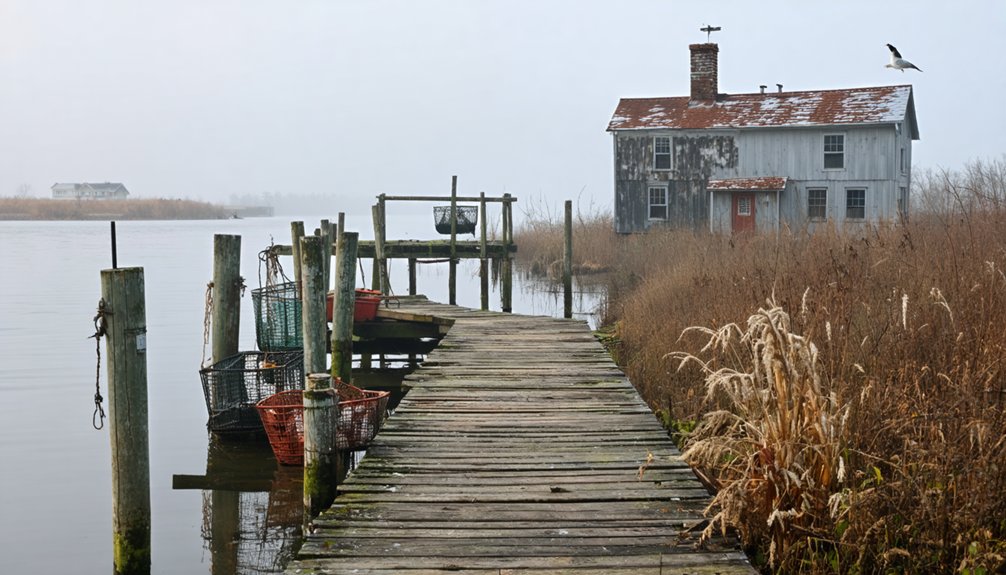
Nestled between the eastern and western passages of the Kennebec River, Perkins emerged as a distinct community when it separated from the Town of Dresden in 1847.
Named after Boston merchant Col. Thomas Perkins Jr., this maritime settlement arose from land once traversed by Abenaki hunters.
This coastal village bears the name of a Boston merchant, standing upon ancestral paths of the Abenaki people.
You’ll find rich Kennebec history here, where European settlers first arrived in 1607, establishing a community that thrived on shipbuilding, fishing, and ice harvesting.
Seven sea-going vessels were constructed on these shores during the town’s heyday, while three major ice houses supported the local economy.
Today, the island is accessible only by paddle or boat since ferry service from Richmond ended, creating a truly isolated ghost town experience.
The town reached its population peak in 1860 with nearly 100 residents before declining and eventually ceasing to exist in 1918 when insufficient male voters remained to fill town offices.
Whitewash Village: Cape Cod’s Vanished Settlement
While New England’s coastal communities often faced maritime challenges, few disappeared as dramatically as Whitewash Village. Established around 1710 on Monomoy Island, this fishing settlement thrived until the mid-1800s with its Maritime Heritage centered around Powder Hole harbor.
You’d find up to 200 residents catching cod, mackerel, and lobsters that sold for merely two cents each. The village’s fate mirrored that of other Massachusetts communities like Long Point village, which also experienced decline in the 1850s due to changing economic conditions. Unlike the Quabbin Reservoir towns that were intentionally disincorporated in 1938, Whitewash Village faced a natural demise.
Environmental Changes sealed the village’s fate when:
- A devastating 1860 winter storm filled Powder Hole with sand
- Overfishing depleted the once-abundant fish stocks
- Cheaper salt deposits elsewhere undermined local salt works
Port Oneida: Michigan’s Preserved Rural Ghost Town
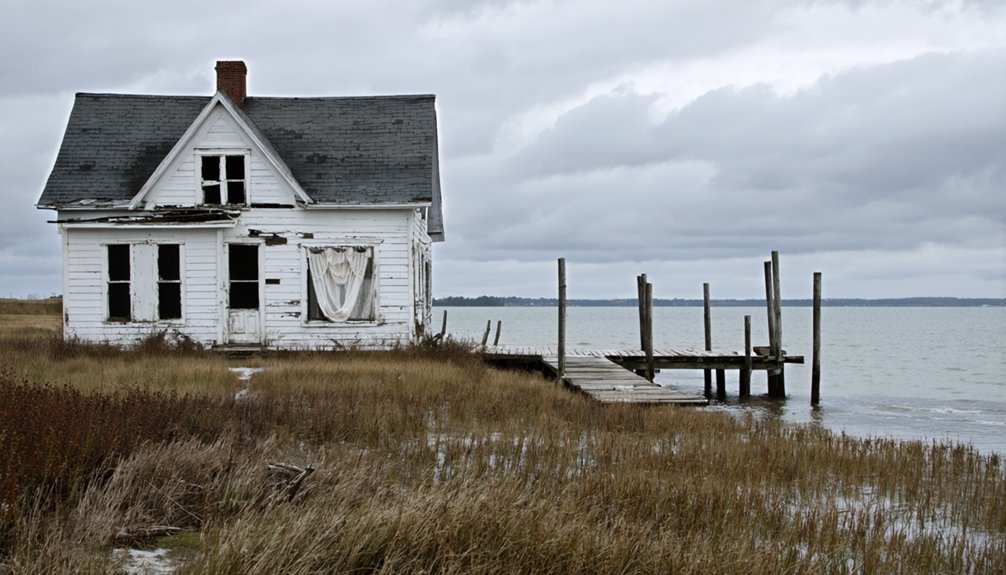
You’ll discover that Port Oneida’s economy shifted dramatically from its 1860s lumber industry, when Thomas Kelderhouse’s sawmill and dock facilitated a bustling timber trade on Lake Michigan, to subsistence farming by the 1890s as forests were depleted.
The rural community’s agricultural evolution is perfectly preserved today in approximately 150 historic structures spread across 3,400 acres within Sleeping Bear Dunes National Lakeshore.
These meticulously maintained farmsteads, with their barns, milk houses, and sugar shacks, offer a rare glimpse into the adaptive strategies of 19th-century settlers who survived Michigan’s changing economic tides. The community’s peak population reached 87 residents during its most prosperous period, highlighting the modest scale of this historic settlement. Visitors seeking this hidden historical treasure should stop at the ranger station to obtain a Port Oneida booklet with maps and building descriptions before exploring the district.
Logging to Farming Transition
As logging operations dwindled in Port Oneida during the 1890s, a remarkable economic metamorphosis unfolded along Michigan’s pristine Lake Michigan shoreline.
You’d have witnessed the twilight of traditional logging techniques as forests depleted and machinery fell silent. The agricultural evolution that followed transformed this maritime community into farmland, with its sandy soils surprisingly accommodating potato cultivation.
- Former lumberjacks and their families adapted to farming livelihoods by 1908, with only remnant dock pilings marking their industrial past.
- The community’s resilient German immigrants established a network of farmsteads that withstood Lake Michigan’s harsh conditions.
- Diverse subsistence activities including fishing, maple syrup production, and dairy farming sustained residents through the change.
Though the industrial center vanished, Port Oneida’s community persisted, gradually shifting from axes and saws to plows and harrows as they forged their independent coastal existence.
Preserved Historic Farmsteads
Twenty-two historic farmsteads now comprise the heart of Port Oneida Rural Historic District, preserved as a living tribute to Michigan’s 19th-century coastal agricultural heritage.
Walking these grounds, you’ll encounter remnants of a maritime community that flourished after the Burfiends’ 1852 settlement and Kelderhouse’s crucial dock construction in 1862.
The district’s historic significance extends beyond its buildings to the stories of resilient settlers who balanced fishing, logging, and farming despite challenging sandy soils.
Community life centered around the schoolhouse and Evangelical Lutheran church, while the Kelderhouse Cemetery chronicles generations who called this shore home.
Though the settlement’s economic importance faded by 1908 as steamships shifted from cordwood to coal, today’s National Register recognition guarantees these farmsteads continue telling the tale of Michigan’s coastal pioneers.
North Manitou Island: Twin Ghost Settlements of the Great Lakes
Within the misty waters of Lake Michigan, North Manitou Island harbors two forgotten settlements that once thrived as essential maritime outposts.
North Manitou Village and Crescent Village emerged in the mid-1830s when William Burton established a cordwood business to fuel passing steamships. These twin communities flourished until the 1860s, when economic decline followed forest depletion and shifts to alternative fuels.
- Archaeological evidence reveals human presence dating back to 3000 BC, including Late Archaic Period artifacts.
- Indigenous Anishinaabe people considered the island spiritually significant, with “Manitou” meaning “spirit” or “ghost.”
- Early settlers endured harsh isolation, sometimes trading with Native Americans for survival essentials.
You’ll find remnants of wooden rail lines, docks, and buildings that once supported these crucial ports between Chicago and Buffalo—silent witnesses to a vanished maritime economy. The island is now maintained as a wilderness area within Sleeping Bear Dunes National Historic Lakeshore, preserving its natural beauty and historical significance.
Florida’s Nature Coast: Fading Fishing Communities
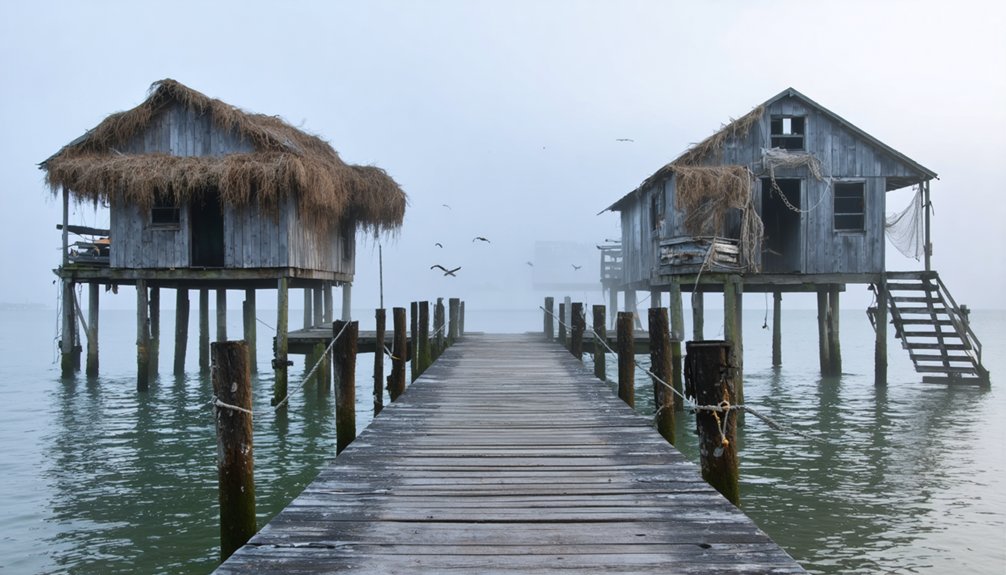
While the Great Lakes region’s ghost settlements reflect the boom-and-bust cycles of maritime trade, Florida’s Nature Coast tells a different tale of decline.
You’ll find once-thriving fishing communities like Cedar Key, Aripeka, and Yankeetown slowly fading into the coastal landscape.
As you venture along the coastline, keep an eye out for hidden gems along California coast that offer a glimpse into the region’s rich maritime heritage. These quaint towns are often overlooked, yet they provide a unique charm and a slower pace that contrasts sharply with the bustling cities nearby. Exploring these areas can unveil unexpected delights, from local seafood markets to stunning ocean views.
These villages, built on rich fishing heritage in the 19th century, supported vibrant communities until mid-20th century challenges forced an economic shift.
Cedar Key’s dual economy of fishing and pencil manufacturing collapsed, while smaller hamlets suffered from environmental degradation and changing markets.
Today, you can explore these communities where aging fishermen still share stories of abundant catches and maritime traditions.
Unlike Destin, which transformed from a small fishing village into a premier tourist destination earning the nickname “World’s Luckiest Fishing Village”, these coastal communities couldn’t adapt to changing economic conditions.
The ban on commercial net fishing in 1995 delivered a devastating blow to these traditional fishing communities, eliminating livelihoods that had sustained families for generations.
Though tourism and real estate development have partially revived some areas, the authentic character of these coastal villages continues to erode with each passing generation, leaving behind echoes of Florida’s maritime past.
Bombay Beach: The Salton Sea’s Decaying Resort Town
Unlike the weathered fishing villages of Florida’s Nature Coast, Bombay Beach presents a surreal desert paradox—a resort town born from an ecological accident. Established in 1929 along the shores of the Salton Sea—created when the Colorado River flooded the basin in 1905—this community transformed into a booming resort destination by the 1950s.
You’ll find Bombay Beach’s history follows a dramatic arc:
- 1950s-1960s: The golden era—attracting 1.5 million annual visitors, celebrities like Frank Sinatra, and thriving with marinas and yacht clubs
- 1970s-1980s: Environmental collapse as agricultural runoff and rising salinity triggered massive fish die-offs
- 1976-present: Hurricane-driven floods submerged one-third of the town, leaving skeletal ruins that now attract artists transforming decay into open-air exhibitions
The Salton Sea ecology’s devastating decline mirrors Bombay Beach’s transformation from paradise to post-apocalyptic canvas. The community’s early residents primarily inhabited travel trailers on weekends before the area developed permanent housing.
Frequently Asked Questions
Are Any Coastal Ghost Towns Accessible Only by Boat?
Yes, you’ll find several coastal ghost towns with rich fishing history that require boat access, including Ferguson (underwater), North Manitou Island villages, and Ocean Falls cabins in British Columbia.
Can Visitors Legally Remove Artifacts From These Abandoned Settlements?
No, you cannot legally remove artifacts from these sites. Legal restrictions protect these maritime relics, ensuring artifact preservation for future generations to experience America’s coastal fishing heritage in its authentic context.
Which Ghost Town Has the Most Paranormal Activity Reports?
Like a beacon in the fog, Bodie, California tops the charts for ghost sightings. You’ll find daily ranger-led tours exploring haunted locations where paranormal activity thrives among over 200 preserved frontier-era buildings.
Do Any Former Residents Still Return for Reunions?
Yes, you’ll find former residents gathering at reunion events in places like Fishtown, Leland, where families like the Carlsons maintain five-generation connections through seasonal festivals and maritime heritage celebrations.
What Environmental Factors Most Commonly Caused These Towns’ Abandonment?
Like ships against tides of change, you’ll find sea level rise, land subsidence, and coastal erosion drove these towns under. Economic decline followed when fish stocks plummeted, while hurricanes and flooding delivered the final blow.
References
- https://newenglandhistoricalsociety.com/six-new-england-ghost-towns/
- https://www.nps.gov/slbe/learn/historyculture/ghosttowns.htm
- https://www.youtube.com/watch?v=t85jyEeiOOo
- https://www.outoftheoffice4good.com/post/exploring-the-almost-ghost-town-of-bombay-beach-ca
- https://www.loveexploring.com/gallerylist/188219/the-us-state-with-the-most-ghost-towns-revealed
- https://www.mainepreservation.org/most-endangered-2023-1/2023/10/4/historic-resources-of-swan-island
- https://visitmaine.com/articles/swan-island/
- https://swanislandmaine.org/history
- https://swanislandmaine.org/uniqueness
- https://maineboats.com/coastal-adventures/swan-island-jewel-on-the-kennebec