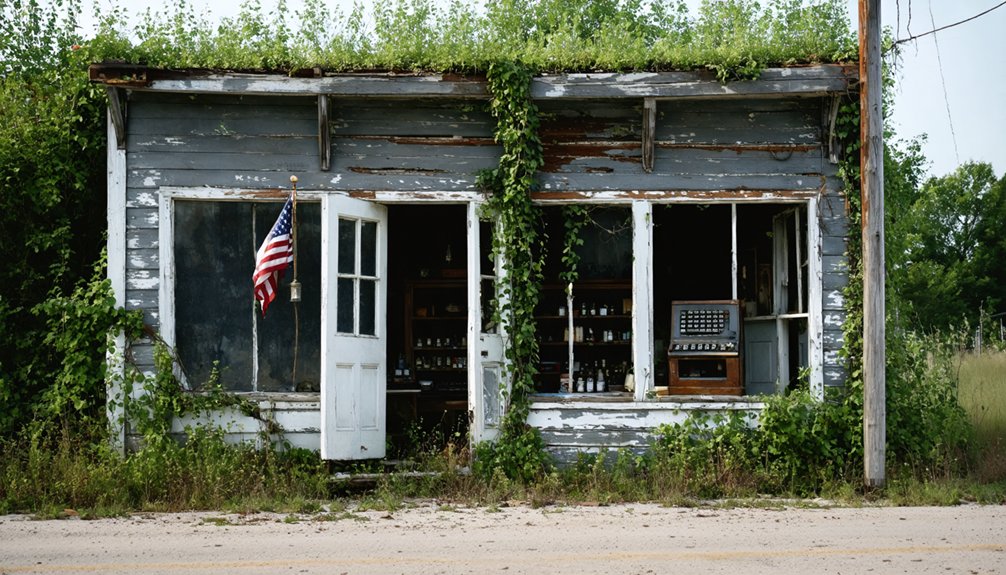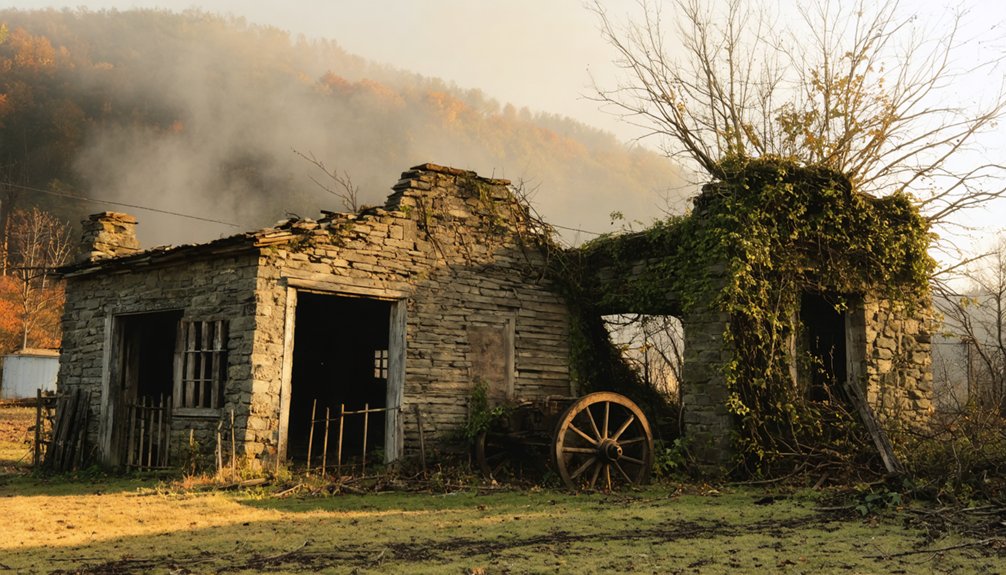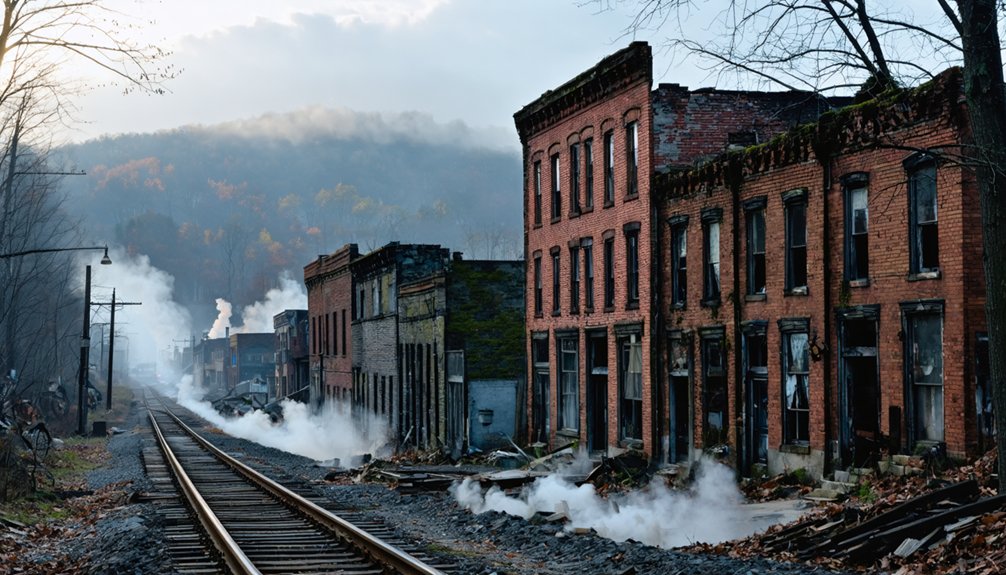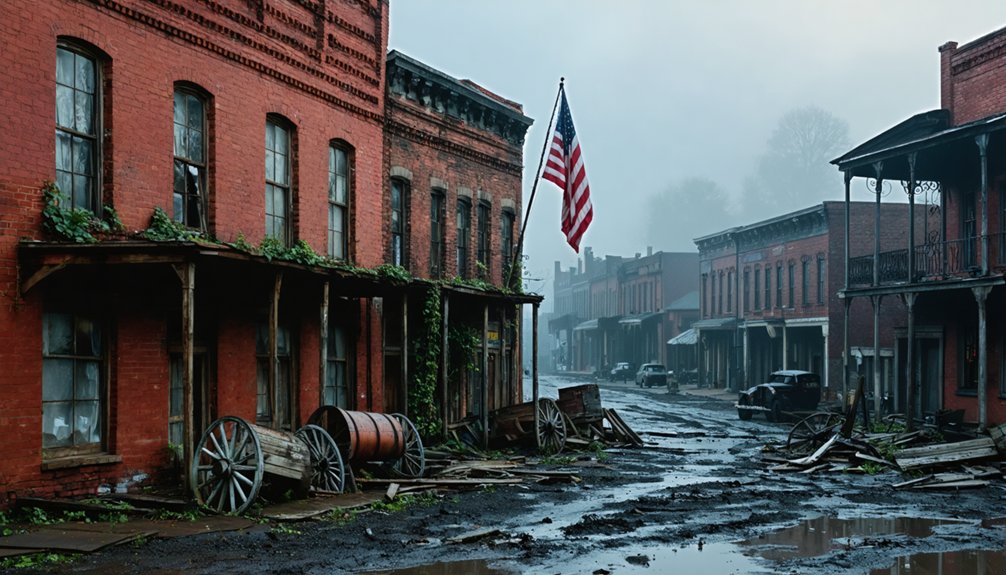
Civil War-era abandoned towns dot America’s landscape as silent witnesses to destruction and exodus. You’ll find Southern settlements like Randolph, Tennessee, where Union forces left just one house standing, and Northern communities like Chambersburg, Pennsylvania, where Confederate troops burned 550 buildings. Post-war mineral booms created boom-towns like Bodie, which surged from 20 to 10,000 residents before declining. These ghost towns now preserve their stories through “arrested decay” and archaeological research. Their brick foundations whisper forgotten histories.
Key Takeaways
- Civil War destruction left numerous Southern towns as ghost settlements, with places like Randolph, Tennessee reduced to a single remaining structure.
- Confederate attacks on Northern communities like Chambersburg, Pennsylvania caused civilian exodus and abandonment of entire settlements.
- Post-war mineral booms created temporary settlements that were later abandoned when resources depleted, like Bodie and Vulture City.
- Failed Reconstruction policies contributed to the collapse of newly established Black settlements as land was returned to pardoned Confederates.
- Modern preservation efforts like “arrested decay” at sites such as Old Cahawba maintain these ghostly remnants as historical tourism destinations.
War-Ravaged Southern Towns: Destruction and Exodus
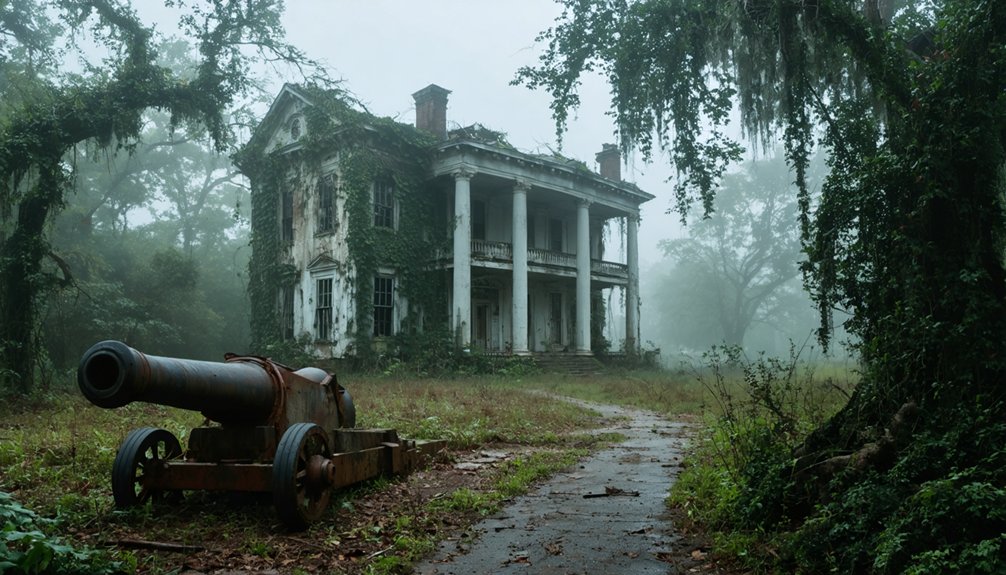
As the American Civil War raged across the Southern landscape from 1861 to 1865, hundreds of towns faced deliberate and systematic destruction by Union forces.
You would’ve witnessed Union troops targeting Randolph, Tennessee, where Sherman’s scorched-earth policy left just one house standing. Town destruction was particularly devastating in places like Orangeburg, South Carolina, where half the city burned in 1865. In Darien, Mississippi, Union soldiers reduced the once-thriving port town to brick foundations only.
This methodical demolition carried an estimated $1.5 billion price tag, with Southerners bearing costs 2.5 times higher per capita than Northerners.
The strategic campaign triggered massive population migration as families abandoned their ruined communities. The staggering value of slaves that reached nearly $3 billion by 1860 was effectively erased through emancipation, further devastating Southern wealth. One-third of Southern households lost family members, while destroyed rail lines and buildings made recovery nearly impossible.
Many settlements became ghost towns, their populations scattered, unable to rebuild for decades.
Northern Communities Under Confederate Fire
You’ll find that Chambersburg, Pennsylvania held essential strategic value as a railroad hub and supply depot before Confederate forces under General McCausland burned 550 buildings on July 30, 1864.
Northern civilians, unlike their southern counterparts, experienced fewer direct attacks but still witnessed population displacement following these targeted Confederate raids. The St. Albans Raid demonstrated the Confederacy’s ability to strike far into Northern territory, creating fear among border communities. Led by Lieutenant Bennett H. Young, the raiders successfully robbed three local banks while announcing their Confederate allegiance.
The town’s destruction caused a significant exodus of residents who couldn’t rebuild, creating one of the few northern communities abandoned specifically due to Civil War combat damage.
Chambersburg’s Strategic Significance
Nestled along the Cumberland Valley Railroad, Chambersburg emerged as a strategic northern target throughout the Civil War, attracting multiple Confederate raids due to its essential infrastructure and supply line importance.
The important rail line facilitated Union supply movement toward Maryland, making its disruption a prime Confederate objective.
Confederate tactics evolved through successive incursions. J.E.B. Stuart’s October 1862 raid captured horses, arms, and officials for prisoner exchanges. During this operation, Stuart appointed Wade Hampton as military governor of the town after its surrender.
Later, Brig. Gen. McCausland’s 1864 assault demanded $100,000 gold ransom before burning 537 buildings when payment failed.
Both raids methodically targeted Chambersburg’s significance as a logistical hub while evading Union defenders.
The October 1862 raid resulted in the rebels seizing approximately 1,200 horses from Franklin County, significantly diminishing local transportation resources.
These attacks destroyed approximately $250,000 in property (1860s value) and left 2,000 residents homeless, yet failed to destroy the critical Conococheague Creek railroad bridge.
Northern Civilian Exodus
While the Confederate forces executed strategic raids on Northern infrastructure, thousands of civilians fled their homes in a massive exodus that fundamentally altered the demographic landscape of border regions.
You’d witness entire communities in frontier areas abandoned as families sought safety from Confederate cavalry incursions, particularly during Sterling Price’s 1864 raid into Missouri and Kansas.
You’d see remnants of the once-thriving agricultural landscape, with abandoned farms in the Midwest serving as haunting reminders of the hardships faced by those who were uprooted. The impact of these events left scars not just on the land, but also on the hearts of the families that were forced to leave their homes behind. As time went on, many of these properties fell into complete disrepair, overtaken by nature and the passage of time.
The civilian resilience was tested as migration patterns shifted dramatically—nearly naked families appearing on desolate prairies demonstrated the desperation of displacement.
Border towns experienced profound depopulation as Confederate threats combined with economic pressures. Real wages declined by 20%, while desertion and draft evasion (with 200,000 men fleeing to Canada) further destabilized communities. Similar to North Carolina troops, many soldiers abandoned their posts due to family hardships and concerns for loved ones back home.
The total death toll of the Civil War reaching approximately 750,000 casualties meant that almost every Northern community lost significant portions of their population, deepening the demographic crisis.
Women filled vacant positions in fields and factories as men departed, permanently altering Northern town demographics.
Military Strategy and the Targeting of Civilian Settlements
Although military conflicts typically conjure images of soldiers fighting on battlefields, the Civil War’s military strategy often deliberately targeted civilian settlements as a tactical component.
Commanders understood that controlling civilian populations could greatly impact military outcomes. You’ll find that targeting settlements served to undermine civilian morale through psychological warfare, while simultaneously depriving enemy forces of crucial resources and support. General William T. Sherman’s destructive March to the Sea demonstrated how devastating this approach could be to Southern infrastructure.
Military success often hinged on controlling towns and breaking civilian spirit—a brutal calculus of psychological warfare and resource denial.
- Towns were systematically burned to deny enemies shelter and supplies
- Artillery deliberately shelled houses harboring enemy sharpshooters
- Armies routinely requisitioned or looted civilian food stores and livestock
- Guerrilla bands like Quantrill’s Raiders terrorized settlements to disrupt Union control
- Forced displacement created ghost towns as communities were abandoned
This “total war” approach aimed to break the enemy’s will beyond the battlefield, making civilian settlements strategic prizes rather than innocent bystanders. The destruction of civilian property began early in the conflict with incidents like the First Manassas battle where homes were commandeered and destroyed.
Post-War Boom and Bust: Mining Ghost Towns of the 1860s-1880s
As the Civil War’s conclusion released a flood of laborers and adventurers westward, you’ll find that the American mining frontier expanded dramatically with gold and silver discoveries across the Rocky Mountains between 1862-1880.
You’d have witnessed mining towns like Bodie, California and St. Elmo, Colorado materialize almost overnight, transforming from barren landscapes to bustling communities of thousands within months of mineral discovery.
When the Sherman Silver Purchase Act’s 1893 repeal coincided with depleting ore quality, you’d have observed these once-thriving settlements rapidly hollow out, leaving behind the remarkably preserved structures that today constitute America’s most iconic ghost towns.
Gold Rush Aftermath
In the aftermath of the Civil War, America’s western territories experienced an unprecedented mining boom that birthed hundreds of settlements virtually overnight.
These gold rush impacts reshaped the frontier landscape between 1861-1890, with towns like Bodie, California and Vulture City, Arizona swelling from nothing to thousands of residents in mere months.
- Mining town dynamics followed predictable patterns: rapid growth, feverish extraction, then abandonment.
- Bodie’s population peaked in the 1870s before declining steadily until the last mine closed in 1942.
- Towns like St. Elmo collapsed when ore quality deteriorated, rendering operations financially unviable.
- These economic microcosms contributed greatly to western wealth—Teller County mines alone produced $432 million in ore.
- By the early 1900s, most boomtowns had transformed into the ghost towns you can visit today.
Mineral Boom Settlements
Five distinct waves of mineral discoveries swept across the American West between 1860-1880, transforming vacant landscapes into bustling communities virtually overnight.
You’d have witnessed the Rocky Mountains bloom with gold and silver operations, drawing thousands to remote outposts like Bodie, California, which exploded from 20 miners to 10,000 residents.
These settlements quickly developed sophisticated mining infrastructure – mills, quarries, and rail connections that shipped wealth eastward.
Places like Leadville, Colorado and Deadwood, South Dakota flourished briefly before mineral depletion sent them spiraling toward abandonment.
Today, these skeletal remains of America’s extractive past have found new purpose through ghost town tourism.
Walking Bannack’s weathered boardwalks or exploring Kennicott’s copper operations, you’re experiencing freedom’s physical legacy – places built rapidly and abandoned just as quickly when resources vanished.
Post-War Resource Exploitation
The aftermath of the Civil War released unprecedented resource exploitation across American landscapes, transforming raw wilderness into industrial hubs virtually overnight.
As you explore these ghost towns today, you’re walking through America’s rapid post-war industrial evolution.
- Railroad arteries pumped life into remote mining settlements, enabling efficient mineral extraction.
- Population explosions saw towns swell from hundreds to thousands within months.
- Mining infrastructure evolved from basic camps to sophisticated operations with stamp mills and smelters.
- Demographic shifts followed mineral values—towns emptied as quickly as they filled.
- Resource shifts from precious metals to industrial minerals extended some towns’ lifespans.
When ore quality declined or deposits were exhausted, these booming communities collapsed.
Some mines briefly revived during World Wars, producing lead for bullets and extending their economic viability before inevitable abandonment.
The Reconstruction Era’s Abandoned Settlements
When the Civil War finally ended in 1865, countless settlements across the American South lay in ruins, creating a landscape of abandoned towns that would define the Reconstruction Era (1865-1877).
Eleven major Southern cities stood damaged or destroyed, while smaller towns struggled with crippled economies and demolished infrastructure.
The Freedmen’s Bureau, tasked with managing abandoned lands, failed to secure permanent property for most freedpeople, undermining community permanence.
When President Johnson ordered lands returned to pardoned Confederates, many Black settlements collapsed.
Freedpeople migration patterns reveal attempts to escape these conditions.
The “Exoduster” movement led many to establish towns like Nicodemus, Kansas, which initially thrived but soon dwindled under harsh conditions.
Throughout the South, Black Codes and violent resistance further destabilized fragile Reconstruction communities, accelerating abandonment of once-promising settlements.
Preserving the Forgotten: Archaeology and Tourism at Civil War Ghost Towns
While many Civil War-era towns faded into obscurity during Reconstruction, contemporary efforts to study and preserve these sites have illuminated a rich historical legacy previously lost to time.
You’ll find archaeologists employing “arrested decay” methods at locations like Old Cahawba, where archaeological techniques reveal structural foundations and artifacts without modern restoration.
Tourism impact has proven vital—revenue from guided tours and interpretive programs funds ongoing research while contributing to rural economic development.
Tourism dollars breathe new life into forgotten communities while preserving their historical significance for future generations.
- Sites like Bodie State Historic Park blend history with folklore through seasonal ghost tours
- Ground surveys and excavations uncover military presence and civilian life patterns
- Environmental threats including flooding and erosion challenge preservation efforts
- Collaborative work with descendants helps identify relocated graves and honor the dead
- “Arrested decay” preservation maintains authentic historical conditions for visitors to experience
- https://www.loveexploring.com/gallerylist/131658/abandoned-in-the-usa-92-places-left-to-rot
- https://www.geotab.com/ghost-towns/
- https://247wallst.com/special-report/2022/12/31/us-cities-and-towns-destroyed-during-the-civil-war/
- https://www.mentalfloss.com/geography/wanderlust/creepiest-ghost-towns-united-states
- https://visitusaparks.com/top-ten-ghost-towns-in-america/
- https://www.christywanders.com/2024/08/top-ghost-towns-for-history-buffs.html
- https://en.wikipedia.org/wiki/Lists_of_ghost_towns_in_the_United_States
- https://www.blueridgeoutdoors.com/go-outside/southern-ghost-towns/
- https://www.worldatlas.com/cities/10-famous-ghost-towns-of-america.html
- https://247wallst.com/special-report/2023/09/01/cities-destroyed-during-civil-war/
Frequently Asked Questions
Did Any Completely Destroyed Towns Successfully Rebuild After the War?
Yes, while towns like Eunice and Columbus never recovered, many others achieved post-war recovery through economic revitalization, rebuilding infrastructure and attracting new residents despite total Civil War destruction you’ve researched.
What Happened to the Displaced Residents of These Abandoned Towns?
You’d expect displaced residents to vanish like their towns, but they scattered in predictable migration patterns—relocating to nearby economic centers, following railroad developments, or merging with neighboring communities through systematic displacement impacts.
Were Any Ghost Towns Created by Disease Outbreaks During the War?
Yes, you’ll discover several towns like Wilmington and Beechland were emptied by yellow fever. Disease outbreaks triggered town abandonment when wealthy residents fled, leaving desolate communities behind during 1862-1878.
How Did Racial Tensions Influence Which Towns Survived Reconstruction?
Over 90% of black-majority towns failed when racial segregation limited economic opportunities. You’ll find towns survived reconstruction when they embraced integration, creating diverse labor markets instead of perpetuating economic disparities through racial exclusion.
Did Occupying Soldiers Salvage Materials From Destroyed Settlements?
Yes, you’ll find Union soldiers conducted extensive material salvage, routinely collecting abandoned equipment, stripping buildings for usable parts, and repurposing materials during their occupation of Southern settlements throughout 1861-1865.