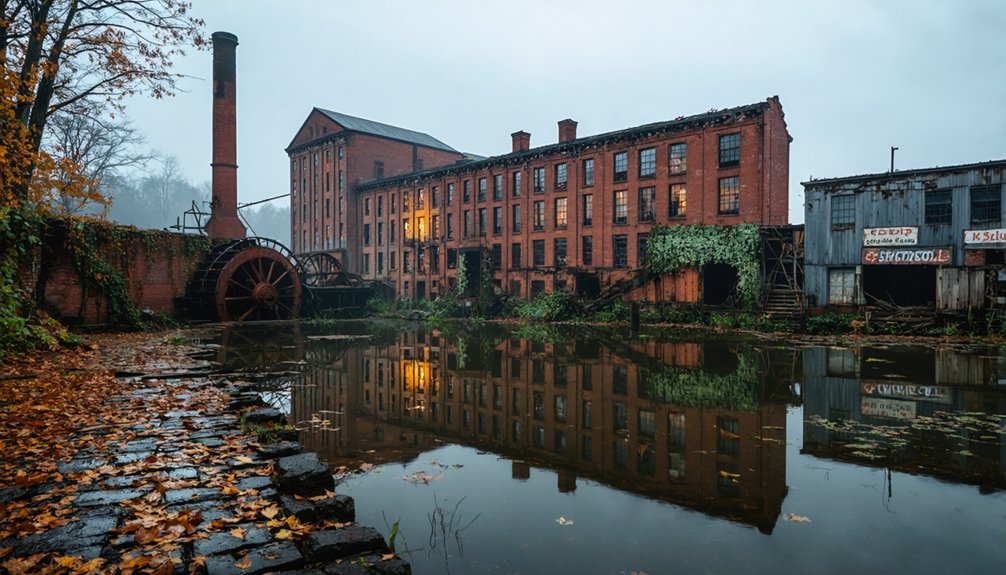
Abandoned mill towns across America harbor numerous paranormal encounters, with spirits of workers trapped in eternal labor loops. You’ll find spectral figures at sites like the Remington Arms Plant in Connecticut and Kennecott Copper Mine in Alaska. These hauntings often reflect violent deaths, child laborers, or environmental devastation. The economic collapse of these industrial communities seems to have created perfect conditions for collective spiritual imprints that reveal the darker side of America’s industrial past.
Key Takeaways
- Abandoned textile mills across New England feature apparitions of young female workers who endured harsh labor conditions during the Industrial Revolution.
- Former workers are reportedly seen performing eternal labor loops in locations like the Remington Arms Plant, accompanied by haunting machinery sounds.
- Child spirits are commonly observed running through mill town community buildings, reflecting the tragic history of child labor.
- Environmental contamination has created potent hauntings where spectral figures wander through polluted landscapes, symbolizing both human and ecological loss.
- Ghost tourism has revitalized mill town economies, with locations like Henry River Mill Village converting haunted reputations into significant tourism revenue.
The Rise and Fall of America’s Industrial Mill Towns
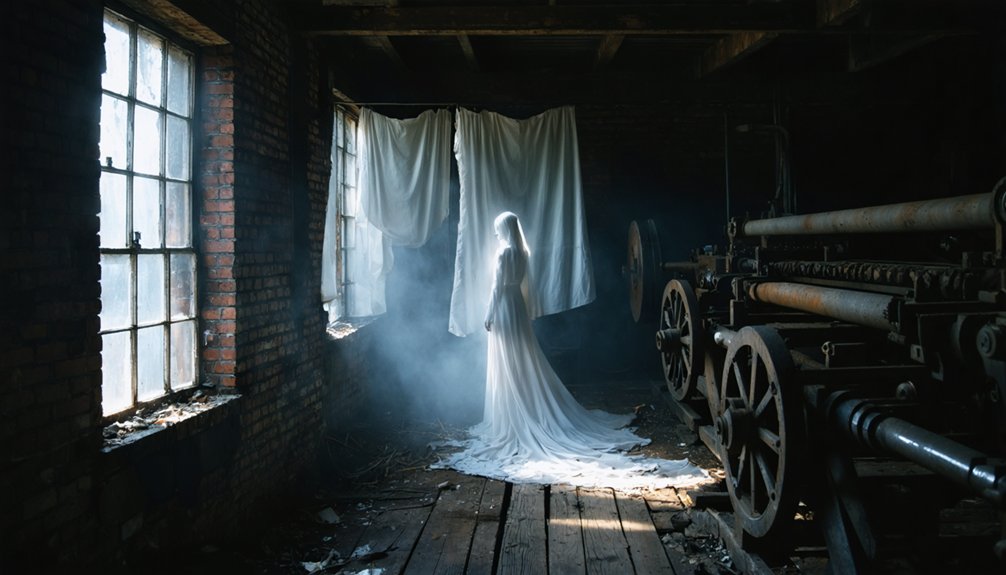
While the American industrial landscape was forever changed by the emergence of mill towns in the early 19th century, these once-thriving centers of production now stand largely abandoned.
You can trace their origins to post-War of 1812 New England, where wealthy merchants established water-powered textile mills along rivers. Samuel Slater’s first cotton mill in Pawtucket marked the beginning of America’s industrial revolution. The Boston Associates created massive operations in places like Lowell and Manchester, consolidating production under single roofs.
The American textile revolution began in New England, where merchant-capitalists harnessed river power to build industrial empires.
After 1850, the industry spread southward, particularly throughout the Piedmont region.
These company towns gave owners unprecedented control over both labor and living conditions. Workers found themselves dependent on mill owners for housing, education, and basic services. Young women workers faced strict schedules with ten to twelve hours of daily labor and limited breaks.
This industrial heritage eventually faced decline as manufacturing shifted overseas, automation increased, and economic priorities changed—leaving behind abandoned structures as silent monuments to America’s industrial past.
Paranormal Hotspots: Most Haunted Abandoned Mills
The crumbling facades of America’s abandoned mill towns harbor more than just industrial relics—they’ve become epicenters of paranormal activity.
If you’re seeking encounters with the unexplained, the Remington Arms Plant in Connecticut offers 73 acres of haunted history, where spectral sounds of bullets echo through 38 buildings following the deadly 1942 explosion.
At Peters Cartridge Company in Ohio, haunted artifacts from the Civil War era seem to attract spirits of workers killed in industrial accidents.
The Olivesburg manufacturing plant in Ohio is notorious for ghostly voices of five workers who suffered slow, painful deaths after a horrific accident involving molten metal in the 1940s.
Alaska’s Kennecott Copper Mine presents a more remote option, where harsh conditions claimed numerous lives now manifesting as disembodied voices and vanishing objects. Mining families and workers faced dangerous conditions daily before the operation closed in 1938, leaving their restless spirits to wander the abandoned town.
Even repurposed structures like Memphis’s Orpheum Theatre, built in former industrial zones, host their own resident ghosts.
These locations share common threads: violent deaths, sudden tragedies, and unresolved suffering—creating perfect conditions for supernatural phenomena.
The Curse of Bodie: When Souvenirs Bring Supernatural Consequences
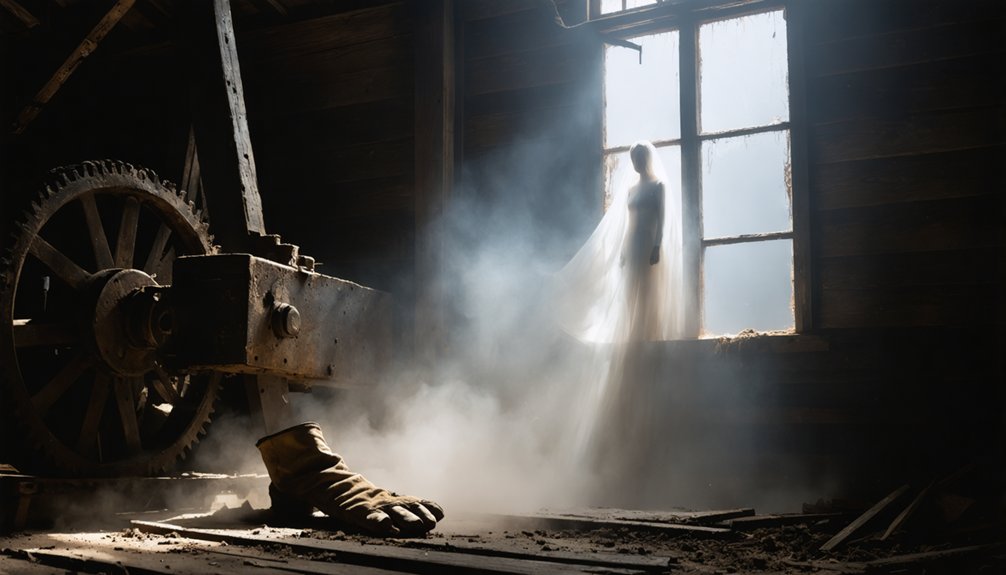
Taking a trinket from Bodie’s ghost town might saddle you with unexplained misfortune, as evidenced by hundreds of annually returned items accompanied by letters describing accidents, illnesses, and bad luck.
Park rangers report finding mysteriously returned artifacts on doorsteps and have experienced their own unsettling encounters while patrolling the grounds after dark. The J.S. Cain House has particularly frequent paranormal activity, with visitors reporting sightings of a Chinese woman’s spirit wandering through the abandoned rooms.
The curse’s origins trace back to the town’s violent history, with some attributing it to protective spirits ensuring the site’s preservation in its state of “arrested decay.” The town’s dark reputation was already established during its peak years when the Bodie Free Press documented ghost sightings as early as 1882.
Stolen Artifacts Return Mysteriously
Among the most compelling phenomena associated with Bodie’s supernatural reputation is the steady stream of artifacts that mysteriously return to the ghost town after being pilfered by visitors.
Park rangers receive approximately one letter per week containing stolen items, often accompanied by expressions of deep artifact remorse and descriptions of inexplicable misfortunes.
These confessional submissions typically arrive anonymously, with objects rattling inside envelopes. Writers detail health problems, accidents, and “things very hard to explain” that began after removing items from the site. The prevalence of these returns aligns with Bodie’s reputation as one of California’s most haunted locations. This abandoned boomtown has 110 structures still standing, preserved in a state of arrested decay since its decline began in 1880.
One 2003 letter expressed particular distress after taking just a small piece of metal.
This phenomenon serves as both supernatural warning and practical preservation tool. The curse effectively deters theft at the largely unsupervised park, ensuring irreplaceable Gold Rush artifacts remain where they belong—under the watchful eyes of Bodie’s protective spirits.
Park Rangers’ Ghostly Encounters
For those who manage Bodie State Historic Park, supernatural encounters aren’t merely campfire stories—they’re workplace experiences.
Rangers regularly document unexplained phenomena throughout the preserved ghost town. Doors open and close on their own in the J.S. Cain House, while the phantom aroma of Italian cooking wafts through an abandoned home despite no culinary activity. Staff members have recorded sounds of phantom parties and laughter echoing from empty buildings. Many rangers suspect these sounds come from the Mendocini House, where the smells of cooking are also detected.
These ranger experiences extend beyond observation. Many have witnessed visitors returning stolen artifacts, accompanying them with detailed accounts of misfortune. The town’s ghostly protectors are believed to safeguard Bodie’s artifacts from those who attempt to remove them. The park maintains an extensive collection of these returned items and their associated letters, some displayed as evidence of the “Bodie Curse.”
The town’s violent history and isolated location, preserved in “arrested decay,” create perfect conditions for the supernatural encounters that have become part of rangers’ daily reality.
Curse Origin Stories
The origins of Bodie’s infamous curse can be traced to the town’s abrupt abandonment and the protective spiritual forces that remained behind. This curse folklore developed as visitors began reporting misfortune after removing items from the ghost town, with consequences continuing until stolen objects were returned.
Evidence supporting supernatural justice appears in numerous documented letters from remorseful thieves. One 2004 letter describes “extreme bad luck” following rock theft, while another details “decades of misfortune” after stealing shoes in 1978.
The curse enforcement pattern seems connected to protective spirits inhabiting historic structures like the J.S. Cain and Mendocini houses.
The curse mechanism activates regardless of item value—even rocks or rusty nails trigger consequences. Rangers regularly receive packages from visitors desperately attempting to reverse their cursed circumstances by returning what they’ve taken.
Spectral Miners and Mill Workers: Common Apparition Patterns
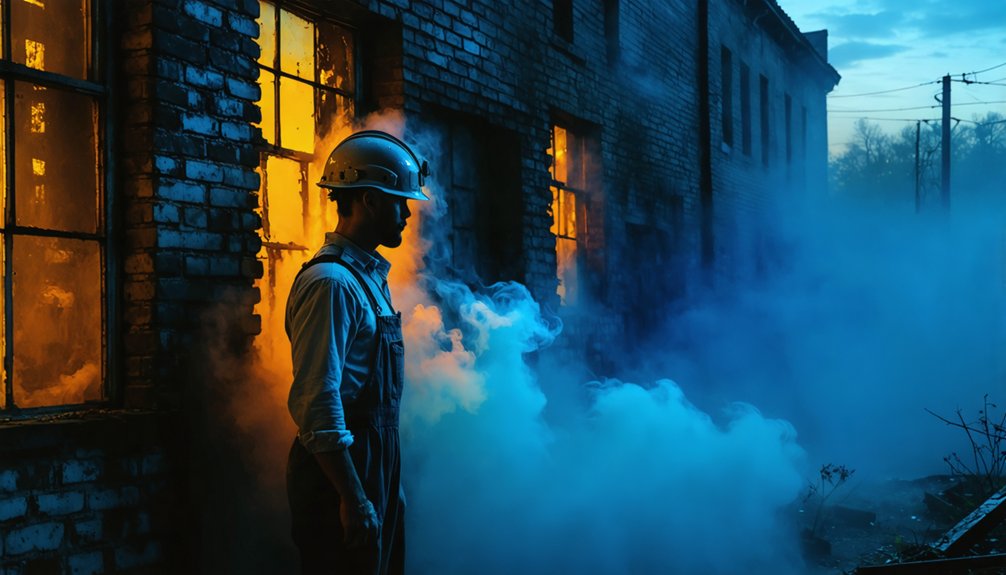
While abandoned mill towns stand as physical reminders of America’s industrial past, their ghostly inhabitants tell a more persistent story through recurring apparition patterns.
You’ll find spectral miners trapped in eternal labor loops, their lanterns bobbing along ridges at dusk, particularly near sites like Colorado’s Crystal Mill. These mining spirits continue their search for wealth long after death, with faint pickaxe sounds echoing through abandoned tunnels.
The eternal miners press on, their spectral lanterns cutting through twilight as they search for riches that death itself couldn’t convince them to abandon.
The apparitions follow distinct patterns: trapped workers forever completing unfinished tasks, child spirits running through former community buildings, and victims of violence lingering near their death sites.
Most compelling are the collective hauntings—entire groups of miners appearing simultaneously, often connected to mass exodus events following economic collapse.
These ghostly apparitions reveal how trauma, unfulfilled purpose, and sudden abandonment imprint themselves on physical locations.
Environmental Disasters and Their Ghostly Aftermath
Environmental catastrophes that devastated mill towns have created a particularly potent form of haunting, where ecological trauma and spiritual manifestations intertwine.
In this context, many visitors seek out ghost tours in historic New England to explore these ghostly remnants of the past. These tours often highlight the eerie tales of those who endured the harsh realities of industrial decline and its lingering effects. As they walk the streets, participants not only encounter ghostly legends but also reflect on the environmental histories that continue to haunt these communities.
When you visit these sites, you’re witnessing the ghostly legends born from profound environmental impact—industrial pollution and toxic mine drainage that forced communities to abandon their homes.
In towns where underground mine fires still burn or where acid rain destroyed surrounding forests, witnesses report spectral figures wandering through contaminated landscapes.
These apparitions often appear near the very industrial facilities that poisoned their communities. The economic collapse that followed these disasters adds another layer to the haunting narrative—bankrupt companies left behind not just physical toxicity but spiritual unrest.
The ghosts you might encounter represent both human loss and environmental devastation, their presence a reflection of wounds that remain unhealed.
Preserving Haunted History: Ghost Tourism and Mill Town Economies

Once abandoned and left to decay, these spectral mill towns have transformed into unlikely economic engines through the growing phenomenon of ghost tourism.
You’ll find places like Henry River Mill Village capitalizing on their haunted reputations, with ghostly encounters driving up to 20% of local tourism revenues in paranormal hotspots.
This economic revitalization isn’t accidental. Over 60% of ghost tour operators have seen a 20% increase in bookings through strategic marketing that leverages storytelling, social media, and seasonal events.
Behind every spectral success lies calculated marketing magic, not supernatural luck.
In Missouri alone, penitentiary ghost tours accounted for 60% of October sales in 2022.
These preservation efforts create jobs, increase tax revenue, and support local businesses.
Frequently Asked Questions
Can Children Sense Ghosts More Easily at Abandoned Mill Sites?
Your childhood intuition likely makes you more receptive to playful spirits at mill sites. Research suggests children’s theta brainwaves, undeveloped prefrontal cortex, and reduced skepticism enhance paranormal sensitivity.
Do Paranormal Investigators Find Different Entities During Seasonal Changes?
Yes, you’ll encounter different seasonal entities as paranormal investigators document fluctuations in activity patterns. Evidence shows ghost manifestations intensify from September through December, with full moons enhancing spirits’ ability to materialize.
What Equipment Do Professional Ghost Hunters Recommend for Mill Hauntings?
You’ll need quality EMF detectors to track fluctuating energy fields in mill machinery spaces, plus weatherproof EVP recorders that capture whispers amid ambient noise. REM pods excel in large industrial areas.
How Has Modern Technology Affected Ghost Documentation in Historic Mills?
While skeptics dismiss ghost apps, evidence shows technology has revolutionized your ability to document mill phenomena. You’ll capture more verifiable data through digital recordings, thermal imaging, and environmental monitoring than ever before.
Are Mill Hauntings Connected to Traumatic Industrial Accidents?
Yes, you’ll find traumatic memories from fatal accidents often manifest as industrial ghosts. The evidence strongly connects these hauntings to unresolved collective trauma from disasters where workers lost their lives.
References
- https://www.mentalfloss.com/geography/wanderlust/creepiest-ghost-towns-united-states
- https://nightofthejack.com/2025/01/23/top-creepy-ghost-towns-in-america/
- https://www.loveexploring.com/gallerylist/188219/the-us-state-with-the-most-ghost-towns-revealed
- https://1033wvyb.com/ranking-every-u-s-state-from-most-to-least-haunted/
- https://albiongould.com/ghost-towns-to-visit-in-the-states/
- https://www.geotab.com/ghost-towns/
- https://en.wikipedia.org/wiki/List_of_reportedly_haunted_locations_in_the_United_States
- https://www.timeout.com/usa/things-to-do/ghost-towns-usa
- https://pressbooks-dev.oer.hawaii.edu/ushistory/chapter/early-industrialization-in-the-northeast/
- https://www.loc.gov/classroom-materials/industrial-revolution-in-the-united-states/