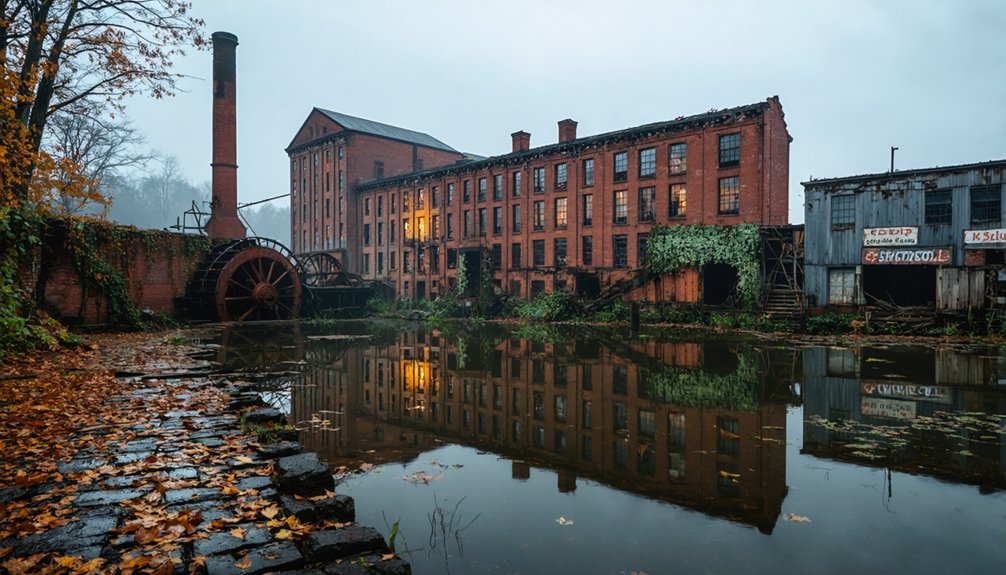
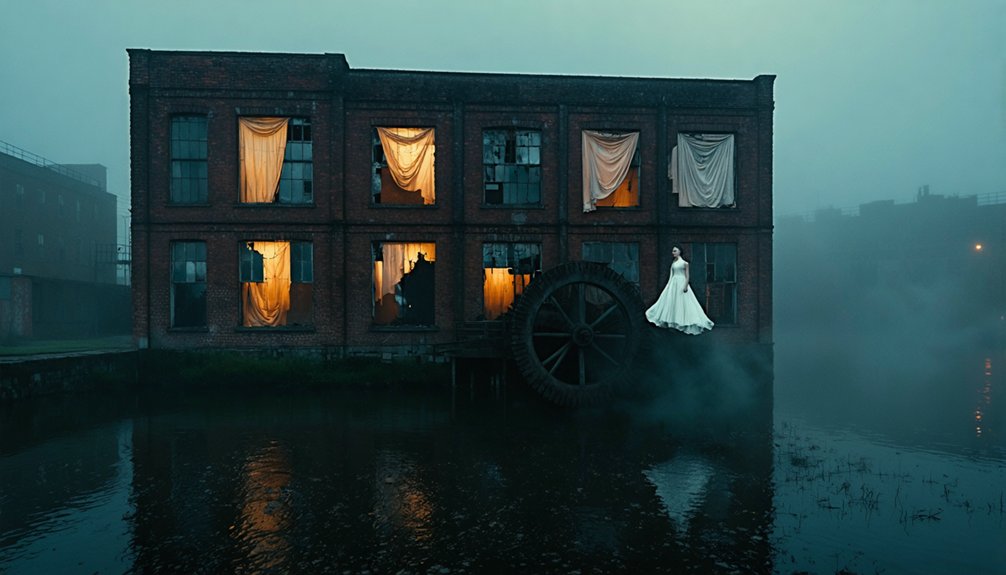
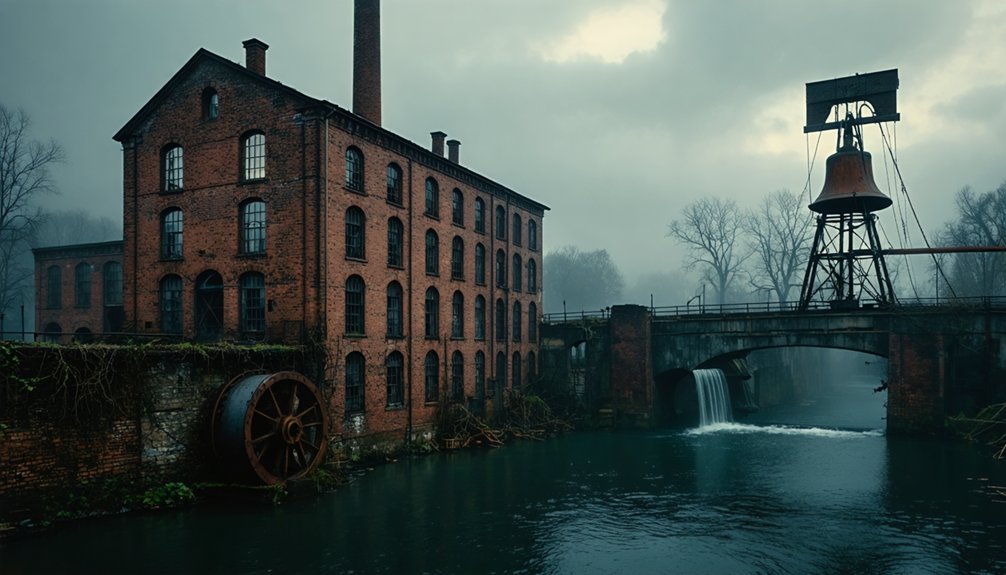
You’ll discover that abandoned mill towns harbor more than empty buildings—they contain spectral echoes of workers’ suffering. Listen for the phantom machinery operating at midnight, children’s footsteps in empty hallways, or widows’ weeping among silent looms. These hauntings often reflect historical injustices: child labor, industrial accidents, and labor uprisings. The segregated spirits of Black mill workers remain largely unacknowledged in paranormal lore, their stories waiting to be uncovered.
Key Takeaways
- Spectral night shift workers are reported at Glencoe Cotton Mill, with unexplained sounds and apparitions near the wheel house.
- Child laborers’ spirits manifest as echoing laughter in hallways and staircases of abandoned mill buildings.
- The “Widow’s Weeping” phenomenon features grieving women’s apparitions in twilight hours, symbolizing industrial sorrow and collective trauma.
- Phantom machinery sounds follow historical shift schedules in empty factories, suggesting workers’ spirits continue their duties after death.
- Black mill workers’ untold spectral legacy reflects their dangerous working conditions and segregated experiences in industrial settings.
The Spectral Night Shifts at Glencoe Cotton Mill
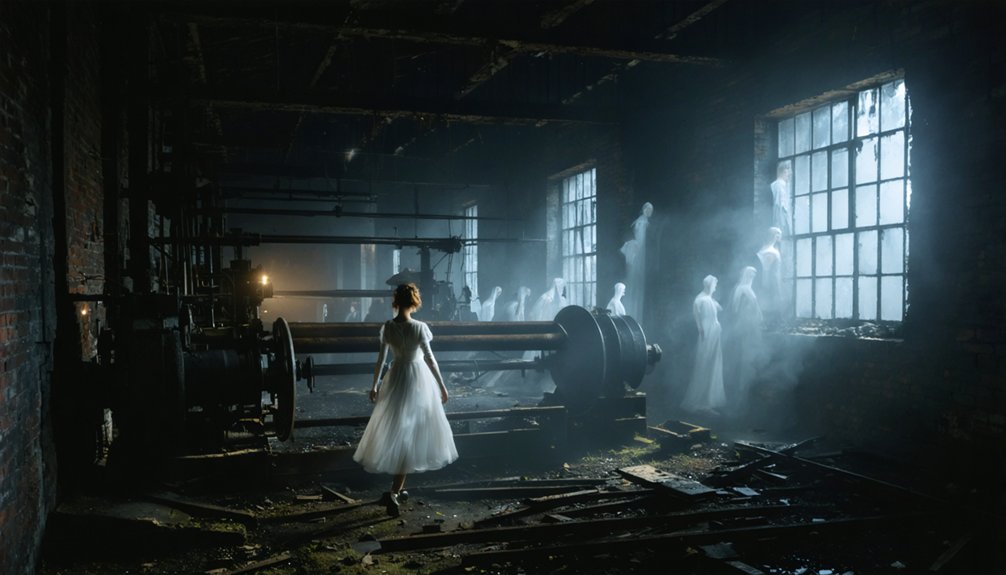
While Glencoe Cotton Mill operated as a thriving industrial complex from 1882 to 1954, its night shifts embodied some of the most challenging aspects of mill work in early twentieth-century America.
You’d have encountered hazardous conditions with limited lighting and dangerous moving machinery in the three-story building along the Haw River.
The introduction of electric power in the late 1930s intensified this round-the-clock operation, with spectral machinery casting long shadows across carding, spinning, and weaving departments.
Workers’ ghostly labor continued through the darkness, maintaining production of cotton checks and woven plaids amid deafening noise and minimal safety protocols.
The mill initially began operations with 186 looms and 2,120 spindles, representing significant industrial capacity for its time.
The mill’s significance to the textile industry is highlighted by it becoming one of the world’s major producers of plaid fabrics during its operational years.
Today, visitors report unexplained sounds and apparitions, particularly near the wheel house and finishing operations—echoes of the exhausted souls who once powered this industrial hub.
Child Laborers’ Haunting Echoes in the Machinery
The night shifts at Glencoe Cotton Mill held particular horrors for its youngest workers, whose small frames moved between massive machines like shadows themselves.
You’d have found children as young as 8 comprising 20% of Britain’s mill workforce in 1833, while America’s mills employed 25,000 under-16s by 1900—numbers that doubled within four years.
These children’s machinery whispers haunt abandoned mills today. They endured 12-hour days, six days weekly, handling dangerous equipment barefoot with inadequate protection.
Their mortality rates tripled adults’, especially among coal sorters. Mill owners preferred children’s cheap labor and compliance with hazardous conditions. Recent legislative efforts in several states now seek to loosen labor laws for minors in construction and manufacturing, echoing concerning historical patterns. In textiles, children under 19 constituted 54.5% of workers in cotton factories, highlighting their prevalence in this dangerous industry.
Families desperate for survival sent children who often lied about their ages. Despite 1,000+ laws attempting regulation by the late 1800s, enforcement remained weak until the 1938 Fair Labor Standards Act—childhood memories forever embedded in industrial America’s darkest corners.
The Widow’s Weeping Among the Spinning Frames

Amid towering cast-iron machinery in abandoned textile mills, you’ll find stories of the Widow’s Weeping—a spectral phenomenon where grieving women’s spirits allegedly linger near spinning frames where their husbands perished.
The apparition typically materializes in twilight hours, dressed in worker’s garb or mourning clothes, her ghostly lamentations echoing through the cavernous mill spaces.
You’re most likely to encounter these tales in 19th-century industrial towns like Oldham or Lowell, where accidents claimed countless lives.
This folklore embodies industrial sorrow—a collective trauma born from harsh working conditions, low wages, and dangerous machinery.
For women who lost husbands to mill accidents, their grief transformed into symbolic hauntings that persist today, representing both personal tragedy and the broader human cost of industrialization.
In Oldham, which became the cotton spinning center of the world by the late 19th century, these spectral tales grew alongside its explosive industrial growth.
Visitors exploring Old Lain Mill in Halifax might feel particularly connected to these stories, as this oldest surviving mill from 1825 witnessed generations of workers facing dangerous conditions without modern safety regulations.
Segregated Spirits: The Untold Stories of Black Mill Workers
Beyond the mourning white widows immortalized in mill folklore lies another spectral dimension—the haunting absence of Black mill workers from traditional ghost stories.
When you explore mill hauntings, you’re rarely told of segregated labor practices that confined Black workers to dangerous outdoor tasks or menial indoor positions. In 1897 Atlanta, twenty Black women hired for folding work faced such violent resistance that mills shut down.
Similar conflicts erupted in Charleston when mills replaced white workers with Black laborers paid just one-third the wages.
Northern and Western mills offered slightly better conditions—Quincy Lumber paid equal wages and permitted skilled Black workers.
Jacob Elsas was unusual among mill owners for hiring African Americans, though less than 2% of textile workers were Black until 1965.
Black workers at Pittsburgh’s Carrie Furnaces endured dangerous conditions without proper safety equipment, resulting in common injuries like burns and blisters.
But these forgotten voices remained marginalized until the 1970s when cases like Lea v. Cone Mills finally challenged discriminatory hiring.
Despite decades of struggle, the spectral legacy of Black mill workers remains largely unacknowledged in America’s industrial haunting narratives.
Company Housing Hauntings: When Walls Remember Suffering
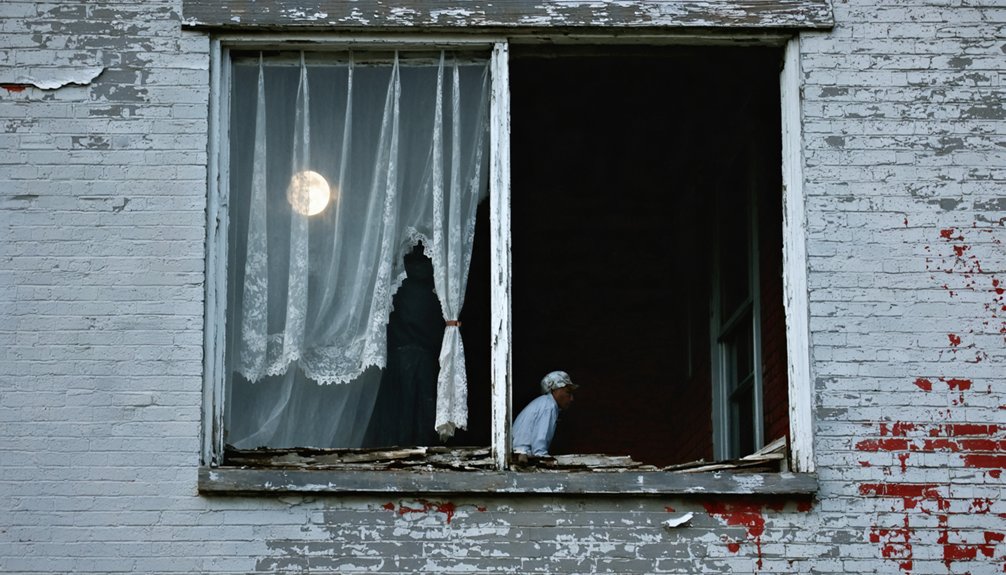
You’ll hear the phantom patter of children’s footsteps across company housing floorboards, remnants of the overcrowded conditions where four to six boarders shared cramped bedrooms.
The distinct shadows of women mourners at windowsills emerge at dusk, marking the spots where mill mothers watched for loved ones during industrial accidents that claimed countless lives.
Midnight brings the ghostly echoes of machinery throughout worker housing walls, evidence of how the controlling nature of company towns extended beyond working hours into the private spaces of laborers’ homes. Mill owners enforced strict paternalistic attitudes that controlled nearly every aspect of workers’ daily routines, from when they could leave their homes to what social activities were permitted. The Bibb Mill workers endured harsh conditions with 12-hour shifts six days a week while earning only $10 weekly in hot, dusty environments.
Vanishing Children’s Footsteps
As mill towns fell silent following industrial collapse, the abandoned company housing complexes became theaters for a peculiar acoustic phenomenon: the persistent sound of children’s footsteps echoing through empty corridors.
You’ll find these auditory hauntings most prevalent in structures where families once crowded into tight quarters. The thin walls and creaky floorboards of hastily built boarding houses amplify what many interpret as echoing laughter of children long gone.
These acoustic anomalies typically manifest in hallways and staircases where children once played and trudged to and from school.
The footsteps represent more than architectural quirks—they embody childhood memories imprinted in spaces where exploitation and hardship were daily realities.
When you walk these abandoned halls today, the spectral sounds reflect the emotional residue of those who suffered within these walls.
Windowsill Mourning Shadows
The spectral children’s footsteps aren’t the only paranormal phenomena haunting abandoned mill towns. Across the isolated company housing built between 1880-1935, windowsill whispers emerge at dusk, where miners’ wives once watched for husbands returning from dangerous shifts.
These spectral reflections materialize in homes where total company dependence trapped families. You’ll notice shadows lingering longest in areas where ethnic and racial segregation was physically enforced through housing arrangements.
Former residents report seeing silhouettes in abandoned duplexes where scrip-paid workers once struggled under economic entrapment.
When companies abandoned operations after mine closures, they left more than decaying infrastructure—they left emotional imprints. The paternalistic control mechanisms that monitored social behavior and restricted movement seem embedded in the cheap, identical walls that still stand as crumbling reminders of worker exploitation and dependency.
Late-Night Machinery Echoes
Whispers of industrial ghosts echo through abandoned mill towns when darkness blankets the crumbling remains of once-bustling factories.
You’ll hear it if you listen carefully—phantom machinery clanking and whirring in empty buildings across Coleridge and Henry River, NC.
These auditory phenomena typically manifest after midnight, when the boundary between past and present thins.
Former residents consistently report rhythmic thumping and metallic creaking where no operational equipment exists.
Audio recordings have captured these unexplained sounds, lending credibility to local folklore about spirits of workers continuing their endless shifts.
Paranormal investigators suggest these echoes represent residual energy—psychic imprints created through repetitive labor patterns.
The sounds follow historical shift schedules, as if invisible hands still operate looms and presses, trapped in cycles of industrial servitude long after death.
The Vanished Village: Tracing the Footsteps of Displaced Families
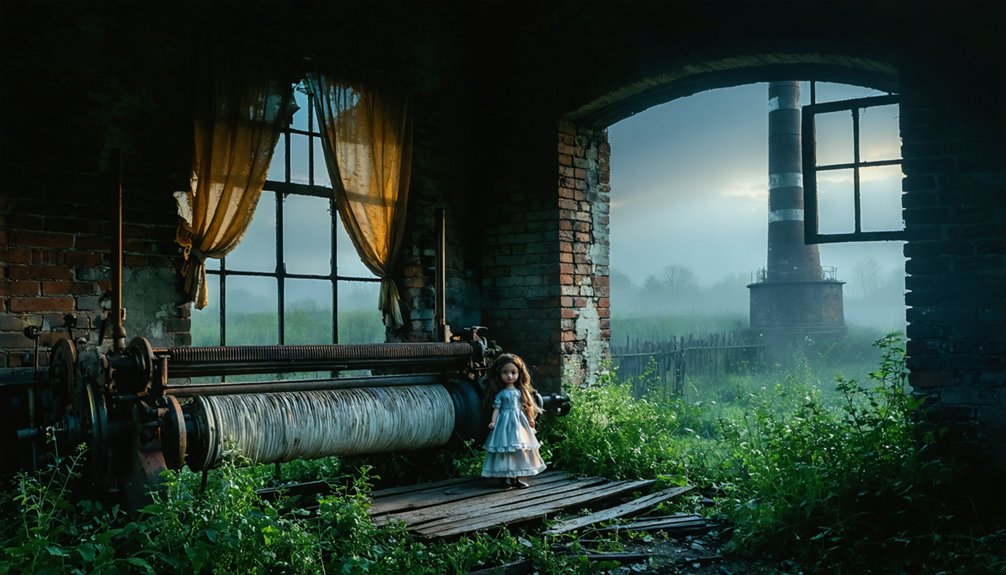
You’ll find the displaced families’ histories etched into the landscape where tent cities once sprawled along irrigation ditches, much like the Dust Bowl migrants who created makeshift communities along Route 66.
Their footprints remain in census data showing dramatic population variances, particularly in mining regions like Lake County, Colorado, where figures reached 0.0617 compared to the state average of 0.0061.
These statistical ghosts mirror the physical remnants of abandoned structures that once housed workers earning wages 10% below their non-displaced counterparts, leaving behind both economic data and crumbling artifacts of lost family legacies.
Faded Worker Footprints
Where can we find the traces of those who once animated these silent mill towns? Look for the faded memories in abandoned buildings where 100-1,000+ workers once labored before displacement scattered them.
You’ll discover labor legacies in deteriorating infrastructure, often dismantled by residents for heating resources as economic downturns exceeding 6% unemployment ravaged communities.
The footprints of workers aged 50-59 reveal particularly devastating impacts—lost pensions, limited retraining success, and severed social connections. Women and men alike faced lower wages in subsequent employment when they could find work at all.
Beyond physical structures, examine the collapse of ancillary businesses and social support systems that once sustained vibrant communities. These ghost towns don’t just represent lost jobs—they embody shattered social networks and community identities that disappeared alongside industrial relevance.
Lost Family Legacies
Beyond the physical remnants of abandoned workplaces, a deeper story unfolds in the scattered families who once called these mill towns home.
You’ll find generational wealth stripped away through family displacement, particularly in Black communities uprooted by eminent domain. These families didn’t just lose houses—they lost legacies built over decades. Moving from owned property to overcrowded public housing decimated their ability to transfer wealth to descendants.
When mills close, as in Canton where over 1,000 workers were laid off, entire social ecosystems collapse. Your family networks fray as communities disperse. Town budgets shrink by up to 20%, forcing painful cuts to services you’ve relied on for generations.
Legacy loss extends beyond economics—it’s measured in dissolved traditions, vanished village landmarks, and family histories that become increasingly difficult to trace.
Wage Theft and Restless Souls: Economic Injustice Beyond the Grave
While tales of haunted mill towns often focus on spectral apparitions or mysterious sounds, the most pervasive horror lurking in these abandoned communities stems from economic exploitation that followed workers even to their graves.
In the Midwest, numerous haunted sites serve as reminders of these dark pasts, echoing stories of those who suffered. Visitors to these locations often report eerie sensations and feelings of unease, as if the spirits of the past are still affected by the injustices they faced. Exploring these haunted sites in the Midwest not only unveils chilling tales but also prompts a reflection on the economic hardships that defined their existence.
You’ll find wage theft was a rampant form of economic injustice, with billions stolen annually from America’s most vulnerable laborers. In places resembling these mill towns, over two-thirds of low-wage workers experienced pay violations weekly, losing nearly $3,300 annually—roughly 20% of their meager earnings.
The restaurant, healthcare, and construction industries were particularly ruthless exploiters, with small businesses often among the worst offenders.
Even when workers fought back and won their cases, many never received compensation as employers simply vanished—their economic oppression continuing beyond death, like restless souls seeking justice that never came.
The Striking Phantoms of the 1894 Labor Uprising
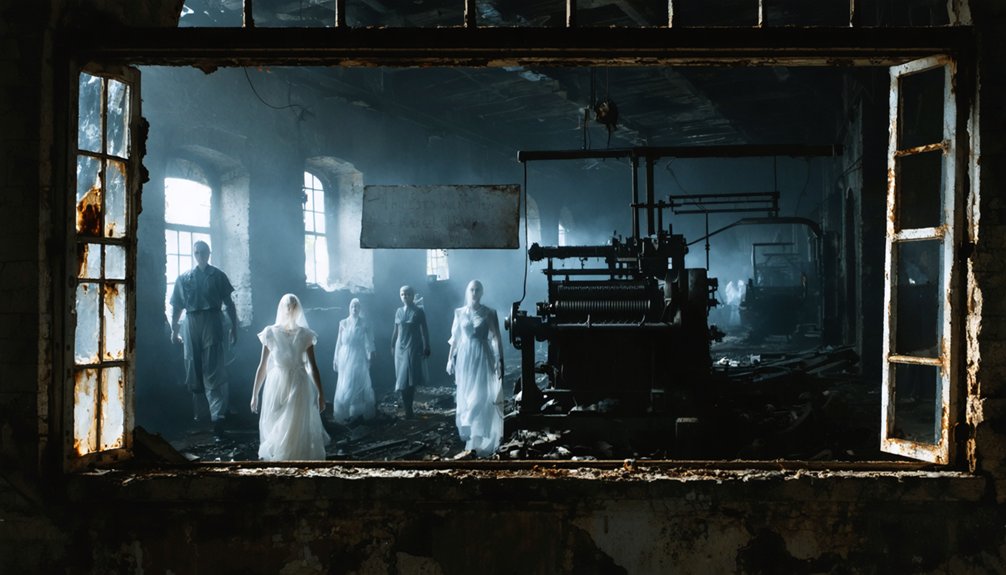
As dusk settles over the abandoned mill towns of America’s industrial past, legends persist of ghostly figures marching in silent procession—the striking phantoms of the 1894 labor uprising who never found peace.
These spectral memories embody the nationwide revolt that erupted after the Panic of 1893, when 125,000 to 250,000 workers across 27 states unified against brutal 16-hour workdays and relentless wage cuts.
You’ll hear tales of ghostly workers appearing near the barbed-wire fences and sniper towers companies erected to keep strikers out.
The phantoms reportedly reenact violent confrontations with Pinkertons and federal troops sent by President Cleveland—echoes of class warfare that divided communities along racial and ethnic lines.
Their unresolved grievances linger like mist around abandoned company towns where paternalistic control once dominated every aspect of workers’ lives.
Last Lights Out: Witnessing the Final Days of Mill Town Life
The darkest day in Canton’s industrial history arrived without ceremony when management announced the mill’s closure in March, giving 1,050 employees a mere three months before permanent shutdown.
You’d feel the weight of economic despair hanging in the air as workers exited for the final time on June 8, greeted by supporters with homemade signs and fire trucks displaying an American flag.
Canton now teeters on the edge of becoming a ghost town. Workers face impossible choices—relocate, start new careers, or accept lower-paying jobs.
Many fear speaking out might cost them severance benefits. The psychological toll hits hardest for those nearing retirement, who’ve spent decades at the mill.
“Mill Town Strong” remains their rallying cry, even as they navigate this devastating shift.
Frequently Asked Questions
Do Specific Mill Workers’ Families Report Paranormal Encounters Today?
No, you won’t find documented family encounters today. Research shows no verified testimonies or systematic ghost stories from mill workers’ descendants in contemporary settings—only historical accounts and cultural lore remain.
What Protective Rituals Did Child Workers Use Against Dangerous Machinery?
You’d grab your iPhone’s lucky case before carrying protective charms like tokens and personal talismans. Children whispered prayers, developed timing techniques, touched specific machine parts, and adhered to childhood superstitions about cursed floorboards to survive.
Can Paranormal Investigators Distinguish Between Different Eras of Mill Ghosts?
You can distinguish ghostly eras through detailed EMF patterns, period-specific EVPs, and historical research that reveals spectral identities tied to specific industrial timeframes and working conditions at the mill.
Do Haunting Patterns Differ Between Company-Owned Versus Independent Worker Housing?
You’ll find company housing hauntings reflect systemic traumas with concentrated activity, while independent housing manifests more isolated, event-specific phenomena tied to individual tragedies rather than collective workforce suffering.
What Paranormal Technology Best Captures Mill Town Spiritual Activity?
You’ll capture mill town spirits best with Kestrel Weather Meters for environmental data, thermal cameras for apparitions, audio equipment for spirit communication, and barometric pressure sensors—all standard ghost hunting tools that document objective evidence.
References
- https://textileheritagemuseum.org/glencoe-cotton-mill-village-historical-quick-facts-1880-1954/
- https://collaborativehistory.gse.upenn.edu/stories/boothroyd-and-goodyear-families-mill-workers-and-west-end-mill
- https://library.ecu.edu/wp-content/pv-uploads/sites/242/2017/06/2002-Keats-Sparrow-Award-Winner–1st.-Life-in-Southern-Mill-Villages-1900s.pdf
- https://saportareport.com/mill-industry-workers-created-modern-georgia/archived-columnists/jamils-georgia/nge/
- https://www.richmondfed.org/publications/research/econ_focus/2023/q3_economic_history
- https://socialwelfare.library.vcu.edu/organizations/labor/company-towns-1890s-to-1935/
- https://environmentamericas.org/2024/08/22/life-in-a-mill-village/
- https://heritagecalling.com/2021/11/16/9-interesting-facts-about-life-as-a-19th-century-mill-worker/
- https://jasontdunn.com/files/ghost_towns_big_cities.pdf
- https://www.glencoemill.com/history