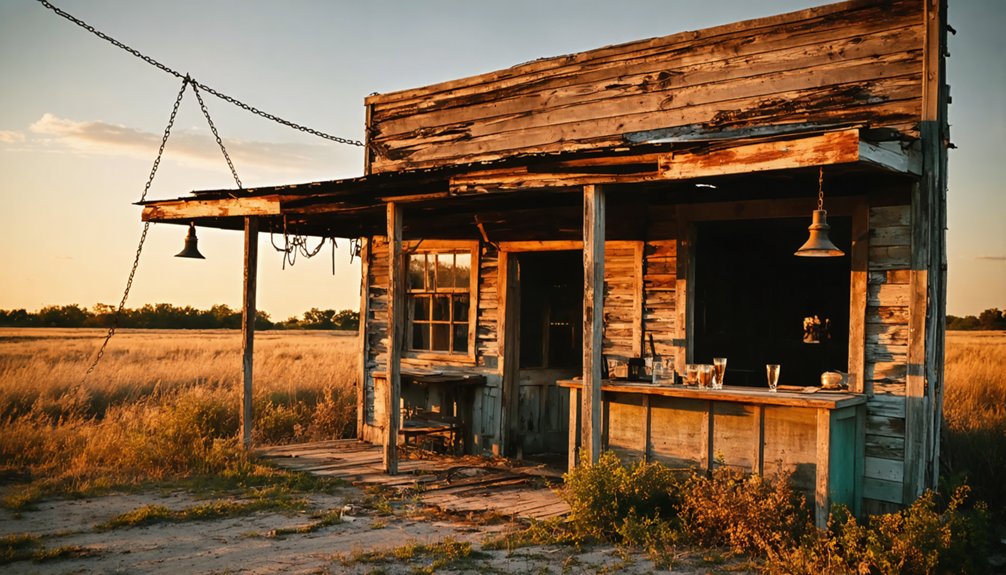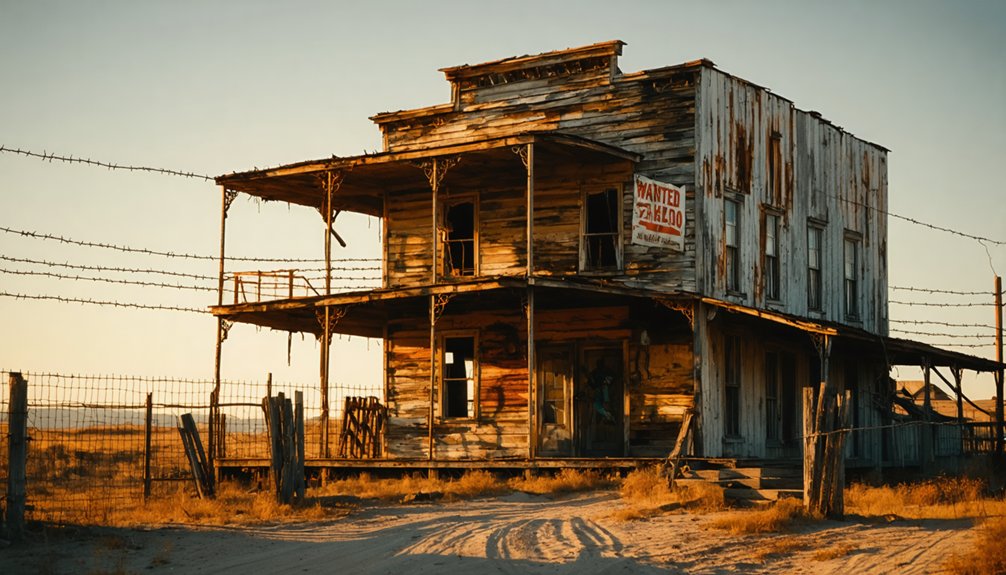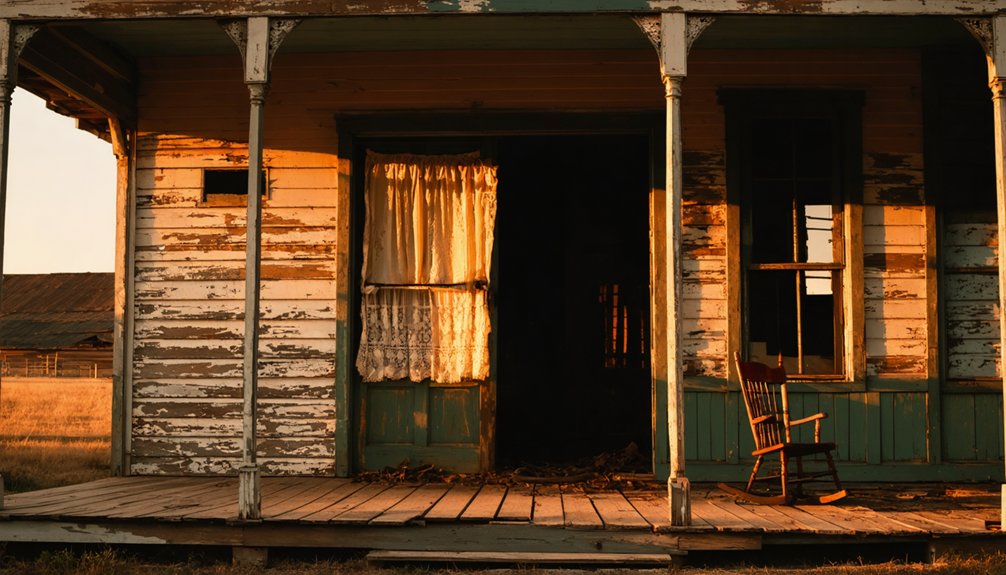
Texas’s ghost towns reveal dramatic boom-and-bust cycles of the frontier era. You’ll find abandoned cattle boomtowns where lawlessness once ruled, mercury mining centers that collapsed with market crashes, and coastal hubs destroyed by devastating hurricanes. These weathered ruins tell stories of vigilante justice, railroad politics, and resource extraction that shaped Texas identity. Each crumbling structure and empty main street holds secrets of the dreamers who sought fortune in America’s western frontier.
Key Takeaways
- Terlingua’s abandoned mercury mines and historic cemetery harbor tales of restless spirits from deceased miners and Mexican immigrants.
- Indianola’s underwater ruins reportedly manifest ghostly apparitions during storms, echoing the devastating hurricanes of 1875 and 1886.
- Vigilante justice in lawless boomtowns like Fort Griffin created legends of hanged outlaws whose spirits still haunt former gallows sites.
- Belle Plain’s abandoned courthouse and college buildings are said to echo with phantom sounds from its brief glory days.
- Former cattle towns like Dodge City feature tales of spectral cowboys and gunfighters from their chaotic, minimally policed eras.
The Rise and Fall of Boom Towns in the Texas Frontier
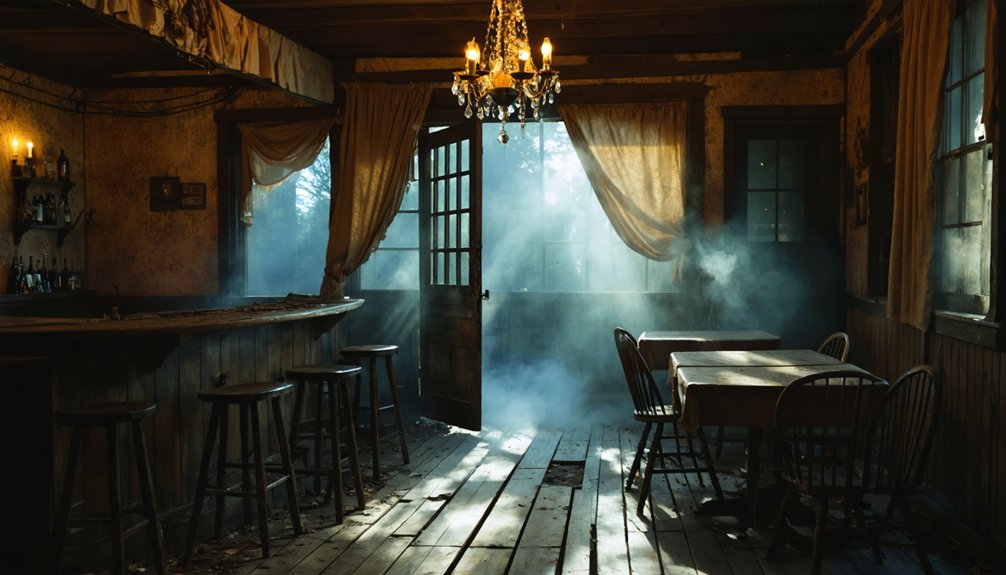
As the 19th century unfolded across the Texas frontier, boomtowns emerged with remarkable speed, transforming the landscape through economic forces that would define the Old West.
You’d have witnessed two distinct waves of explosive growth. First came cattle-driven settlements, where post-Civil War beef demand sent ranchers northward to railheads like Dodge City. Saloons and hotels sprang up overnight to serve these cattle drives. Towns like Dodge City became vibrant yet chaotic, with minimal law enforcement contributing to their notorious reputations.
Then came the revolutionary Spindletop oil strike of 1901. Virtually overnight, sleepy towns like Beaumont exploded from 10,000 to 50,000 residents. The discovery yielded an unprecedented 100,000 barrels daily, establishing Texas as a powerhouse in the petroleum industry.
Later oil strikes around Mexia and west of Fort Worth created similar surges. When the derricks stopped pumping, these towns often emptied as quickly as they’d filled, leaving behind ghost towns that still haunt the Texas landscape today.
Terlingua: From Mercury Mining Hub to Desert Ghost
While cinnabar ore glinted in the harsh Chihuahuan Desert sun, Terlingua’s transformation from remote borderland to bustling mining center began in the mid-1880s.
You’d have found Howard Perry’s Chisos Mining Company dominating the landscape by 1903, producing more mercury than all regional competitors combined.
Walking through Terlingua during its 1900-1930s heyday, you’d encounter nearly 2,000 residents—mostly Mexican immigrants—supporting America’s strategic mercury needs for manufacturing explosives and detonators.
During Terlingua’s boom years, immigrant workers risked health for America’s military-industrial complex, extracting mercury for weapons production.
The town thrived with stores, schools, and dance halls.
But you can’t fight economics.
Post-WWI stockpiles collapsed prices, and by 1942, bankruptcy struck.
Despite brief revival attempts through the 1960s when prices soared to about $775 per flask, commercial mercury mining ended in 1973.
The Terlingua Cemetery, a solemn marker of the town’s history, still welcomes visitors paying respects to those who lived and died during the mining boom.
The miners who survived toxic mercury vapor poisoning eventually abandoned Terlingua, leaving behind only silent ruins of this once-vital ghost town.
When Nature Strikes: Indianola’s Hurricane Devastation
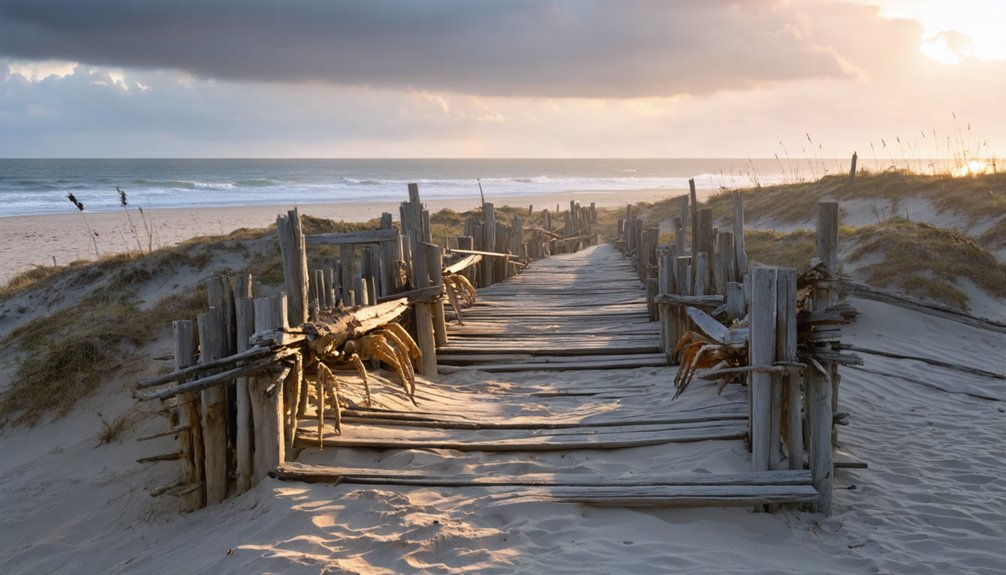
You’ll find few ghost towns with a more dramatic demise than Indianola, once Texas’s second-largest port before the catastrophic 1875 hurricane destroyed three-quarters of its buildings and killed up to 270 people.
Despite rebuilding efforts, the fatal blow came in 1886 when a Category 4 hurricane with 150 mph winds generated a 15-foot storm surge that submerged the town and sparked fires that consumed what little remained.
The 1875 disaster, with winds reaching 115 mph, was classified as a Category 3 hurricane when it made landfall near the Texas coast on September 16.
Many survivors, including Eliza Ophelia Smith Fisher, recounted the violent storm that left deep psychological impacts on those who lived through it.
Today, Indianola’s ruins lie underwater in Matagorda Bay, a sobering reminder of nature’s power to erase even the most promising frontier settlements.
Coastal Trading Hub
Founded in 1846 as Indian Point on Matagorda Bay, Indianola rapidly transformed into one of Texas’ premier coastal trading hubs. By 1870, it had become the state’s second-largest port, rivaling Galveston with a population exceeding 2,000 residents that peaked at 5,000 by 1875.
As a crucial coastal commerce center, Indianola served as the eastern terminus of the Chihuahua Trail and chief immigration gateway for over 4,000 German colonists entering western Texas. The town faced significant challenges during the Civil War when it was bombarded and occupied by Union forces in 1862 and again in 1863.
You’d find Morgan’s steamship line operations, which fueled the town’s commercial expansion, alongside innovative developments like the world’s first mechanically-refrigerated beef shipment in 1869. The town was officially incorporated in 1853, establishing its legal status as a growing commercial center.
The port supported frontier forts, received the U.S. Camel Corps shipments, and connected to inland Texas through rail service established in 1871.
Twin Hurricane Catastrophes
Despite its early prosperity, Indianola’s fate was sealed by two devastating hurricanes that struck just eleven years apart. The first catastrophe hit on September 15, 1875, with 140 mph winds killing approximately 400 people and destroying nearly every building, exposing the town’s coastal vulnerabilities.
Remarkably, residents attempted to rebuild. Their hurricane resilience was tested again on August 20, 1886, when a Category 4 storm brought 150 mph winds and a 15-foot storm surge. The devastation altered the course of Texas history, as Indianola’s destruction shifted port dominance to other coastal cities.
Though only 46 died, thanks to daytime evacuation, all but two buildings were destroyed. A fire originating from the damaged Signal Office spread through several blocks, compounding the destruction. A subsequent storm six weeks later delivered the final blow.
The town was officially abandoned, its post office closed, and its remains now rest beneath 15 feet of Matagorda Bay water—a cautionary tale of nature’s power against human settlement.
Port Legacy Underwater
Beneath the waters of Matagorda Bay today lies what was once Texas’ second busiest port—a manifestation of Indianola’s former glory and sudden downfall.
You’re looking at submerged heritage that once thrived as the terminus for Morgan’s steamship line and gateway to western frontiers.
Underwater archaeology has revealed remarkable remnants of this once-bustling commercial hub:
- Shipwrecks including the Mallory Line’s City of Waco
- Foundations of wharves where European immigrants first stepped onto Texas soil
- Artifacts from warehouses that stored goods bound for San Antonio via the Chihuahua Trail
The town that stretched three miles along the beach now exists only in maritime excavations.
This underwater time capsule—officially recognized as a Recorded Texas Historic Landmark—continues to yield insights into a prosperous port community that nature reclaimed in a devastating display of power.
Political Feuds and Midnight Raids: The Belle Plain Story
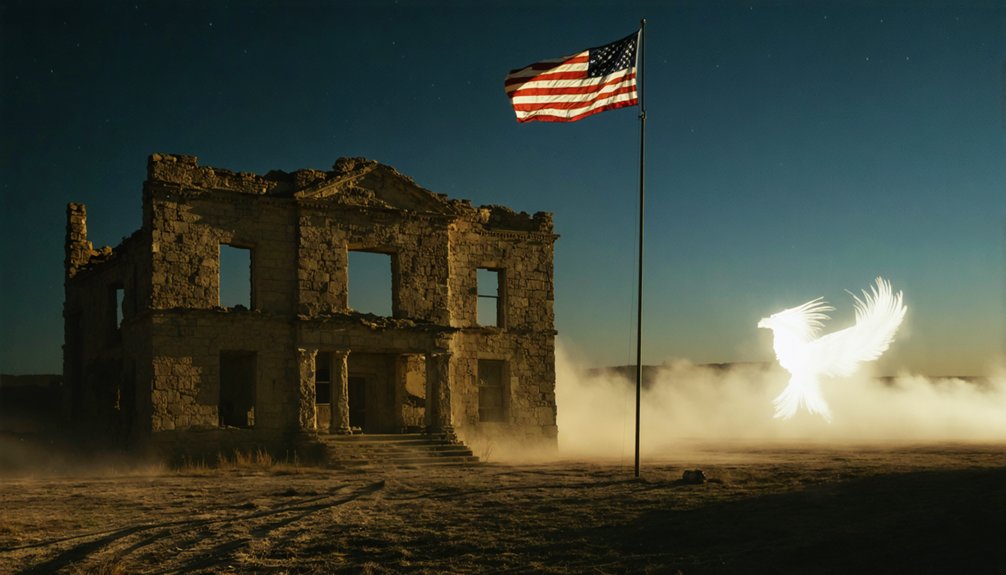
You’ll witness the swift demise of Belle Plain as the political feud over the county seat reached its boiling point when the Texas and Pacific Railway bypassed the town for neighboring Baird in the early 1880s.
The loss of county seat status in 1883 triggered an economic death spiral, with businesses, institutions, and residents rapidly abandoning the once-promising settlement.
Years later, the area briefly gained notoriety for midnight raids and lawless activities during Prohibition, as bootleggers and gamblers established operations that required aggressive law enforcement intervention by Sheriff Chester Logue between 1928 and 1936.
County Seat Power Struggle
In 1877, as Callahan County officially formed in the Texas frontier, a bitter power struggle erupted between competing settlements vying for the prestigious county seat designation.
Belle Plain emerged victorious in this political rivalry, quickly establishing itself with a courthouse, jail, and bustling business district.
Your understanding of this county seat battle deepens when you recognize:
- The Texas and Pacific Railway’s decision to bypass Belle Plain by six miles sealed its fate.
- Baird strategically leveraged its railroad access to win the county seat in 1883.
- The stone jailhouse was literally dismantled and moved from Belle Plain to Baird.
This shift exemplifies how transportation infrastructure determined political power in the Old West.
When Belle Plain lost its governmental status, it triggered an exodus that transformed a once-thriving town into the ghost town you’ll find today.
Violent Midnight Vigilantes
While Belle Plain’s county seat battle reshaped the political landscape, a darker undercurrent of frontier justice operated in the shadows.
You’ll find vigilante justice was rampant across post-Civil War Texas, particularly in lawless frontier regions lacking proper courts and jails.
Fort Griffin’s vigilance committee emerged as the state’s most notorious group, hanging six men in just three months during 1876. These midnight enforcers targeted cattle rustlers, murderers, and thieves using systematic approaches – issuing thirty-day departure notices before taking lethal action.
What began as community protection sometimes devolved into personal vendettas.
When Belle Plain later faced a second wave of frontier lawlessness during Prohibition, bootleggers and gamblers flooded the area before Sheriff Logue’s 1928 appointment.
His sixteen arrests over two years echoed the earlier vigilante tradition of imposing order on chaotic borderlands.
Economic Death Spiral
Founded with tremendous promise in 1876, Belle Plain’s descent from prosperous county seat to abandoned ghost town represents one of Texas’ most dramatic frontier reversals.
The economic decline began when the Texas and Pacific Railway bypassed Belle Plain for Baird, just six miles north, triggering a fatal chain of events.
Three factors sealed Belle Plain’s fate:
- Loss of county seat status to Baird in 1883, prompting institutions to relocate
- Devastating droughts of 1886-1887 that crippled agriculture and local resources
- Closure of Belle Plain College by 1892, eliminating the town’s cultural cornerstone
Railroad Destinies: How Train Routes Determined Town Survival
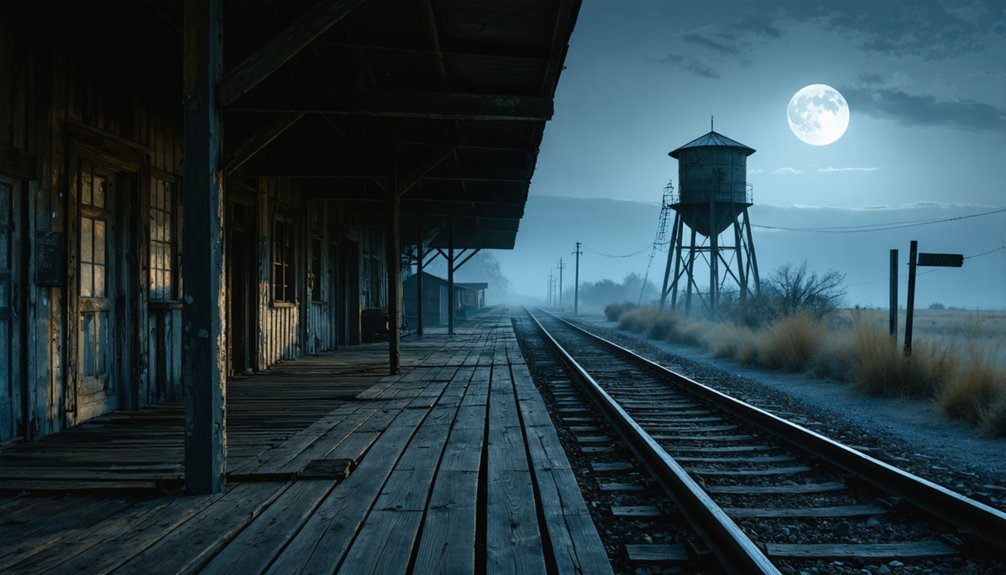
As iron rails stretched across the Texas landscape during the late nineteenth century, they silently determined which frontier settlements would flourish and which would fade into obscurity.
You’d find thriving communities wherever trains stopped, while isolation from rail lines often spelled doom. Towns like Dallas and Morgan exploded into commercial hubs at rail intersections, their very identities shaped by railroad impact.
Many settlements even adopted names of railroad officials—Calvert, Yoakum, Denison—reflecting their dependence on these essential transportation arteries.
The economic consequences were stark: rail towns attracted merchants, created jobs, and connected farmers to distant markets.
Meanwhile, bypassed communities withered. Geography played a significant role too—favorable junctions thrived while dead-end spurs struggled.
For frontier Texans, your town’s fate hung on a simple question: would the railroad come?
Preserved in Time: Architectural Remnants of the Old West
Scattered across the forgotten corners of Texas, architectural remnants tell silent stories of frontier life more eloquently than written histories ever could.
You’ll find Terlingua’s stone cottages standing alongside The Grove’s German-built structures—testaments to the architectural significance of early settlement patterns.
Historic preservation efforts have maintained these structures despite nature’s attempts to reclaim them:
- Independence Baptist Church remains intact where Sam Houston was baptized
- Stone walls at The Grove still demonstrate 1850s German masonry techniques
- Terlingua’s cemetery features folk art markers crafted from local materials
These weathered buildings—from Sherwood’s remarkably preserved church to St. Mary’s foundations—represent more than mere ruins.
They’re tangible connections to a frontier past where freedom-seeking settlers built communities with whatever materials the harsh landscape provided.
Cultural Legacies and Traditions of Abandoned Communities

Beneath the crumbling facades and weathered structures of Texas ghost towns lies a rich tapestry of cultural legacies that continue to influence the state’s identity today.
You’ll find these legacies preserved in places like San Elizario, where the 18th-century Presidio Chapel stands as a symbol of enduring religious traditions amid adobe buildings that blend Western and Spanish heritage.
The storytelling heritage remains vibrant through local legends, like Hico’s claim that Billy the Kid lived there under an assumed identity.
Cultural preservation thrives in former mining towns like Terlingua, where rusted equipment tells industrial stories while modern chili cook-offs create new traditions.
With over 500 ghost towns, Texas maintains these abandoned communities not just as physical remnants but as living repositories of frontier narratives and multicultural influences that shaped the state.
Among these ghost towns and historical sites, numerous haunted locations in Texas attract thrill-seekers and paranormal enthusiasts alike. Each site holds its own chilling tales and spectral legends that add to the rich tapestry of the state’s history. Visitors often report eerie encounters, making these locations a fascinating experience for those intrigued by the supernatural.
Among the ghost towns of Texas history, one can explore the stories of early settlers, miners, and outlaws who once breathed life into these now-silent spaces. The crumbling structures provide a glimpse into a bygone era, inviting visitors to imagine the vibrant communities that thrived there. As dusk falls, the atmosphere shifts, and the haunting beauty of these forgotten places becomes even more palpable, drawing in those curious about the echoes of the past.
Frequently Asked Questions
Are Ghost Towns Legally Accessible to Visitors for Exploration?
Want to explore Texas ghost towns legally? Most require permission from owners since they’re on private property. Ghost town regulations prioritize visitor safety while prohibiting trespassing, but some are accessible through historical sites.
Have Paranormal Activities Been Documented in Texas Ghost Towns?
Yes, you’ll find extensive documentation of supernatural encounters in Texas ghost towns like Jefferson, Terlingua, and Indianola, where haunting legends include apparitions, mysterious sounds, and unexplained sensations throughout their historic sites.
What Wildlife Now Inhabits These Abandoned Settlements?
You’ll find over 300 wildlife species reclaiming these ghost towns. Desert ruins host rattlesnakes and cottontails, forests shelter deer and raccoons, prairies attract coyotes, while water-adjacent settlements become habitat restoration zones for herons and alligators.
Can I Metal Detect or Collect Artifacts in Ghost Towns?
You can’t legally metal detect in ghost towns without proper permits. You’ll need landowner permission on private property, while public sites require official authorization. Artifact preservation ethics demand respecting these regulations.
Do Any Ghost Towns Still Have Permanent Residents Today?
Like embers in abandoned fireplaces, you’ll find current residents keeping ghost town stories alive in places like Helena (200 people), Terlingua, Lobo, and Marfa, which have transformed through tourism and art communities.
References
- https://www.county.org/county-magazine-articles/summer-2025/ghost-towns
- https://www.hipcamp.com/journal/camping/texas-ghost-towns/
- https://texashighways.com/travel-news/four-texas-ghost-towns/
- https://929thelake.com/texas-ghost-towns/
- https://www.youtube.com/watch?v=Jkdn0Q6IS0c
- https://www.instagram.com/p/DQWxfJEDehe/
- https://en.wikipedia.org/wiki/List_of_ghost_towns_in_Texas
- https://authentictexas.com/texas-ghost-towns/
- https://www.texasescapes.com/TOWNS/Texas-Ghost-Towns-4-West-Texas.htm
- https://yesterdaysamerica.com/texas-boomtowns/