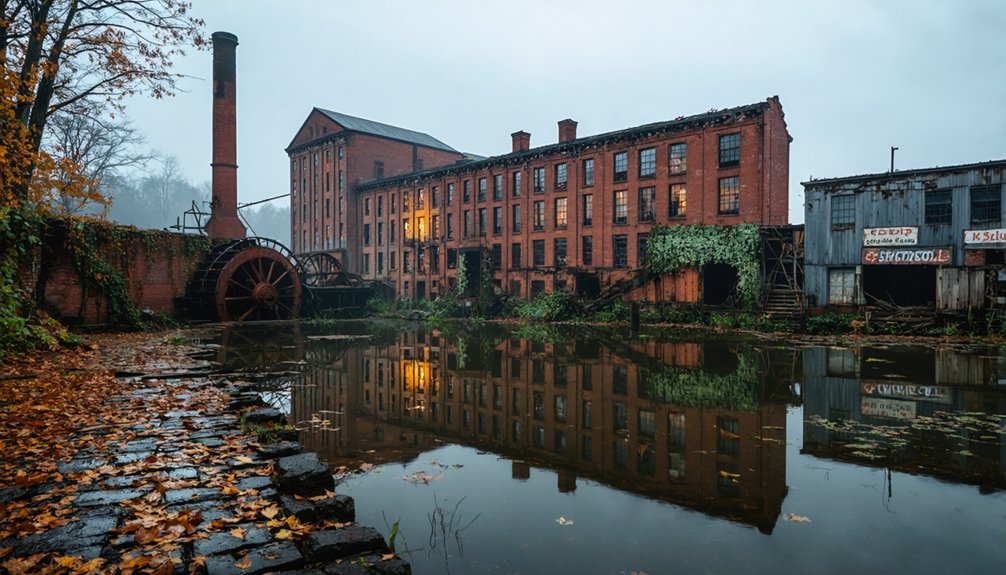
Mill town ghosts across America reflect complex industrial histories. You’ll find spectral miners reportedly continuing their shifts in Appalachian villages like Henry River Mill, which later served as a “Hunger Games” filming location. These apparitions often emerge during economic collapse periods, embodying collective trauma of communities that experienced sudden decline. Ghost towns like Henry River now leverage these supernatural narratives for tourism and preservation efforts. The spirits of abandoned industry await those curious enough to explore their stories.
Key Takeaways
- Abandoned mill towns like Henry River Mill Village report spectral miners carrying lanterns and pickaxes, especially during foggy conditions.
- Paranormal investigators document anomalies including EMF spikes, cold spots, shadowy figures, and unexplained audio recordings in former mill communities.
- Ghost stories in mill towns often preserve labor history, memorializing industrial accidents and dangerous working conditions when official records failed workers.
- Economic collapse of mill towns creates psychological trauma that manifests as supernatural narratives featuring temperature anomalies and phantom machinery sounds.
- Former textile communities leverage their haunted reputations for heritage tourism and economic revitalization, creating jobs and attracting visitors to abandoned areas.
The Abandoned Cottages of Henry River Mill Village
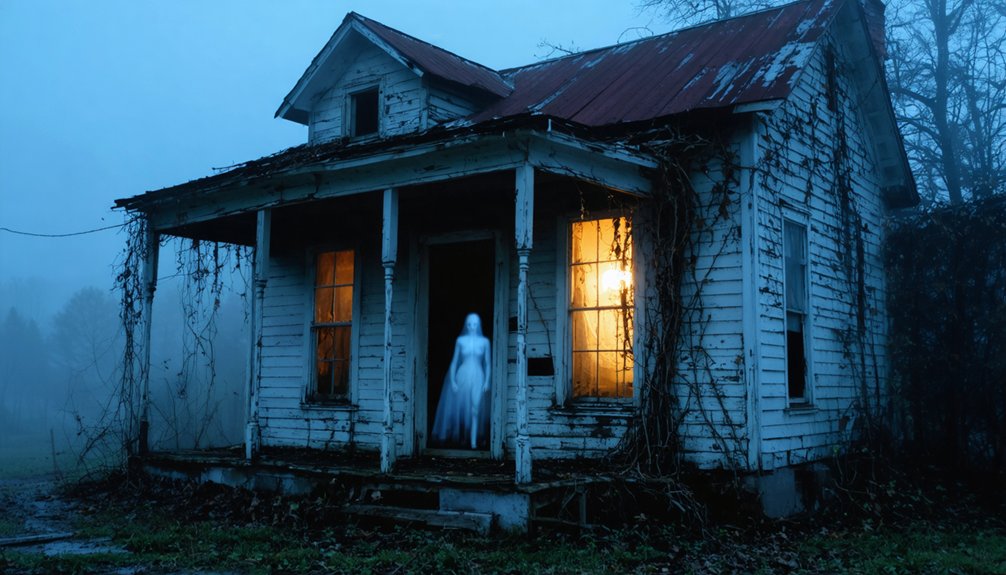
Standing as silent witnesses to America’s industrial past, the abandoned cottages of Henry River Mill Village offer a compelling window into early 20th century textile manufacturing life.
As you wander among the 35 worker houses, you’re traversing the remains of a once-thriving community established in 1905 by the Aderholdt and Rudisill families.
These modest dwellings, constructed from sun-baked mud bricks from the Henry River banks, housed 450 workers at peak production.
Workers earned “doogaloo” coins redeemable only at the company store—a system that exemplifies the controlled environment typical of textile mill towns.
Though some attribute textile hauntings to this exploitation, the village’s preservation on the National Register of Historic Places since 2019 guarantees these structures continue telling their complex story of industrialization, even after the last residents departed in the early 2000s.
The village gained significant popularity when it served as the filming location for District 12 in the 2012 blockbuster film “The Hunger Games.”
Visitors today can see house #16, which was featured as Katniss Everdeen’s cottage and remains one of the best-maintained structures in the village.
Spectral Miners and Their Eternal Shifts
You’ll find that throughout Appalachian and Western mining communities, reports persist of spectral miners continuing their labor long after death, with witnesses describing ghostly figures carrying lanterns and wielding pickaxes in the twilight hours.
These apparitions, often associated with tragic mining accidents, appear most frequently during foggy conditions near abandoned mine entrances, where the boundaries between past and present seem most permeable. Similar ghostly phenomena have been reported at Henry River Mill Village, which flourished during the textile boom before being abandoned after the mill’s closure in 1973. In Crystal City, Colorado, many visitors have documented sightings of a ghostly miner working tirelessly near the Crystal Mill at dusk.
While skeptics attribute such sightings to atmospheric conditions and psychological suggestion, the consistency of these accounts across diverse regions—from Crystal Mill in Colorado to Nighthawk, Washington—warrants examination as cultural responses to the dangerous and often fatal nature of historical mining work.
Pickaxes Beyond the Grave
While abandoned mill towns may appear dormant during daylight hours, countless witnesses claim these sites transform after sunset when spectral miners reportedly resume their eternal shifts.
This phenomenon of spectral labor manifests most commonly near stamp mills and ore processing facilities, where eyewitnesses describe shadowy figures swinging pickaxes at invisible rock faces.
In locations like Bodie, California and St. Elmo, Colorado, paranormal investigators have documented unexplained audio recordings of rhythmic tapping and chiseling sounds after midnight.
These haunted tools appear to operate independently, with visitors reporting pickaxes moving on their own. EMF detectors frequently register anomalies near these sites, while thermal cameras occasionally capture cold spots where witnesses describe seeing miners in period attire. Ghost town hunters seeking communion with history often feel a profound connection to these sites where spirits of the past still linger, evoking both awe and melancholy. In Bonnie Claire, Nevada, explorers reported hearing a blood-curdling scream during their visit to the remnants of the old five-stamp mill, prompting a call to local authorities.
Local legends often attribute these manifestations to workers who died in mining accidents, perpetually completing their unfinished tasks.
Underground Ethereal Labor Forces
Beneath the weathered floorboards of abandoned mill towns, a different kind of workforce allegedly continues their labor long after the living have departed.
These spectral miners—victims of cave-ins, explosions, and other tragedies during America’s mining booms—manifest through phantom labor that witnesses claim to experience with surprising consistency.
You’ll hear accounts of pickaxe strikes and footsteps echoing through empty tunnels in places like Bodie, California and Nelson, Nevada.
Temperature drops often accompany these spectral echoes, while apparitions in period clothing reportedly carry lanterns through the darkness.
From Colorado’s high-altitude shafts to Montana’s abandoned tunnels, these eternal shifts represent more than mere ghost stories—they embody the cultural imprint of dangerous labor conditions that claimed countless lives, preserved now in folklore that sustains tourism and local identity. The boom-and-bust cycles that characterized these towns left behind not just abandoned structures but the restless spirits of those who gambled everything on dreams of wealth. The infamous Techatticup Mine in Nelson stands as a particularly haunting location, with its history of violent disputes and murders adding to the supernatural atmosphere that draws curious visitors.
Underwater Hauntings: Submerged Towns and Their Restless Spirits

You’ll find America’s landscape dotted with eerie underwater ghost towns, from Georgia’s Etowah to New England’s deliberately flooded Dana, where communities were sacrificed for hydroelectric progress.
When drought conditions lower water levels, partially exposed structures like those in St. Thomas beneath Hoover Dam offer tangible evidence of these submerged histories.
In Georgia, the creation of numerous lakes by the Army Corps of Engineers transformed the previously lake-free North Georgia landscape while claiming dozens of historic communities.
Cherokee sacred sites and frontier towns now rest silently beneath artificial lakes, sparking persistent local legends about bell chimes and spectral figures that rise from the depths during foggy nights.
The rising waters of Lake Mead in 1938 forced residents to abandon St. Thomas, Nevada, leaving behind buildings that periodically emerge during extreme drought.
Depths Hide Lost Communities
Deep under the still surfaces of America’s reservoirs and lakes lie the remnants of once-thriving communities—silent streets, forgotten buildings, and possibly restless spirits.
From St. Thomas beneath Nevada’s Lake Mead to Proctor under North Carolina’s Fontana Lake, these submerged histories span the nation.
You’ll find hundreds of such towns across the West alone, with thousands nationwide according to historian Bob Reinhardt.
The Quabbin Reservoir project in Massachusetts displaced 2,500 residents and required relocating 7,000 human remains.
During droughts, Lake Texoma occasionally reveals glimpses of Cedar Mills and Hagerman, Texas—their lost legacies briefly resurfacing as water levels drop.
These communities weren’t simply abandoned; they were sacrificed for infrastructure projects promising progress while leaving cultural memories and perhaps spectral residents trapped beneath the waters.
Chimes From Below
When the waters recede during seasonal droughts, locals report mysterious sounds emanating from America’s submerged towns—bell-like chimes and phantom noises that defy simple explanation.
These haunted chimes particularly manifest near Lake Buchanan, where historical depth and cyclical droughts create perfect conditions for acoustic anomalies.
While paranormal investigators have documented these submerged echoes during low water periods, scientific analysis suggests shifting debris or water movement against abandoned structures as likely culprits.
Yet oral histories persistently link these sounds to the original town’s church bells or school chimes.
The phenomenon raises questions about memory’s persistence in landscapes transformed by progress.
Are these merely physical echoes amplified by isolation, or something more profound?
The answer may lie somewhere between acoustics and our human need to maintain connection with what we’ve lost.
The Tragic Tale of the Burned Smelter Worker
Among the most frequently recounted spectral tales from Copperdale Mill is the tragic story of Thomas Weldon, a smelter worker who reportedly died in 1887 after being engulfed in molten metal during a catastrophic equipment failure.
Historical research reveals significant gaps between folklore and documented industrial accidents. When investigating claims of ghostly apparitions in the smelter ruins, consider:
- Primary source documentation lacks verification of Weldon’s existence or death
- The narrative mirrors common 19th-century cautionary tales about industrial hazards
- Reports of spectral workers often emerge during periods of economic uncertainty
The Weldon narrative likely functions as cultural memory preserving legitimate concerns about dangerous working conditions rather than supernatural phenomena.
Local historians suggest these stories preserve labor history through folklore when official records failed workers.
Ghostly Encounters in America’s Preserved Mining Communities
While the Weldon tale exemplifies how industrial tragedies transform into ghost stories, America’s preserved mining communities offer a wealth of similar spectral narratives that persist long after their economic engines have stilled.
In these time-capsule towns—like Bodie with its “arrested decay” or St. Elmo’s remarkably intact structures—reported ghostly encounters follow consistent patterns. Visitors describe disembodied voices, footsteps without visible sources, and objects moving autonomously. Named entities like Bodie’s “Little Girl in Blue” or Annabelle Stark in St. Elmo personalize these hauntings.
These accounts warrant analytical consideration: they frequently correspond to documented historical tragedies or significant personalities.
Whether in Calico’s abandoned mines, Ruby’s murder-scarred landscape, or Bayhorse’s isolated stone buildings, these mining communities preserve not just architectural heritage but also cultural narratives of struggle, loss, and remembrance.
When Industry Dies: The Birth of Hauntings
The haunted reputation of America’s defunct mill towns emerges not merely from their physical abandonment, but from the psychological trauma of economic collapse that permeates their empty streets.
The ghosts haunting mill towns aren’t just in crumbling buildings—they’re trapped in the collective memory of sudden economic death.
You’re witnessing the intersection of industrial decay and collective memory when you explore these forgotten places. When companies abruptly departed—often after resource depletion or economic downturns—they left behind more than deteriorating buildings.
These spectral echoes manifest in three distinct patterns:
- Temperature anomalies in mill structures where fatal accidents occurred
- Shadowy figures reported near former company housing
- Unexplained sounds of machinery in long-silent factories
The transformation from thriving community to ghost town creates perfect conditions for supernatural narratives.
These hauntings may represent unresolved trauma—the psychological aftermath when livelihoods vanish overnight and entire communities are forced to scatter or fade away.
The Silver and Gold Rush Spirits of the West
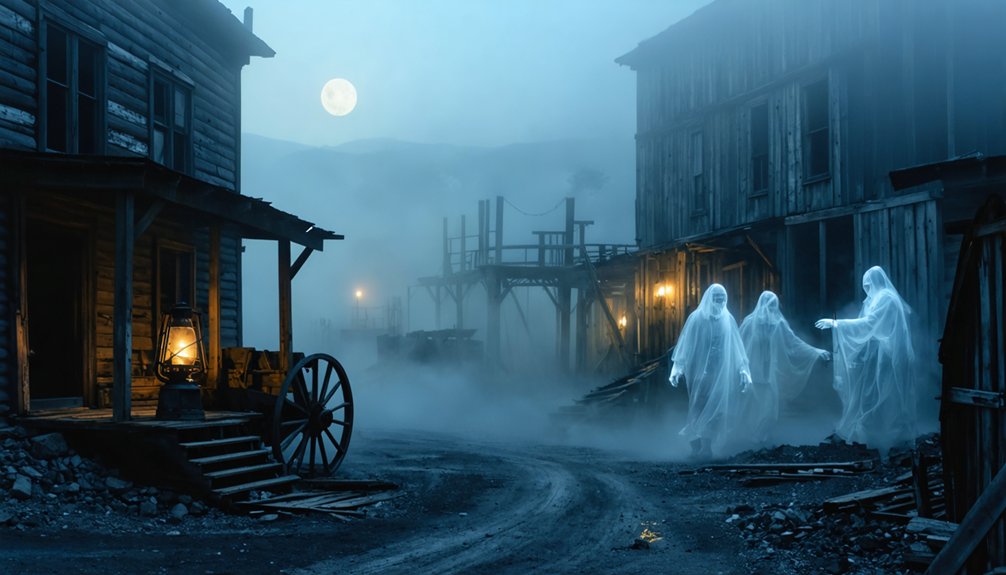
Silver and gold rush territories across the American West harbor some of the most compelling ghost stories in the nation’s paranormal landscape.
When you visit places like Virginia City or St. Elmo, you’re walking through landscapes where ghostly sightings have become integral to local identity. The abandoned structures of Kennecott and Calico preserve not just architectural history but mining folklore centered on phantom workers still laboring in played-out seams.
These narratives typically feature spectral miners with bobbing lanterns, children’s spirits running through decrepit hotels, and prospectors eternally searching for lost claims.
The economic collapse that transformed boom towns into ghost towns created perfect conditions for supernatural narratives to flourish. Whether interpreted as cultural memory, unresolved trauma, or genuine paranormal phenomena, these stories now fuel preservation efforts and tourism across the Western frontier.
The haunting history of the Midwest serves as a poignant reminder of the resilience of communities in the face of adversity. As people revisit these locations steeped in tragedy, they often uncover stories that deepen their understanding of regional identity. This emotional connection not only drives tourism but also revitalizes local economies that once thrived during more prosperous times.
Environmental Disasters and Their Supernatural Aftermath
Beyond the ghostly miners and prospectors of western boom towns, industrial America’s mill towns harbor darker supernatural narratives born from environmental catastrophe.
The Donora Smog Disaster and Church Rock uranium spill exemplify how industrial trauma transforms into supernatural folklore. When environmental disasters occur, they leave behind more than contamination—they create haunted landscapes where survivors report inexplicable phenomena.
Industrial wounds leave more than scars—they birth phantom legacies that speak through poisoned earth and unsettled air.
Three manifestations of environmental trauma in haunted mill towns:
- Persistent “dead zones” where vegetation refuses to grow decades after contamination
- Respiratory distress visitors experience near abandoned zinc plants, often attributed to “angry spirits”
- Glowing waters reported near uranium spill sites, simultaneously explained by science and folklore
These phenomena represent the intersection of measurable environmental damage and cultural processing of collective trauma, where scientific explanation and supernatural interpretation coexist in communities seeking meaning from devastation.
How Mill Town Ghosts Became Tourist Attractions
From environmental tragedy to economic opportunity, the spectral residents of America’s abandoned mill towns have undergone a remarkable transformation in recent decades.
You’ll find these once-derelict communities now revitalized through strategic mill town preservation efforts, with over 40 original structures maintained in “arrested decay” to authenticate the visitor experience.
Ghost storytelling has become a cornerstone of the economic revival, with annual events and “haunted” tours drawing visitors year-round.
The economic impact extends beyond the heritage sites themselves—creating hospitality jobs, retail opportunities, and increased tax revenue for surrounding communities.
Digital mapping platforms now catalog over 3,800 ghost towns for tourism planning, while social media amplifies supernatural narratives that capture public imagination.
These former industrial centers have fundamentally monetized their own demise, transforming abandonment into a marketable cultural asset.
Frequently Asked Questions
Can Ghost Hunting Equipment Detect Mill Town Apparitions?
Your EMF detectors and spirit boxes might register anomalies in old mill towns, but they can’t definitively confirm apparitions. Scientific skepticism demands you consider alternative explanations for any readings you collect.
Are Former Mill Town Residents Opposed to Ghost Tourism?
You’ll find mixed local sentiments toward ghost tourism. Some former residents oppose it, fearing commercialization and disrespect, while others welcome economic benefits and renewed interest in their town’s heritage.
How Do Seasonal Changes Affect Paranormal Activity in Mill Towns?
When winter’s icy fingers grip mill towns, you’ll notice intensified paranormal patterns. Seasonal shifts create ideal conditions through cooler temperatures, reduced humidity, and lower visitor numbers, potentially heightening your perception of ghostly phenomena.
Do Ghost Towns Experience More Hauntings Than Partially Inhabited Ones?
You’ll find ghost town dynamics generally foster higher haunting frequency reports due to preserved trauma narratives, undisturbed structures, and visitor psychological priming—though this reflects cultural interpretation rather than verified paranormal differences.
Can Visiting Ghost Towns Cause Spiritual Attachments to Follow You Home?
Empty vessels may gather shadows. You might absorb spiritual energy from ghost towns, though evidence remains anecdotal. Your belief system, sensitivity, and unconscious behaviors could influence potential haunting experiences following these visits.
References
- https://www.orphanednation.com/the-ghost-town-of-henry-river-mill-village/
- https://www.mythfolks.com/haunted-us-ghost-towns
- https://www.sixt.com/magazine/travel/top-ghost-towns-us/
- https://www.youtube.com/watch?v=l_ogVgvyw7Y
- https://stateofwatourism.com/ghost-towns-of-washington-state/
- https://www.christywanders.com/2024/08/top-ghost-towns-for-history-buffs.html
- https://www.youtube.com/watch?v=5wytKBsjSYw
- https://travelnevada.com/ghost-town/
- https://roadtrippers.com/magazine/henry-mill-river-hunger-games-district-12/
- https://appalachianhistorian.org/repurposed-appalachia-the-rise-fall-and-revival-of-henry-river-mill-village/