America’s abandoned riverbank ghost towns reveal how once-thriving commercial hubs surrendered to time and nature. You’ll find weathered warehouses and forgotten docks along major waterways like the Mississippi and James Rivers. Some settlements disappeared completely—claimed by floods, erosion, or dam projects—while others remain preserved in “arrested decay” like Bodie and Thurmond. Crumbling structures and overgrown streets mark where generations lived before technological changes redirected commerce, leaving these communities as haunting witnesses to our nation’s complex river history.
Key Takeaways
- Riverside ghost towns like Thurmond preserve railroad stations and structures offering insights into America’s coal mining history.
- Holland Island, Bayocean, and Napoleon were once-thriving river settlements claimed by natural erosion and waterway changes.
- Historic river ports declined due to modern shipping challenges, leaving abandoned landings and warehouses as remnants.
- Some submerged towns like St. Thomas emerge during droughts, providing rare opportunities to explore America’s flooded history.
- Bodie State Historic Park and Berlin, Nevada showcase preserved structures maintained in “arrested decay” for historical documentation.
The Forgotten River Ports: From Commerce Hubs to Silent Ruins

As America’s earliest settlements took shape along its sprawling network of rivers, bustling commercial hubs emerged that would serve as the lifeblood of a developing nation.
From Atlantic estuaries to inland waterways, America’s river towns formed the commercial backbone of a young republic.
These forgotten histories began with colonial outposts like Jamestown, where river trade volumes rivaled medieval London despite disease and conflict. Historical records detail how merchants required shipping tickets from the Virginia Company to transport valuable cargo like tobacco back to England.
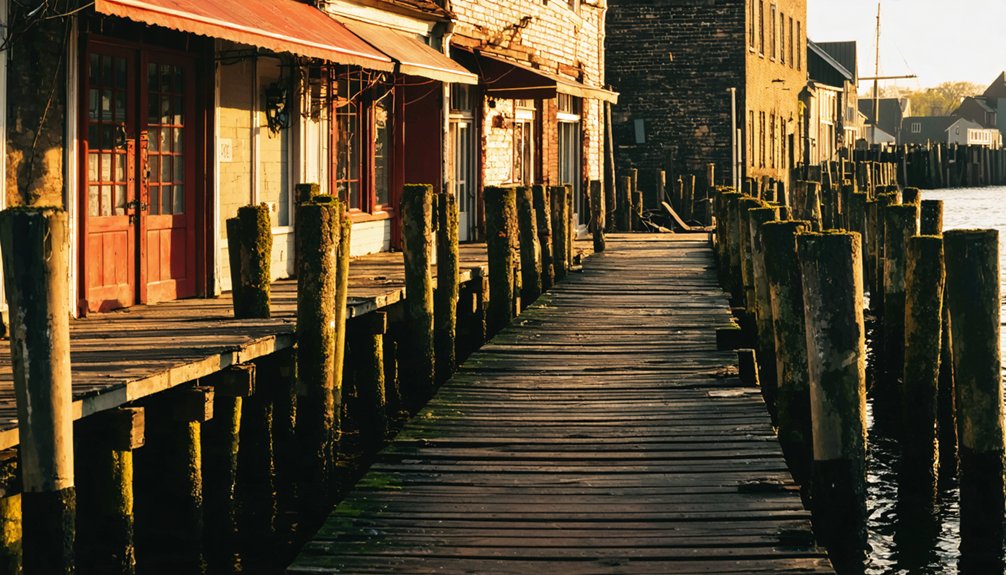
You’ll find the remains of once-thriving ports at strategic river bends and junctions, where steamboat legacies endure through abandoned landings, warehouses, and submerged piers.
Towns that flourished along the Mississippi, Delaware, and James rivers now stand as silent witnesses to America’s shifting transportation priorities. Modern coastal shipping faces challenges from inflated costs due to Jones Act restrictions, leaving many historic river ports unable to compete in the contemporary economy.
When Nature Reclaims: River Changes That Erased Towns From Maps
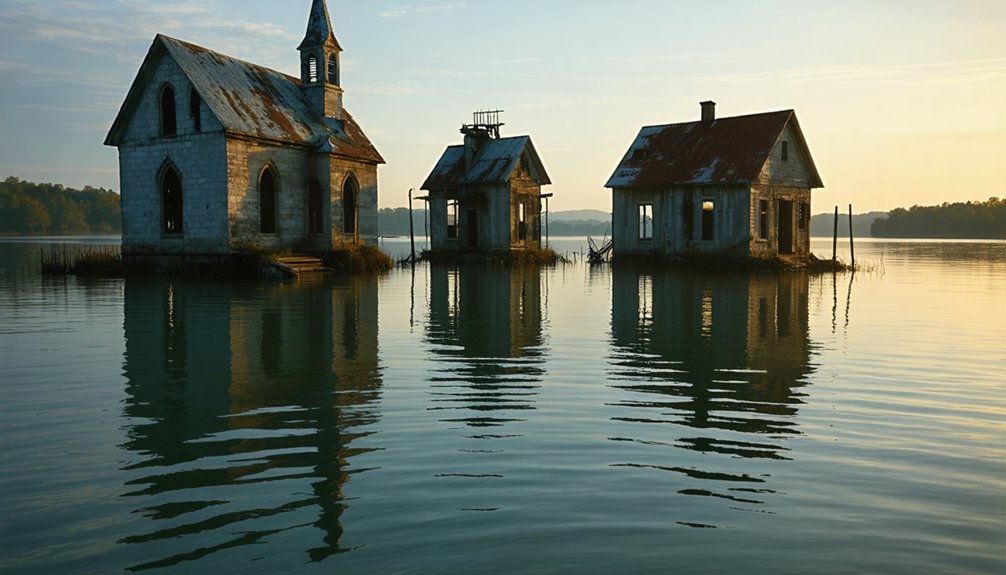
The ever-shifting nature of America’s waterways has dramatically reshaped its riverside settlements—sometimes erasing them entirely.
You can trace these town disappearances through places like Holland Island, Maryland, which gradually surrendered to Chesapeake Bay’s persistent waves, or Bayocean, Oregon, claimed by Pacific erosion.
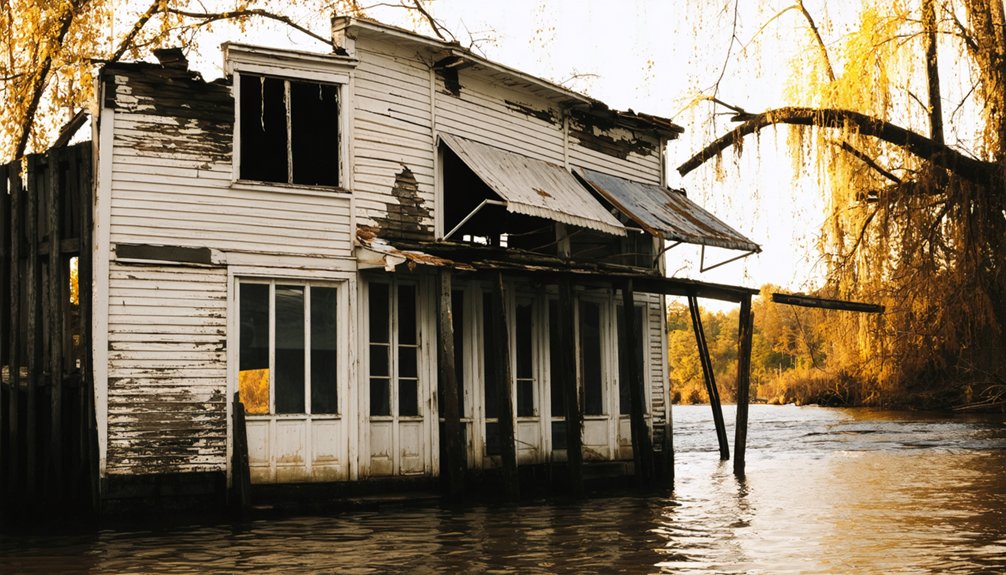
The Mississippi River proved particularly unforgiving, washing away Napoleon, Arkansas through relentless current action and flooding.
River shifts occurred over decades, forcing communities to abandon their homes before complete submersion. The Great Flood of 1862 alone destroyed multiple settlements including Champoeg and Linn City. In Alabama, the town of Adamsville was largely destroyed by a flood and was never rebuilt.
Even more devastating were deliberate submersions from dam projects like those that drowned Robinette, Oregon and Celilo Falls—erasing not just buildings but centuries of Indigenous cultural practices and sacred spaces that can never be recovered. Similar to Monty Nay, Arkansas, these submerged towns now serve as underwater attractions where scuba divers explore the haunting ruins of once-thriving communities.
Preserved in Time: America’s Most Hauntingly Intact Waterside Ghost Towns

Unlike their fully submerged counterparts, America’s most well-preserved waterside ghost towns stand as hauntingly intact monuments to bygone eras of river commerce.
You’ll find these haunting landscapes frozen in time, their preserved architecture telling stories of industrial booms and inevitable decline. St. Augustine’s Matanzas River shoreline holds nearly five centuries of Spanish colonial history within its weathered structures.
- Natchez’s elegant mansions still overlook the Mississippi, filled with period antiques and historical artifacts.
- Bodie maintains approximately 200 original structures with furniture and artifacts exactly as residents left them.
- Thurmond’s remarkably intact railroad station offers glimpses into coal mining’s heyday within New River Gorge.
- Galena’s preserved Main Street storefronts include Ulysses S. Grant’s pre-Civil War home.
- Ferguson’s cypress lumber mill remnants remain visible in the Santee River waters, accessible only by boat.
In California, the ghost town of Bodie State Historic Park provides visitors with an authentic snapshot of life during the gold rush era, with buildings preserved in a state of “arrested decay.”
These riverside relics offer freedom to explore America’s industrial heritage without modern intrusions.
Whispers From the Riverbank: Cemeteries and Legends of Abandoned Settlements
Silent witnesses to forgotten communities, riverbank cemeteries hold the most enduring stories of America’s abandoned settlements.
Among these remnants are ghost towns in the American West, where the echoes of the past linger in the dusty streets and crumbling facades. Each deserted building serves as a testament to the dreams and hardships of those who once called these places home. Exploring these forgotten locales reveals not only the history of the land but also the resilience of those who sought fortune in an unforgiving environment.
At Fairbank, Arizona, sun-baked hillside graves have suffered vandalism, yet still harbor whispers heard by twilight visitors who report ghostly figures moving between markers.
You’ll find similar cemetery hauntings at Moonville, Ohio, where only thirteen known graves remain on a hilltop near the infamous tunnel where spectral railroad workers supposedly linger. The tunnel itself, once part of the Marietta and Cincinnati Railroad, stands as one of southeastern Ohio’s most haunted landmarks.
Mount Holly Cemetery’s flute melodies drift among mausoleums, while the abandoned factory site along the Ouachita River echoes with phantom telephone rings.
These burial grounds often constitute the primary historical evidence of once-thriving communities, their weathered stones and iron fencing telling tales of laborers, miners, and families who lived and died along America’s waterways—stories preserved despite minimal conservation efforts. The Fairbank Cemetery’s original grave markers have largely disappeared due to years of grave robbery and extensive vandalism, leaving mostly simple stone piles to mark burial locations.
Exploring America’s Riverside Ghost Towns: Accessibility Guide for Modern Adventurers

For modern adventurers seeking America’s forgotten riverside settlements, accessibility varies dramatically depending on location, season, and preservation status.
You’ll need to research water levels before attempting kayak exploration of submerged towns like Ferguson beneath Lake Marion, where lumber company ruins await beneath the surface.
- St. Thomas emerges from Lake Mead during drought periods, offering rare walking access to a normally submerged settlement.
- Randsburg remains partially inhabited with approximately 70 residents, making it ideal for ghost town accessibility without permits.
- Bodie State Historic Park maintains preserved structures under official protection with seasonal road closures.
- Ferguson requires watercraft access with specialized equipment for underwater exploration.
- Rhyolite’s volcanic canyon location offers year-round desert accessibility but demands proper hydration and vehicle preparations.
Berlin, Nevada provides visitors with a unique opportunity to explore historic mining equipment while learning about the town’s 1880s origins.
Frequently Asked Questions
Can Visitors Legally Collect Artifacts From Riverbank Ghost Towns?
No, you can’t legally collect artifacts from riverbank ghost towns. You’ll face serious legal ramifications under NAGPRA and ARPA laws designed for artifact preservation on public and tribal lands.
How Do Seasonal River Fluctuations Affect Ghost Town Accessibility?
Like a time-traveling portal, river levels determine your ghost town access. You’ll find exploration opportunities during low-water seasons when foundations emerge, while high water completely submerges these fragile historical treasures, restricting seasonal access.
Are There Underwater Ghost Towns Visible Through Glass-Bottom Boats?
You’ll rarely see true underwater ghost towns via glass-bottom exploration. Water clarity limits underwater visibility, with most boats focusing on natural features, shipwrecks, or scattered artifacts rather than submerged settlements.
Which Riverbank Ghost Towns Have the Most Photographable Ruins?
Time stands still at Cahawba, Alabama and Thurmond, West Virginia—both offering photographic techniques heaven for urban exploration enthusiasts. You’ll find their riverbank ruins perfectly preserved, contextually rich, and hauntingly accessible.
Do Any Abandoned Riverbank Towns Still Have Functioning Postal Services?
You’ll rarely find functioning post offices in riverbank ghost towns today. While some maintain limited ghost town services through mobile routes, most postal operations ceased with population decline, leaving only historical remnants.
References
- https://wheninyourstate.com/usa/hidden-abandoned-ghost-towns-worth-exploring-this-fall/
- https://www.lonelyplanet.com/articles/coolest-ghost-towns-us
- https://www.youtube.com/watch?v=eyOASXxAmMI
- https://www.geotab.com/ghost-towns/
- https://www.blueridgeoutdoors.com/go-outside/southern-ghost-towns/
- https://www.minnesotahistory.org/post/a-complete-guide-to-the-ghost-towns-of-hennepin-county
- https://www.visitwhitemountains.com/blog/post/spooky-stories-ghost-towns-and-historic-haunted-spots/
- https://myfamilytravels.com/arkansas-riverside-sites-with-noted-paranormal-sounds/
- http://globalmaritimehistory.com/jamestown-first-permanent-english-port-in-america-needs-archaeological-investigation/
- https://www.cato.org/publications/policy-analysis/jones-act-burden-america-can-no-longer-bear