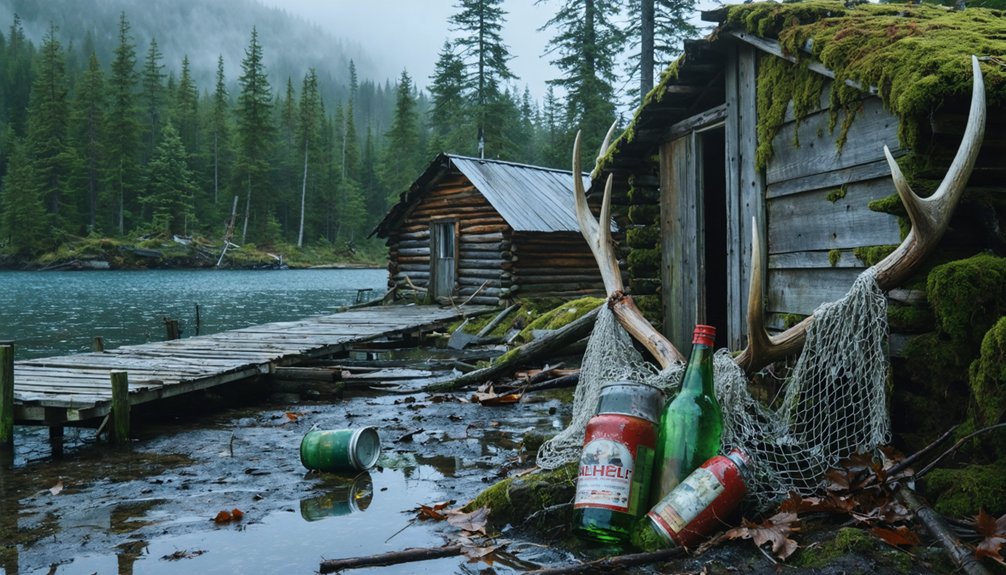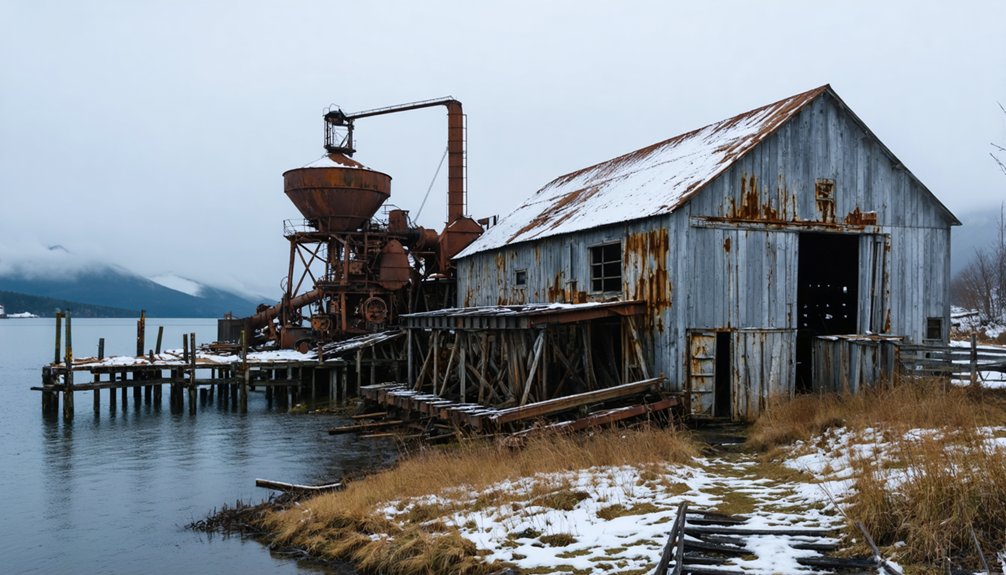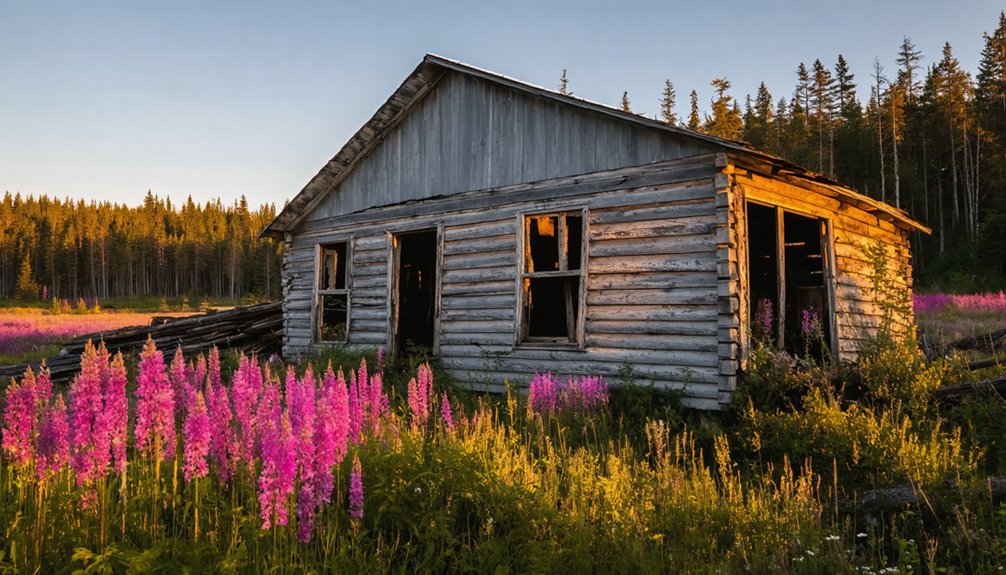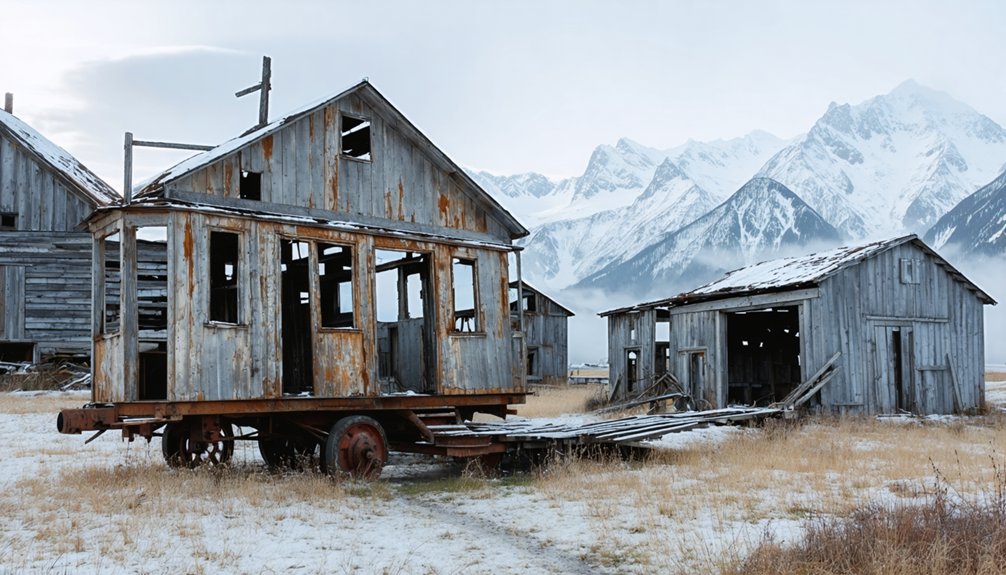
You’ll find Alaska’s most haunted ghost towns scattered across its wilderness, from Kennicott’s abandoned copper mine where 600 workers left behind personal possessions in 1938, to Treadwell’s flooded ruins near Juneau where Alaska’s largest gold mine collapsed catastrophically in 1917. Portlock on Kodiak Island remains notorious for unexplained disappearances attributed to Bigfoot-like creatures, while Dyea’s gold rush remnants hide beneath forest regrowth. These sites merge documented industrial disasters—cave-ins, floods, and economic collapses—with persistent supernatural legends that have accumulated over decades of abandonment, creating locations where historical tragedy intertwines with unexplained phenomena that continue attracting those seeking Alaska’s darkest mysteries.
Key Takeaways
- Kennicott Ghost Town near McCarthy was abruptly abandoned in 1938, leaving personal possessions behind in preserved buildings now open for tours.
- Treadwell Ruins near Juneau feature flooded mine shafts and collapsed structures from the catastrophic 1917 cave-in that destroyed Alaska’s largest gold mine.
- Portlock village includes legends of mysterious disappearances and Bigfoot-like creatures, blending Sugpiaq history with supernatural folklore.
- Kodiak’s Erskine House is reportedly haunted, connected to the 1908 murder of fur trapper MacIntyre and ongoing paranormal activity.
- Alaska’s “supernatural triangle” encompasses over 20,000 unexplained vanishings, with Tlingit legends attributing them to demons and the Keelut spirit dog.
Kennicott Ghost Town: Where Copper Riches Left Behind a Frozen Legacy
When prospectors stumbled upon a distinctive green patch in the summer of 1900, they’d discovered one of Alaska’s richest copper deposits—a find that would transform the remote wilderness above Kennicott and Root Glaciers into a thriving industrial operation.
The Kennicott Copper Corporation deployed cutting-edge mining technology, including a 16,000-foot aerial tramway and a massive 14-story mill, to extract ore worth $32.4 million at 1916’s peak production.
You’ll find remnants of a company town that once housed 600 workers in controlled conditions—no alcohol, no gambling.
McCarthy village emerged nearby, offering forbidden freedoms the corporation banned.
Despite labor strikes and depleted ore reserves, the operation generated over $200 million before closing in 1938, leaving buildings frozen in time. The town was abandoned so abruptly that residents left behind personal possessions, creating an eerie time capsule of Alaska’s mining era. Today, the site operates as a National Historic Landmark where visitors can take guided tours through the preserved mine buildings and facilities.
Treadwell Ruins: The Submerged Secrets of Alaska’s First Swimming Pool
You’ll find Douglas Island’s Treadwell complex transformed from the world’s largest hard rock gold mine—employing over 2,000 workers and producing 3 million troy ounces between 1881 and 1922—into a waterlogged ruin after the catastrophic April 21, 1917 cave-in.
The collapse, triggered by ground subsidence near Alaska’s first indoor swimming pool at 11:30 p.m. during an 18.1-foot tide, sent water spraying 200 feet high and flooded three mines below sea level.
The Treadwell community supported five top baseball teams in 1917, drawing crowds in the thousands with gambling as a major attraction before the disaster struck.
The mine’s operations utilized 960 stamps across five mills during peak production, processing gold-bearing ore from shafts extending as deep as 2,400 feet below the surface.
Today you can walk the Treadwell Historical Society‘s nature trail past crumbling foundations, the flooded glory hole, and the restored saltwater pump where buildings once housed a natatorium, gymnasium, and 500-seat theater.
Glory Days and Collapse
Between 1882 and 1917, the Treadwell Mine Complex dominated Alaska’s mining landscape as the world’s largest hard rock gold operation, extracting over 3 million troy ounces of gold worth approximately $70 million.
You’d have found a self-sufficient town infrastructure supporting over 2,000 workers—complete with five mills, company stores, a post office, and the renowned Treadwell Club featuring Alaska’s first indoor swimming pool.
The industrial engineering achievements included a 1914 pump house lifting 2,700 gallons per minute and a sophisticated power system converting hydroelectric energy at 23,000 volts.
But cracks appeared in the natatorium’s structure before disaster struck. On April 22, 1917, cave-ins triggered catastrophic subsidence, plunging buildings into the earth.
The collapse flooded three of the four mines, with tons of equipment and animals lost in the deluge, though workers had been safely evacuated. The mine never recovered, leaving behind haunting ruins of Alaska’s once-thriving industrial empire. Today, a major fire in 1926 destroyed most remaining wooden structures, though several concrete buildings endured and have since been restored for their historical significance.
Exploring the Haunted Ruins
Today’s visitors to Douglas Island can walk the nature trail through Treadwell’s skeletal remains, where Alaska’s first indoor swimming pool once anchored the company’s elaborate social facilities.
Historical markers guide you past the water-filled glory hole and preserved salt water pump—the only standing icon of the natatorium that vanished first during the 1917 mine collapse.
The Treadwell Historic Preservation & Restoration Society maintains interpretive signaling documenting how subsidence swallowed the pool during an 18.1-foot high tide, leaving only floating debris by morning. Digital collections now preserve historic photographs and documents from this era, making the site’s transformation accessible to researchers worldwide.
While structural preservation efforts focus on accessible ruins, the submerged sections beneath Gastineau Channel represent potential underwater archaeology sites. The interconnected mines once linked Treadwell, Mexican, Ready Bullion, and 700-Foot operations through below-sea-level tunnels before the catastrophic flooding.
You’ll find crumbling foundations where 350 miners once evacuated from depths reaching 2,100 feet below sea level.
Dyea: The Klondike Gateway Swallowed by Forest
You’ll find Dyea’s story in the official census records that document its meteoric transformation from a Tlingit fishing camp called Dayéi to an 8,000-person boomtown between October 1897 and May 1898.
The federal government declared it a port to handle the 22,000 stampeders who trudged through its 48 hotels and over the Chilkoot Pass toward Klondike gold. The Palm Sunday Avalanche on April 3, 1898, killed over 70 people on the Chilkoot Trail, devastating the town’s reputation and marking the beginning of its rapid decline.
The construction of the White Pass & Yukon Route Railway through neighboring Skagway diverted traffic away from Dyea’s Chilkoot Trail route, sealing the town’s fate. By 1903, the once-thriving gateway to the goldfields had been completely abandoned, leaving only silence where thousands once passed through.
Gold Rush Gateway History
Long before stampeders flooded the mudflats of Lynn Canal, the Chilkat Tlingit from Klukwan controlled the Dyea area and Chilkoot Pass as their primary trade route to interior First Nations.
They’d burned Fort Selkirk in 1852 to maintain their monopoly on local trade with Russian, Boston, and Hudson’s Bay companies.
You’ll find that indigenous routes opened to miners through an 1879 agreement by U.S. Navy Commander L.A. Beardsley, which protected Tlingit trade interests.
Nature Reclaims the Town
Where Dyea’s wooden sidewalks once clattered with 10,000 stampeders, dense alder and spruce forests now reclaim every trace of civilization. Forest regrowth has consumed the townsite since 1898, with moss-draped trees shading the Slide Cemetery and a haunting “Avenue of Trees” marking Main Street’s ghost.
River dynamics accelerated Dyea’s disappearance. The Taiya River shifted course through the 1940s and 1950s, floods washing away remaining structures and creating treeless meadows where buildings once stood. After homesteaders dismantled what remained—selling lumber and hardware—nature finished the job.
Today, you’ll find only scattered foundations, one weathered false-front facade, and ground depressions marking old privies. The National Park Service manages these ruins as a National Historic Landmark, where bears and eagles roam freely through Alaska’s most thoroughly erased boomtown.
Three Saints Bay: Russia’s Lost Colony on Kodiak Island
Nature ultimately reclaimed this imperial ambition.
The 1788 earthquake caused devastating subsidence and tsunami damage. Commander Alexander Baranov arrived in 1790, recognizing the site’s fatal limitations—sinking ground, insufficient timber, cramped quarters.
Portlock: The Cannery Town Terrorized by Unknown Forces
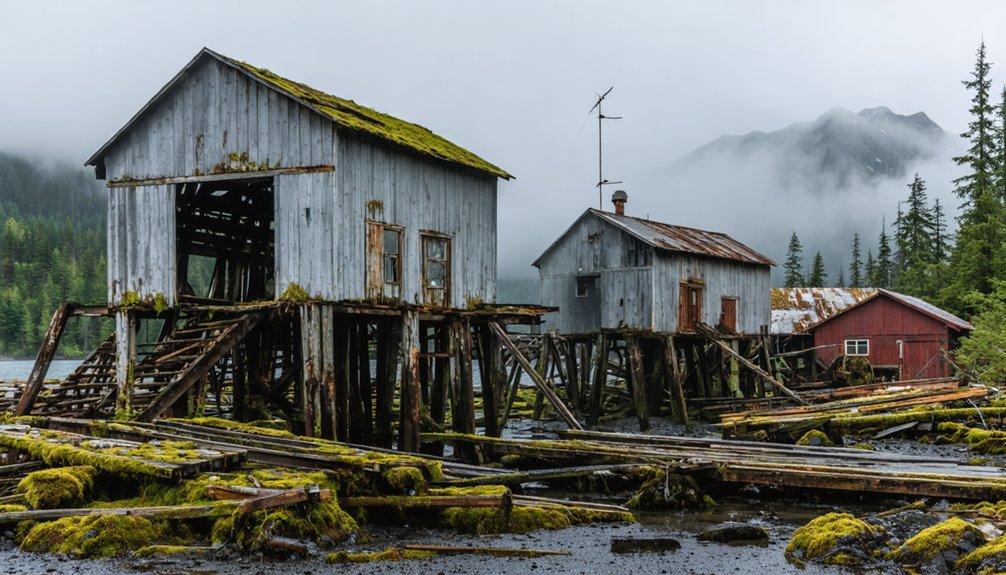
Around 1900, a cannery town emerged on the southern Kenai Peninsula within Port Chatham bay, taking its name from British naval captain Nathaniel Portlock. The site overlaid an abandoned Sugpiaq village, already tainted by ancient legends of mountain-dwelling entities and unexplained deaths reported by Spanish explorers in 1861.
By 1905, cannery workers fled mysterious disturbances.
The 1920s brought Albert Petka’s fatal encounter with a hairy creature. Throughout the 1930s, fifteen people vanished—their mutilated remains discovered in creeks, torn beyond bear capabilities. Locals called it Nantiinaq, a Bigfoot-like predator.
Spectral sightings included a wailing woman in black on seaside cliffs.
Armed guards couldn’t stem the terror. By 1950, residents abandoned Portlock entirely, ending fifty years of documented disappearances and murders that official records couldn’t explain away.
Fort Egbert: The Abandoned Military Outpost on the Yukon
While Portlock’s residents fled supernatural terrors, another Alaskan settlement met abandonment through bureaucratic indifference rather than bloodshed. You’ll find Fort Egbert along the Yukon River, where Lieutenant W.P. Richardson established this military history landmark in 1899 with just 25 men.
Named for Brigadier General Harry Egbert, the outpost served frontier defense during the Klondike Gold Rush, protecting commerce and maintaining order near the Alaska-Canada border.
Fort Egbert stood sentinel over Klondike commerce, where military order met gold rush chaos along Alaska’s remote Canadian frontier.
The fort grew to nearly 40 buildings housing over 100 soldiers who constructed the transcontinental telegraph line connecting Alaska to the lower 48 states.
General Billy Mitchell oversaw this communications breakthrough between 1901-1904.
McCarthy: Where Miners Once Sought Vice and Entertainment
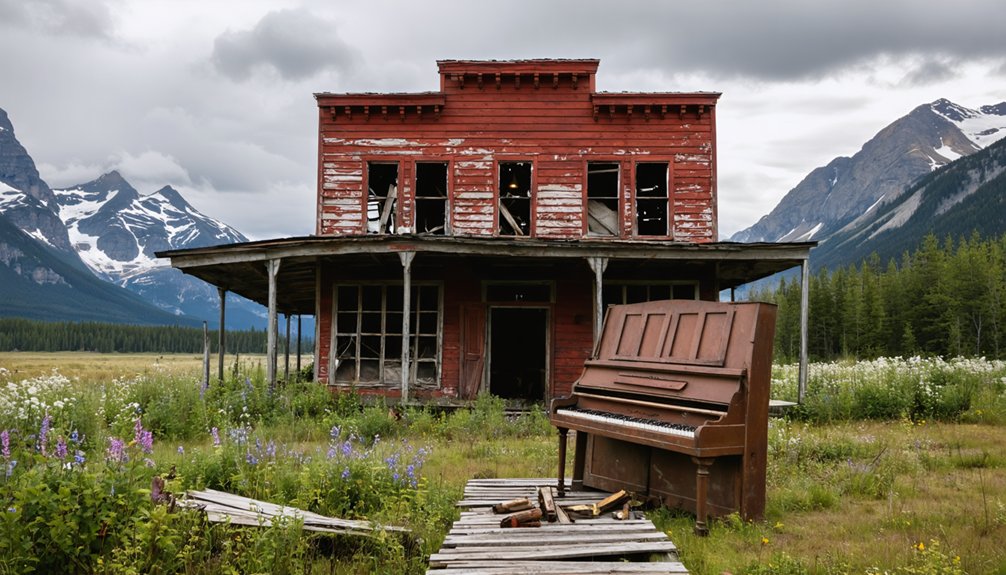
While the company-owned town of Kennicott five miles up the tracks enforced strict prohibition policies, you’ll find McCarthy’s historical record tells a different story—one where miners spent their wages freely in saloons, gambling halls, and brothels after grueling shifts extracting copper ore.
The settlement emerged in 1906 specifically to serve as the railway’s turnaround station, but its true economic engine became providing the vices forbidden at the mine site.
At its peak serving 800 residents, McCarthy operated as an unregulated frontier town where alcohol flowed, card games ran through the night, and sex workers catered to laborers earning top wages from what was then the world’s richest copper deposit.
Saloons and Gambling Halls
Between 1911 and 1938, McCarthy’s saloons and gambling halls operated as the designated vice center for Kennicott Copper Corporation’s miners, who faced strict prohibitions in their company town just five miles away. You’ll find the Potato Saloon and Golden Saloon dominated the nighttime economy, while “fountains & pool halls” served as fronts for illicit gambling and bootlegging operations.
During Prohibition, these establishments developed sophisticated warning systems—railroad engineers blew special whistles when US Marshals approached, allowing proprietors to conceal contraband.
Slim Lancaster ran a covert moonshine operation between the towns, supplying Prohibition speakeasies until undercover agent J. Lindley Green’s crackdowns. The red light district along the creek banks housed these operations until the mine’s 1938 closure ended McCarthy’s reign as Alaska’s premier vice town.
Miners’ Relief From Labor
Your holiday experience would’ve included:
- Fourth of July festivities featuring races, baseball tournaments with $200 prizes sponsored by Kennecott Copper Corporation, and ice cream.
- Christmas celebrations organized at mill camps with picture shows and basketball games in recreation facilities.
- McCarthy indulgences offering female companionship, moonshine, and entertainment unavailable in Kennicott’s strictly regulated 300-resident camp.
Higher salaries compensated for isolation, though company oversight maintained proper behavior until miners sought McCarthy’s liberation.
McCarthy’s Wild Frontier Days
When John Barrett homesteaded 296 acres along McCarthy Creek around 1900, he’d positioned his land strategically for a locomotive turnaround—but the settlement that emerged served a purpose far removed from railroad logistics.
McCarthy became the wild frontier counterpart to Kennecott’s strict company policies that banned alcohol and brothels. Five miles from the copper mines, the town developed a thriving red-light district along the creek banks where miners sought entertainment unavailable in their sterile company town.
These frontier legends include special train whistles warning of approaching U.S. Marshals during Prohibition. On March 9, 1918, two mysterious deaths rocked the settlement: drug store owner Gustave Priesner was murdered after returning from the district at 5:00 a.m., and witness Joe Petrie died before Marshal Joe Feister could interview him.
The Eerie Remnants of Alaska’s Gold Rush Communities
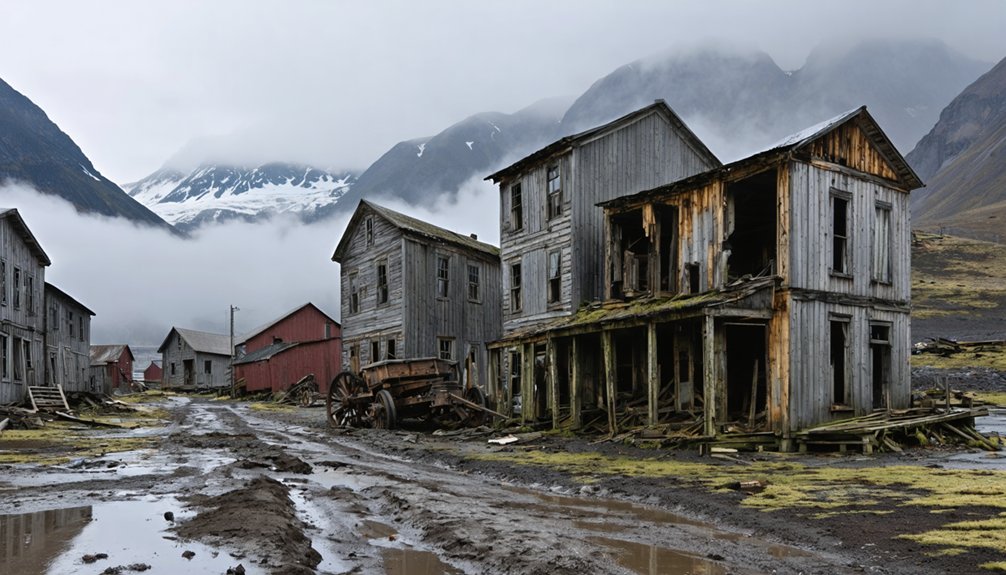
Alaska’s gold rush era spawned dozens of boomtowns across its wilderness, yet most dissolved as quickly as they’d appeared, leaving behind skeletal structures and rusted equipment that now stand as monuments to human ambition and nature’s persistence.
You’ll find these remnants scattered throughout the state, each telling distinct stories:
- Iditarod transformed from a bustling supply port on the river banks into complete abandonment by World War I. Its overland winter trails incorporate ancient Native routes now reclaimed by wilderness.
- Dyea processed thousands through Chilkoot Pass before Skagway’s railroad rendered it obsolete. With 1940s floods erasing what remained of 150 businesses.
- Treadwell’s submerged mine shafts near Juneau create haunting landscapes where urban legends thrive. Preservation challenges intensify as nature steadily consumes these historical sites.
Supernatural Stories and Unexplained Disappearances in Alaskan Settlements
Beyond the crumbling facades and abandoned infrastructure, these forsaken settlements harbor darker narratives that defy rational explanation. Supernatural legends permeate Alaska’s wilderness, where over 20,000 people vanished within the triangle formed by Juneau, Anchorage, and Barrow during the past five decades. The Tlingit tribe attributes these disappearance mysteries to demons and Keelut—black hairless dogs leaving no traces.
Alaska’s wilderness conceals unexplained vanishings—over 20,000 people lost to a supernatural triangle where ancient legends intersect with modern disappearances.
You’ll encounter chilling accounts at Erskine House in Kodiak, where fur trapper MacIntyre’s 1908 murder spawned persistent hauntings.
Skagway’s Golden North Hotel hosts Scary Mary, eternally awaiting her prospector fiancé.
Near Anchorage, Eklutna Cemetery’s spirit houses trigger unexplained phenomena.
Remote areas report cryptozoological encounters: ten-foot Bushmen murdering hunters, Saberwolves decapitating victims, Qalupalik kidnapping children, and Kushtaka luring fishermen underwater—creatures intertwined with Alaska’s unsolved vanishings.
Visiting Alaska’s Ghost Towns: What Remains Today
While spectral legends pervade Alaska’s wilderness, tangible remnants of abandoned settlements await contemporary exploration.
Kennecott, situated near McCarthy within Wrangell-St. Elias National Park, preserves copper mining structures from the early 1900s, accessible via McCarthy Road.
Taku Harbor, twenty miles southeast of Juneau, showcases indigenous heritage through Tlingit village ruins alongside Hudson’s Bay Company remnants, where marine ecology now reclaims collapsed cannery buildings.
Three distinct ghost town experiences include:
- Fort Egbert (Taylor Highway) – Five buildings from 45 originals, self-guided Klondike Gold Rush exploration April-October
- Dyea (Skagway) – Flood-demolished gold rush site within National Historical Park boundaries since 1978
- Kiska Island – WWII battlefield frozen since 1943, accessible only by boat or aircraft
Each location reveals Alaska’s transformation from boomtown prosperity to wilderness reclamation.
Frequently Asked Questions
Are Guided Tours Available for Visiting Alaska’s Ghost Towns?
Yes, you’ll find guided tours at Kennecott Mill Town and Independence Mine, where expert guides share historical preservation efforts through archival evidence. You might experience wildlife encounters while exploring these authentic 1900s mining camps on chronologically-structured walks.
What’s the Best Time of Year to Explore Abandoned Alaskan Settlements?
You’ll find absolutely perfect conditions from June to early August when abandoned buildings become fully accessible and ghost town history comes alive. Summer’s endless daylight and melted snow let you freely explore remote settlements that remain locked behind winter’s grip year-round.
Do You Need Special Permits to Access These Ghost Town Sites?
You’ll need permits for property access depending on ownership. Legal considerations include Native Corporation lands requiring paid permits, while federal sites may need ADFG Special Area authorization. Always verify current ownership status before exploring to avoid trespassing charges.
Are These Ghost Towns Safe to Explore Without a Guide?
You’ll face serious risks exploring independently—structural collapses, wildlife encounters with bears, and zero emergency services. Historical preservation rules restrict building access. Remote sites like Kennecott require professional guidance for safety, though some areas permit self-exploration with proper preparation.
What Equipment Should Visitors Bring When Exploring Alaska’s Ghost Towns?
You’ll need sturdy boots, protective clothing, navigation tools, and first aid supplies. Bring bear spray for wildlife encounters, respirators against mold, and cameras to document historical artifacts. Pack emergency beacons since Alaska’s remote ghost towns lack cell service.
References
- https://thealaskafrontier.com/ghost-towns-in-alaska/
- https://www.onlyinyourstate.com/experiences/alaska/this-abandoned-ghost-town-is-downright-bone-chilling-ak
- https://getlostinamerica.com/alaska-ghost-towns/
- https://www.experiencedenali.com/blog/alaskas-most-haunted-places/
- https://www.atlasobscura.com/things-to-do/alaska/ghost-towns
- https://www.youtube.com/watch?v=Cz0IGc2Uy0E
- https://en.wikipedia.org/wiki/List_of_ghost_towns_in_Alaska
- https://alaskaitinerary.com/haunted-places-in-alaska/
- https://www.atlasobscura.com/places/kennicott-ghost-town
- https://www.kennicottlodge.com/about-the-area/kennicott-national-historic-landmark/