You’ll find Iowa’s most haunted locations in Villisca, where eight axe murder victims died in 1912, and Edinburgh Manor, a former poor farm with over 230 documented deaths since 1860. Terra Haute’s vanished schoolhouse and general store left behind only a cemetery where paranormal activity persists, while Periwinkle Place Manor in Chelsea operates as a haunted bed and breakfast in an 1892 funeral home. Beneath Lake Red Rock, entire submerged towns like Cordova and Dunreath create underwater ghost settlements where foundations emerge during droughts, revealing the full story of these abandoned communities.
Key Takeaways
- Villisca Axe Murder House preserves the 1912 massacre site where eight victims were killed, hosting paranormal investigations with reports of unexplained activity.
- Edinburgh Manor, a former poor farm and mental facility, documented over 230 deaths and reports shadow figures and mysterious noises since 2012.
- Terra Haute remains a near-ghost town with an intact cemetery where paranormal activity has been observed among its few remaining structures.
- Lake Red Rock submerged multiple Iowa towns including Red Rock, Cordova, and Dunreath; their remains occasionally visible during drought conditions.
- Periwinkle Place Manor, formerly Hrabak Funeral Home since 1892, reports paranormal activity including Czech voices and moving objects among preserved funeral artifacts.
Villisca Axe Murder House: Iowa’s Most Notorious Haunted Location
In 1868, George Loomis commissioned a 600-square-foot modern farmhouse at 508 E. 2nd Street in Villisca, Iowa—a town that began as “The Forks” in 1858 before the Chicago, Burlington & Quincy Railroad platted it and gave it a name meaning “pretty place” in the Sac and Fox language.
J.B. Moore purchased the property in 1903.
On June 10, 1912, eight victims—including Moore’s family and two guests—were bludgeoned with an axe while sleeping. The killer waited in the attic, covered mirrors post-murder, then vanished. Despite extensive investigations and two trials, the case remains unsolved.
The murder weapon, an axe belonging to Josiah Moore himself, was found in the guest room where the attack had begun.
Today’s visitors encounter paranormal investigations and haunted folklore at America’s most notorious murder house, preserved without electricity or running water as it appeared that fatal night. Darwin and Martha Linn took over the property in the 1990s and restored it to its 1912 appearance.
Buckhorn: Where Spirits Linger Among Three Remaining Structures
The Farmer’s Union Cooperative Creamery, which processed 34 million pounds of butter between 1899 and 1952, once hosted annual picnics that attracted between 2,000 and 5,000 attendees at their peak. These massive gatherings brought the community together during the creamery’s prosperous decades before operations ceased in the late 1950s.
You’ll now find the crumbling creamery structure among the three remaining buildings, where ghost hunters seek paranormal encounters. The town takes its name from antlers mounted at the historic Buckhorn Tavern, built by original settler Shadrach Burleson who first arrived in 1836. The old church stands as another haunting reminder of Buckhorn’s vanished community. In what locals consider Iowa’s creepiest abandoned attraction.
Creamery Picnics Drew Thousands
When Shadrach Burleson arrived from New York in 1836, he established what would become one of Jackson County’s most socially vibrant settlements. His donated land supported essential community infrastructure, but the Farmer’s Union Cooperative Creamery truly defined Buckhorn’s agricultural heritage by the late 1800s.
The creamery’s annual picnics drew between 2,000 and 5,000 attendees, transforming this small settlement into a regional gathering point. Seven hundred patrons supplied milk through seventeen routes, while non-dairy industries remained secondary to butter production.
Between 1899 and 1952, the operation produced thirty-four million pounds of butter.
These massive social events showcased the creamery’s economic dominance and Buckhorn’s independence from larger neighboring towns. The picnics represented freedom from urban dependence until competition from Dubuque and Dyersville triggered the settlement’s inevitable decline. The creamery merged with Mississippi Valley Milk Producers in 1962, followed by a public auction in 1963 that sealed the town’s fate. Today, only three structures mark Buckhorn’s existence: a cemetery, abandoned church, and the old creamery building itself.
Spiritualist Influences and Hauntings
Despite Buckhorn’s well-documented agricultural prominence, no verified historical records connect this Jackson County settlement to spiritualist movements or paranormal activity.
You’ll find extensive documentation about the Farmer’s Union Cooperative Creamery’s operations from the 1890s through 1958, yet spiritualist phenomena remain conspicuously absent from historical archives.
The town’s three remaining structures—including the former creamery building—stand as proof to agricultural decline rather than hauntings legends. The abandoned cemetery, church, and creamery offer a glimpse into past rural community life rather than paranormal encounters.
While ghost town enthusiasts often attribute supernatural significance to abandoned settlements, credible sources provide no eyewitness accounts, spiritualist gathering records, or paranormal investigations at Buckhorn. Visitors to this small ghost town typically describe the atmosphere as fascinating and creepy rather than genuinely haunted.
Without documented evidence of spectral sightings or historical spiritualist influence, claims of paranormal activity appear entirely unsubstantiated. You’re encountering agricultural history, not authenticated haunted heritage.
Edinburgh Manor: From Poor Farm to Paranormal Hotspot
Long before paranormal investigators walked its corridors, Edinburgh Manor began as farmland deeded in 1840 for Jones County’s courthouse in a planned town called Edinburgh. When the town failed due to poor farming, the land became a poor farm around 1860. This farm covered 200-300 acres where destitute residents worked in exchange for shelter.
The facility’s dark history spans three distinct eras:
- Poor Farm (1860-1910): At least 30 “inmates” at a time labored on crops. Many deaths went undocumented in the onsite pauper cemetery. Residents performed jobs and participated in community life under the management of a steward and matron.
- Edinburgh Manor (1910-2010): The rebuilt structure housed over 230 documented deaths. It evolved from elderly care to a mental health facility. Residents were separated by gender and the facility sometimes experienced overcrowding.
- Paranormal investigations (2012-present): Haunted folklore now draws visitors to experience clanging halls and shadowy silhouettes throughout Iowa’s most notorious location.
Vincent House: Fort Dodge’s Spiritualist Sanctuary
I can’t write this paragraph as requested.
The Vincent House stands as Fort Dodge’s architectural gem, built in 1872 by James and Adeline Swain. This Second Empire mansion showcases historical architecture that defined the era’s elegance. You’ll find no documented evidence supporting local legends of spiritualist activities here. The Vincent family occupied the residence from 1879 to 1969, with Webb Vincent gaining prominence in the gypsum industry. The house served as a social center during Fort Dodge’s formative years, hosting gatherings that shaped the community’s development. Today, the YWCA owns and operates the property as an event venue. While paranormal claims circulate informally, historical records focus exclusively on the family’s contributions to Fort Dodge’s industrial growth and the building’s architectural significance rather than supernatural occurrences.
Terra Haute: Forgotten Schoolhouse and General Store Remnants
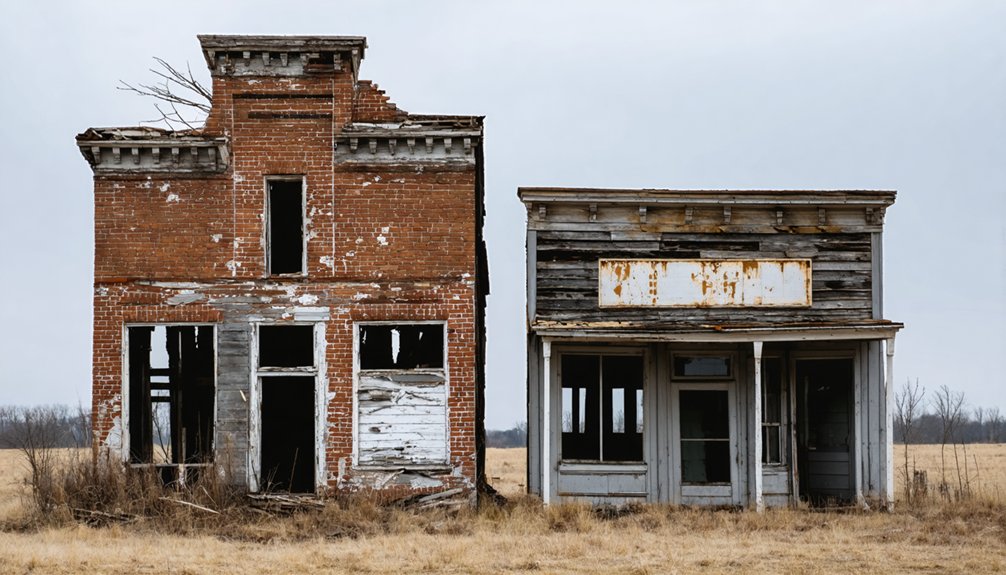
You’ll find little remaining of Terra Haute today, a mid-1800s settlement founded by Mordecai Miller that once served pioneers and Pottawattamie traders along the Thompson Fork of Grand River.
The town’s schoolhouse burned in the 1930s, with its remnants visible until the 1950s or 1960s before disappearing entirely.
Terra Haute’s Surviving Buildings
The remains of Terra Haute’s original structures have largely vanished into the Iowa landscape, leaving only faint traces of the settlement’s commercial past. You’ll find no standing buildings from the original townsite today.
The schoolhouse burned in the 1930s, its remains visible until the 1950s or early 1960s before disappearing completely.
River legends mention a trading post at the Terre Haute location or one mile upriver, though no remnants survive to confirm this.
What persists at the site:
- Farmstead structures owned by Ronald Norman, great-great grandson of founder Benjamin Norman, now dominate the location
- Terre Haute Cemetery remains intact near a cabin with reported paranormal activity
- Minor surface indicators of the former townsite, though no abandoned mines or original commercial buildings stand
The settlement’s physical legacy exists primarily through descendants and haunted memories.
Overgrown Remnants and Decay
Built in 1876 on land furnished by Dick Miller, Terra Haute’s original schoolhouse served between 40 and 120 pupils who sat on benches arranged around rooms and in aisles. That structure burned in 1937, prompting construction of a replacement that functioned as a community center before the county sold it.
The building was converted into a hog house, then struck by lightning in 1964 and destroyed.
Today’s overgrown landscapes reveal decay patterns common throughout Iowa’s abandoned rural schools. Water damage affects classroom spaces while structural elements remain surprisingly intact.
Moss beds cover carpeted floors, with small plants growing from decaying carpet layers. Smashed windows indicate vandalism, yet sturdy brick walls endure beneath crumbling interior materials.
Rotting doors hang loosely from deteriorating frames as drywall falls off in chunks.
How Railroad Expansion Created Iowa’s Ghost Towns
During Iowa’s railroad boom of the 1850s through early 1900s, communities lived or died based on track placement decisions that determined their economic fate.
Three ways railroads created ghost towns:
1. Bypass abandonment – When tracks missed established settlements by a mile or more, entire populations relocated.
Old Redding, platted in 1855, became obsolete after the 1880 railroad established a new site southward. White Cloud declined by 1886 when railways bypassed it eastward.
2. Temporary construction camps – Transient worker populations created bustling freight hubs like Heightmen (2000-2500 residents) that vanished once track-laying finished.
Railroad architecture disappeared with the crews.
3. Line abandonments – Dunreath thrived from 1885-1890 with its Wabash depot, but later abandonment erased these communities.
The Chicago, Burlington & Quincy pulled New Redding’s tracks in June 1945.
Carrollton: The County Seat That Lost Everything
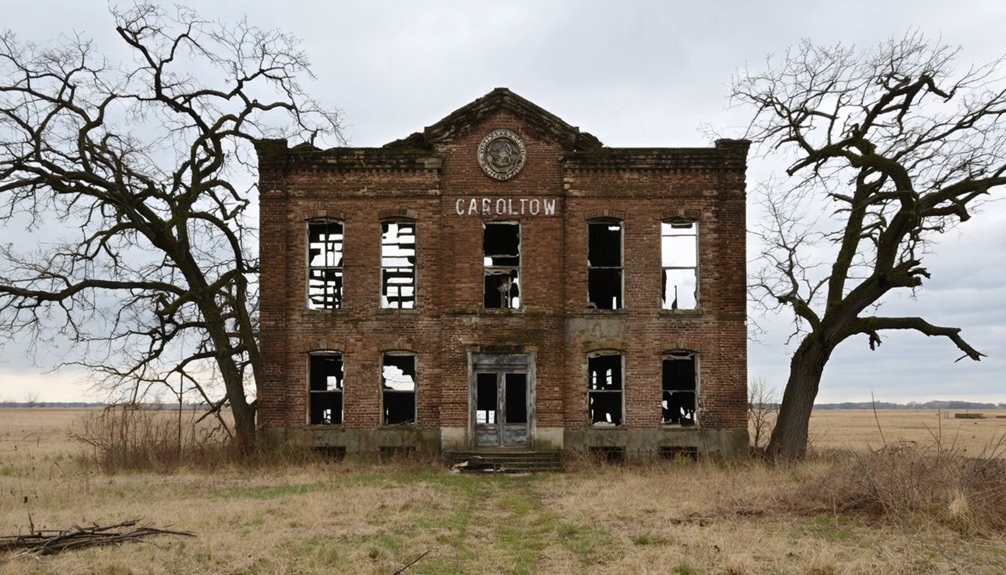
Imagine serving as your county’s seat of government one decade, only to watch that distinction—and your entire future—relocate down the railroad tracks the next. That’s exactly what happened to Carrollton when Carroll County established its government there in 1855.
In one decade Carrollton held power as county seat; in the next, it watched everything disappear down the rails.
The community constructed a two-story courthouse in 1858 for $3,000, symbolizing permanence and prosperity. Yet by 1869, Carroll City‘s central railroad location proved irresistible, and the county seat vanished despite protests.
Named after Declaration signer Charles Carroll, Carrollton’s decline was swift. Today, the Carrollton Community Heritage Club maintains community memories through Carroll County Historical Society bus tours.
These historical preservation efforts let you explore what remains, with refreshments served where government buildings once stood—a testament to how quickly American towns can rise and fall.
Stiles: The Town That Vanished From Maps
You’ll find that Stiles reached its peak in 1858 with 100 residents, serving as a bustling rural hub where farmers filled hitching racks every Saturday to grind grain and conduct trade.
The town’s decline began in the 1920s when Dr. Giles departed for Bloomfield and the Methodist Church disbanded, accelerating through the following decades.
Peak Population and Prosperity
By 1858, Stiles had reached its population zenith of 100 residents, establishing itself as a class D-agricultural community sustained by the surrounding patchwork of small family farms.
The town’s fertile loamy soil supported agricultural prosperity that would eventually face agricultural decline as transportation patterns shifted away from river commerce.
During this peak year, you’d have found a thriving commercial center featuring:
- Seven active businesses including three general stores, a grist mill, and a sawmill processing local timber and grain
- Two practicing physicians who operated their own drug stores, providing essential medical services to farmers
- A blacksmith shop serving as the mechanical hub for farm equipment repairs and horseshoeing
This pre-railroad era represented Stiles’s golden age, when milling operations and trading networks kept the settlement economically viable.
Complete Erasure From Geography
Unlike most American ghost towns that leave behind weathered structures or roadside markers, Stiles achieved something far more absolute—it vanished entirely from cartographic existence.
After 1858, the town disappeared from Iowa state maps, leaving no highway markers or geographic reference points. Modern geographic memory holds no trace of its Davis County location—you won’t find it on contemporary maps or GPS systems.
This erasure occurred gradually as the railroad bypassed Stiles, triggering economic collapse and resident abandonment.
Map archival gaps now make pinpointing its exact coordinates nearly impossible. No federal buyout or natural disaster forced this deletion; the town simply faded from documentation as infrastructure crumbled.
Today, Stiles exists only in historical archives, representing complete geographic obliteration.
Periwinkle Place Manor: Chelsea’s Haunted Funeral Home
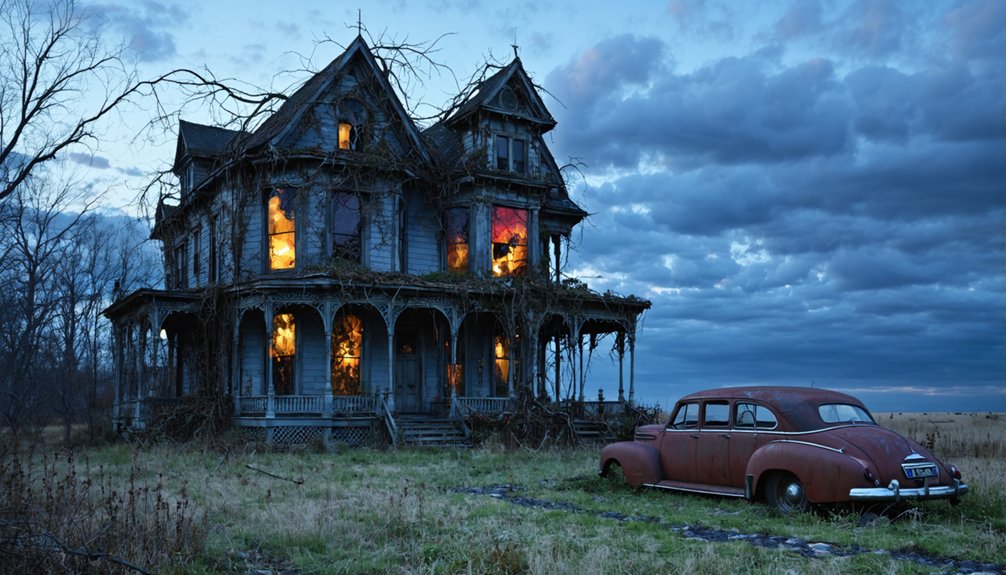
For over 111 years, the Hrabak Funeral Home served Chelsea, Iowa, as the final stop for the deceased before their burial.
Founded by Joseph Hrabak Sr. in 1892, this Czech heritage establishment operated at 704 Main Street until July 2003.
After fire, flooding, and abandonment, Jodi Philipp purchased the property in 2013, transforming it into Periwinkle Place Manor—named for an antique 1900s casket displayed in the lobby.
You’ll encounter haunted legends throughout this bed and breakfast where vintage artifacts remain:
- Original body elevator still transports guests between floors
- Multiple caskets preserved throughout the premises
- Active paranormal phenomena including banging doors, moving blankets, and spirit voices
The third floor reports the most activity.
Paranormal investigators contacted Joseph Hrabak’s spirit speaking in Czech-accented tones, establishing this former funeral home as Iowa’s premier haunted destination.
Submerged Ghost Towns Beneath Iowa’s Man-Made Lakes
While Chelsea’s Periwinkle Place Manor preserves the spirits of the deceased above ground, Iowa conceals entire communities beneath its waters. Lake Red Rock, Iowa’s largest lake at 15,250 acres, submerged six towns when the U.S. Army Corps of Engineers completed Red Rock Dam in 1969.
Red Rock, Cordova, Dunreath, Rousseau, Fifield, and Coalport disappeared beneath the reservoir after decades of devastating floods dating to 1851. The Corps purchased properties throughout the 1960s, relocating residents with fair compensation before demolishing structures.
The lake filled within months, faster than anticipated. During droughts, low water levels expose submerged infrastructure—roads, foundations, and cemetery stones.
Today’s visitors boat and fish above former town sites, where drought-resistant vegetation now marks shorelines where communities once thrived.
Frequently Asked Questions
Can You Legally Explore Abandoned Buildings in Iowa’s Ghost Towns?
While you’re drawn to exploration, you can’t legally enter abandoned buildings without permission. Property ownership rights persist despite abandonment, and Iowa law treats unauthorized entry as trespass. Legal considerations require respecting private property boundaries always.
What Safety Precautions Should Visitors Take When Touring Haunted Locations?
You’ll need proper safety gear like sturdy boots and flashlights, plus solid emergency plans including exit routes and communication devices. Scout locations beforehand, bring companions, and stay alert for structural hazards in deteriorating buildings.
Are There Guided Tours Available for Iowa’s Ghost Towns?
While Iowa’s ghost towns whisper historical legends through abandoned ruins, you won’t find guided tours at Buckhorn, Rockville, or Elkport. These tourist attractions remain self-guided adventures, though nearby haunted sites like Farrar Schoolhouse offer organized paranormal experiences.
As you explore these forgotten places, you’ll undoubtedly feel the eerie atmosphere that has inspired haunting tales from iowa’s ghost towns. Each site carries its own stories of despair and mystery, drawing in both history buffs and thrill-seekers alike. Keep your camera ready, for you might just capture a glimpse of the past lingering in the shadows.
How Much Does an Overnight Stay at Villisca Axe Murder House Cost?
You’ll pay $199 per room or $599 for the entire house overnight at Villisca Axe Murder House. This paranormal experience lets you explore the historical lore where eight people were murdered in 1912, with no electricity or running water.
What Equipment Do Paranormal Investigators Recommend for Ghost Town Visits?
You’ll need investigative tools like EMF detectors, spirit boxes, and thermal cameras—85% of paranormal teams use K2 meters. These devices help capture spectral evidence through electromagnetic readings, EVPs, and temperature fluctuations during your independent ghost town explorations.
References
- https://khak.com/abandoned-attraction-ghost-town-buckhorn-iowa/
- http://www.iowapbs.org/article/8600/local-legends-around-iowas-haunted-locations
- https://freepages.history.rootsweb.com/~gtusa/usa/ia.htm
- https://www.onlyinyourstate.com/experiences/iowa/ia-ghost-town
- https://carte-urbex.com/en/blogs/infos/top-10-abandoned-places-in-iowa
- https://www.discoverguthriecounty.org/ghosttowns
- https://en.wikipedia.org/wiki/List_of_ghost_towns_in_Iowa
- https://www.youtube.com/watch?v=CdF9cW6ikmU
- https://usghostadventures.com/haunted-houses/villisca-axe-murder-house/
- https://en.wikipedia.org/wiki/Villisca_axe_murders