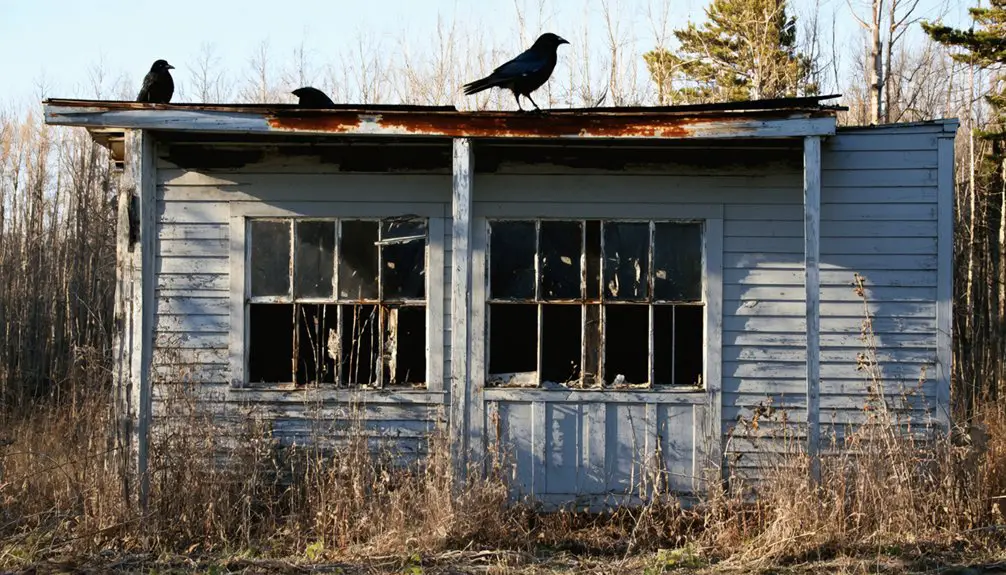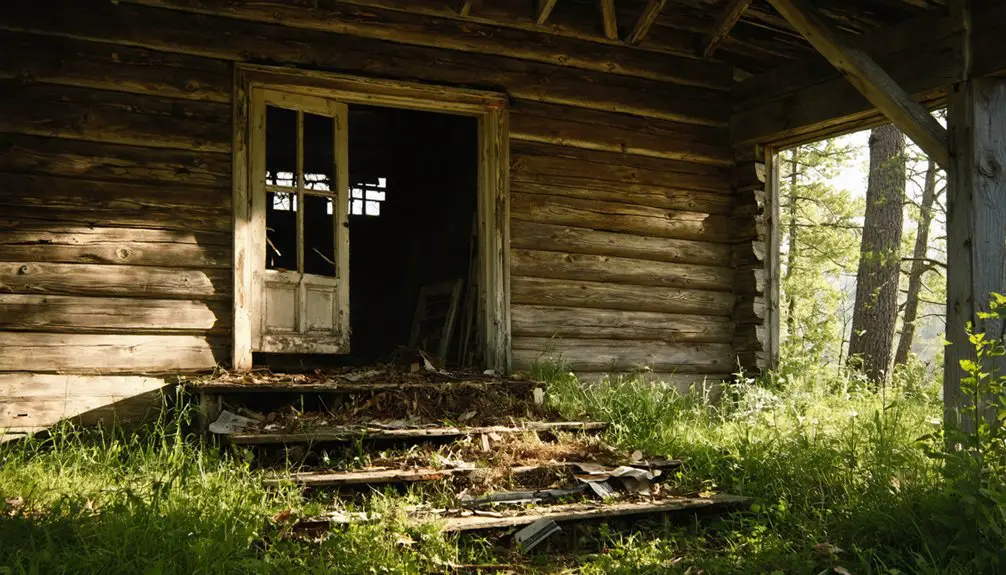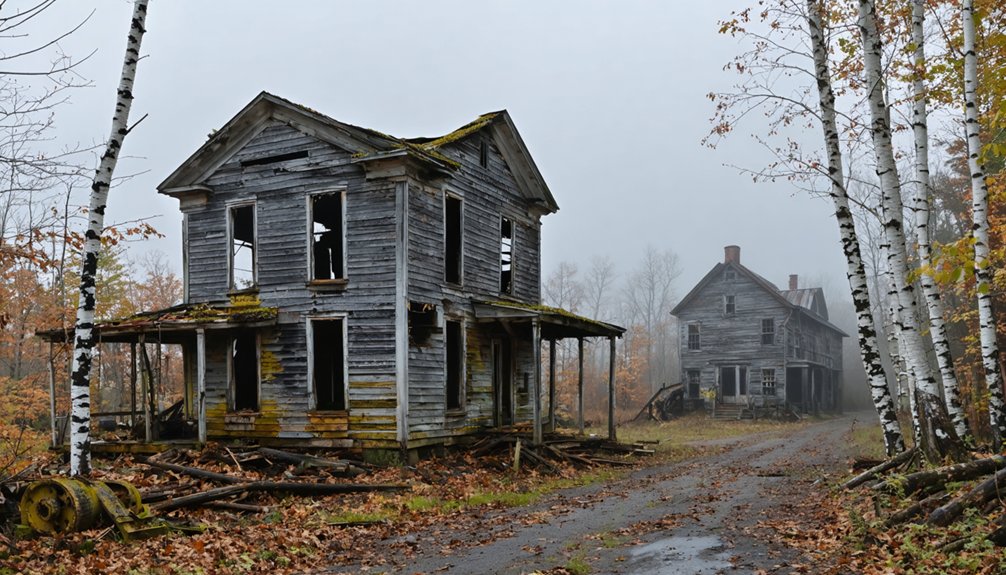
Maine’s haunted ghost towns include Sullivan’s Nelly Butler haunting from 1799—America’s first documented apparition case—and Flagstaff, flooded in 1950 to create a lake that now conceals building foundations. You’ll find Freeman’s dissolved settlement from 1808 with relocated graveyards, Riceville’s mysteriously vanished community from 1905 along Buffalo Stream, and Ligonia Village‘s industrial ruins near South Portland. These sites blend documented historical decline with persistent supernatural legends, though Fort William Henry is often misattributed to Maine when it’s actually located in New York. The stories behind each location reveal distinct causes of abandonment.
Key Takeaways
- Nelly Butler’s ghost haunted Sullivan, Maine in 1799-1800, appearing in white to arrange marriages before prophesying deaths.
- Flagstaff was intentionally flooded in 1950 to create a lake; building foundations remain visible on clear days.
- Riceville vanished overnight in December 1905 after a tannery explosion, leaving only overgrown cellars and cemetery stones.
- Freeman Ghost Town declined from 838 residents in 1840 to dissolution in 1937 due to war losses and migration.
- Ligonia Village gradually dissolved in the 19th century; now lies beneath South Portland’s industrial area and Calvary Cemetery.
Nelly Butler Haunting: America’s First Documented Ghost Story
During the bitter winter of 1799, a disembodied voice emerged from the cellar of Abner Blaisdell’s house on the rocky shores of Taunton Bay in Sullivan, Maine, marking what would become America’s first documented ghost haunting.
America’s first documented ghost haunting began in a cellar on Maine’s rocky shores during the bitter winter of 1799.
The spirit identified itself as Nelly Butler, who’d died in 1797. By January 1800, direct communication began, with the apparition eventually appearing in a flowing white gown to over a hundred witnesses.
The ghost’s primary objective was orchestrating a marriage between her widower, Captain George Butler, and Lydia Blaisdell. The union occurred in May 1800, fulfilling the spirit’s demand. The spirit tragically prophesied that Lydia would die after childbirth, a prediction that came true when both Lydia and her child perished.
The historical significance lies in consistent testimonies across multiple witnesses, while its cultural impact shaped regional paranormal records. Abraham Cummings collected 37 eyewitness testimonies, including his own, which were later documented in *The Nelly Butler Hauntings: A Documentary History* by Marcus LiBrizzi in 2010.
The haunting concluded in mid-August 1800 when the apparition vanished permanently.
Flagstaff Ghost Town: The Submerged Settlement Beneath the Lake
What drives a community to deliberately erase its own towns from existence? You’ll find the answer beneath Flagstaff Lake’s surface, where Central Maine Power flooded entire settlements in 1950.
The geography of submerged towns reveals foundations still visible on clear days—remnants of villages spanning Bigelow and Carrying Place townships.
Long Falls Dam’s construction brought devastating environmental impact of flooding, drowning rich Dead River valley soil and timber resources that once sustained thriving communities.
The submersion process unfolded ruthlessly:
- Land purchases began 1930s; clear-cutting finished 1948
- Buildings burned deliberately in 1949 before flooding
- Residents fought eminent domain but lost legislative battle
- July 4, 1949 “Old Home Days” served as final farewell
The destruction marked the end of annual gatherings that had fostered town identity and strengthened bonds among residents for generations. Today, Maine’s fourth-largest lake conceals what government power took—a haunting reminder that your freedom can vanish beneath manufactured progress. Located 20 miles north of Rangeley, near Eustis, Flagstaff Lake stands as Maine’s largest man-made lake and draws tourists who unknowingly visit above the drowned town.
Freeman Ghost Town: Abandoned Farmlands and Forgotten Graveyards
While Flagstaff’s demise came through government decree, Freeman’s dissolution unfolded through the quieter violence of economic obsolescence.
You’ll find this 1808 settlement born from Revolutionary War survivors peaked at 838 residents in 1840, operating Maine’s largest sheep farms across thousands of cleared acres.
Historical preservation efforts document Jonathan Freeman III’s estate rising from $16 to $146 between 1805-1817, marking prosperity’s arc.
Civil War losses and Industrial Age migrations drained the population to 219 by 1930.
The town surrendered incorporation in 1937, leaving stone foundations across abandoned farmlands as archaeological significance markers.
You can trace five generations of self-sufficient farming through 1791 land grants at Maine Historical Society.
Family cemeteries, now exhumed and relocated to Gray Cemetery, stand behind stone walls—silent witnesses to economic forces stronger than community will.
Freeman Ridge originated from relief grants awarded to Revolutionary War survivors after Portland (Falmouth) was burned, with the 1791 land document establishing the foundation for this settlement that would eventually dissolve circa 1937.
The town maintained train stations, schools, churches, and businesses during its peak, creating a thriving community infrastructure that would later crumble into architectural remnants.
Riceville Ghost Town: The Vanished Community of Township 39
Where Freeman’s abandonment stretched across decades of slow attrition, Riceville’s erasure came swift and absolute—a single December night in 1905 that erased a thriving industrial outpost from Hancock County’s map.
One December night in 1905 transformed a bustling tannery town into memory, its 136 residents scattered to history.
You’ll find Township 39’s former tannery hub along Buffalo Stream, where 136 residents once processed buffalo hides into leather. The Shaw brothers established operations in 1879, later expanding under Buzzell and Rice ownership with schools, stores, and entertainment venues.
Riceville’s haunting elements include:
- Community legends of mysterious mass deaths and unmarked graves
- A lantern explosion that destroyed the $50,000 tannery facility
- Mining history whispers of undeveloped coal veins beneath township grounds
- Complete population vanishing—from 75 residents to zero within five years
The post office was disincorporated following the devastating fire, marking the formal end of village services. Today’s overgrown cellars and cemetery stones mark where prosperity once flourished. This abandoned settlement reflects the broader pattern of ghost towns that dot Maine’s landscape, each preserving stories of sudden demographic shifts and economic collapse.
Ligonia Village and Fort William Henry: Industrial Ruins and Colonial Fortifications
Unlike Riceville’s catastrophic single-night collapse, Ligonia Village dissolved gradually into South Portland’s industrial sprawl—a mid-19th-century Irish settlement that evolved from farmland to factory town before vanishing beneath cemetery stones and oil tanks.
You’ll find its Ligonia industrial ruins scattered from Cash Corner to Fore River’s waterfront, where Portland Rolling Mills workers once lived in a self-contained community with shops, schools, and railway access. Henry Bodge’s 1866 hall and Portland Kerosene Company’s refinery marked its industrial peak before automobile ownership and mill competition triggered depopulation.
Today, Calvary Cemetery and petroleum facilities occupy the ghost neighborhood, with dispatchers still referencing “Ligonia” on calls. Oil companies now control portions of the former settlement site, leaving minimal traces of the original residential infrastructure. The better-preserved Perkins ghost town, located elsewhere in Maine, protects 13 historic buildings through active preservation efforts, some structures dating to the 1750s. Research confirms Fort William Henry absence from Maine’s ghost town records—that colonial fortification belongs to New York’s Lake George, not Cumberland County’s industrial history.
Frequently Asked Questions
Are Any Maine Ghost Towns Legally Accessible to the Public Year-Round?
You’ll find Fort Williams Park and Perkins Township’s Swan Island accessible year-round, where historical preservation meets local legends. These sites offer unrestricted exploration of Maine’s abandoned settlements, with documented ruins and interpretive details available through all seasons.
What Safety Precautions Should Visitors Take When Exploring Abandoned Maine Settlements?
Urban exploration isn’t a horror movie—you’ll need real safety gear: N95 respirators for asbestos, sturdy boots, flashlights, first aid kits, and offline maps. Verify legal access first, scout structures carefully, and never explore Maine’s abandoned settlements alone.
Can You Camp Overnight at Any of Maine’s Ghost Town Locations?
Camping at Maine’s ghost towns requires landowner permission on private property. You’ll find most abandoned settlements lack legal camping infrastructure. Respect historical preservation laws and local folklore while exploring these sites, as trespassing violations carry serious penalties.
Do Any Ghost Towns in Maine Offer Guided Tours or Visitor Centers?
Maine’s ghost towns don’t offer guided tours or visitor centers—you’ll explore independently. Historical preservation focuses on maintaining sites, not infrastructure. You’re free to discover local legends yourself at places like Fort William Henry, experiencing authentic, unstructured adventures through Maine’s abandoned past.
In addition to ghost towns, there are numerous historic sites in Maine that highlight the state’s rich maritime history. From lighthouses that stand sentinel over the rocky coast to charming fishing villages, each destination tells a unique story. Exploring these locations offers a glimpse into the past, allowing visitors to connect with Maine’s vibrant cultural heritage.
What Permits Are Required to Photograph or Document Maine’s Ghost Towns?
You’ll need owner permission for private properties and should register with Maine Film Office beforehand. Historical preservation rules apply at registered sites, though photography regulations remain minimal statewide. Special permits govern state parks and protected locations.
References
- https://gardinerpubliclibrary.org/the-spooky-side-of-maine-hauntings-urban-legends-from-the-pine-tree-state/
- https://en.wikipedia.org/wiki/List_of_ghost_towns_in_Maine
- https://www.mooseriverlookout.com/post/ghost-towns-in-maine-9-fascinating-places-that-rose-fell
- http://strangemaine.blogspot.com/2012/02/ghost-towns-of-maine.html
- https://www.americanghostwalks.com/the-ghosts-of-maine
- https://hometownriot.com/blogs/explore-the-usa/haunted-maine-stephen-king-fans
- https://b985.fm/6-maine-ghost-towns-you-never-knew-existed/
- https://downeast.com/history/maine-ghost-stories/
- https://www.americanghostwalks.com/articles/nelly-butler-maine-ghost-story
- https://sullivansorrentohistory.org/pages/5359