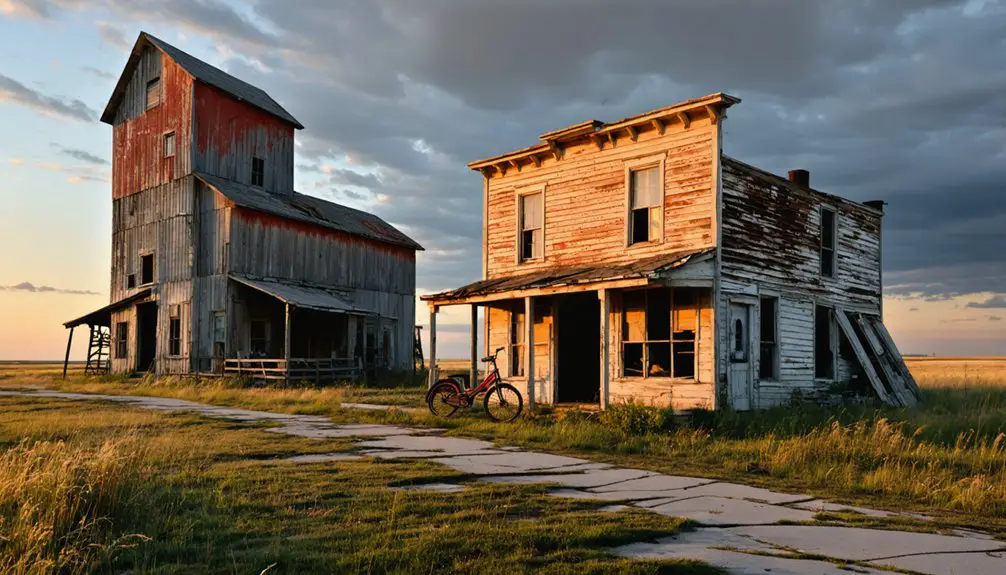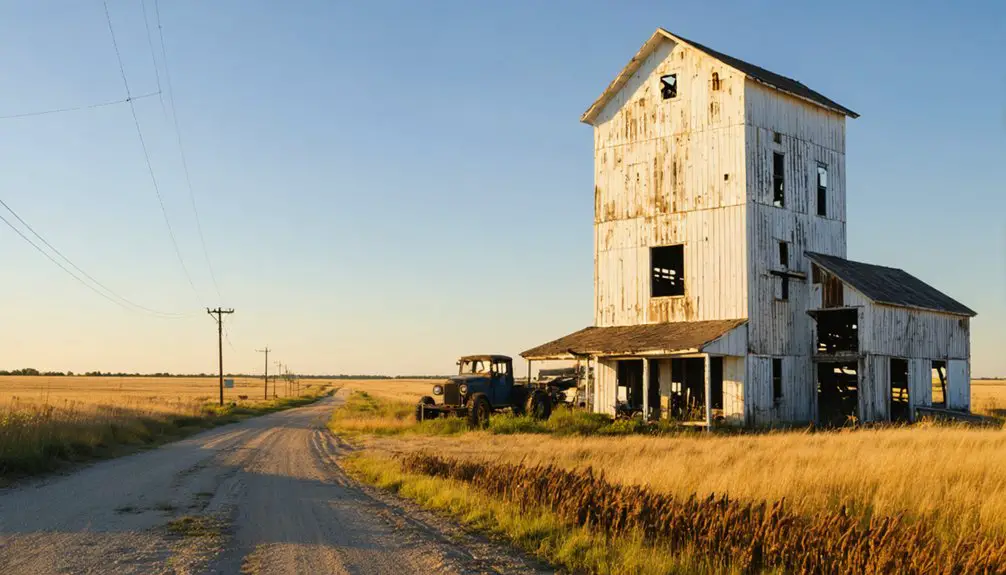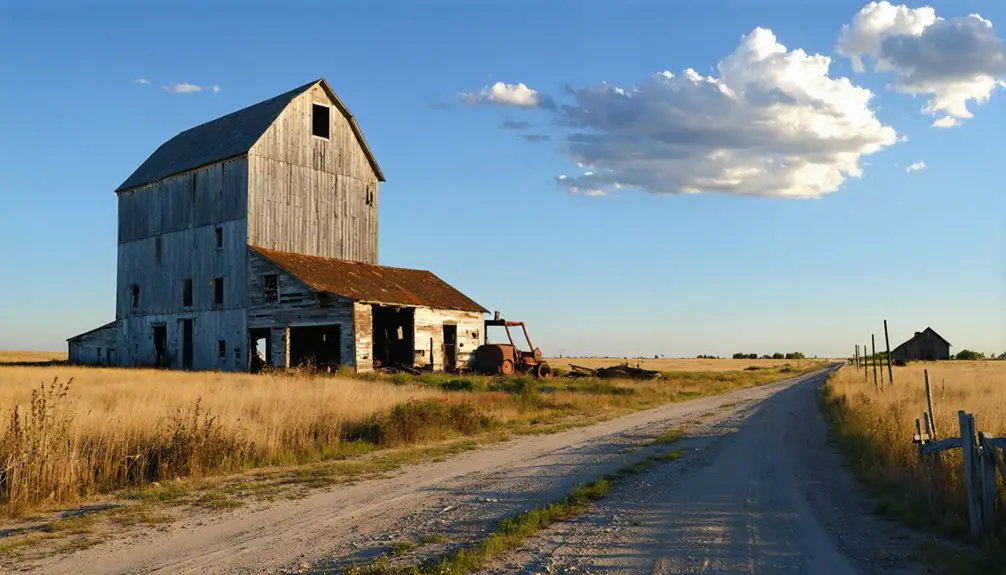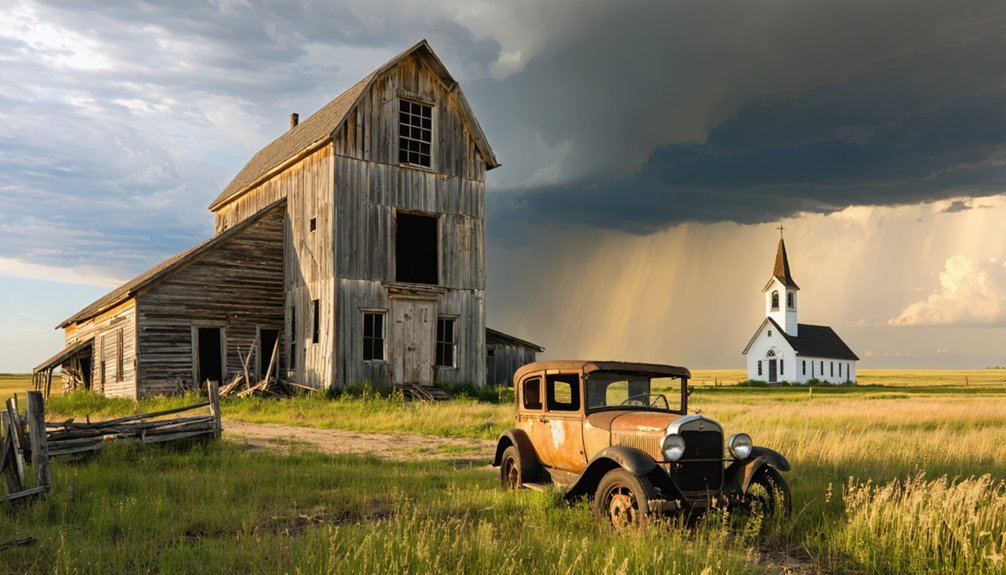
You’ll find North Dakota’s most haunted ghost towns scattered across the windswept plains, where documented paranormal activity dates back decades. Sims features the Gray Lady ghost—believed to be Bertha Dordal—with church records from the 1930s documenting unexplained organ music and moving curtains at the 1884 Lutheran parsonage. Other locations include Arena’s abandoned amphitheater landscape, Charbonneau’s crumbling hotel ruins, and San Haven Sanatorium’s deteriorating five-story building. Phantom trains, glowing gravestones at Tagus, and ghostly cavalry at Fort Abraham Lincoln round out these authenticated encounters that await your exploration.
Key Takeaways
- Sims’ 1884 Lutheran parsonage is haunted by the Gray Lady ghost, identified as Bertha Dordal, with documented paranormal activity since the 1930s.
- St. Olaf Lutheran Cemetery in Tagus features glowing gravestones and aggressive phantom dogs that threaten trespassers exploring the abandoned town.
- Phantom trains reportedly rumble through empty streets of former railroad towns, echoing their historic transportation routes that once sustained these settlements.
- San Haven Sanatorium, closed in 1992 amid mistreatment allegations, remains a dilapidated five-story building with cottages attracting paranormal enthusiasts.
- Fort Abraham Lincoln features ghostly cavalry sightings, while Chateau de Mores reports silver brush sets mysteriously redistributing themselves without explanation.
Arena: A Forgotten Settlement in Burleigh County
In January 1906, the Patterson Land Company established Arena after acquiring over one million acres of railroad land stretching between Bismarck and Jamestown.
Postmaster Harry A. Mutchler named it for the natural basin surrounded by rolling hills.
The town’s name Arena reflects the amphitheater-like landscape that first captivated its postmaster and early settlers.
You’ll find this settlement 35 miles northeast of Bismarck in Burleigh County, where it once thrived with 150 residents by 1920.
The Northern Pacific Railroad‘s arrival sparked rapid growth, attracting German immigrants and Jewish merchants.
By 1924, Arena featured multiple thriving businesses including a train depot, general stores, a creamery, a schoolhouse, a bank, and a grain elevator.
The economy centered on agriculture and livestock, with residents growing corn, hay, grain, wheat, oats, and flax.
Today, ghost stories linger among the few remaining historical landmarks: St. John’s Lutheran Church with its crumbling foundation, deteriorating grain elevators, and scattered houses.
The Great Depression devastated Arena’s population, which plummeted to just nine residents by 1968.
The post office’s closure in 1996 sealed its fate as a ghost town.
Sims and the Mysterious Gray Lady Ghost
If you’re searching for North Dakota’s most documented paranormal site, you’ll find it in Sims, a near-ghost town 30 miles west of Bismarck.
The Gray Lady has haunted the 1884 Lutheran parsonage for nearly a century. The spirit, believed to be Pastor’s wife Bertha Dordal who died between 1916-1918, became so renowned that First Lady Laura Bush visited the restored parsonage in 2008.
She called it the best stop on her North Dakota tour. Church records from the 1930s confirm that concerned residents wrote their bishop about unexplained phenomena.
This makes it one of few hauntings with archival church documentation. Reports included the church organ playing on its own and windows mysteriously opening and closing without explanation.
Witnesses have spotted her drawing back curtains at the parsonage window during early morning hours, adding to the century of documented sightings.
The Gray Lady Legend
Among North Dakota’s forgotten settlements, Sims stands apart as a community where documented paranormal claims span nearly a century.
The Gray Lady’s identity traces to Bertha Dordal, a 26-year-old pastor’s wife and church organist who died between 1916-1918 from a prolonged illness in the parsonage’s first-floor bedroom.
Her husband later remarried and moved to Larimore, but Bertha’s presence allegedly remained.
Witnesses have reported windows opening and closing on their own in both the parsonage and church, manifestations that eventually prompted concerned townspeople to contact a bishop about her persistent presence.
The town of Sims appears on disambiguation pages due to multiple locations sharing the name across different regions.
Laura Bush’s 2008 Visit
When First Lady Laura Bush arrived at the Sims Scandinavian Lutheran Church in October 2008, she wasn’t just visiting another rural historic site—she’d chosen North Dakota’s oldest Lutheran church west of the Missouri River as the final stop on her nationwide preservation tour.
As honorary chairperson of the Save America’s Treasures Program, she’d personally selected this ghost town for its exceptional prairie architecture and preservation efforts.
The parsonage had stood vacant for nearly 25 years before volunteers completed restoration work in 2007.
Bush praised the 50-member congregation and Preservation North Dakota’s dedication, stating Sims represented “America’s story” and the “values that make America strong.”
She’d “saved the best for last,” bringing national recognition to this abandoned town‘s ghost town history and architectural significance.
The church had become known for being actively haunted, drawing visitors intrigued by both its historical importance and its ghostly reputation.
Located in Morton County, Sims sits about 50 miles west of Mandan and remains one of the few ghost towns with an active church still standing.
Blue Grass: A Town That Never Saw the Railroad
Thirty-five miles northwest of Mandan in Morton County, Bluegrass stands as one of North Dakota’s truest ghost towns—a settlement where the population has dropped to zero and silence now replaces the voices of the Germans from Russia homesteaders who once called it home.
Where voices of German-Russian homesteaders once echoed, only silence remains in this Morton County settlement frozen in abandonment.
The railroad never reached Bluegrass, sealing its fate. Its peak population of just 20 in 1920 tells the story of a community that couldn’t survive isolation.
What remains of this abandoned ruins:
- Farmhouse planned for fire department training burn
- Weathered barn on posted private property
- Gas station/store site—burned by vandals in 2014
- Rosebud Catholic Cemetery holding homesteader graves
- Garage structure gradually surrendering to time
This historical architecture crumbles while descendants, like the Krause family who departed in 1927, occasionally return to witness their ancestral home disappearing. The landscape features rolling hills and scenic beauty across all seasons, offering a haunting backdrop to what little remains of the settlement. Like the Northgate Port of Entry building that was demolished after abandonment, Bluegrass’s remaining structures face similar inevitable fates.
Charbonneau: Abandoned West of Watford City
Where does a railroad town go when the trains stop coming? You’ll find the answer fifteen minutes west of Watford City, where Charbonneau’s skeletal grain elevators pierce the prairie skyline.
Founded in 1913 along the Great Northern Railroad, this settlement honored Toussaint Charbonneau, Lewis and Clark’s interpreter recruited from nearby Hidatsa villages. By 1920, 125 residents supported a newspaper, bank, and general store.
Then the railroad rerouted. Historical migration drained the town—125 souls became fifteen by 1960. The post office’s closure sealed its fate.
Today’s architectural decay tells everything: broken schoolhouse, collapsing roofs, monuments to ambition abandoned. The cemetery remains best-maintained, ironically preserving names nobody remembers.
Posted signs warn you away, but the ruins stand visible on private land between Alexander and Cartwright.
Sherbrooke’s Silent Streets in Steele County
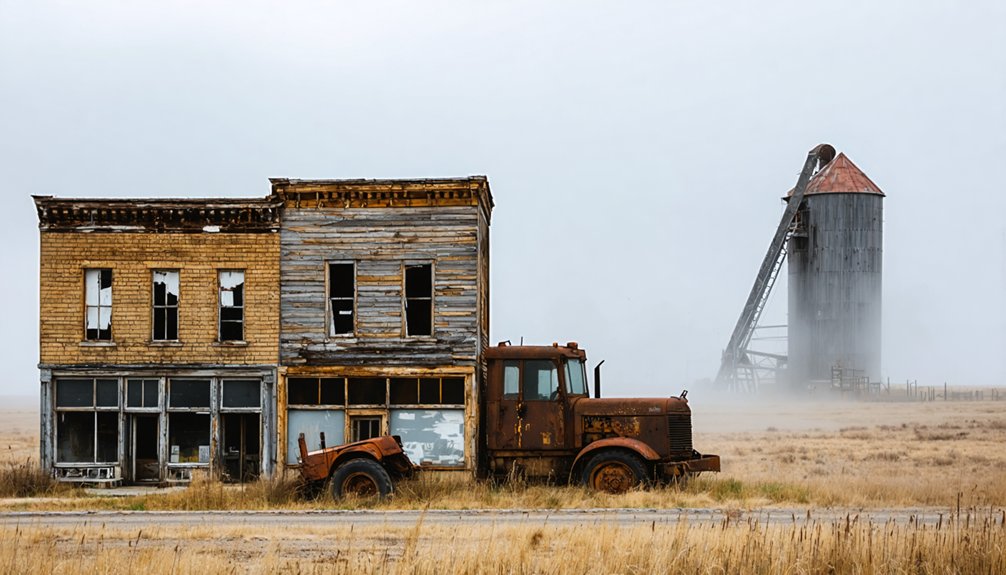
Although Sherbrooke once wielded enough political power to host President William McKinley in 1896, this Steele County ghost town couldn’t survive its own geographic limitations. Without railroad access, voters relocated the county seat to Finley in 1918, triggering complete abandonment.
You’ll find nature reclaiming what residents left behind:
- Sherbrooke House Hotel ruins with charred timbers and rusted bed frames
- Field stone foundations marking vanished businesses
- Lizzie Devlin’s pink house and grotto with Blessed Virgin Mary statue
- Two-room schoolhouse remnants slowly crumbling
- Empty streets where the Steele County Tribune once published
Today’s abandoned structures tell a stark story: political influence means nothing without infrastructure.
The 1919 Supreme Court decision sealed Sherbrooke’s fate, and by 1982, only two residents remained in this ghost town.
San Haven Sanatorium: Echoes of the Past
Deep in the Turtle Mountains’ foothills north of Dunseith, San Haven Sanatorium stands as North Dakota’s most haunting institutional ruin.
Established in 1909, this tuberculosis facility opened its doors to patients in November 1912, with Martha Magnusson of Wildrose becoming its first resident.
You’ll find remnants of three original 1913 cottages and the five-story main building, now swaying dangerously after thirty years of abandonment.
The institution’s transformation tells a darker story—from treating 140 TB patients by 1922 to housing over 1,300 developmentally disabled individuals by 1973.
Allegations of understaffing and mistreatment plagued its later years until court-ordered closure in 1992.
Today, urban exploration enthusiasts debate whether historical preservation can save this crumbling testament to institutionalization’s troubled legacy.
The Supernatural Side of North Dakota’s Abandoned Places
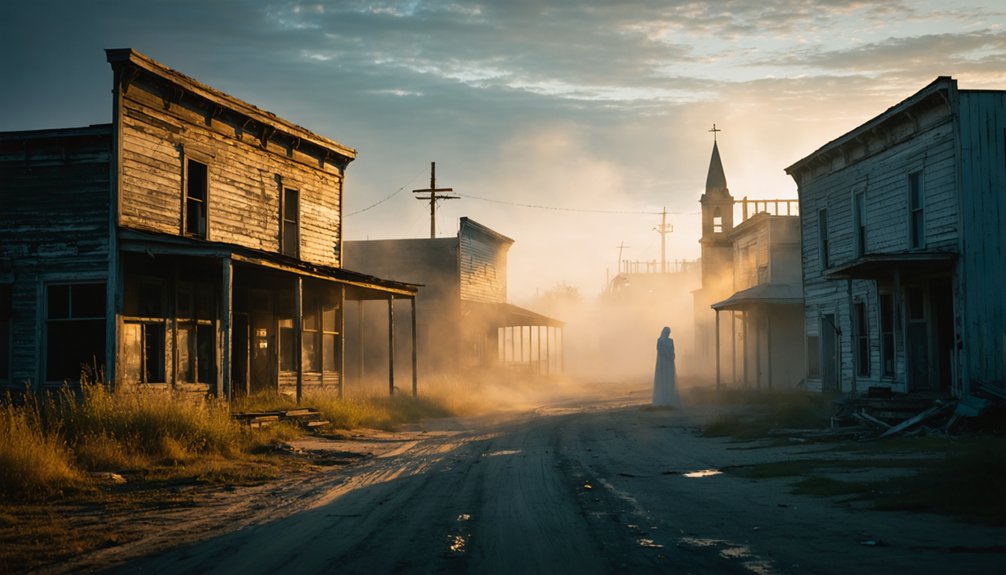
Beyond the crumbling architecture and overgrown streets, North Dakota’s abandoned settlements harbor tales that defy rational explanation. You’ll find urban legends woven through these forsaken places, where haunted artifacts and supernatural phenomena persist long after residents departed.
Documentary evidence reveals chilling encounters:
- Glowing gravestones illuminate St. Olaf Lutheran Cemetery in Tagus while phantom trains thunder through empty streets.
- Medora de Mores’s silver brush set rearranges itself nightly at Chateau de Mores, her body impression appearing on the deathbed.
- Spectral organ music emanates from Sims Scandinavian Lutheran Church without human touch.
- Fort Abraham Lincoln’s ghostly cavalry gallops across plains, accompanied by flickering cemetery lights.
- Aggressive phantom dogs snarl at trespassers exploring Tagus’s burnt church ruins.
These documented occurrences challenge skeptics seeking rational explanations for North Dakota’s paranormal persistence.
Exploring What Remains: Buildings and Landmarks
When physical structures outlast their communities, they transform into skeletal monuments marking where ambition once flourished. You’ll find St. John’s Lutheran Church commanding Arena’s landscape, while Crystal Springs’ schoolhouse crowns a hilltop visible from I-94.
Deisem’s Seventh Day Adventist Church stands alone among grass-hidden ruins. These architectural styles range from rural churches to commercial buildings, each reflecting settlers’ practical aspirations.
Preservation challenges intensify as elements reclaim abandoned spaces. Griffin’s stockyard infrastructure has nearly vanished, leaving minimal traces. Sims maintains an active church despite surrounding abandonment, demonstrating how community will determines survival.
Crystal Springs’ fieldstone fountain earned National Register recognition in 2010, proving documentation matters. You’re witnessing structures caught between existence and erasure, their fate depending on whether anyone remembers to care.
Visiting North Dakota’s Ghost Towns Today
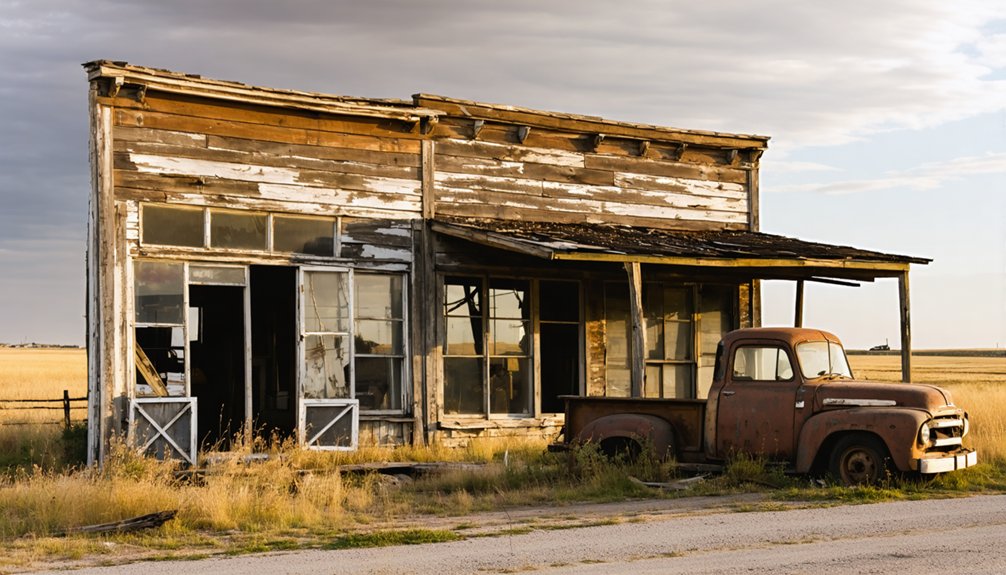
These architectural remnants await your exploration across North Dakota’s backcountry, though reaching them requires specific navigation.
Griffin in Pierce County sits 35 miles from major routes, while Arena lies northeast of Bismarck in Burleigh County. You’ll find no commercialization or guided tours—just unfiltered encounters with historical preservation.
Your journey demands awareness:
- Unstable structures threaten collapse without warning
- Hidden mine shafts pierce forgotten ground
- Wildlife encounters with prairie inhabitants require vigilance
- No interpretive signs mark Griffin’s grain elevator
- Silence broken only by wind and bird calls
Burnstad near Beaver Lake State Park and Sims with its active Scandinavian Lutheran Church offer accessible starting points.
The Ghosts of North Dakota website provides coordinates for remoter locations like Griffin, where you’ll discover history on your terms.
Frequently Asked Questions
Are There Guided Tours Available for North Dakota’s Haunted Ghost Towns?
No guided tours exist for North Dakota’s haunted ghost towns. You’ll explore independently, discovering historical legends at sites like Arena and Charbonneau. These self-directed visits offer excellent photography opportunities while you document abandoned churches and crumbling structures at your own pace.
For those seeking a more adventurous experience, the thrill of discovering abandoned places in eastern North Dakota can be unmatched. Each location tells a story of the past, inviting explorers to uncover the mysteries hidden within their walls. As you travel through the region, you’ll find remnants of a once-thriving landscape, now eerily silent and waiting to be rediscovered.
What Safety Precautions Should Visitors Take When Exploring Abandoned Buildings?
You’ll need sturdy boots, respirators for dust, and flashlights when entering abandoned structures. Test floors before stepping, watch for structural hazards like rotting beams, and stay alert for wild animals seeking shelter in North Dakota’s decaying buildings.
Can You Legally Enter and Photograph the Structures in These Ghost Towns?
You can’t legally enter without permission due to trespassing laws protecting private property. Photography permits aren’t required from public roads, but you’ll need owner consent for structure access. Most North Dakota ghost towns remain privately owned, requiring advance authorization.
What Is the Best Time of Year to Visit North Dakota Ghost Towns?
Late September offers 70-degree temperatures and 40% fewer crowds than summer peaks. You’ll find ideal conditions for photographing deteriorating structures while exploring historical legends and local ghost stories without peak-season restrictions limiting your independent access.
Are There Other Haunted Locations Near These Ghost Towns Worth Visiting?
Yes, you’ll find several haunted sites near North Dakota’s ghost towns. Sims Church features the Gray Lady, while San Haven Sanatorium reports intense paranormal activity. Medora’s historic buildings showcase local legends, and Fort Buford documents soldier apparitions from the 1800s.
References
- https://us1033.com/a-haunting-look-at-some-real-life-north-dakota-ghost-towns/
- https://northernsentry.com/2025/06/26/north-dakota-ghost-towns/
- https://ghostsofnorthdakota892857007.wordpress.com/2015/10/30/true-ghost-towns-population-zero/
- https://hot975fm.com/north-dakota-ranks-1-for-ghost-towns/
- https://www.youtube.com/watch?v=8GO57Im_dss
- https://www.northdakotahauntedhouses.com/real-haunts/
- https://en.wikipedia.org/wiki/List_of_ghost_towns_in_North_Dakota
- https://www.quincyvagell.com/arena/
- https://www.legendsofamerica.com/arena-north-dakota/
- https://www.youtube.com/watch?v=JrbLsH8cdps