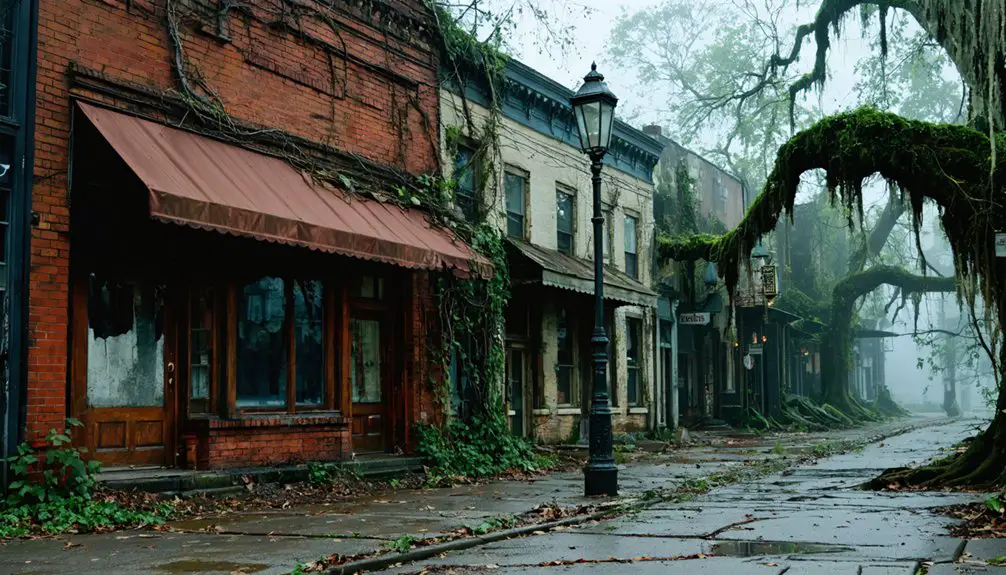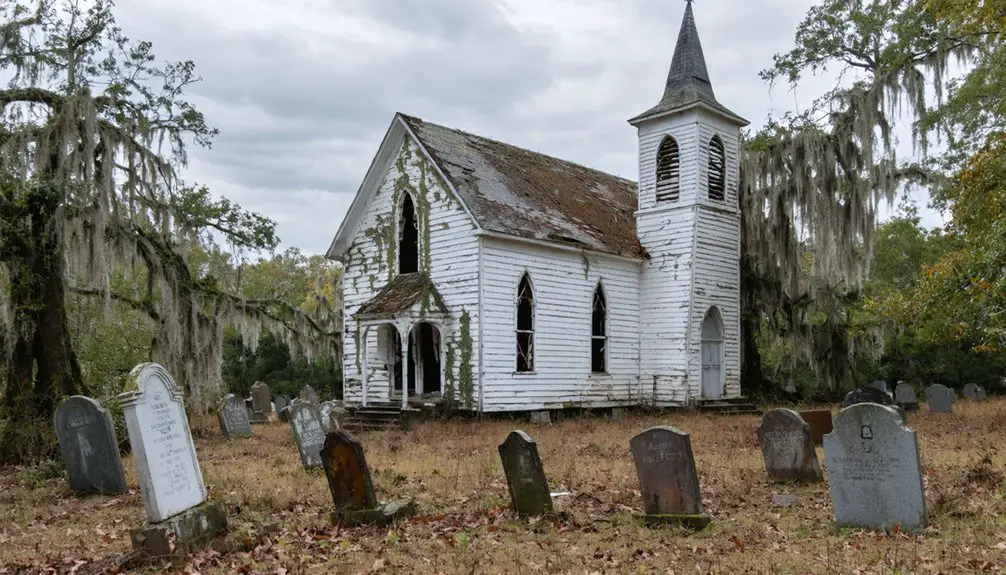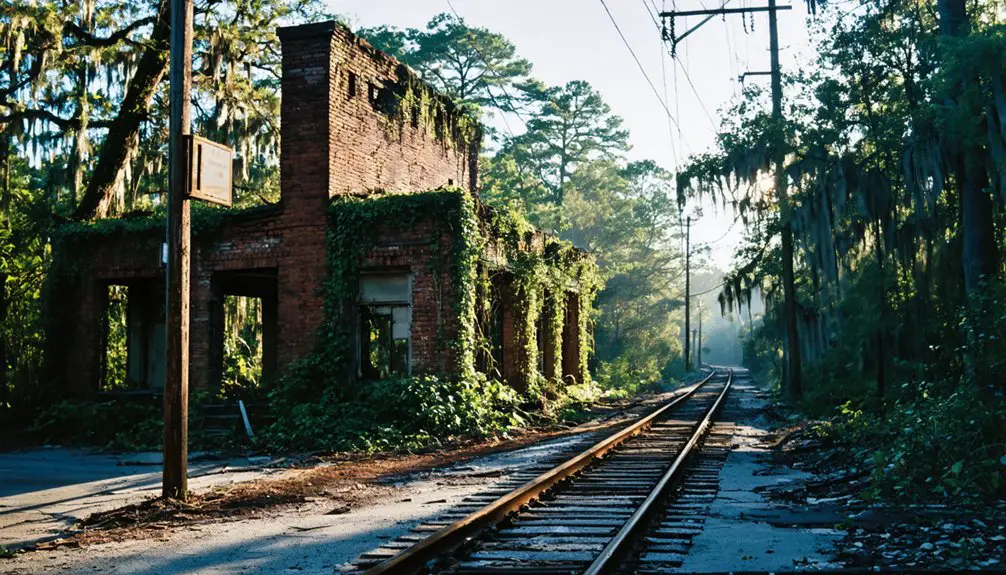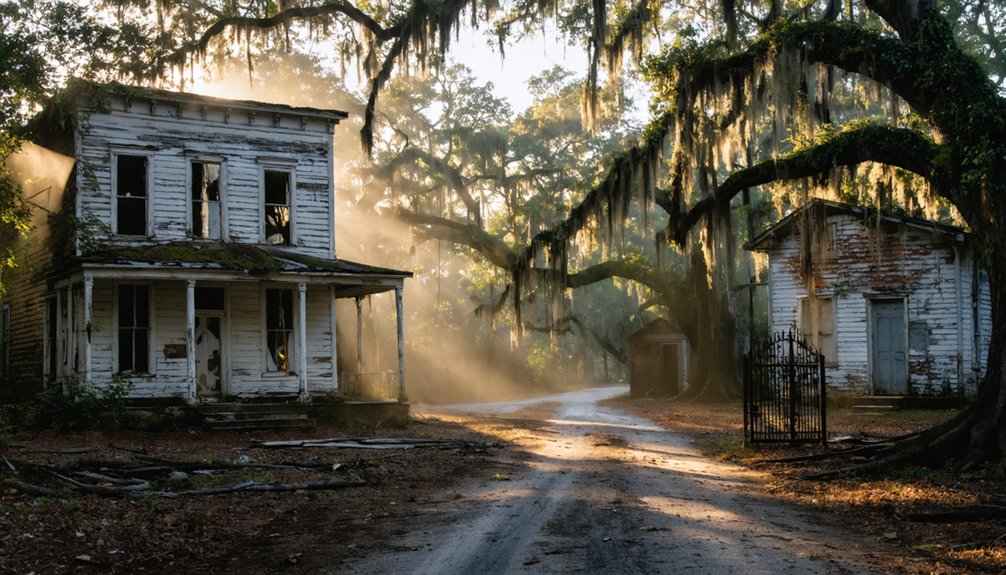
You’ll find South Carolina’s most haunted ghost towns include Dorchester, a colonial settlement burned during the Revolutionary War with ruins still standing at Colonial Dorchester State Historic Site, and Ellenton, displaced in 1950 for nuclear development after the 1876 race riot that killed 15 Black residents. Andersonville lies submerged beneath Lake Hartwell following devastating 1840 and 1852 floods, while Pickens Courthouse and Pinckneyville feature crumbling structures where witnesses report unexplained phenomena. The stories behind these abandoned settlements reveal how violence, disaster, and government displacement created today’s eerie landscapes.
Key Takeaways
- Dorchester features preserved colonial ruins including a tabby fort and church bell tower at Colonial Dorchester State Historic Site.
- Andersonville lies submerged beneath Lake Hartwell with visible underwater foundations and legends of phantom lights and haunted appearances.
- Old Pickens Presbyterian Church and jail are linked to Willie Earle’s lynching, with reports of ghostly cries and unexplained phenomena.
- Pinckneyville contains scattered brick foundations and folklore about Confederate gold, a hanging tree, and its failed ambitions.
- Hamburg’s ruins remain overgrown after the 1876 massacre and 1929 floods destroyed this once-important inland port town.
Dorchester: South Carolina’s Creepiest Abandoned Settlement
When English Puritans from Dorchester, Massachusetts established their namesake settlement along South Carolina’s Ashley River in 1696, they created what would become the colony’s third permanent community and one of its most archaeologically significant ghost towns.
You’ll find this once-thriving inland trade center reached 3,815 residents by 1748 before declining in the 1750s as families relocated en masse to Georgia’s fertile lands.
The Revolutionary War sealed Dorchester’s fate when British forces burned the fortified town in 1781.
Today’s Colonial Dorchester State Historic Site presents preservation challenges despite yielding over 6,500 artifacts from minimal excavation.
The archaeological record enables historical reconstruction of colonial life, revealing a self-sufficient community with markets, wharves, and boat-building facilities that vanished into South Carolina’s haunted landscape. The settlement’s tabby fort, constructed between 1757 and 1760 by enslaved labor and covering over 10,000 square feet, remains one of the few structures still standing today.
The brick bell tower of St. George’s Anglican Church stands as another haunting reminder of the abandoned settlement’s former prosperity.
Ellenton: The Town Swallowed by Nuclear Secrets
You’ll find Ellenton’s story distinctly different from typical ghost towns—this community didn’t decay naturally but vanished by government decree.
On November 28, 1950, the U.S. Atomic Energy Commission announced the acquisition of 300 square miles for the Savannah River Plant, forcing the complete evacuation of Ellenton and surrounding areas within fifteen months.
The decision displaced 6,000 residents, many of whom were Black farmers and sharecroppers who lost their homes and livelihoods to Cold War nuclear development.
The name Ellenton now serves primarily as a disambiguation reference for multiple locations, reflecting how thoroughly the original South Carolina town was erased from its place on the map.
Forced Evacuation in 1950
On November 28, 1950, the U.S. Atomic Energy Commission and DuPont announced Ellenton’s fate: complete evacuation for the Savannah River Plant. President Truman approved this massive undertaking amid Cold War fears and Soviet hydrogen bomb development.
You’d find it hard to believe the government displaced 6,000 residents—including hundreds of African-American farmers and sharecroppers—from their ancestral lands. The 300-square-mile perimeter needed for radiation cleanup and nuclear disposal operations left no room for negotiation.
Properties were purchased for $10 per acre or condemned outright, totaling just $19 million despite timber alone worth $28 million. By April 1, 1952, Ellenton’s last resident departed. The nuclear reactors became operational in 1953, employing around 24,000 workers at the facility’s peak.
The largest construction project since the Panama Canal erased entire communities—Dunbarton, Hawthorne, Meyers Mill—requiring relocation of 6,000 graves and countless homes. The site’s proximity to the Savannah River made it ideal for the hydrogen bomb facility’s crucial water supply needs.
Radioactive Wasteland Today
The Savannah River Site now sprawls across 310 square miles of Aiken, Barnwell, and Allendale counties, where Ellenton once stood. You’ll find more high-level nuclear waste here than anywhere else on Earth—a Cold War legacy from three decades of plutonium and tritium production.
The environmental contamination is staggering: 153 scattered dumps contain radioactive debris, while cesium-137 contaminates Par Pond after a 1963 fuel rod failure.
Today’s 14,000 workers focus on neutralizing this toxic inheritance. You can still see Ellenton’s curbs and sidewalks, though the R Reactor sits entombed in cement, sealed for 1,400 years. The government purchased property for ten dollars per acre or simply condemned it, spending around $19 million total to clear the area.
Public tours reveal what transparency looks like after decades of secrecy. The Department of Energy now manages this superfund site, grappling with contamination that demanded a 300-square-mile safety perimeter. The cleanup costs are estimated at $100 billion, making it one of the most expensive environmental remediation efforts in history.
Andersonville: Twice-Destroyed Mill Community Beneath the Waters
Beneath Lake Hartwell’s murky waters lies Andersonville, a South Carolina settlement that suffered destruction not once but twice before disappearing beneath the reservoir in 1962.
You’ll find this Revolutionary War-era town at the convergence of the Seneca and Tugaloo Rivers, where devastating floods in 1840 and 1852 demolished its textile mills.
When railroads bypassed the struggling community, residents abandoned their homes, leaving behind stone foundations and chimneys now resting 60–90 feet underwater.
Urban legends surround divers who’ve reported haunted appearances among weathered walls and grave markers beneath the surface.
The Army Corps of Engineers forcibly relocated families during Hartwell Dam construction, though some resisted surrendering their property.
The dam was built to control flooding, generate hydroelectric power, and provide water supply to the growing region.
Today, only Andersonville Island remains visible—a kayaker’s destination marking where an entire community once thrived before nature and progress erased it forever.
Locals report phantom lights beneath the lake’s surface and feelings of being watched by unseen entities, adding to the town’s ghostly reputation.
Pinckneyville: Eerie Remnants of Upstate’s Past
While Andersonville vanished beneath rising waters, Pinckneyville’s demise followed a different trajectory—one marked by unfulfilled ambitions and gradual abandonment. Established in 1791 as the Pinckney District seat, this settlement aspired to become the “Charleston of the Upstate.” Despite early infrastructure including inns, a jail, and post office, the community never thrived.
When district courts relocated to Union, Pinckneyville’s fate was sealed. Today, you’ll find scattered brick foundations, one remaining wall, and a solitary chimney marking the architectural decay. Local legends persist about Confederate gold and a “hanging tree,” though historians dismiss these as tall tales.
Vandalism has ravaged what time hadn’t already destroyed—spray-painted obscenities and plundered graves documented by 1982. Located in Union County, the site’s eerie remnants offer a haunting testament to ambition’s failure.
Pickens Courthouse: Where Presbyterian Spirits Linger
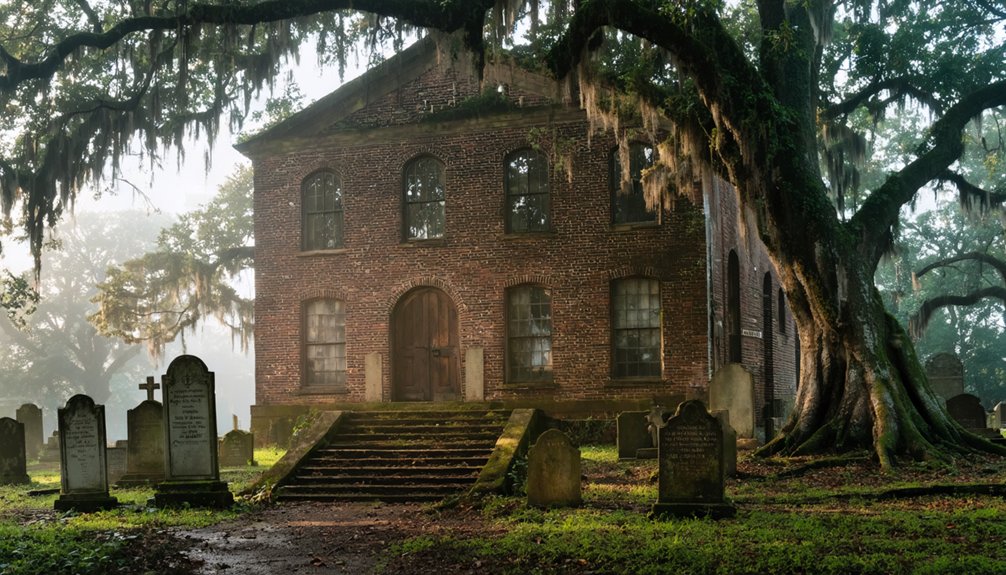
You’ll find one of South Carolina’s most historically significant ghost towns along the Keowee River, where Pickens Courthouse served as the district seat from 1828 until the county’s 1868 reorganization forced relocation.
The Old Pickens Presbyterian Church, constructed between 1849-1851, stands as the sole surviving structure from the original settlement that once housed over 100 residents. This brick meeting house, now listed on the National Register and maintained by the Historic Old Pickens Foundation, reportedly harbors unexplained phenomena within its walls.
The adjacent cemetery contains more than 200 marked graves.
Old Presbyterian Church Ruins
Constructed between 1849 and 1851 from clay bricks dug along the Keowee River banks, the Old Presbyterian Church stands as the sole surviving structure from the once-thriving town of Pickens Court House, established in 1828.
This rural architecture exemplifies mid-19th century meeting house design, featuring a two-story rectangular form with gable roof and boxed cornice. Unlike medieval architecture’s ornate complexity, you’ll find straightforward construction here—local townspeople built it using available materials.
The interior preserves original plaster-over-brick walls, unpainted poplar and pine pews, and a slave gallery accessible through a side entrance. You can explore the adjacent cemetery containing over 200 graves, including Lt. Joseph Reed’s from 1825 and Revolutionary War-era burials.
The Historic Old Pickens Foundation maintains the property, opening it to visitors during daylight hours.
Early County Seat History
The church’s congregation witnessed profound governmental upheaval when South Carolina’s 1868 Constitutional Convention converted Pendleton District into Anderson and Pickens Districts in 1826, with implementation delayed until 1828.
You’ll find minimal historical preservation at the original Pickens Courthouse site, where approximately 100 residents once inhabited a thriving district seat featuring shops, an academy, and the Keowee Courier newspaper.
Speculators purchased numerous lots, yet the town never expanded substantially.
When the courthouse relocated fourteen miles east in 1868, workers dismantled and transported the original structure, leaving behind architectural remnants that now whisper of governmental shifts.
The Old Pickens Presbyterian Church remained standing while surrounding buildings vanished, creating an isolated monument to this abandoned governmental center where freedom-seeking pioneers once administered frontier justice.
Paranormal Activity Reports
Since 1975, when Pickens County Jail ceased operations and transformed into a museum, visitors have documented disturbing paranormal phenomena tied to the facility’s darkest chapter.
Willie Earle’s ghost allegedly roams these halls, where he was imprisoned in 1947 before a white mob lynched him for a murder modern accounts suggest he didn’t commit.
Eerie legends surround his cries of “I didn’t do it!” echoing from former cells, accompanied by agonizing moans penetrating the walls.
Paranormal encounters documented by groups like Raven Paranormal and Ghost Girls include shadowy figures peering through barred windows, unexplained touches, and faint perfume scents.
Investigators believe entities attach themselves to historical artifacts throughout the National Register building.
These manifestations persist as reminders of injustice—an all-white jury acquitted Earle’s killers in under five hours.
Hamburg: Site of Tragic Violence and Abandonment
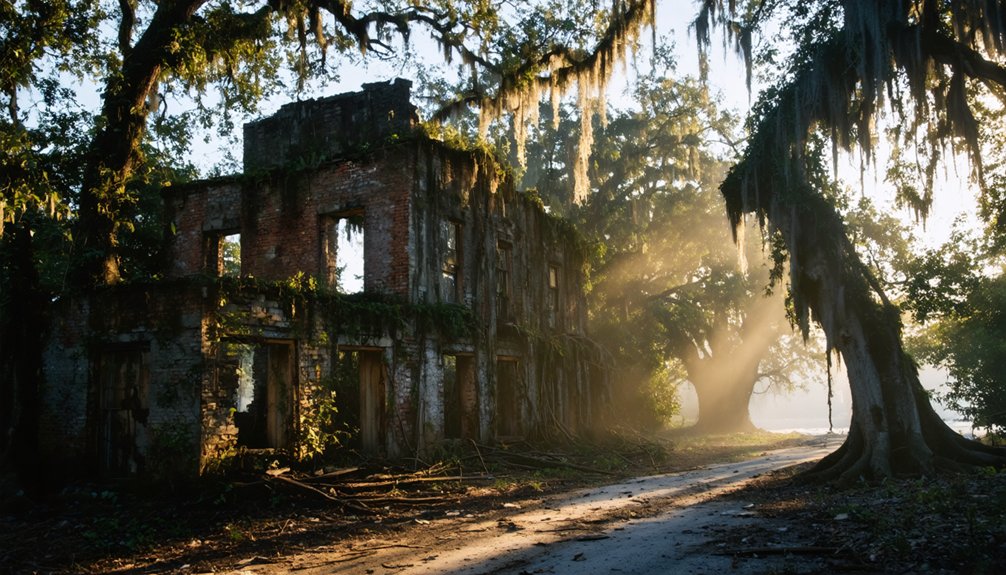
Founded in 1821 by Henry Shultz and named after his German hometown, Hamburg rose as a thriving inland port across the Savannah River from Augusta, Georgia. By the 1830s, cotton and tobacco trade made it South Carolina’s primary interior market.
Hamburg flourished as South Carolina’s premier inland trading hub, built on cotton and tobacco commerce flowing through its Savannah River port.
However, the Augusta Canal’s 1848 construction diverted commerce, triggering economic collapse.
Hamburg’s tragic fate sealed itself during the July 8, 1876 massacre—one of South Carolina’s bloodiest episodes of racial violence. Democratic paramilitary “Red Shirts” besieged forty black militiamen, executing five after capture.
This civil rights atrocity aimed at voter suppression devastated the community.
The violence forced permanent abandonment:
- Freedmen fled in terror, emptying the Republican stronghold
- State legislators revoked the town charter
- Catastrophic 1929 floods obliterated remaining structures
Today only overgrown ruins mark this blood-soaked ground
The Haunting Legends Behind South Carolina’s Ghost Towns
Beyond Hamburg’s documented atrocities, South Carolina’s abandoned settlements harbor stories that blur historical tragedy with supernatural folklore.
You’ll find Chappells’ deteriorating Main Street structures standing as monuments to architectural deterioration, their empty windows witnessing decades of neglect.
Ellenton’s federal displacement created instant abandonment when residents fled the Savannah River Plant’s construction, leaving behind whispers of lives interrupted.
Andersonville’s complete submersion beneath Lake Hartwell transformed an entire community into underwater ruins, where historical agriculture once sustained families.
Fairfield County’s sunken graves lie deep in wooded isolation, marking settlements lost to war and reconstruction.
These locations don’t require embellished ghost stories—their authentic histories of displacement, destruction, and abandonment provide sufficient haunting.
You’re exploring genuine American tragedy where communities vanished through federal projects, natural disasters, and economic collapse.
Why These Towns Were Abandoned and Left to Decay
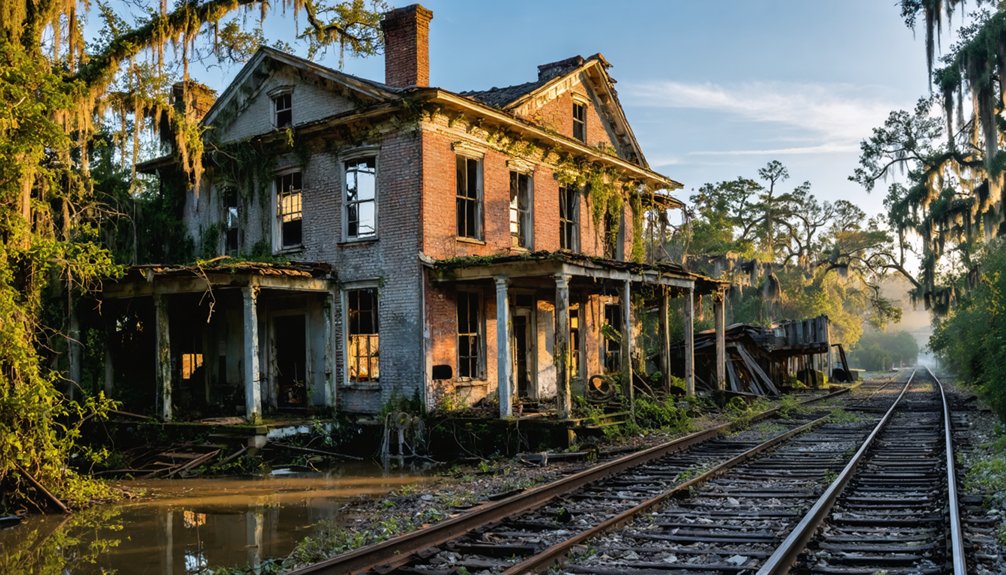
You’ll find that South Carolina’s ghost towns met their end through distinct forces: economic collapse when textile mills shuttered, natural disasters like catastrophic floods and earthquakes, and government seizure for Cold War infrastructure.
The forgotten history of South Carolina reveals tales of communities that thrived before being lost to time. These once-vibrant towns, rich with culture and industry, now serve as poignant reminders of the state’s past. As we explore each location, we unearth stories that highlight the resilience of the people who called them home.
The most dramatic abandonment came in the 1950s when federal authorities displaced 6,000 residents to construct the Savannah River Site, now a radioactive exclusion zone.
Other communities simply withered after Interstate 26 rerouted commerce away from established towns, cutting off their economic lifelines.
Economic and Natural Disasters
While some South Carolina ghost towns faded through gradual economic decline, others met sudden, catastrophic ends that forever barred residents from returning home. You’ll find communities swallowed by dam projects like Lake Marion and Lake Murray, where entire valleys disappeared beneath rising waters. The Broad River repeatedly devastated Midlands settlements, destroying hotels and depots that fueled railroad-era prosperity.
In addition to these ghost towns, there are also many historic towns to explore in South Carolina that showcase the state’s rich heritage. From the charming streets of Charleston to the colonial architecture of Beaufort, each town offers a glimpse into the past. These locations not only tell stories of resilience but also celebrate the vibrant culture that continues to thrive today.
Government seizures for nuclear facilities displaced 6,000 residents from Dunbarton and Ellenton, transforming 300 square miles into restricted contamination zones.
The human cost remains staggering:
- Over half of displaced Dunbarton residents over 50 died within ten years
- 150 graveyards required relocation from seized nuclear lands
- Families received $19 million for property worth $28 million
- Wildlife conservation efforts now restrict access to radioactive ghost towns
These catastrophes eliminated entire communities overnight, leaving climate change and contamination as permanent barriers.
Government Seizure and Violence
The federal government’s Cold War nuclear ambitions erased two entire communities from South Carolina’s map in the late 1940s. You’ll find nothing remains of Ellenton and Dunbarton—6,000 residents forcibly evacuated when the Savannah River Plant nuclear facility required 210,000 acres.
Government corruption became evident when officials paid just $19 million for land containing timber alone worth $28 million. They demolished every building, exhumed 150 graveyards, and relocated bodies.
Your cultural heritage vanished as displaced families moved into prefab government homes at New Ellenton.
Violence had already scarred these communities—the 1876 Ellenton Riot killed 15 blacks, including legislator Simon Coker, while the Hamburg Massacre suppressed black voting rights.
Democratic paramilitaries ended Reconstruction through bloodshed, previewing the government seizures that would complete these towns’ destruction decades later.
Exploring the Ruins: What Remains Today
South Carolina’s abandoned settlements offer varying degrees of physical evidence, from substantial architectural remnants to landscapes where only scattered artifacts hint at former habitation. At Colonial Dorchester, you’ll find tabby ruins and a powder magazine amid overgrown earthworks. Archaeological discoveries there include pottery shards and colonial artifacts.
Lake Marion’s submerged sites reveal Ferguson foundations and lumber kiln remains during low water.
Old Pickens Court House preserves its red brick Presbyterian Church, accessible Sundays April through October.
Edmundsbury and Ashwood present starker realities—scattered graves and a repurposed gymnasium respectively. Their landscapes are largely reclaimed through botanical preservation.
What you’ll encounter:
- Vine-covered walls standing as silent witnesses to colonial ambitions
- Fire-damaged rubble emerging from lake waters like skeletal reminders
- Cemetery gates opening onto forgotten communities
- Subsurface remnants hidden beneath fields, awaiting rediscovery
Visiting South Carolina’s Most Notorious Ghost Towns
Beyond the documented ruins lie five settlements whose histories reveal the devastating forces—both natural and human—that transform thriving communities into abandoned landscapes.
You’ll find Andersonville accessible only by boat after Lake Hartwell’s waters consumed it.
Ellenton remains off-limits, its radioactive grounds closed since government seizure for the Savannah River Plant.
At Dorchester, you can explore state-preserved structures from 1696, where archaeological teams continue uncovering artifacts.
Hamburg’s streets, once repopulated by Freedmen, witnessed the 1876 massacre that accelerated its decline.
Glenn Springs offers remnants of its closed academy near where luxury hotel guests once sought healing waters.
These haunted landmarks embody local legends of prosperity destroyed, their stories preserved through careful documentation rather than supernatural tales.
Frequently Asked Questions
Are Ghost Hunting Tours or Overnight Paranormal Investigations Allowed at These Sites?
Ironically, despite local legends attracting paranormal enthusiasts, you won’t find official ghost hunting tours or overnight investigations permitted at these sites. Historical preservation focuses on archaeological research and daytime exploration, letting you freely wander—but only during regular hours.
What Safety Precautions Should Visitors Take When Exploring Abandoned South Carolina Towns?
You’ll need sturdy boots, flashlights, and insect repellent while respecting historical preservation rules. Research local legends beforehand, but never enter structurally unsafe buildings. Always obtain proper permissions, stay alert for environmental hazards, and respect no-trespassing signs on private property.
Can You Collect Artifacts or Souvenirs From These Ghost Town Locations?
No, you can’t collect artifacts from these locations. Souvenir collection violates federal and state historical preservation laws, risking fines up to $10,000. These protections safeguard archaeological integrity while contamination and trespassing penalties further restrict access.
Which Ghost Town Has the Most Documented Paranormal Activity or Sightings?
Old City Jail in Charleston has the most documented paranormal activity, featuring spectral sightings on multiple TV shows and guided tours. Historical legends of wars and disease support extensive archival research documenting supernatural encounters you’ll find compelling.
Are There Any Other Haunted Ghost Towns in South Carolina Worth Visiting?
You’ll find Dorchester’s the only “haunted” town you can actually visit—thanks to historical preservation and local legends. The state maintains archaeological sites there, letting freedom-lovers explore remnants without trespassing on radioactive or flooded federal property.
References
- https://en.wikipedia.org/wiki/List_of_ghost_towns_in_South_Carolina
- http://www.onlyinyourstate.com/trip-ideas/south-carolina/haunted-road-trip-sc-ghost-towns
- https://www.hauntedrooms.com/south-carolina/haunted-places
- https://www.ghostsandgravestones.com/charleston/haunted-places-south-carolina
- https://www.randomconnections.com/ghost-towns-of-south-carolina/
- https://sctravelguide.com/2018/06/11/south-carolina-ghost-towns/
- https://wnok.iheart.com/content/2023-10-11-abandoned-south-carolina-town-named-the-creepiest-ghost-town-in-the-state/
- https://www.youtube.com/watch?v=-kK74wq5NUQ
- https://www.atlasobscura.com/places/dorchester-south-carolina-s-abandoned-town
- https://archaeology.org/issues/march-april-2014/off-the-grid/south-carolina-colonial-dorchester/