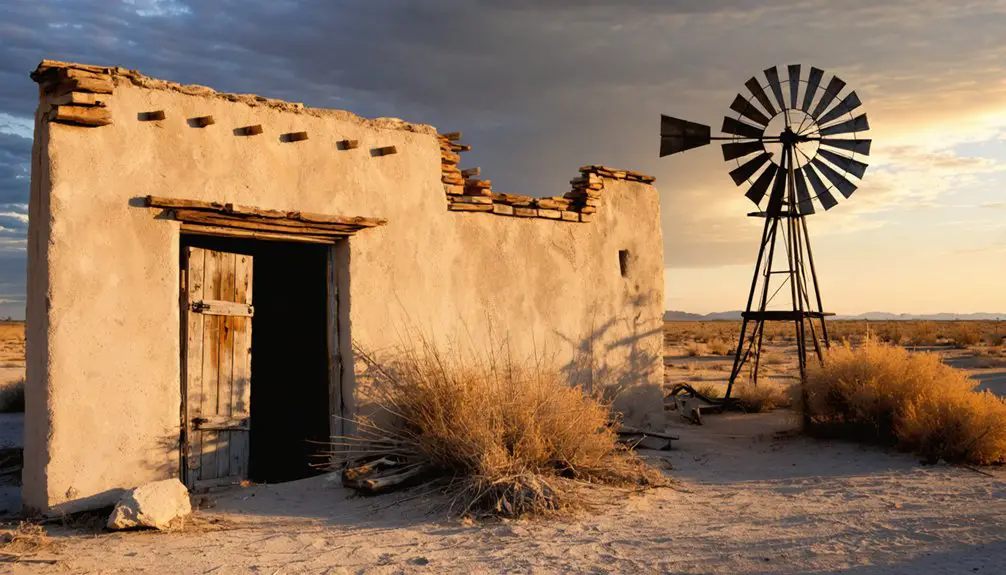
You’ll find Texas’s most haunted ghost towns scattered across remote regions where tragedy left its mark. Terlingua’s abandoned mercury mines near Big Bend harbor tales of restless spirits, while Belle Plain’s crumbling college ruins six miles from Baird draw reports of mysterious lights and unexplained encounters. Fort Griffin’s frontier violence and Thurber’s industrial past—complete with weathered chimneys—fuel paranormal investigations. Medicine Mound’s sacred Comanche peaks and hurricane-ravaged Indianola round out locations where locals insist the dead haven’t fully departed. What happened at each site reveals why these legends persist.
Key Takeaways
- Belle Plain features ghost sightings, mysterious lights, and unexplainable encounters near stone ruins of its courthouse, college, and cemetery.
- Terlingua’s abandoned mercury mine shafts are associated with urban legends of restless spirits haunting the remote Big Bend settlement.
- Thurber’s weathered chimneys and crumbling brick foundations connect to frontier violence stories from its diverse immigrant community’s industrial past.
- Fort Griffin’s decaying structures link to tales of frontier lawlessness and figures like Doc Holliday during its Wild West era.
- Glenrio’s abandoned Route 66 storefronts preserve ghost stories tied to faded mid-century American dreams along the historic highway.
Terlingua: Mercury Mining Settlement Near the Rio Grande
Nestled in the harsh desert landscape of the Big Bend region, Terlingua rose from the dust as one of Texas’s most prolific mercury mining settlements.
From barren desert wasteland to booming mercury empire, Terlingua’s remarkable transformation shaped the raw frontier of West Texas mining history.
You’ll find this ghost town approximately 90 miles south of Alpine, where cinnabar deposits sparked a boom that’d define the area’s mining history.
Chicago industrialist Howard E. Perry established the Chisos Mining Company in 1903, transforming desolate terrain into a thriving community. During its heyday from 1900-1920, you’d have encountered 2,000 residents—mostly Mexicans fleeing revolution—who built limestone-adobe homes around the company store, school, and dance pavilion.
World War I’s demand for explosives propelled production, making Terlingua America’s top mercury producer. The Chisos Mining Company operated continuously for 40 years from 1903, making it one of the longest-running mercury operations in Texas history. But by 1942, depleted ore and market collapse forced bankruptcy, leaving behind the skeletal remains you’ll explore today.
The cemetery, located on private property in the northeast section of Terlingua, remains active as families continue to visit and honor their loved ones.
Independence: Home to Texas’s First University
While Terlingua’s story unfolded in West Texas’s desert wilderness, Washington County’s Independence carved its name in history through education rather than extraction.
You’ll find where Sam Houston donated $5,000 to establish Texas’s first chartered university in 1845. Baylor University opened its doors here in 1846, operating separate male and female departments on campuses a mile apart until relocating to Waco in 1886. The university was chartered by the Republic of Texas, making it one of the oldest educational institutions in the state.
The campus location was chosen after competitive bids from Travis, Huntsville, and Shannons Prairie before classes began.
Today’s ghost town preserves remarkable archaeological significance as the only known site documenting nineteenth-century collegiate education in Texas.
You can explore ruins at Windmill Hill and pillars at Academy Hill, maintained by the Mayborn Museum for historic preservation.
During wildflower season, you’ll witness how this abandoned educational pioneer attracts visitors seeking both natural beauty and Texas’s independent spirit of learning.
Belle Plain: The Town That Lost to the Railroad
You’ll find Belle Plain’s demise written in railroad tracks that never came—when the Texas and Pacific Railway chose Baird in the early 1880s, it triggered an exodus that stripped this once-thriving county seat of its population, businesses, and future.
The train bell ringing through Baird six miles north became Belle Plain’s death knell, and by 1892, the town had practically vanished.
Before its decline, Belle Plain College enrolled 85 students by 1882 and became known for its impressive music program featuring a dozen pianos.
Today, only the native stone ruins of Belle Plain College and a cemetery mark where 400 residents once built their lives, making it one of Texas’s most complete ghost towns. The cemetery is regularly preserved to honor the early residents and their stories, serving as the last maintained connection to Belle Plain’s forgotten past.
Railway Rivalry Seals Fate
When the Texas and Pacific Railway plotted its route across Callahan County in the late 1870s, Belle Plain’s leaders couldn’t have imagined their thriving town would vanish within a generation.
The railroad impact proved devastating when T&P established Baird just six miles north, shifting the route twelve miles away from Belle Plain’s location. You’d have heard the death knell yourself—that first train whistle echoing through Baird in 1883, sealing Belle Plain’s fate forever.
The town decline accelerated rapidly. Businesses packed up, residents migrated north, and by 1887 only four families remained.
The county seat relocated, the newspaper followed, even the jail moved. Belle Plain College closed its doors, and by 1892, this once-prosperous settlement had essentially ceased to exist. The post office closed in 1909, marking the final chapter of Belle Plain’s existence as a functioning community. Today, the Dean’s House of native stone and crumbling college walls stand as eerie monuments to the community’s ambitious dreams.
Haunted Cemetery and Ruins
Today, Belle Plain’s stone skeleton stands in an empty field six miles southeast of Baird, accessible only by winding country roads off U.S. Highway 283.
The abandoned structures include the hollowed-out courthouse, the three-story college building with its distinctive cupola, and scattered stone residences—all standing windowless against the West Texas sky.
The lonely cemetery and crumbling ruins have attracted spiritual legends for generations.
Locals report ghost sightings, mysterious lights flashing from the graveyard, and unexplained encounters with strange visitors.
The Dean’s house, vandalized and burned, had furniture dragged into the front yard before destruction.
The property remains under private ownership, with the family denying access due to safety concerns including unstable structures, snakes, and hunters on the land.
Belle Plain Street in Brownwood still follows the ancient route once traveled by early settlers seeking protection at Camp Colorado and supplies from this frontier town.
These haunted remnants mark where nearly 1,000 people once lived, worked, and built Texas’s frontier—now silent for over a century.
Fort Phantom Hill: Abandoned Military Outpost on the Frontier
You’ll find Fort Phantom Hill’s strategic importance was clear from day one—established in 1851 as part of a defensive line protecting California-bound migrants crossing through Comanchería.
The post operated barely three years before harsh west Texas conditions forced its abandonment in April 1854, with only 139 men left to walk away from what they’d built.
Despite this short stint as an active fort, it served the frontier again as a Butterfield-Overland Mail station, Confederate outpost, and base for Buffalo Soldiers fighting the Red River War.
Strategic Frontier Military Importance
As tensions mounted between westward-pushing settlers and Comanche forces in 1851, Major General Persifor F. Smith’s military strategy positioned Fort Phantom Hill as a critical defense point. You’ll find this frontier defense outpost stood at the heart of Comanchería, where Comanche and Kiowa warriors controlled vast territories.
The fort served as your second-line protection in a defensive chain stretching from the Red River to the Rio Grande.
This strategic location offered:
- Oversight of California Trail routes where gold-seekers risked Comanche attacks crossing hostile terrain
- Launch points for cavalry patrols defending scattered western settlements from Indian raids
- Coordinated defense network connecting frontier outposts through crude roads across barren west Texas
The garrison’s military strategy transformed treacherous passage into safer corridors, though the harsh landscape challenged every soldier stationed there.
Brief Operational History
When Lt. Col. John Joseph Abercrombie led five companies to the Clear Fork of the Brazos on November 14, 1851, he’d already lost a teamster and dozens of animals to a Blue Norther. Military strategy demanded immediate construction despite brutal conditions.
You’ll find the soldiers worked through June 1852, hauling blackjack oak from 40 miles out and quarrying stone from Elm Creek. Construction challenges plagued every phase—jacal walls for enlisted men, stone buildings for supplies.
Command changed hands three times before abandonment in 1853. You’d have witnessed troops departing April 6, 1854, after just 680 days. Fire consumed the wooden structures shortly after, leaving only stone chimneys standing.
The post later served Butterfield-Overland Mail and Buffalo Soldiers fighting Comanche raids.
Thurber: From Coal Boom to Industrial Ruins
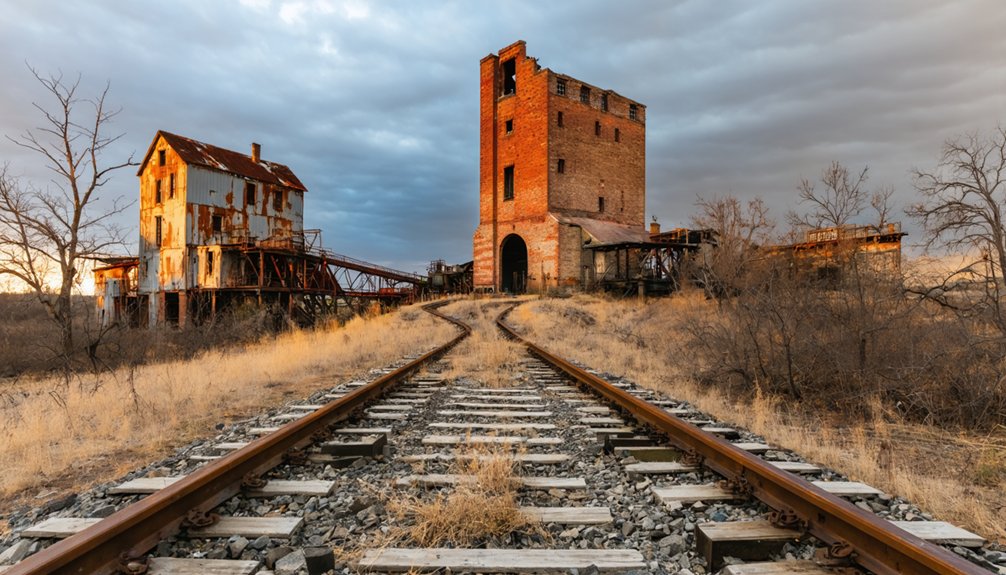
The discovery of coal deposits in northwestern Erath County during the mid-1880s transformed a remote stretch of Texas prairie into one of the state’s most significant industrial centers.
By 1920, Thurber’s population swelled to nearly 10,000 souls—immigrants from over a dozen nations working the mines that fed Texas & Pacific locomotives.
At its peak, nearly 10,000 immigrants from a dozen nations descended upon Thurber’s coal mines to power an empire.
You’ll find remnants of this vanished world scattered across the landscape:
- The towering smokestack from the electric plant, standing sentinel over empty fields
- Foundations where Stump Hill houses once sheltered striking miners
- Crumbling brick structures from the plant that paved much of Texas
Labor unrest plagued operations from the start. The 1903 Labor Day strike saw nearly every miner walk off.
Coal decline accelerated after 1917’s Ranger oil discovery, and by 1926, the mines closed permanently.
Medicine Mound: Sacred Comanche Ceremonial Grounds
While Thurber’s industrial fortune rose from coal extracted beneath the earth, Medicine Mound’s power emanates from four sacred peaks that pierce the Hardeman County prairie.
These dolomite formations, reaching 350 feet high, served as Comanche vision quest sites where warriors fasted four days for spirit communication with benevolent beings inhabiting the flat-topped summits.
You’ll find ancient rituals still echo here—Quanah Parker himself worshipped at these mounds, gathering medicinal herbs believed strengthened by spiritual influence.
The town that borrowed their name relocated for railway construction in 1908, peaked at 500 souls, then withered after a devastating 1932 fire.
Today’s cobblestone ruins and shuttered 1940s schoolhouse stand beneath those eternal peaks, now part of a 20,000-acre ranch where Comanche descendants still seek permission to honor their ancestors’ sacred ground.
Exploring Texas’s Most Haunted Abandoned Communities
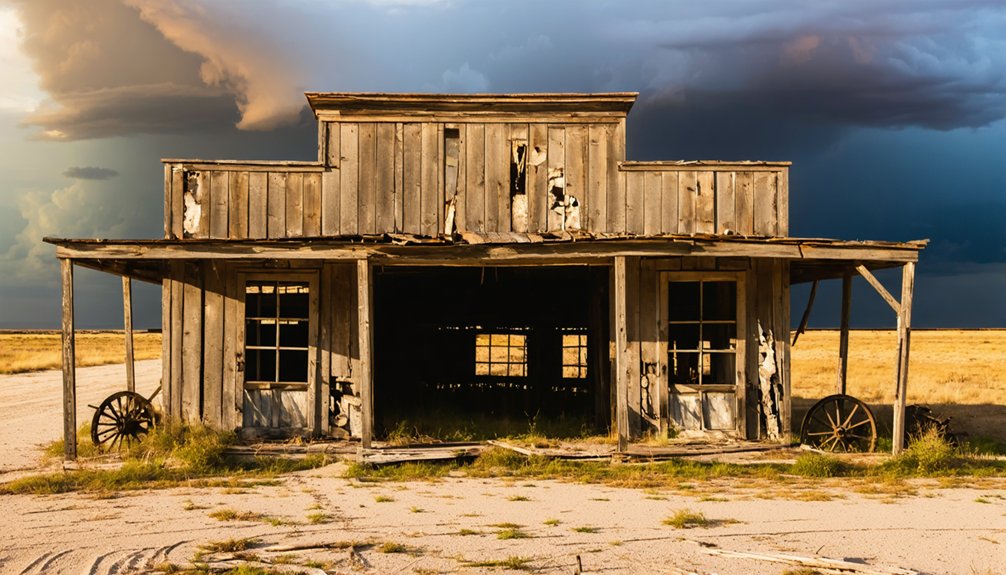
Beyond the ceremonial peaks and coal-blackened chimneys lies Texas’s darker legacy—abandoned settlements where paranormal encounters merge with historical tragedy. You’ll find urban legends woven through Terlingua’s deserted mine shafts, where restless spirits reportedly linger among boot hill graves.
Indianola’s hurricane-ravaged ruins attract paranormal investigations seeking the Queen City’s lost souls.
These haunted communities offer more than historical curiosities:
- Weathered chimneys at Thurber stand sentinel against starlit skies, marking where miners once toiled
- Fort Griffin’s crumbling foundations echo with tales of Doc Holliday’s gunfights and frontier violence
- Glenrio’s abandoned Route 66 storefronts preserve mid-century dreams turned to dust
You’re free to explore these sites independently, walking among authentic ruins where Texas’s untamed past refuses to stay buried.
Frequently Asked Questions
Are Visitors Allowed to Explore These Ghost Towns Overnight?
You can explore most Texas ghost towns overnight through designated campsites like Terlingua’s tent areas or nearby RV parks. However, nighttime exploration often requires guided tours at protected historic sites, while private property needs owner permission first. Another fascinating option for those intrigued by the supernatural is to visit haunted sites in Texas, where numerous legends and stories breathe life into the past. Many of these locations offer walking tours, allowing visitors to delve into their eerie histories under the cover of night. Whether you’re a skeptic or a believer, the tales woven around these sites can provide a thrilling experience that enhances the allure of the Lone Star State.
What Safety Precautions Should Tourists Take When Visiting Abandoned Structures?
Picture rotting floorboards cracking beneath your boots—you’ll need to test structural stability before entering, wear protective gear, travel with buddies, and practice photographic safety by staying alert rather than getting lost behind your camera lens.
Which Ghost Town Offers the Best Paranormal Investigation Opportunities?
Terlingua offers y’all the best paranormal investigation opportunities with its accessible historical landmarks, multiple haunted hotels, Boot Hill Cemetery paranormal sightings, and active community events that let you explore freely without restrictions on your ghost-hunting adventures.
Can You Camp Near These Haunted Locations in Texas?
You’ll find historical preservation rules keep y’all from camping right where local legends roam, but don’t fret—nearby state parks and BLM lands offer camping spots within 25-60 miles of these haunted Texas ghost towns.
What’s the Best Time of Year to Visit Texas Ghost Towns?
Visit Texas ghost towns in October through early November when you’ll enjoy comfortable weather for exploring historical preservation sites, experience local legends during Día de los Muertos celebrations, and avoid summer’s brutal heat while discovering authentic frontier heritage.
References
- https://texashighways.com/travel-news/four-texas-ghost-towns/
- http://texappealmag.com/texas-ghost-towns-explore-haunting-remnants-of-forgotten-cities/
- https://www.southernthing.com/ruins-in-texas-2640914879.html
- https://en.wikipedia.org/wiki/List_of_ghost_towns_in_Texas
- https://www.ghostsandgetaways.com/blog-1/27-fascinating-ghost-towns-in-texas
- https://www.hipcamp.com/journal/camping/texas-ghost-towns/
- https://austinghosts.com/jefferson-the-most-haunted-town-in-texas/
- https://www.texasescapes.com/TOWNS/Texas_ghost_towns.htm
- https://www.youtube.com/watch?v=_ndTmBBAC1I
- https://www.traveltexas.com/articles/post/spooky-roadtrip/