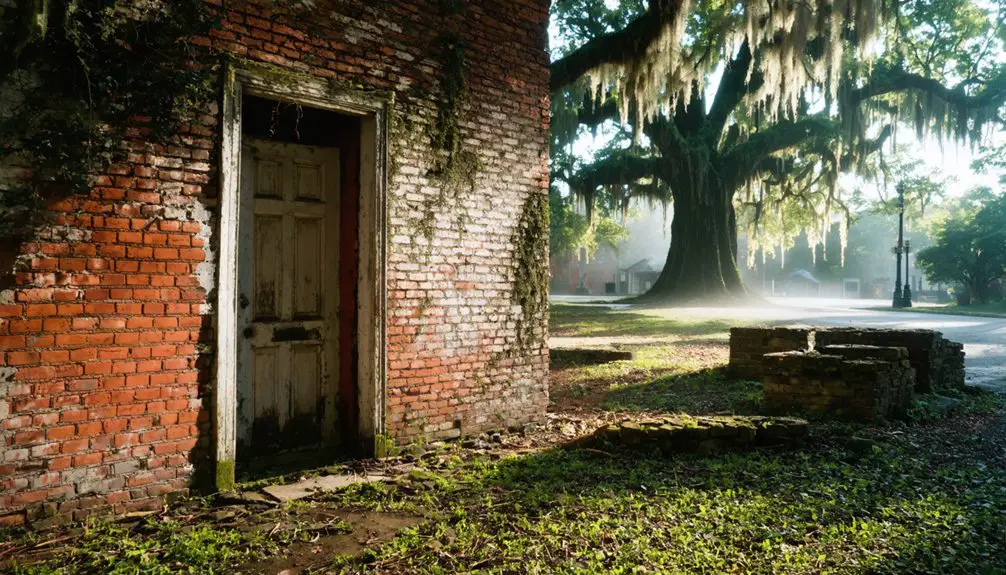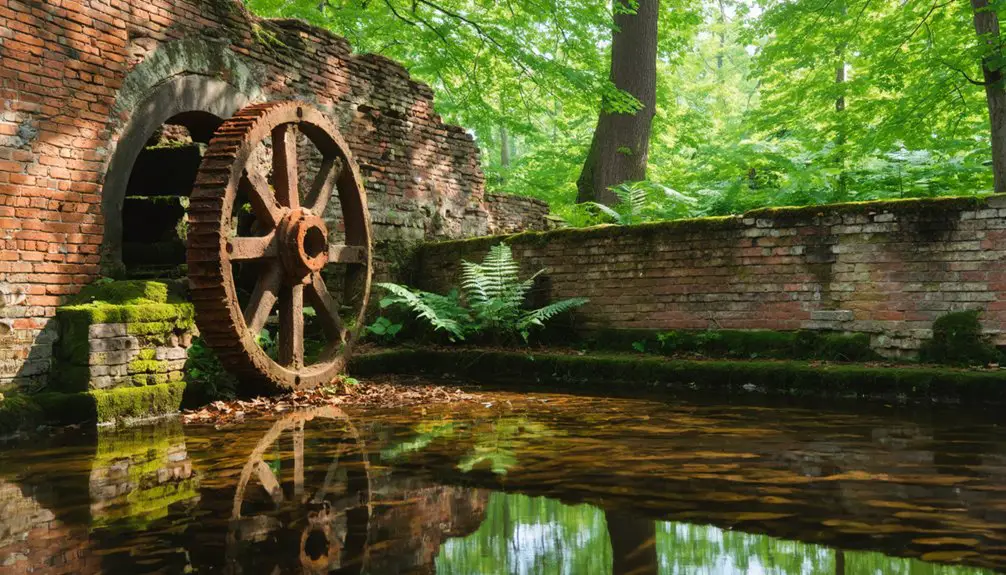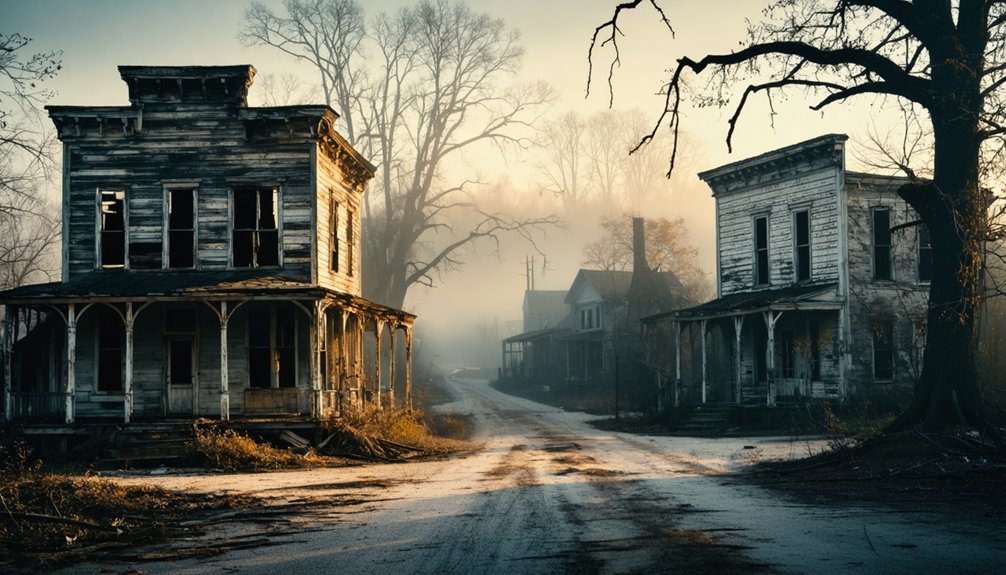
You’ll find Virginia’s ghost towns scattered from Colonial-era Jamestown, established in 1607 and nearly destroyed by starvation and disease, to Colchester’s 1753 tobacco port abandoned after malaria epidemics and river silting. Matildaville collapsed in 1828 when Light Horse Harry Lee’s canal project failed financially, while Union Level’s tobacco economy never recovered from Civil War devastation. The Elko Tract became a WWII phantom air base with camouflaged buildings, and Appalachia’s coal camps like Jewell Valley emptied as seams depleted. These abandoned settlements preserve archaeological evidence that reveals their complete histories.
Key Takeaways
- Jewell Valley, an abandoned 1930s coal town, features local ghost legends though paranormal activity remains unconfirmed by investigators.
- Matildaville, founded in 1793, is now a ghost town with visible stone ruins accessible via a 1.7-mile trail.
- Jamestown’s “Starving Time” (1609-1610) and archaeological evidence of cannibalism contribute to its dark historical reputation.
- Elko Tract, a WWII deception site called “Lost City,” features crumbling roads and abandoned structures near Richmond.
- Colchester, a colonial port from 1753, declined due to malaria epidemics and remains an archaeological site today.
Union Level: Tobacco Town Lost to Time
Deep in Mecklenburg County’s tobacco fields, Union Level emerged in the 1840s as a bustling way station where stagecoaches and wagons stopped along rural Virginia routes.
Union Level rose from Virginia’s tobacco country as a vital crossroads where weary travelers found rest along dusty stagecoach routes.
You’ll find records showing James Bridgeforth served as its first postmaster in 1836, before the town even formally existed.
The tobacco economy drove prosperity through the 1860s, when Union Level boasted more businesses than nearby South Hill.
The Civil War devastated this hub when tobacco warehouses never materialized.
Southern Railroad’s arrival around 1889 sparked revival, and by the 1920s, twenty businesses thrived—including C.P. Jones’s brick drugstore and Luther W. Lett’s general store.
C.P. Jones, known as “Neely,” earned his pharmacy license through a correspondence course and married Elfleda Saunders in 1898.
Rural decline accelerated through the Great Depression.
Train service ceased in the 1980s, severing the community’s vital transportation link.
Today, eight abandoned storefronts stand as Virginia’s most photographed ghost town, though residents still inhabit the surrounding area.
Visitors often explore historic sites in northern virginia to gain a deeper understanding of the region’s rich past. Many are drawn to the stories of resilience and transformation that these sites represent. The juxtaposition of modern life with remnants of history creates a unique atmosphere that captivates both locals and tourists alike.
Elko Tract: The Phantom Air Force Base
While Union Level’s decline stretched across decades, Virginia’s most unusual ghost town vanished by design. In 1942, the federal government condemned 2,400 acres near Richmond for military deception.
The 936th Camouflage Battalion constructed a phantom air base using Hollywood techniques—canvas buildings, plywood aircraft, and cloth-wire trucks. This wartime camouflage mimicked Richmond Army Air Base four miles away, intended to fool German bombers during potential raids. Soldiers moved props daily to simulate activity, even trimming brush into P-47 silhouettes. Troops lived in camouflaged huts directly on the decoy site to maintain the elaborate ruse.
The Luftwaffe never attacked. Post-war, the site served as bombing practice ranges and briefly as infrastructure for an abandoned mental hospital. In the late 1990s, the site became part of White Oak Technology Park, though much of the land remains undeveloped woodland.
Today, you’ll find crumbling roads, a lonely water tower, and runway outlines visible through trees—earning its nickname “Lost City” among conspiracy theorists and ghost town enthusiasts.
Matildaville: Washington’s Failed Canal Dream
Among the Potomac’s rocky cliffs, where whitewater crashes over an 80-foot drop, you’ll find the skeletal remains of George Washington’s most ambitious commercial failure. Revolutionary War hero Light Horse Harry Lee founded Matildaville in 1793 as headquarters for the Patowmack Canal project.
The town flourished with mills, foundries, and worker housing, eventually employing over 200 people through the Great Falls Manufacturing Company.
Historical engineering miscalculations doomed the venture. Construction costs exceeded $650,000 while tolls generated merely $172,689 by 1818. Temperamental river conditions limited navigable periods, and the canal couldn’t overcome Great Falls’ challenges. The Patowmack Company collapsed in 1828.
Town abandonment accelerated after Virginia repealed Matildaville’s charter in 1839. The Dickey family remained in the area for nearly 200 years, with descendants operating businesses and hosting visitors including presidents from George Washington to Teddy Roosevelt. The final resident departed in 1935.
Today, crumbling stone foundations mark Washington’s failed dream of continental commerce. Visitors can explore these ruins via the Matildaville Trail, a scenic 1.7-mile out-and-back hike through wooded terrain with views of the Potomac River falls.
Colchester: Malaria’s Riverside Victim
You’ll find Colchester’s story differs from most ghost towns—this once-thriving colonial port on the Occoquan River didn’t fade from economic failure alone, but from disease that drove residents away in the early 1800s.
Founded in 1753 as a rival to Alexandria, the town bustled with six taverns and tobacco warehouses before malaria epidemics, combined with river silting and the War of 1812, emptied its streets by 1820. The port had thrived on tobacco trade and goods exchange with England during its colonial heyday. Peter Wagener established the town on 350 acres purchased on the north bank, securing ferry crossing rights and control of the Ox Road terminus.
Today, archaeologists work in Old Colchester Park and Preserve, where infrared surveys have identified 19 sites and foundation remnants from a town that vanished in just 60 years.
Port Town’s Fatal Disease
Research Limitation Notice: Available historical records don’t provide documented evidence linking Colchester, Virginia’s decline specifically to malaria outbreaks.
You’ll find that examining disease history in 18th-century Virginia ports requires verified documentation. While Colchester functioned as a Potomac River tobacco port from 1753, existing records don’t establish malaria as its primary downfall.
Port town ailments certainly existed throughout colonial Virginia—mosquito-borne illnesses affected tidewater regions generally. However, attributing Colchester’s abandonment to disease lacks historical support.
Virginia did report isolated malaria cases in Loudoun and Fairfax counties during 2002, proving the disease’s presence statewide. These cases were identified as locally acquired malaria through laboratory testing that confirmed the absence of international travel or other typical risk factors. Yet, connecting these modern instances to Colchester’s 18th-century decline creates unsupported historical leaps.
Colonial-era treatments for fever included questionable practices such as blood-letting and inducing vomiting, which medieval and early modern physicians employed despite limited understanding of disease causation.
You’re better served understanding that Colchester’s demise stemmed from documented factors: silting waterways, economic shifts, and competing trade routes—not unverified epidemic narratives.
Archaeological Remains Today
Despite uncertain disease narratives surrounding Colchester’s abandonment, concrete archaeological evidence paints a clearer picture of the port town’s physical legacy. You’ll find nineteen identified sites within the original town plot, discovered through 1970 infrared photography analysis.
The Colchester Archaeological Research Team uncovered 18th century artifacts in 2013, including ancient pottery fragments and structural materials at Old Colchester Park’s 140 forested acres. Excavations revealed stone foundations, charred timber, and occupation evidence dating between 1753 and 1840.
While no underground tunnels have been documented, ground-penetrating radar mapped the cemetery layout. Today, walking trails with interpretive panels allow you to explore these colonial remains.
The site’s earned National Register of Historic Places consideration, with ongoing digs continuously revealing artifacts from daily colonial life.
Jamestown: America’s First Forsaken Settlement
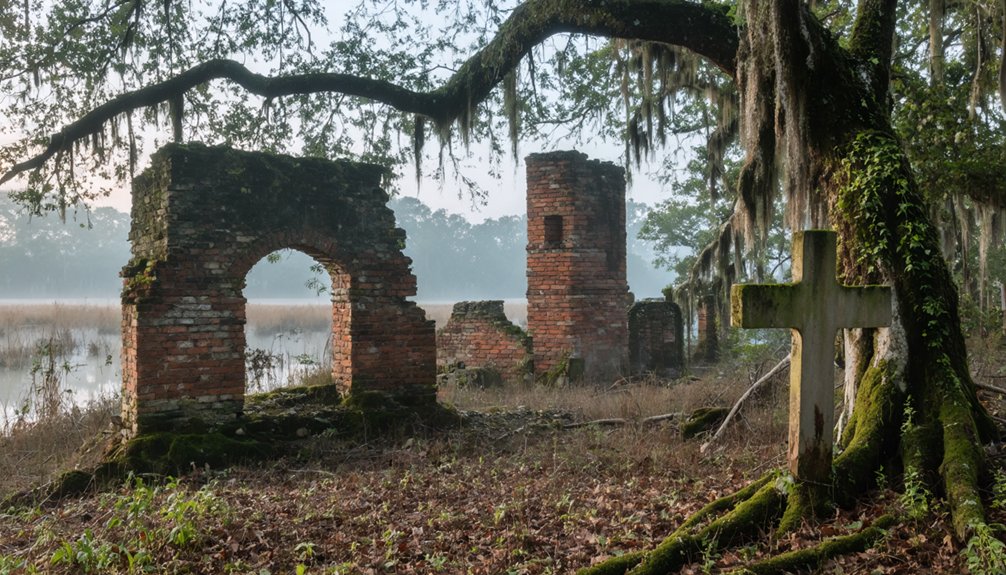
On May 14, 1607, 104 English men and boys sailed 60 miles up the James River from Chesapeake Bay and established Jamestown on a marshy, mosquito-infested island that would become America’s first permanent English settlement—and very nearly its first mass grave.
The site’s brutal reality challenges romanticized colonial settlement preservation narratives:
- Contaminated water from arsenic runoffs and human waste killed 20 colonists in August 1607 alone.
- The Starving Time (1609-1610) reduced 300 settlers to 60 survivors. Archaeologists confirmed cannibalism through 14-year-old “Jane’s” butchered remains.
- Indigenous history acknowledgment reveals Opechancanough’s 1622 attack killed over 300 settlers, followed by colonists poisoning Native leaders at a 1623 peace parley.
- Bacon’s Rebellion burned Jamestown in 1676; the capital relocated to Williamsburg in 1699.
Appalachia’s Forgotten Coal Mining Communities
While Jamestown’s abandonment stemmed from colonial failures and political shifts, southwestern Virginia’s coal towns died slower deaths—strangled by depleted seams, mechanization, and market forces that rendered generations of labor obsolete.
Coal towns withered as veins ran dry and machines replaced miners, erasing entire communities built on now-worthless labor.
You’ll find Jewell Valley, built in the 1930s, now a legitimate ghost town in Buchanan County with signs of abandonment everywhere. Nearby Appalachia declined from 2,090 to 1,624 residents over forty years, its vintage architecture standing empty.
Stonega Coal Camp, nicknamed from Stone Gap, featured uniform houses with attached coal sheds—some still occupied despite its 1972 post office closure. Coal camp legends persist in these hollows, though paranormal investigators found no confirmed evidence.
Dante represents hope: remediated mine sites became sixteen miles of trails in October 2023, modeling revitalization for communities built on mining town legends.
Frequently Asked Questions
Are Virginia’s Ghost Towns Safe to Visit and Explore?
Safety varies dramatically—you’ll find well-preserved sites with historical preservation measures and guided tours, while others hide dangers beneath their local legends. Research each location’s current conditions, infrastructure, and access restrictions before exploring Virginia’s abandoned settlements.
Can You Camp Overnight in Any of Virginia’s Abandoned Towns?
No, you can’t legally camp in Virginia’s abandoned towns. Unauthorized access violates trespassing laws, and historical preservation regulations protect these sites. You’ll find primitive camping only on designated public lands like WMAs, requiring proper permits.
What Paranormal Equipment Works Best for Investigating Virginia Ghost Towns?
Over 67% of investigators report EVP captures in abandoned locations. You’ll find EMF meters detect electromagnetic anomalies near historic structures, while Spirit boxes enable real-time communication attempts. Both tools document unexplained phenomena you might encounter in Virginia’s desolate settlements.
Do You Need Permission to Photograph Virginia’s Ghost Town Ruins?
You’ll need photography permits for state-owned ruins, but abandoned private properties lack clear legal restrictions. Always research ownership first—state parks require advance approval for commercial shoots, while truly abandoned sites operate in legal gray areas requiring caution.
Which Virginia Ghost Town Has the Most Reported Supernatural Activity?
You’ll find St. Albans Sanatorium holds the darkest record—Civil War carnage and patient torture created layers of torment. Historical legends document rifle fire, cannon blasts, and wandering spirits, giving this site profound cultural significance among Virginia’s most actively haunted locations.
References
- https://theforgottensouth.com/union-level-virginia-ghost-town-history/
- https://www.blueridgeoutdoors.com/go-outside/southern-ghost-towns/
- https://colonialghosts.com/haunted-cities-in-virginia/
- https://en.wikipedia.org/wiki/List_of_ghost_towns_in_Virginia
- https://www.virginia.org/blog/post/virginias-haunted-sites/
- https://usghostadventures.com/haunted-places/the-top-10-haunted-places-in-virginia-city/
- https://alexandriaghosts.com/why-alexandria-is-one-of-virginias-most-haunted-cities/
- https://www.youtube.com/watch?v=3F_Gv_xp3Y4
- https://www.youtube.com/watch?v=6X6JsAhXneE
- https://icatchshadows.com/a-walking-tour-of-the-ghost-town-at-union-level-virginia-with-video/