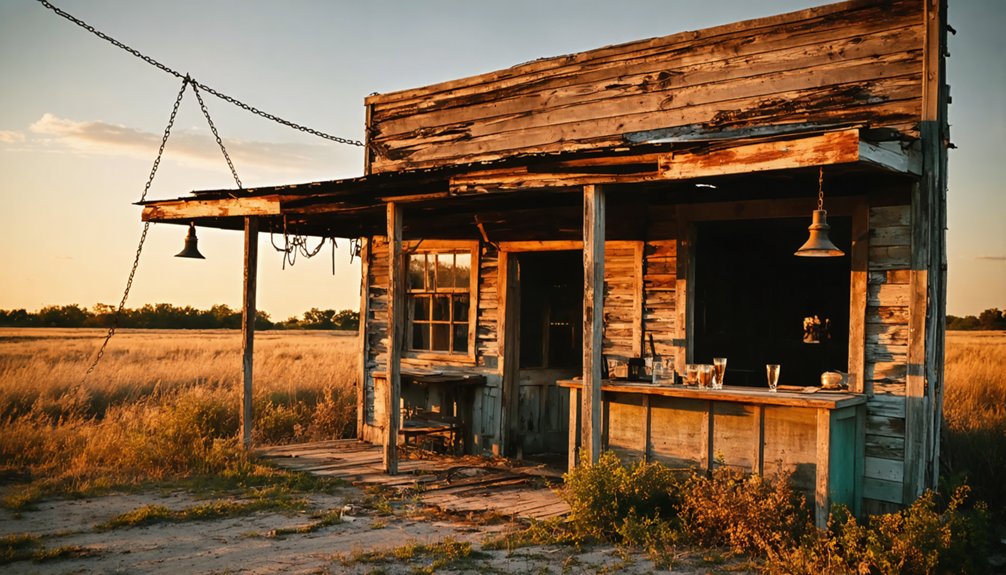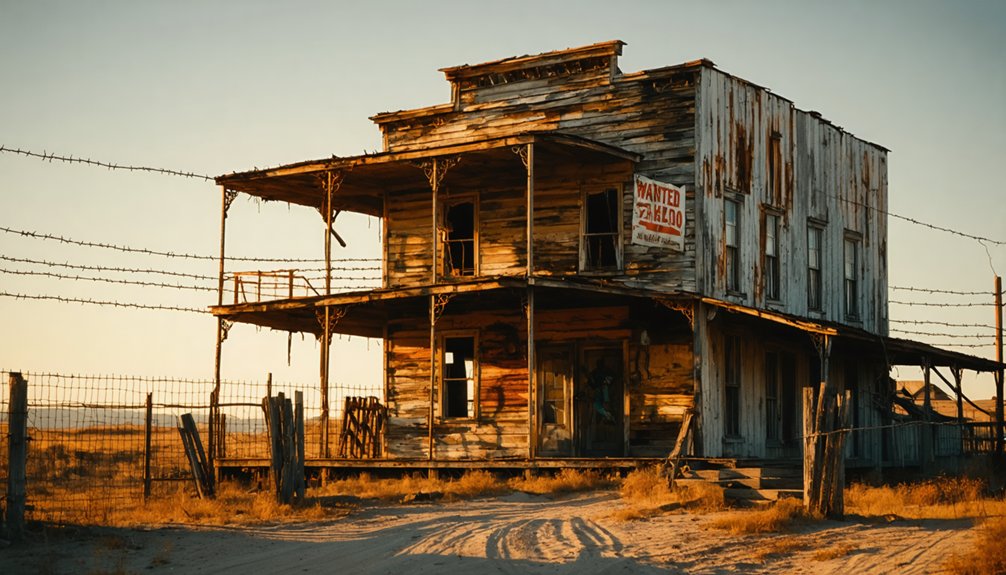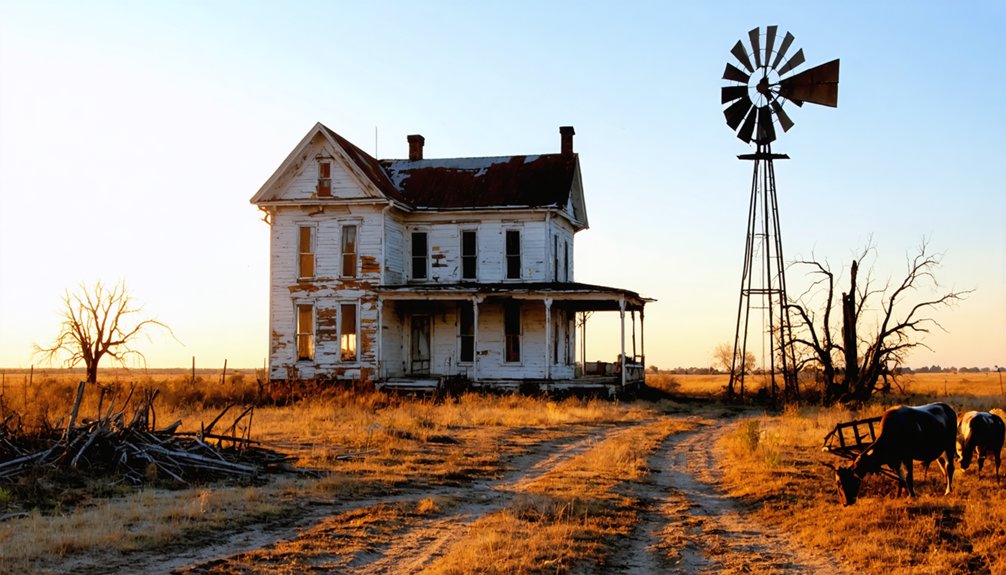
Texas ghost towns offer several haunted homesteads with documented paranormal activity. You’ll find spectral residents at the 1875 Wood Mansion with its phantom piano music and apparitions, Terlingua’s abandoned mining homes with their lingering miner spirits, and the Jefferson Hotel where each room hosts unique supernatural encounters. Medicine Mound’s schoolhouse emanates Comanche energy, while Barstow’s crumbling adobe walls tell tales of sudden evacuation. These silent structures await those brave enough to explore their histories.
Key Takeaways
- Wood Mansion features phantom piano music, footsteps, apparitions, and unexplained physical disturbances, enhancing its haunted reputation.
- Terlingua’s abandoned mining community contains limestone homes, Howard Perry’s mansion, and a historic cemetery with reported paranormal activity.
- Burleson House, established in 1915, is considered one of Texas’ most haunted locations with a cigar-smoking apparition and disembodied voices.
- Medicine Mound’s haunted schoolhouse reportedly emanates spiritual energy from Comanche ancestors despite the community’s devastating 1933 fire.
- Barstow’s crumbling homesteads feature adobe ruins and legends of robed figures following the 1904 Pecos River dam collapse.
The Eerie Legacy of Terlingua’s Mining Community Residences
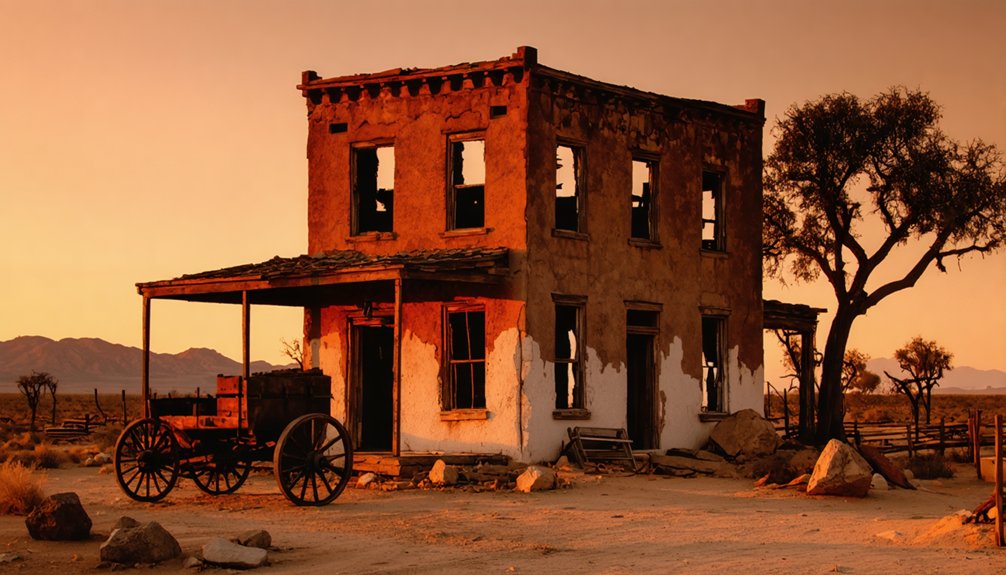
When cinnabar was discovered in the mid-1880s, Terlingua transformed from a barren desert landscape into a bustling mining community.
You’ll find the remnants of simple limestone and adobe homes where Mexican laborers once lived while working for the Chisos Mining Company, established in 1903 by Howard Perry.
At its peak in the 1910s-1920s, up to 2,000 people called Terlingua home. The community thrived with a post office, company store, and school until mercury production declined after 1936.
By 1946, the mines were abandoned, leaving only ghostly whispers behind.
Today, you can explore the crumbling ruins as mining echoes seem to resonate through the collapsed walls. Howard Perry’s mansion built in 1906 still stands as a testament to the town’s former prosperity.
The cemetery, listed on the National Register of Historic Places, remains the focal point for paranormal enthusiasts and preserves the haunted legacy of Terlingua’s mining past. Visitors can explore this historic site during the annual Dia De Los Muertos celebration when the town honors its deceased miners with traditional offerings and altars.
Wood Mansion: St. Mary’s of Aransas’ Haunted Historical Landmark
When you visit the Wood Mansion in Bayside, you’ll find connections to Clara Driscoll‘s family, who once lived in St. Mary’s of Aransas before Clara became known as the “Savior of the Alamo.”
Guests and tour guides report hearing phantom piano music, unexplained footsteps, and whispers throughout the mansion, with paranormal activity concentrated near the adjacent cemetery.
The 1875 Italianate mansion stands today as one of the region’s most significant and well-preserved historical structures, featuring its original ornate woodwork and commanding views of Copano Bay that have remained unchanged for nearly 150 years.
The mansion is located in what was once a thriving shipping port that was devastated during the Civil War when federal warships burned the port facilities.
St. Mary’s of Aransas once had a peak population exceeding 6,000 people before hurricanes in 1875 and 1886 led to its eventual decline.
Driscoll Family History
Nestled along the shores of Copano Bay, the Wood Mansion stands as St. Mary’s of Aransas‘ most significant historical residence, intimately connected to the Driscoll legacy. Clara Driscoll, born April 2, 1881, spent her formative years here when not attending boarding school. Her parents, Robert and Julia Fox Driscoll, established a prominent position in the town’s social hierarchy.
The Driscoll family lineage traces back to Irish pioneers who settled in the Power and Refugio County regions. Her grandfather, Daniel O’Driscoll, was awarded 1,200 acres in Victoria County after serving as a veteran of the Battle of San Jacinto. A family photograph from 1893 captured the Driscoll household gathered at the mansion, documenting their presence before St. Mary’s decline. A seven-foot granite memorial inscribed with “The Driscoll House” now marks the family homestead site where only a stone rainwater cistern remains of the original structure.
While the town ultimately faded into ghost town status after losing the county seat and being bypassed by railway development, Clara’s subsequent financial success and philanthropy stood in stark contrast to her birthplace’s deterioration.
Reported Ghostly Phenomena
Throughout its long history since 1875, the Wood Mansion has gained notoriety as one of Texas’ most actively haunted historical sites.
When you visit this landmark in the ghost town of St. Mary’s of Aransas, you might encounter the numerous spectral residents that reportedly wander its corridors.
Visitors consistently report white or gray apparitions on staircases and in hallways when no living occupants are present. These ghostly encounters often include shadowy or hooded figures observing from windows, their faces eerily absent.
You’ll find physical manifestations too—buttons mysteriously detached from clothing, unexplained thumping sounds, and rattling objects like shaving brushes in cups. A recurring distraction during paranormal investigations is the persistent traffic noise from the nearby highway, often masking subtle ghostly sounds. Similar to the Crescent Hotel in Arkansas, many visitors report seeing a mysterious pool of blood that appears and disappears without explanation.
Many paranormal investigators have documented these phenomena, adding credibility to the mansion’s reputation as a haunted homestead where the past refuses to rest quietly.
Architectural Significance Today
Despite its haunted reputation, the Wood Mansion stands today as an architectural marvel of significant historical importance. Built in 1875 with shellcrete construction, this Victorian-era landmark represents one of the few large coastal homes constructed after the Civil War.
Its two-tiered portico and impressive design showcase the wealth of Major John Howland Wood and his wife Nancy Clark Wood during St. Mary’s brief prominence. The mansion combines Greek revival plan with high Victorian Italianate detailing, reflecting the architectural influence of Wood’s native New York.
The mansion’s architectural preservation efforts include:
- Listing on the National Register of Historic Places
- Ongoing restoration by the Texas Historical Commission
- Maintenance of original features that influenced regional building techniques
- Transformation into an educational site for visitors to learn about historic construction methods
Today, the mansion serves as both a physical reminder of historical significance and a centerpiece for heritage tourism in rural Texas. Visitors can explore all 56 pages of documented history about the structure through the comprehensive archives.
The Burleson House: Voices and Footsteps From Beyond
Standing tall since 1915 in Waxahachie, Texas, the Burleson House carries a legacy that extends beyond its history as the headquarters for TW Burleson & Son’s Pure Honey.
Now it’s known as one of Texas’ most haunted locations, where your visit might include unexpected companions.
Ghost sightings at the Burleson House are remarkably consistent across thousands of visitor accounts.
You’ll potentially encounter a tall cigar-smoking man at the top of the stairs, a distressed young woman who sometimes breaks into wailing, or the spirits of an old woman, boy, and girl who appear throughout the property.
Even if you don’t see these apparitions directly, you might hear disembodied voices, unexplained footsteps in empty rooms, or witness doors opening and closing on their own—paranormal activities that have made this historic home a magnet for ghost hunters.
Jefferson Hotel: Room-by-Room Guide to Supernatural Encounters
While the Burleson House whispers its haunted tales in Waxahachie, the Jefferson Hotel in the historic town of Jefferson offers a more methodical catalog of supernatural phenomena.
You’ll find that each room presents its own unique haunted encounters, from the violent poltergeist activity in Room 0 to Judy’s ghostly messages in Room 19’s bathroom mirror.
- Room 0 features aggressive phenomena including bed levitation and objects thrown about, with five witnesses reporting a disembodied voice shouting “NO.”
- Room 19 houses Judy’s spirit, a murdered brothel-era teenager who writes pleas for help in mirror condensation.
- Rooms 2 and 14 demonstrate furniture movement, with full-bodied apparitions and covers lifting on their own.
- The tragic spirits of Elizabeth and Lydia Grigsby, brides who hanged themselves decades apart, haunt multiple rooms in wedding attire.
Medicine Mound’s Surviving Structures and Their Spectral Inhabitants
As you journey through the barren landscape of Medicine Mound, Texas, you’ll encounter only a ghostly skeleton of what once thrived as a bustling agricultural community.
The devastating fire of 1933, allegedly started by a laughing Ella Tidmore, destroyed most structures, leaving just two cobblestone remnants from the Wichita Mountains standing defiantly against time.
The general store, now a small museum, and the haunted schoolhouse built in the 1940s are all that remain physically of this once-500-resident town.
Local lore suggests something supernatural didn’t want the settlement to prosper. The collapsed bank vault erased financial records, while the schoolhouse, abandoned since 1955, reportedly emanates the spiritual energy of both Comanche ancestors and the town’s tragic demise.
These buildings bear silent witness to Medicine Mound’s spiritual significance and haunting decline.
Abandoned Homesteads of Barstow: When Nature Forces Evacuation
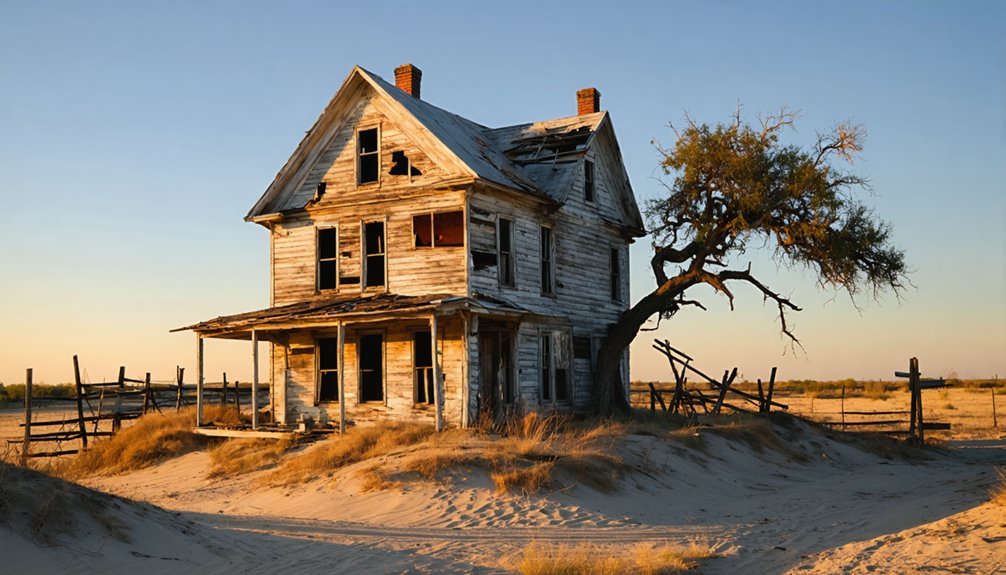
You’ll find Barstow’s ruined homesteads as stark monuments to nature’s wrath, beginning with the 1904 Pecos River dam collapse that flooded farms and later poisoned crops with mineral-heavy water.
The catastrophic droughts of 1907 and 1910 delivered the final blow to the once-thriving agricultural community, forcing families to abandon their livelihoods and dreams.
Now only crumbling adobe walls, the sandstone courthouse, and empty shells of buildings remain where a thousand residents once lived, alongside legends of robed figures that float silently near the abandoned fields.
Pecos River’s Deadly Breakage
How quickly can a community’s fortunes change when natural forces intervene? In 1892, Barstow’s promising future as Ward County’s seat evaporated when the earthen dam on the Pecos River catastrophically failed. The flood impact was immediate and devastating, transforming fertile farmland into salt-laden, uncultivable soil.
The consequences of this natural disaster created a cascade of effects:
- Mineral-laden floodwaters permanently altered soil composition, making agriculture impossible.
- Crop failures triggered an economic collapse that destroyed the community’s foundation.
- Population declined by half within 25 years as families abandoned their homesteads.
- The once-thriving settlement demonstrated the fragility of human developments against nature’s power.
This agricultural decline wasn’t immediate but occurred gradually as settlers realized their dreams couldn’t withstand the Pecos River’s destructive potential.
Homes Consumed By Dust
You’ll find Barstow’s abandoned homesteads tell a tale of nature’s brutal reversal of fortune.
Once-thriving farms established by George E. Barstow in 1892 supported over 1,500 residents by 1903, with award-winning irrigation systems that transformed Pecos River water into agricultural prosperity.
Then disaster struck—a catastrophic dam failure in 1910 followed by punishing droughts created mini dust bowl conditions decades before the infamous 1930s disaster.
These agricultural ghosts stand as warnings against nature’s unpredictability. Where vibrant banks, churches, and businesses once thrived, only crumbling structures remain.
The red stone bank building stubbornly persists while wooden elements rot away.
Today, barely 200 residents—approximately 20 families—remain in this living ghost town, surrounded by empty homes that nature reclaimed after mankind’s brief agricultural triumph.
Haunting Agricultural Dreams
When the earthen dam on the Pecos River catastrophically failed in 1904, Barstow’s agricultural dreams began their slow, inevitable dissolution. Founded by irrigation expert George Barstow in 1892, this once-thriving farming community won silver medals for its grapes at the 1904 World’s Fair before nature reclaimed the land.
Today, you’ll find only agricultural ghosts inhabiting the dilapidated homesteads where spectral memories linger among crumbling structures.
The abandoned town teaches four stark lessons:
- Nature ultimately determines settlement viability
- Economic prosperity requires sustainable infrastructure
- Communities disappear when their purpose vanishes
- Dreams leave physical remnants that outlast their dreamers
The red stone bank still stands as a symbol of human ambition, while local folklore speaks of robed figures wandering fields where families once tended crops before surrendering to drought and flood.
Cemetery Hauntings Across Texas Ghost Town Landscapes
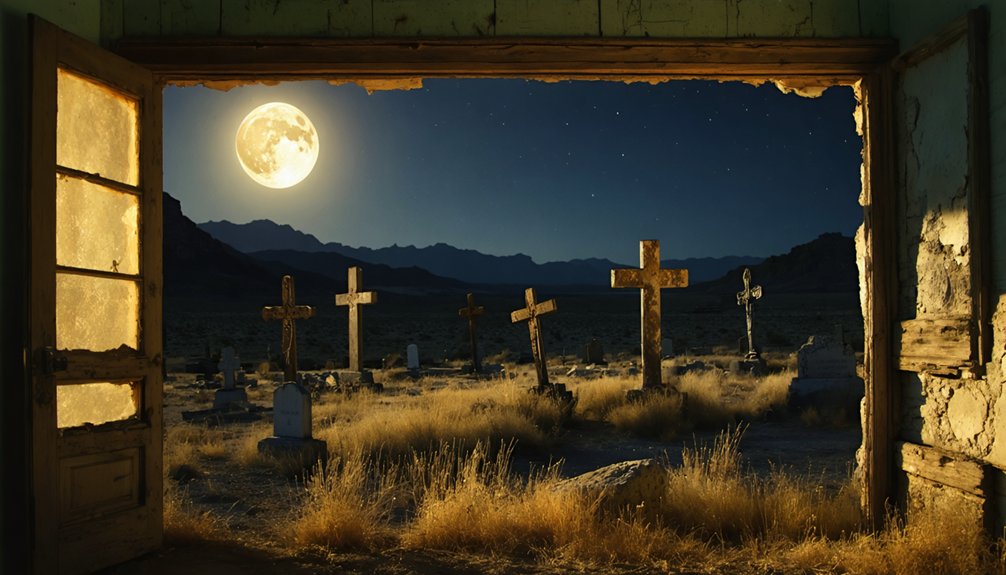
Beneath the forgotten landscapes of Texas ghost towns lie the most haunting grounds of all—their cemeteries, where centuries of history, tragedy, and supernatural phenomena converge.
You’ll encounter Cemetery Spirits in locations like Galveston’s Old City Cemetery, where victims of the 1839 Yellow Fever epidemic and the devastating 1900 hurricane still manifest as restless apparitions.
In El Paso’s Concordia, containing over 60,000 graves, Ghostly Encounters extend beyond cemetery walls, affecting nearby businesses.
Port Isabel Cemetery showcases the wandering spirit of a young boy, while Terlingua Cemetery comes alive during Dia De Los Muertos celebrations.
Evergreen Cemetery features a ghost boy asking for rides in early morning hours, and nearby Demon’s Road is infamous for physical manifestations—even hands emerging from graves.
Under moss-draped oaks at Oakwood Cemetery, mysterious orbs complete Texas’s tapestry of burial ground hauntings.
Devil’s Backbone: Confluence of Native, Confederate, and Settler Spirits
Rising above the rugged Texas Hill Country, the Devil’s Backbone stands as perhaps the most spiritually charged convergence of supernatural energy in the state’s ghost town landscape.
Mysterious and ancient, the Devil’s Backbone pulses with otherworldly energy above Texas’ haunted hillsides.
This 30-million-year-old limestone ridge witnessed bloody conflicts between Native American tribes, European settlers, and Confederate soldiers from the early 1800s through the 1870s.
When you visit this haunted corridor, you’ll encounter:
- A pioneer woman carrying her baby, eternally searching for her husband lost to tribal raids
- Native American Hauntings manifesting as both peaceful rancher spirits and aggressive warrior apparitions
- Confederate Spirits heard as phantom hoofbeats or seen reenacting Civil War battles along the winding road
- Paranormal activity at Devil’s Backbone Tavern, where glasses move and shadowy figures materialize
Tracking the Paranormal: How Mining Busts Created Haunted Housing
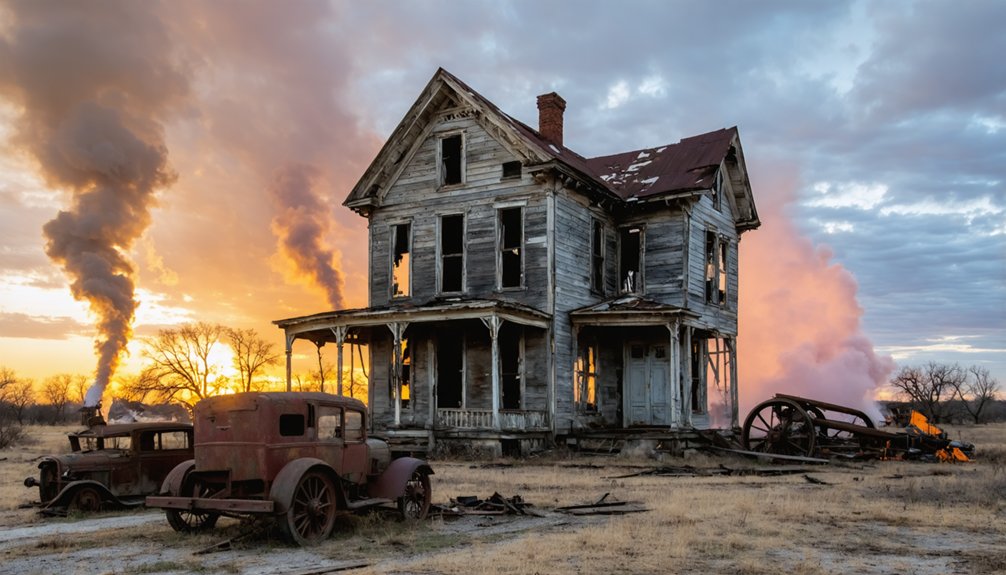
The rapid exodus of miners and their families from Texas boomtowns created a perfect paranormal landscape as thousands of hastily abandoned homes deteriorated into the haunted structures we encounter today.
When you visit Shafter, you’ll witness the remnants of a community that collapsed from 4,000 residents to just 20 in less than a decade after the 1942 mine closure.
In Terlingua, paranormal investigations often center around Howard Perry’s mansion, restored in 2015 after decades of abandonment.
The ghostly legends here connect to the town’s quicksilver mining past, which once supplied 40% of America’s wartime needs before the Chisos Mining Company’s bankruptcy.
Miners’ homes were quickly dismantled for timber and materials, leaving behind hollow shells where apparitions now reportedly dwell—silent witnesses to the boom-and-bust cycle that defined these isolated desert communities.
Frequently Asked Questions
Can Paranormal Activity in Ghost Town Homesteads Be Scientifically Explained?
Yes, you’ll find scientific skepticism explains most paranormal claims through EMFs, infrasound, psychological factors, and structural quirks, though historical context enriches these experiences regardless of their origin.
How Do Locals Feel About Living Near Famously Haunted Homesteads?
You’ll find locals near haunted homesteads often embrace community stories with pride, viewing them as cultural heritage. They’ll share local perceptions ranging from skepticism to fascination, while appreciating the economic benefits these legends bring.
Are There Specific Times of Year When Hauntings Intensify?
Like clockwork, you’ll witness seasonal hauntings intensify during autumn months, particularly September through November. Ghostly gatherings peak around equinoxes, solstices, and cultural commemorations like Día de los Muertos in Terlingua.
What Protective Measures Do Paranormal Investigators Take When Exploring Homesteads?
You’ll employ spiritual protection like prayers before entering, while carrying investigative tools such as EMF meters, thermal cameras, and first aid kits to maintain safety during homestead explorations.
Have Homestead Hauntings Influenced Texas Literature and Folklore Traditions?
You’d think writers invented Texas ghosts, but they’ve merely documented them. Homestead hauntings have deeply shaped your literary heritage, with ghostly influences weaving through Porter’s novels and literary connections in folklore festivals statewide.
References
- https://en.wikipedia.org/wiki/List_of_ghost_towns_in_Texas
- https://texashighways.com/travel-news/four-texas-ghost-towns/
- https://www.youtube.com/watch?v=Zd8-gKw-5Hc
- https://www.worldatlas.com/cities/visit-these-9-creepy-ghost-towns-in-texas.html
- https://www.texashauntedhouses.com/real-haunts/
- https://www.hipcamp.com/journal/camping/texas-ghost-towns/
- https://livefromthesouthside.com/10-texas-ghost-towns-to-visit/
- https://www.texasescapes.com/TOWNS/Texas_ghost_towns.htm
- https://www.legendsofamerica.com/tx-terlingua/
- https://www.dallasites101.com/blog/post/terlingua-texas-ghost-town-guide/