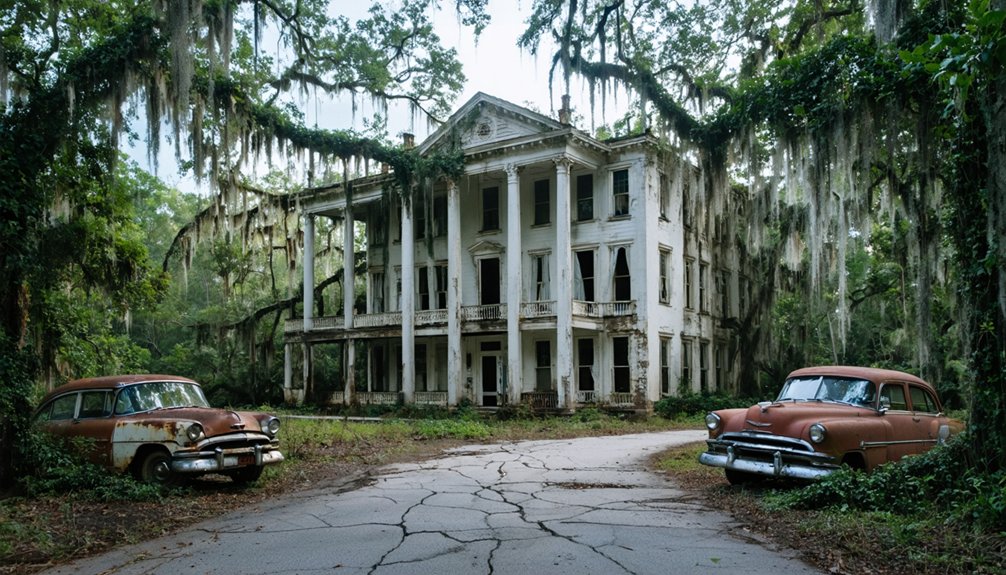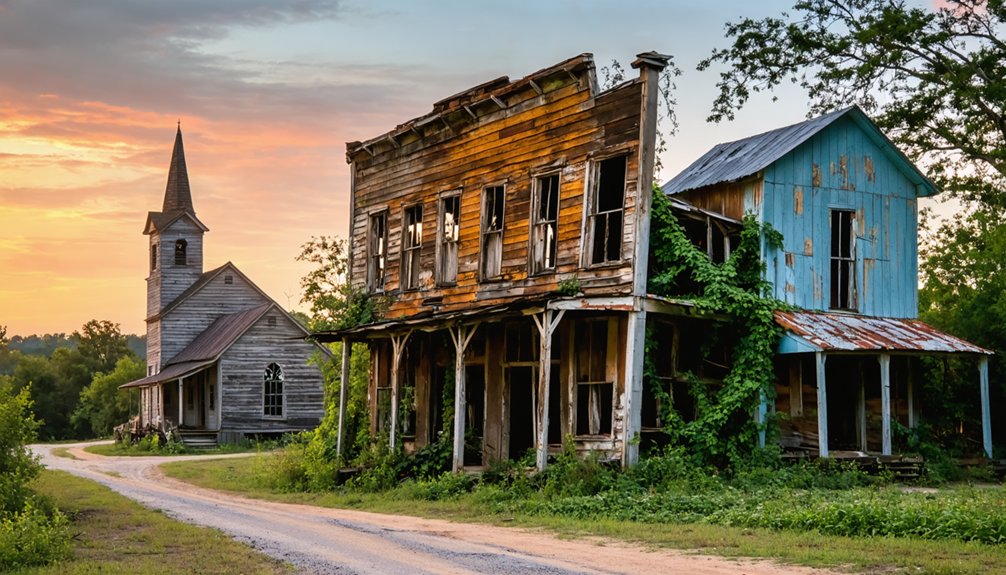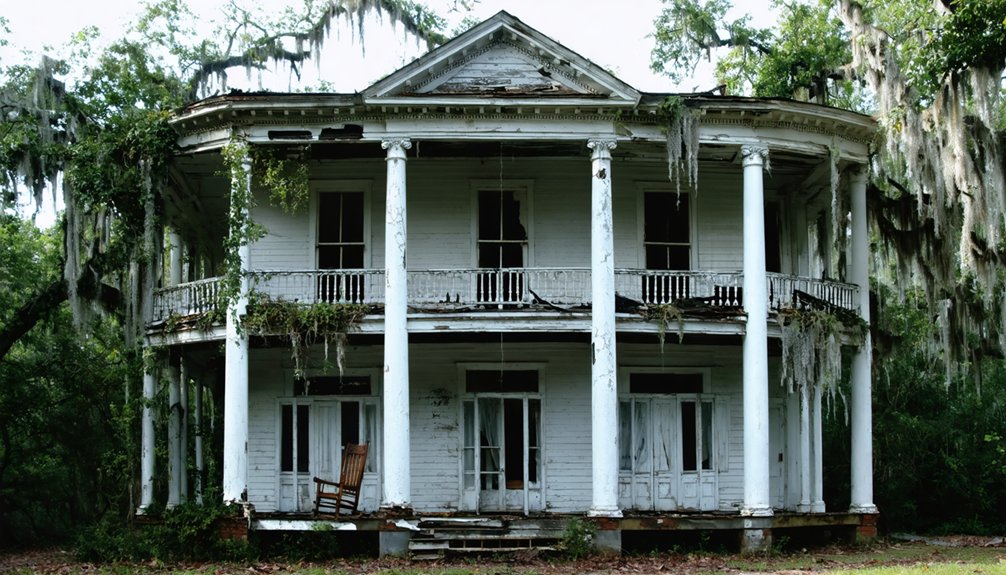
You’ll find haunting tales in Southern ghost towns like Auraria, Georgia, where gold fever led to Cherokee displacement, and Buffalo City, which transformed from timber boomtown to moonshine capital. Rodney became forgotten when the Mississippi River changed course, while Terlingua’s quicksilver mines left only limestone ruins. Government policies forced abandonment of Native and multicultural communities across the region. These silent streets hold centuries of boom-and-bust cycles that shaped the American South.
Key Takeaways
- Auraria, Georgia transformed from a Cherokee territory to a gold rush town before being abandoned when resources depleted.
- Buffalo City evolved from a timber boom town to the “Moonshine Capital of the World” during Prohibition before declining.
- Rodney, Mississippi became a ghost town when the Mississippi River changed course in 1869, leaving historic buildings stranded.
- Economic downturns like the 2008 recession created vacant neighborhoods throughout Southern towns, symbolizing broken dreams.
- Abandoned Southern towns often reflect dependence on single industries, serving as cautionary tales about economic diversification.
The Gold Rush Ghosts of Auraria, Georgia

When gold glinted in the streams of Lumpkin County in 1828, it set off a chain reaction that would forever change the landscape of North Georgia.
Within months, thousands of “Twenty-Niners” flooded Cherokee territory, establishing what would become one of America’s first gold towns.
They came with pickaxes and dreams, transforming sacred Cherokee land into a bustling frontier of fortune-seekers.
You can almost hear the echoes of Auraria’s prosperity as it erupted virtually overnight—miners, merchants and entrepreneurs building a community that once housed over 4,000 souls.
This boom came at the devastating cost of Cherokee displacement, as President Jackson prioritized gold for American settlers over Indigenous sovereignty. The town was originally named by John C. Calhoun, who owned a nearby mine where enslaved people were forced to work. The area produced approximately twenty million dollars in gold from the Cherokee country between 1829 and 1839.
Buffalo City: From Timber Boom to Moonshine Haven
If you’d ventured into Buffalo City in the early 1900s, you would’ve found a bustling timber town where the steady rhythm of saws and the whistle of logging trains dominated daily life.
When the ancient cypress and juniper trees were depleted, local entrepreneurs transformed the remote settlement into the “Moonshine Capital of the World,” with hidden stills producing illicit liquor that was distributed nationwide during Prohibition.
After the repeal of Prohibition in 1933, Buffalo City’s fortunes quickly evaporated, leaving the swampy wilderness to reclaim every trace of the once-thriving community that had housed 3,000 souls at its peak. The town’s layout reflected the social norms of the era, with residential areas segregated by race for white and African-American residents.
The logging operation initially established in 1888 by a company from Buffalo, NY transformed the landscape with its massive harvest of timber across 168,000 acres of pristine coastal forest.
Timber Industry Heyday
While most Southern ghost towns faded after gold rushes or railway diversions, Buffalo City thrived on the abundance of white cedar that transformed this remote North Carolina settlement into a bustling industrial center.
You’d have witnessed a remarkable timber legacy unfold as the town expanded from primitive operations to sophisticated manufacturing. The 1881 railroad arrival sparked unprecedented growth, with Buffalo City Mills Manufacturing and Richmond Cedarworks dominating production of everyday wooden items from buckets to washing machines. The operations resembled those in Alabama, where steam-powered machines transformed labor practices and increased productivity in the timber industry.
The fleet grew from six mules to eighteen trucks, while blacksmith shops maintained essential equipment.
These economic shifts attracted outside investment, creating a company town where hundreds found employment. Mr. Bill Barber’s extensive historical research helps distinguish fact from fiction about this once-thriving community. Large corporations like East Coast Cedar and Dare Lumber Company consolidated operations, maximizing profits from the region’s natural resources until the inevitable depletion began the town’s decline.
Prohibition’s Secret Supplier
How quickly fortunes change when one industry collapses and opportunity knocks from an unexpected direction. As Buffalo City’s timber industry declined, residents found salvation in the Volstead Act of 1919.
You’d have marveled at how this isolated community transformed into “The Moonshine Capital of the World,” where prohibition’s impact created an economic lifeline through illegal distilleries.
- East Lake Whiskey earned fame from Philadelphia to the Carolinas for its distinctive rye-based flavor
- Distribution networks stretched along the coast with ingenious waterway smuggling methods
- Even Al Capone reportedly visited to sample Buffalo City’s renowned spirits
The moonshine legacy sustained nearly 3,000 residents until 1933, when repeal devastated the underground economy. The town’s strategic proximity to waterways made it an ideal location for distributing illicit alcohol while evading authorities.
Federal agents struggled to control production despite numerous raids, proving the resilience of a community that refused to surrender its newfound prosperity. The transport of whiskey often involved towing sealed bottles behind boats to avoid detection by law enforcement.
Vanishing Into Wilderness
The dense forests that once echoed with the sharp crack of axes and buzz of sawmills now whisper only to wildlife in Buffalo City.
You’d never know that this wilderness once housed 500 souls – Russian immigrants, African Americans, and others who toiled in brutal conditions harvesting juniper, cypress, and sweet gum for wooden buckets and shingles.
Like many timber towns across the South, Buffalo City’s logging legacy proved unsustainable. By 1920, premium wood was exhausted, leaving workers with company scrip (“pluck”) that became worthless as operations ceased.
Railroad tracks that once transported lumber now lie buried beneath encroaching vegetation. The timber industry’s decline mirrored other regions where lumber barons had established temporary kingdoms through exploitation of natural resources. The crude company houses built from scrap timber have long since collapsed, reclaimed by the swamp that temporarily yielded its treasures before taking back what was always its own.
When the River Changed Course: Rodney’s Silent Streets
If you’d venture into Rodney today, you’ll find a ghost town that was strangled by nature itself when the Mississippi River dramatically changed course in 1869, leaving this once-thriving river port landlocked and economically devastated.
The town that once hosted presidents and boasted opera houses now features only silent streets with scattered ruins of storefronts and the stately Presbyterian Church standing as a haunting sentinel among overgrown fields.
Reaching this forgotten piece of history requires navigating a rough gravel road, approximately 12 miles from Highway 61, with terrain that demands a four-wheel drive vehicle for safe passage.
Beyond these remnants, the historic cemetery stretches across former cotton plantation lands, housing generations of residents who witnessed Rodney’s meteoric rise and heartbreaking fall from prominence.
Mississippi River’s Fatal Shift
Situated along the mighty Mississippi River, Rodney once thrived as one of the busiest ports between New Orleans and St. Louis. You can almost hear the steamboats whistling as they approached this commercial powerhouse with its 4,000 residents and 53 bustling stores.
Nature, however, had different plans. Around 1864, a devastating shift occurred when:
- A massive sandbar formed, forcing the Mississippi to migrate two miles westward
- By 1940, Rodney stood abandoned, three miles from river navigation
- This geographical catastrophe triggered immediate economic decline
What’s particularly cruel about Rodney’s fate is the timing—this river shift coincided with railroad construction bypassing the town and devastating fires consuming its infrastructure.
The town that once outpaced Mississippi’s capital found itself stranded, watching helplessly as its commercial lifeline drifted away.
Economic Legacy Remains
When the Mississippi River changed course in the 1860s, it didn’t just alter geography—it erased Rodney’s economic identity. You can still see this legacy in the abandoned storefronts where merchants once thrived, serving a bustling port town of 4,000 residents.
Without economic resilience, Rodney’s decline was swift and merciless. The railroad’s decision to bypass the isolated settlement delivered the final blow, severing all viable transportation links.
By 1900, you’d have found most businesses shuttered, cotton plantations struggling, and skilled tradespeople vanished.
No community revival emerged to replace river commerce. As families fled, schools closed, churches lost congregations, and by 1930, the state officially disincorporated the town.
Today, Rodney’s economic legacy exists only in weathered structures—silent witnesses to how quickly prosperity can vanish when transportation lifelines are cut.
Cemetery Among Cotton Fields
The cemetery of Rodney stands as perhaps the most haunting reminder of the town’s vanished vigor.
Walking among the weathered tombstones, you’ll find the names of those who witnessed Rodney’s dramatic transformation after the Mississippi’s fateful relocation in the 1860s. The river’s westward shift—nearly three miles—severed the town’s lifeline, triggering catastrophic economic collapse as port activity vanished overnight.
- Yellow fever victims from the devastating 1843 and 1847 epidemics lie beneath simple markers, their stories of survival and loss etched in stone.
- Prominent merchants who lost everything when the railroad bypassed their already struggling community rest alongside laborers.
- Civil War soldiers sleep in soil that once promised prosperity but delivered abandonment when nature reclaimed what humans had built.
Mercury’s Deadly Legacy: The Quicksilver Mines of Terlingua
Hidden beneath the sun-scorched hills of Texas’s Big Bend region, Terlingua’s quicksilver mines once represented both economic prosperity and insidious danger to those who worked them.
From 1903 to 1943, Howard Perry’s Chisos Mining Company transformed this barren landscape into America’s mercury mining epicenter.
Howard Perry’s visionary enterprise sculpted a desolate wasteland into the beating heart of American mercury production.
You’d scarcely recognize the bustling community of 2,000 that once thrived here, where Mexican laborers fled revolution to extract the valuable liquid metal from cinnabar ore. The quicksilver extraction process evolved from primitive retorts to industrial furnaces producing shipments worth $50,000 each.
While the mines generated $12 million over three decades and supported a full community with schools, stores, and utilities, they eventually fell silent.
Now only limestone ruins remain—silent witnesses to the boom-and-bust cycle that defined Terlingua’s relationship with its subterranean treasure.
Government Intervention and Forced Abandonment in the South

Throughout America’s tumultuous past, perhaps no government intervention proved more devastating than the systematic uprooting of Native American communities across the South during the 1830s.
When gold was discovered in Georgia, government policies accelerated, as federal troops enforced the Indian Removal Act while state militias rounded up Cherokee families for forced migration westward.
You’ll find haunting remnants of this dark chapter across the Southeast:
- Abandoned Cherokee towns where families were given only minutes to gather belongings before their homes were burned
- The routes of the Trail of Tears, where thousands perished during winter marches
- Former Creek and Choctaw settlements, cleared for white settlement despite Supreme Court rulings protecting tribal sovereignty
The federal government’s betrayal of treaty obligations left a landscape of ghost towns and abandoned communities—physical reminders of freedom violently stripped away.
Multicultural Communities Lost to Time
Beyond the familiar narratives of abandoned mining camps and post-industrial towns, America’s South harbors the forgotten stories of vibrant multicultural communities that once thrived against overwhelming odds.
These stories often embody utopian concepts in American history, showcasing how diverse populations came together to build inclusive societies. Their legacy serves as a testament to the persistent human spirit and the quest for a better future, reflecting ideals that continue to resonate today. Exploring these narratives offers a richer understanding of America’s multifaceted past and the aspirations that shaped its communities.
You’ll find these stories in places like Pleasant Ridge and Cheyenne Valley, Wisconsin, where freed and escaped slaves built integrated communities with progressive schools decades before the Civil Rights movement.
The Kingdom of the Happy Land in North Carolina stands as evidence to Black communal societies that carved out independence in the Appalachian mountains.
The Gullah communities along coastal South Carolina and Georgia preserved their West African heritage through remarkable isolation.
Their multicultural heritage remains visible through language, crafts, and community structures like the Penn Center on St. Helena Island.
These sites reveal a powerful community resilience often missing from mainstream historical accounts.
What Remains: Physical Traces of Southern Ghost Towns

The physical remains of Southern ghost towns tell silent stories through their weathered structures and forgotten spaces. You’ll find ghostly remnants scattered across the region—from underwater foundations at Port Royal to the concrete ruins of Aldridge where nature’s reclamation features vines climbing walls and trees growing through floors.
The South’s abandoned towns whisper their history through crumbling walls and empty doorways that frame only memories.
Mining towns like Terlingua display sun-baked structures alongside colorful cemetery decorations, while agricultural communities often retain partial infrastructure amid abandonment.
- Coastal and riverside towns reveal how water shapes destiny, with submerged buildings and relocated communities following floods.
- Mining operations leave the most dramatic visual footprints, with towering industrial structures and abandoned equipment creating eerie industrial landscapes.
- Cemeteries often remain as the final witnesses to towns long vanished, their weathered stones the last storytellers of communities erased by time.
Economic Cycles and the Birth of Abandonment
Southern ghost towns were born from the volatile economic cycles that swept across the region, creating dramatic boom-and-bust patterns that ultimately led to abandonment.
You can trace their origins to resource rushes where single-industry economies flourished briefly, then collapsed when mines emptied or markets shifted.
Workers flocked to these boomtowns seeking prosperity, quickly building communities with wooden structures and rudimentary services.
When resources dwindled, population shifts occurred virtually overnight as laborers moved on to new opportunities.
Without economic resilience, these towns couldn’t sustain themselves—tax bases eroded, businesses closed, and social institutions crumbled.
This pattern echoes in modern Sunbelt communities that experienced rapid growth followed by devastating contractions after the 2008 recession, leaving neighborhoods vacant and dreams shattered—a sobering reminder that economic sustainability requires diversification.
Frequently Asked Questions
Are There Documented Supernatural Hauntings in Southern Ghost Towns?
Yes, you’ll find well-documented spectral sightings throughout Southern ghost towns like Cahawba’s orb apparitions, Brown Mountain’s ancient lights, and Fayette’s burned smelter worker—each location steeped in haunted history.
What Survival Skills Are Needed to Explore Remote Abandoned Towns?
78% of urban explorers report being unprepared for emergencies. You’ll need navigation skills to avoid getting lost and proper survival gear for protection against structural dangers, wildlife, and weather extremes.
How Have Climate Change and Extreme Weather Affected Ghost Town Preservation?
You’ll find climate impact dramatically accelerates deterioration through intensified flooding, drought, and storms. Preservation challenges multiply as rising seas threaten coastal sites and unstable soils undermine historic foundations you’d hope to explore.
Can Metal Detecting Be Legally Done at Southern Ghost Towns?
Venture with caution, freedom seeker! You can’t legally metal detect at most Southern ghost towns without permission. Metal detecting laws require landowner consent, and treasure hunting ethics demand respecting historic preservation regulations.
Which Abandoned Southern Towns Have Been Successfully Revitalized in Recent Decades?
You’ll find Virginia City, Montana and Terlingua, Texas showcase successful revitalization strategies through tourism and cultural preservation, while community involvement transformed Thurmond and Blue Heron into educational heritage sites worth exploring.
References
- https://www.geotab.com/ghost-towns/
- https://quirkytravelguy.com/ghost-towns-of-the-deep-south/
- https://www.visittucson.org/blog/post/8-ghost-towns-of-southern-arizona/
- https://styleblueprint.com/everyday/ghost-towns-in-the-south/
- https://en.wikipedia.org/wiki/Lists_of_ghost_towns_in_the_United_States
- https://www.atlasobscura.com/lists/united-states-of-abandoned-places
- https://www.youtube.com/watch?v=tErPiMbfhsw
- https://www.georgiahistory.com/ghmi_marker_updated/auraria/
- https://vanishinggeorgia.com/category/auraria-ga/
- https://lisamrussell.substack.com/p/auraria-georgias-golden-ghost-town