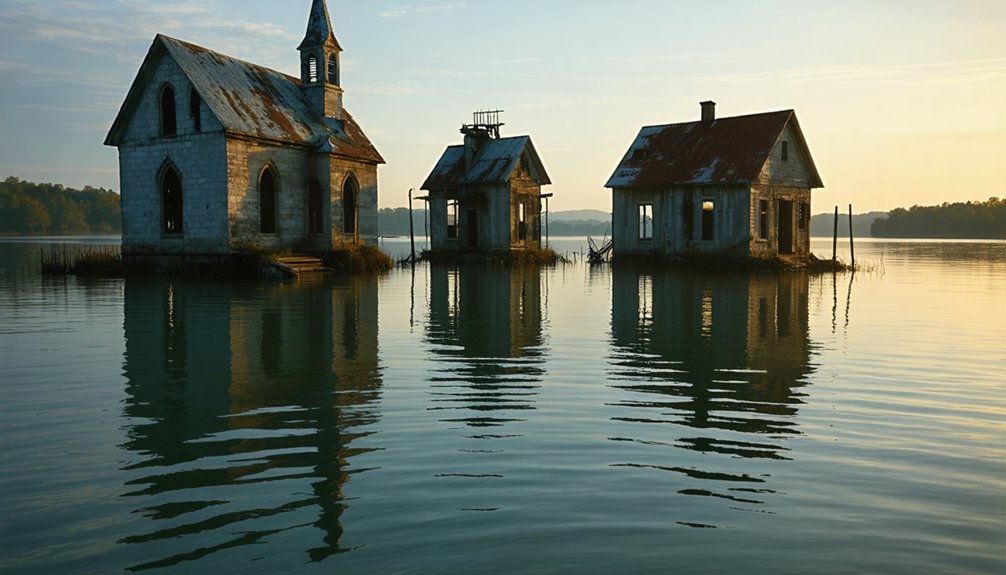
You’ll find numerous historic towns submerged across America’s waterways. New York’s reservoir systems flooded communities like Boiceville and West Shokan in the early 1900s. Oregon lost Champoeg to catastrophic floods in 1861-1862, while Pennsylvania sacrificed settlements like Somerfield for flood control dams. Snake River projects submerged towns including American Falls and Brownlee. Tennessee Valley Authority developments drowned dozens more communities. These underwater landscapes reveal the hidden human costs behind America’s water infrastructure.
Key Takeaways
- Ashokan Reservoir (1907-1915) in New York submerged four hamlets and displaced 2,350 residents through aggressive eminent domain tactics.
- Champoeg, Oregon was buried under 30 feet of water after catastrophic floods in 1861-1862 and ultimately lost after an 1890 flood.
- Pennsylvania’s Kinzua Dam (1966) inundated Seneca Nation lands and historic settlements including Red House.
- Vanport, Oregon was destroyed by a catastrophic flood in 1948, displacing 18,000 residents and causing 14 fatalities.
- Snake River dam projects submerged American Falls town in 1925 and Brownlee town by 1958 as part of federal infrastructure efforts.
The Legacy of New York’s Reservoir Displacement Projects
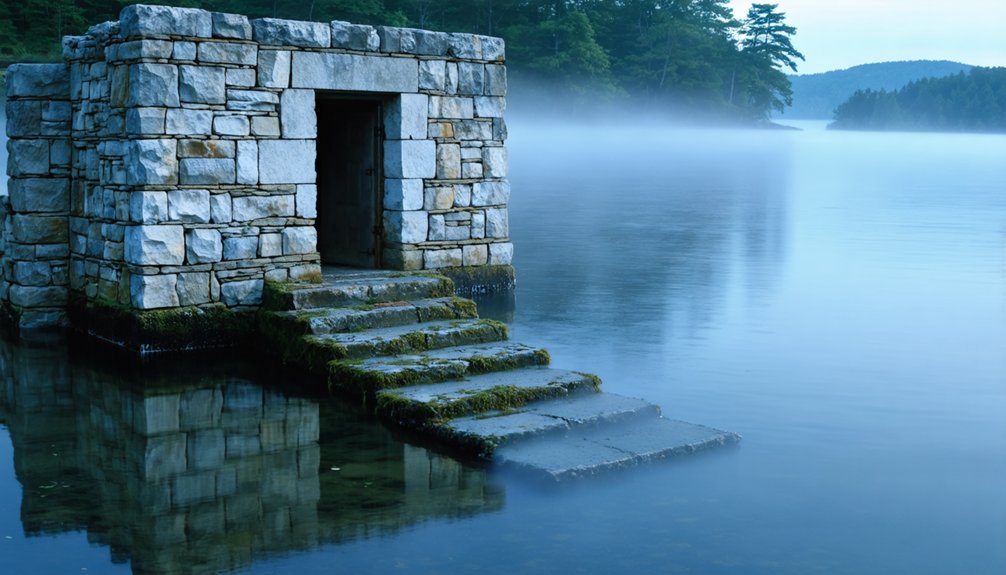
When the rising waters of New York City’s ambitious reservoir system began to flood the valleys of the Catskills in the early 20th century, they erased entire communities from the map.
First came the Ashokan (1907-1915), displacing 2,350 residents and submerging four hamlets while relocating eight others. Nearly 500 homes vanished underwater, along with dozens of churches, stores, and mills.
The Gilboa Dam followed in 1916, forcing another 500 people to relocate. The city established a pattern of lowballing damage claims and dismissing many compensation requests from displaced residents.
Mid-century reservoir displacement continued with the Rondout (1954), Pepacton, and Neversink (1950) projects, wiping towns like Eureka, Lackawack, Arena, and Bittersweet from existence.
The Cannonsville (1955-1967) completed this transformation, flooding five more communities. These water infrastructure projects were enabled by the 1905 legislation that authorized New York City to acquire lands in the Catskills for its expanding water system.
The final blow came with Cannonsville, erasing five more communities beneath the rising waters of progress.
Throughout these projects, cultural erasure was profound—over 2,300 graves were relocated, generational homes condemned, and entire social networks shattered through aggressive eminent domain tactics.
Oregon’s Submerged Communities and Their Stories
The Pacific Northwest shares a similar story of communities lost to water, though Oregon’s submerged towns vanished through both natural disasters and intentional flooding.
Champoeg history begins with its prominence along the Willamette River until catastrophic 1861-1862 floods buried the settlement under 30 feet of water, ultimately ending its existence after an 1890 flood. The town originally served as a main transportation route for the region and was established in the 1830s due to its geographic advantages.
You’ll find its legacy preserved at Champoeg State Heritage Area today.
The 1948 Vanport flood devastated Oregon’s second-largest city in a single day when Columbia River waters breached protective dikes on Memorial Day, displacing 18,000 residents and claiming 14 lives.
Portland experienced its own historic inundation in 1894 when snowmelt caused a record-breaking flood that covered 250 square blocks of the city.
Later, dam projects throughout the 1950s intentionally submerged communities like Detroit, Landax, and Klamath Junction, while simultaneously erasing cultural sites like Celilo Falls—a profound loss for indigenous peoples.
Pennsylvania’s Sacrificed Towns for Flood Control
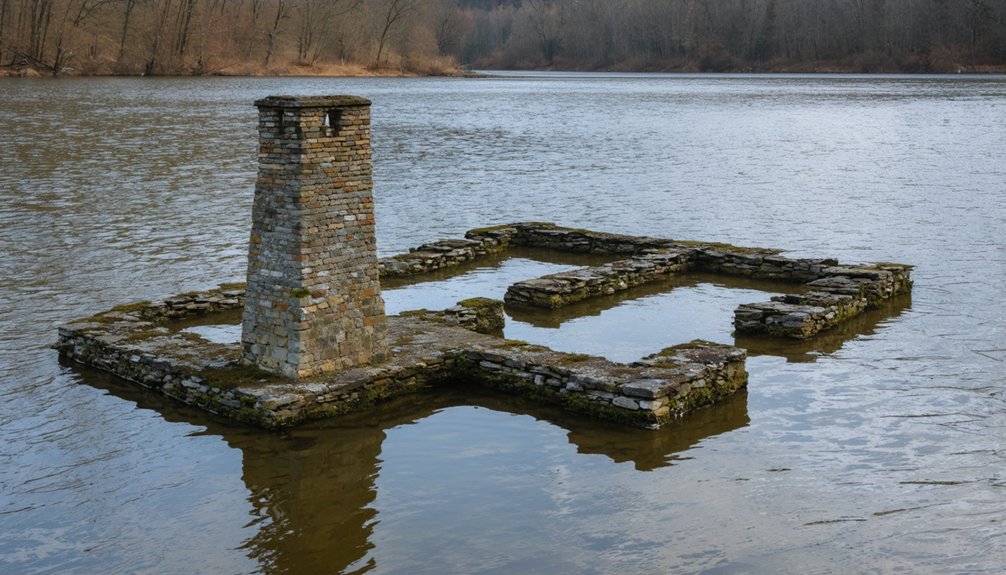
Pennsylvania’s river valleys tell a complex story of sacrifice and survival through their submerged towns—communities deliberately flooded for the greater good of flood control.
Following the devastating 1936 floods, the Flood Control Act launched an era of dam construction that forever altered the landscape. The devastating flood of 1936 claimed 62 lives across the region before prompting legislative action. The Youghiogheny River Reservoir, begun in 1939, swallowed ten historic settlements including Somerfield and Jockey Hollow—their flooded heritage now lies silent beneath the waters.
By 1952, Instanter and Straight disappeared similarly, demolished before submersion.
The most controversial sacrifice came with Kinzua Dam in 1966, which inundated thousands of Seneca Nation acres and settlements like Red House.
While these reservoir impacts erased communities, they’ve protected others—Sunbury’s 1951 flood control project has shielded residents from fourteen major floods. Johnstown established a permanent flood tax in 1951 following recovery efforts from its 1936 disaster that saw 14-foot waters and dozens of fatalities. Your freedom from floodwaters came at the price of others’ homes.
The Snake River Dam Projects and Lost Settlements
Stretching like a silver spine through Idaho and Oregon, the Snake River’s history intertwines with engineered transformations that forever altered the landscape and its communities.
The pattern of community displacement began in 1925 when the original American Falls town was relocated for dam construction, with buildings uprooted and orchards burned before flooding.
By 1958, Brownlee Dam submerged its namesake town, continuing the federal efforts to harness the river. The devastating 1976 Teton Dam failure wiped Wilford and Sugar City from existence, claiming five lives and stripping fertile topsoil from agricultural lands. The Bureau of Reclamation’s flawed geological assessment contributed directly to the disaster, as they ignored warnings about the fissured canyon rock at the dam site.
Historic records document the emotional impact on residents who watched their heritage disappear beneath rising waters.
The Lower Granite Dam completed in 1975 finalized decades of Snake River manipulation, leaving cultural loss in the wake of these massive engineering projects. This dam was the culmination of efforts that began with initial appropriations in 1876 to improve river navigation, transforming dangerous seasonal waterways into reliable transportation corridors.
Notable Towns Beneath America’s Major Reservoirs
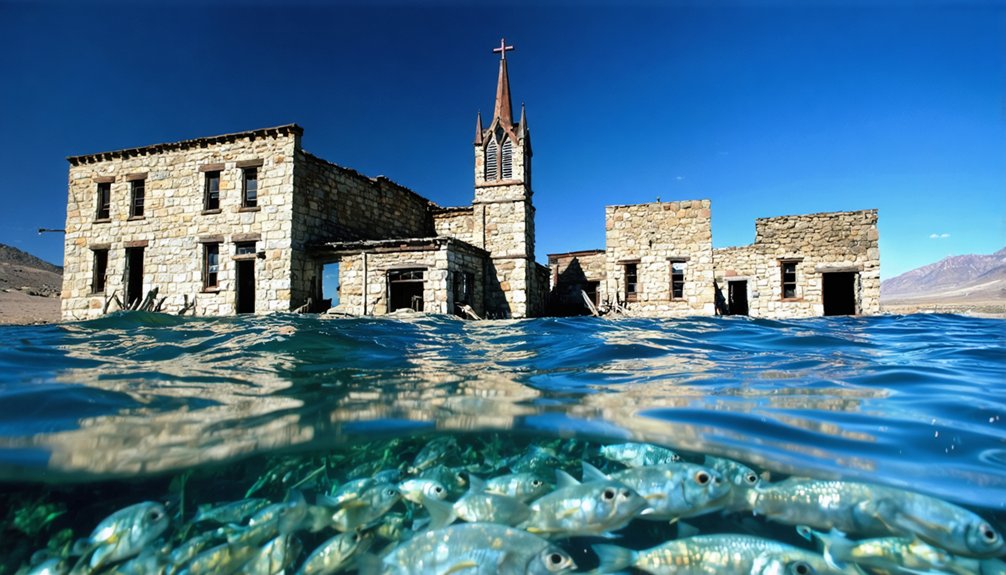
When you explore America’s vast reservoirs today, you’re actually floating above once-thriving communities intentionally sacrificed for urban water supplies and hydroelectric power.
Towns like Boiceville in New York, Detroit in Oregon, and Celilo Falls along the Columbia River now exist only in historical records and the memories of displaced families.
Their submerged buildings, roads, and cultural sites represent a largely unacknowledged legacy of infrastructure development that permanently altered both landscapes and human connections to place. Tennessee alone has multiple communities including Willow Grove that were completely inundated when dams created lakes across the state. In Idaho, communities like American Falls and Fort Hall Bottoms were inundated in 1925 by the construction of Snake River dams.
Displaced Communities’ Silent Legacy
Beneath America’s shimmering reservoir waters lie the remnants of once-thriving towns, their streets and histories submerged in the name of progress.
You’ll find silent memories of communities like Boiceville and West Shokan beneath New York’s Ashokan Reservoir, while Pepacton Reservoir covers the remains of Arena and Shavertown.
The cultural erasure extends westward, where Celilo Falls—a centuries-old Native fishing hub—disappeared beneath The Dalles Dam in 1957.
At Fort Berthold Reservation, Garrison Dam displaced nearly 80% of the population when Elbowoods vanished underwater.
These submerged communities tell a chronological tale of America’s development.
From eastern reservoirs like Neversink, which evicted 340 residents, to western projects like Shasta Dam that displaced multiple towns, these flooded settlements represent the hidden cost of our nation’s infrastructure ambitions.
Submerged Towns Still Remembered
While these communities vanished beneath the water’s surface, their stories continue to captivate our collective imagination. The submerged histories of towns like St. Thomas, Nevada—once home to a school, hotel, and even visited by Herbert Hoover—now emerge during droughts as Lake Mead recedes.
You’ll find similar forgotten legacies across America: Kennett, California lies beneath Lake Shasta; Neversink, New York rests under its namesake reservoir after 340 residents were evicted in the 1950s; and Detroit, Oregon’s 60 buildings were relocated before its valley flooded in 1953.
Robinette, Oregon’s vibrant fruit-growing community disappeared in 1957 beneath Brownlee Reservoir, its train depot, hotel, and orchards now under 100 feet of water—yet remembered by those who treasure America’s drowned heritage.
Communities Destroyed by Natural Flooding Events
You’ll find America’s landscape dotted with “Atlantis villages” – communities erased by catastrophic floods like the Great Flood of 1862 that swept away Champoeg, Oregon and Colorado City, Arizona.
Among these forgotten places are hidden flooded towns across America, each holding stories of resilience and tragedy. As waterways reclaimed their land, families were displaced and memories submerged, leaving behind only vestiges of what once thrived. Today, these sites serve as haunting reminders of nature’s power and the delicate balance between humanity and the environment.
These lost towns, from Vanport’s 1948 destruction to the numerous Mississippi River communities displaced in 1927, represent profound cultural upheavals where entire histories disappeared underwater.
Today’s efforts to document and memorialize these submerged communities through historical markers, museums, and digital archives help reclaim a heritage that might otherwise remain forever beneath the waves.
America’s Atlantis Villages
Throughout America’s history, natural flooding events have completely erased dozens of communities from the map, creating what many historians now call “America’s Atlantis Villages.”
When the Great Flood of 1862 swept across the Pacific Northwest, it didn’t merely damage towns—it obliterated them entirely.
Linn City, Champoeg, and Orleans, Oregon disappeared overnight, their submerged stories forgotten by all but historians.
The Mississippi River claimed its own sacrifices—Napoleon, Arkansas and Washington, Alabama among them.
You’ll find nothing of Ben Lomond or New Mexico, Mississippi today.
The Pacific Ocean steadily devoured Bayocean, Oregon, while the Columbia’s waters swallowed Vanport in a single catastrophic flood.
Even Celilo Falls, sacred to Indigenous peoples for millennia, vanished beneath dam waters in 1957, its flooded history preserved only in tribal memory.
Reclaiming Lost Heritage
Despite nature’s unforgiving power to erase communities from the landscape, many towns destroyed by catastrophic flooding events have found ways to reclaim their submerged heritage.
When Valmeyer, Illinois faced destruction during the Great Flood of 1993, residents collectively rebuilt on higher ground, preserving their community bonds despite physical displacement.
Similarly, after the Johnstown Flood of 1889 devastated Pennsylvania, survivors transformed their heritage recovery efforts into national awareness about dam safety.
The Great Flood of 1862 may have swallowed Adventure, Utah and several Oregon towns, but historical markers now stand where these communities once thrived.
Community resilience shines brightest in places like Vanport, where former residents hold reunions to maintain connections despite their town’s complete obliteration by the 1948 Columbia River flood, ensuring their stories don’t wash away with the waters.
The Environmental and Social Impact of Deliberate Flooding
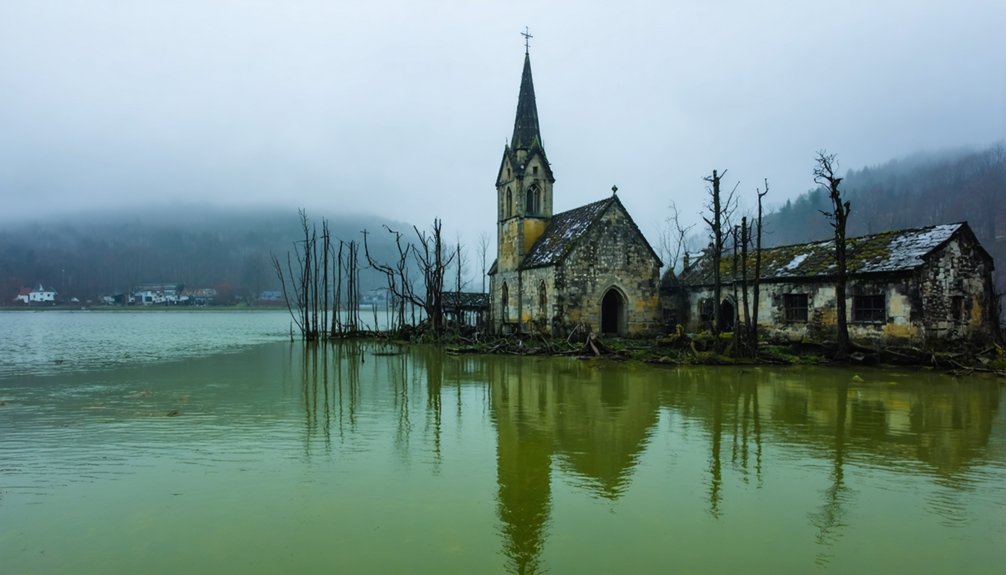
When the floodwaters rose behind America’s grand dam projects throughout the 20th century, they didn’t just fill reservoirs—they fundamentally altered ecosystems and uprooted entire communities.
Fertile valleys vanished underwater, disrupting generations of agriculture and destroying wildlife habitats. The environmental justice implications were profound, as downstream ecosystems suffered from altered water flows and sediment distribution.
As water swallowed valleys, it claimed not just land but inheritance—disrupting nature’s balance and human connections alike.
The human toll was equally devastating. Hundreds of towns like Elbowoods, North Dakota, and Enfield, Massachusetts were erased from maps, their residents scattered.
Sacred Indigenous sites disappeared beneath the waters, severing ties to cultural preservation efforts. Compensation rarely matched what was lost—homes, businesses, and most painfully, community bonds built over generations.
The psychological impact of displacement created a legacy of trauma that continues today, especially among Indigenous peoples whose connection to place was violently severed.
Frequently Asked Questions
How Were Residents Compensated for Their Lost Properties?
You’d receive government assistance through formal relocation programs, property buyouts based on appraisals, and sometimes insurance payouts. Federal agencies often moved entire buildings while states provided land and new infrastructure.
Did Any Flooded Towns Successfully Fight Relocation Efforts?
You won’t find many complete victories in these struggles. Resistance strategies through community organizing delayed some relocations, but government powers ultimately prevailed, though tribes at Celilo Falls secured ongoing recognition of their losses.
Are Underwater Towns Accessible to Divers Today?
Like pearls hidden beneath rippling veils, you’ll find some underwater towns open for exploration. Summersville Lake and Lake Jocassee welcome your diving adventures, while others remain restricted by diving regulations protecting water supplies.
What Cultural Artifacts Were Preserved From Submerged Communities?
You’ll find household items, farming equipment, building foundations, Indigenous artifacts, cemetery markers, and community signage preserved through cultural preservation efforts that document submerged heritage before water claimed these free-spirited communities forever.
How Did Displaced Communities Maintain Their Identities After Relocation?
Home is where the heart is. You rebuilt social institutions, preserved town names, collected oral histories, and reestablished religious practices to guarantee community resilience and cultural continuity despite being forced to higher ground.
References
- https://kids.kiddle.co/List_of_flooded_towns_in_the_United_States
- https://en.wikipedia.org/wiki/List_of_flooded_towns_in_the_United_States
- https://drownedtowns.dev/directory-of-drowned-towns/
- https://www.neh.gov/article/atlas-drowned-towns
- http://librarybooklists.org/mybooklists/drownedtowns.htm
- https://www.usgs.gov/mission-areas/water-resources/science/historical-flooding
- https://www.drownedtowns.com
- https://newrepublic.com/article/168701/towns-bottom-new-york-citys-reservoirs
- https://cwconline.org/about/history/
- https://archaeology.org/issues/may-june-2024/letters-from/ghost-towns-of-the-ashokan-reservoir/