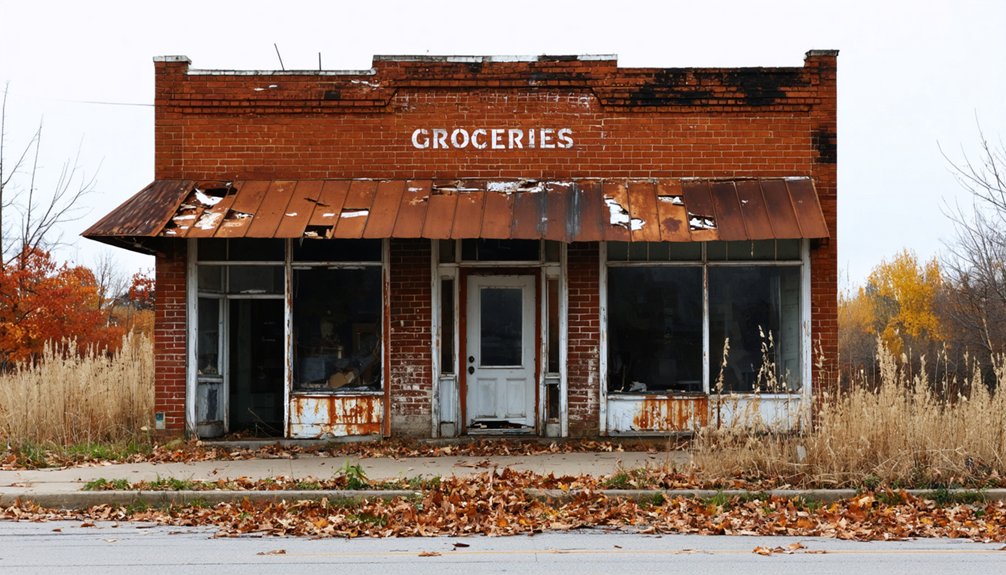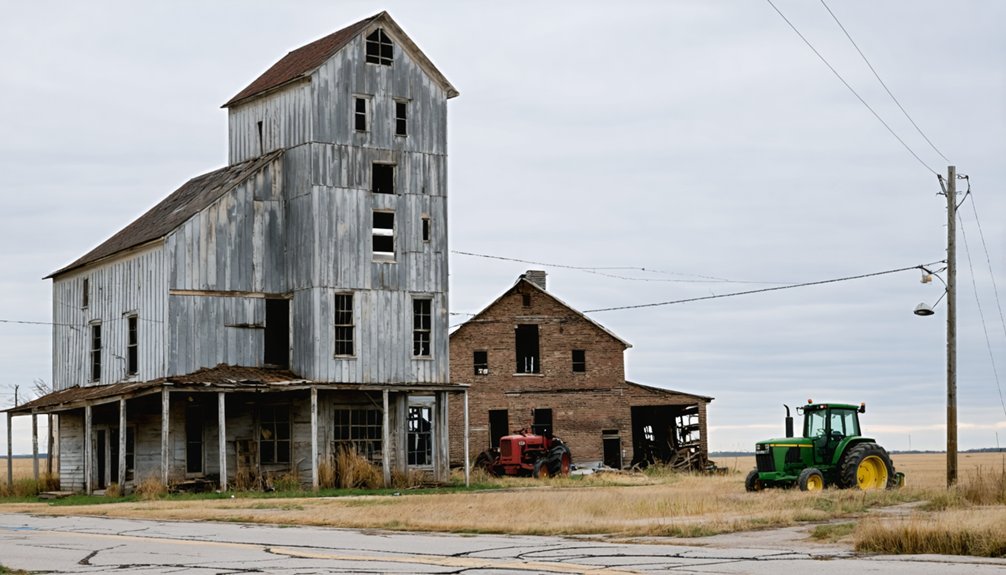
You’ll find between 26 and 2,807 ghost towns in Iowa, depending on your definition of “abandoned.” Popular travel sites list approximately 26-30 notable locations, while the University of Iowa’s extensive index documents 2,205 confirmed deserted settlements from a total of 2,807 abandoned place names. This wide range reflects different criteria—some sources count only fully deserted towns, while others include communities absorbed into larger municipalities or those with drastically declining populations. The full inventory reveals how floods, railroad relocations, and economic shifts shaped Iowa’s landscape.
Key Takeaways
- Estimates range from approximately 26 to over 2,000 ghost towns in Iowa depending on the definition and criteria used.
- University of Iowa indexes identify 2,807 abandoned place names, with 2,205 confirmed as abandoned settlements across the state.
- Ghost Town USA archives list over 1,000 Iowa settlements that have been abandoned or significantly declined in population.
- Definitions vary widely, including fully deserted towns, declining populations, communities absorbed into cities, or towns never built.
- County records document numerous ghost towns, such as Johnson County’s 72 site names representing 58 lost settlements.
The Range of Estimates: From Dozens to Thousands
How many ghost towns actually exist in Iowa? You’ll encounter estimates ranging from 26 to over 2,000, depending on how you define abandonment. Loveexploring.com and Wikipedia document approximately 26-30 named locations, while Geotab’s research tracks 3,800 U.S. ghost towns without specifying Iowa’s share.
RootsWeb’s sampling suggests over 1,000 Iowa sites, but the most exhaustive count comes from UIowa’s index of 2,807 abandoned place names. After removing renamings and unbuilt locations, 2,205 actual abandoned places remain—revealing Iowa’s exceptional cultural significance in settlement history.
These preservation challenges stem from varying definitions: some sources count fully deserted towns like Buckhorn, while others include declining communities like Pacific Junction, which lost 78.8% of its population between 2010 and 2022. Some towns disappeared entirely in recent decades, with communities like Doris and Dudley vanishing during the 1990s. This decline reflects a broader pattern affecting small towns, as 61% of towns under 10,000 residents across the U.S. saw population drops between 2010 and 2022.
Iowa’s Most Complete Ghost Town Inventories
While individual researchers have compiled scattered lists of Iowa’s abandoned settlements, several exhaustive inventories stand as the definitive sources for ghost town documentation.
Ghost Town USA’s archive contains records for more than 1,000 Iowa settlements, representing the most thorough collection available.
Ghost Town USA maintains Iowa’s most comprehensive settlement archive, documenting over 1,000 abandoned communities throughout the state’s history.
The University of Iowa’s historical indexes catalog abandoned towns, villages, and post offices with precise establishment and discontinuation dates.
Crawford County maintains specialized government records with founders’ names and geographic coordinates using township, range, and section notation.
Johnson County’s detailed system documents 72 names representing 58 distinct lost settlements across 19 townships. Some townships like Big Grove and Lincoln contain no recorded ghost towns in county documentation.
These inventories reveal migration patterns influenced by coal mining operations, railroad development, and reservoir construction. The decline of these communities frequently resulted from economic failure triggered by the collapse of primary industries.
Historic preservation efforts, including Marion County’s submerged settlements beneath Lake Red Rock, provide physical evidence of Iowa’s vanished communities.
Marion County’s Submerged Communities Beneath Lake Red Rock
Lake Red Rock, Iowa’s largest lake spanning 15,250 acres of water and 38,000 acres of public land, conceals beneath its surface the remains of six Marion County communities that succumbed to the U.S. Army Corps of Engineers‘ flood control project between 1959-1969.
Historical flooding, particularly the devastating 1851 Des Moines River flood, had already crippled these settlements decades before their final submersion.
The vanished towns include:
- Red Rock (surveyed 1845) – featured a post office and school by 1857
- Cordova (laid out 1845) – boasted four sawmills, stores, and medical services
- Dunreath (platted 1882) – thrived due to Wabash Railroad depot and coal mining
Town relocation proceeded with minimal protest since residents received fair compensation and communities were already declining.
The Corps purchased properties, demolished structures, and closed the dam gates in 1969. The reservoir filled rapidly, with floodwaters completely inundating the towns within months due to heavy rains.
Today, the lake serves as a major recreational destination, popular for boating, fishing, and hiking among families and visitors throughout Iowa.
Counties With the Highest Concentration of Abandoned Settlements
Beyond the submerged communities of Lake Red Rock, Iowa’s ghost town phenomenon concentrates most heavily in several counties where economic shifts, transportation changes, and natural disasters left entire settlements abandoned.
Iowa’s abandoned settlements cluster in counties where railroads, flooding, and economic collapse transformed thriving communities into ghost towns.
Marion County leads with five documented ghost towns, including Coalport, Cordova, Rousseau, Oradell, and Percy. Jackson County follows closely, featuring Buckhorn—established in 1836 by Shadrach Burleson—and Green Island.
You’ll find Winneshiek County’s Conover exemplifies urban decay, having lost 32 saloons after railroads relocated to Calmar in the 1860s. Cedar County preserves two settlements: Sunbury and Buchanan.
Fayette County’s Donnan represents historical preservation challenges, disincorporating in 1991 when its final seven residents voted to dissolve Iowa’s smallest city after seven decades. The town had originally incorporated in the 1920s specifically to facilitate the construction of a school building. Carroll County’s former county seat, Carrollton, declined after the Northwestern Railroad bypassed it in 1867, leading voters to relocate the county seat.
Understanding the Different Categories of Lost Towns
You’ll find Iowa’s lost towns fall into distinct categories that require different classification approaches.
The Annals of Iowa index eliminated 362 towns that simply changed names and 46 settlements absorbed by larger cities, focusing instead on truly abandoned locations.
Ghost Town USA further divides remaining sites into completely abandoned settlements, semi-ghost towns with standing structures, and near-ghost towns with minimal populations—a taxonomy that accounts for varying degrees of abandonment across Iowa’s landscape.
Visual documentation through aerial photographs and ground-level images on platforms like Wikimedia Commons helps researchers assess the current condition of these sites, from places like Arbor Hill to Manti and Unique.
Cataloging systems organize these abandoned locations geographically within Iowa, making navigation easier for enthusiasts and historians researching specific regions.
Completely Abandoned Settlements
When examining Iowa’s ghost towns, the most dramatic examples are settlements that have vanished entirely from the landscape, leaving only scattered ruins or cemetery markers as evidence of their existence. You’ll find several complete disappearances across the state:
Among these ghost towns located in Iowa are places like West Bend, known for its eerie charm and remnants of once bustling communities. The stories behind these locations often reflect the challenges faced by settlers and the gradual decline of small-town life. Exploring these forgotten sites offers a unique glimpse into the state’s rich history and changing landscape.
- Rockville (Jackson County, founded 1845) – Only abandoned architecture remains: a stone grist mill beside the Maquoketa River, standing as Iowa’s sole testament to this once-thriving community that lost its post office in 1898.
- Stiles (Davis County) – Despite reaching 100 residents in 1858 with three stores and two pharmacies, it’s completely vanished from modern maps.
- Carrollton (Carroll County) – Lost county seat status in 1867 after railroad bypass, achieving full ghost town designation.
These sites underscore why historic preservation efforts matter—without documentation, entire communities disappear.
Renamed and Absorbed Towns
Iowa’s historical landscape includes numerous settlements that didn’t vanish entirely but instead transformed through absorption or renaming, representing a distinct category from completely abandoned ghost towns. You’ll find 46 towns absorbed by larger cities, including Boonesboro into Boone and Sevastopol into Des Moines, while 362 communities changed names throughout their town lifecycle.
Bloomington became Muscatine, Montana transformed into Boone, and Miller’s Hollow evolved through Kanesville before another modification. Population shifts drove these changes when railroads bypassed original sites, eliminating economic viability.
The 1871 tornado destroyed Morrisburg after its 1856 renaming from Fairview. Post office records from 1846-1847 and 1880-83 document these modifications, with county-by-county indexes cataloging each settlement’s location.
Historical archives distinguish these transformed communities from genuinely abandoned sites.
Planned But Never Built
Among Iowa’s lost settlements, some communities never progressed beyond paper plans, representing ambitions that failed before construction began. These phantom towns reveal speculative ventures where developers envisioned thriving centers that market forces or logistical realities prevented from materializing.
Key characteristics of unbuilt Iowa settlements:
- Promotional schemes – Railroad companies and land speculators platted numerous townsites during Iowa’s territorial expansion, selling lots for communities that remained vacant.
- Environmental impact considerations – Geological surveys and flooding assessments killed projects before groundbreaking, unlike the six Marion County towns later submerged by Lake Red Rock.
- Historical preservation challenges – Only plat maps and promotional materials survived, making documentation difficult compared to physical ghost towns like Buxton or Coalport.
These paper communities represent Iowa’s unrealized potential rather than actual decline.
Notable Ghost Towns That Tell Iowa’s Story
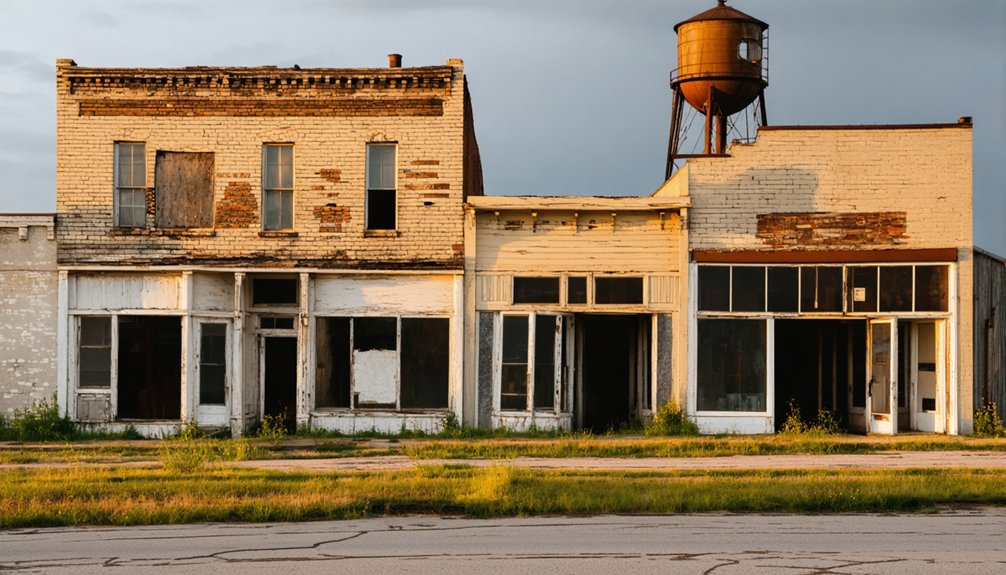
Each abandoned settlement across Iowa’s landscape reveals distinct factors that transformed thriving communities into empty remnants. You’ll find Elkport, displaced by the catastrophic 2004 flood that forced citizen relocation by 2006.
Carrollton lost its county seat status when the Northwestern Railroad bypassed it in 1867, redirecting growth to nearby Carroll.
Sunbury exemplifies railroad boom towns—thriving after rail arrival with its famed dance hall (1895-1964) and 1901 bank, yet ultimately declining.
Stiles completely vanished despite supporting 100 residents in 1858 with three stores, mills, and medical facilities.
Buckhorn maintains minimal historical preservation through its cemetery, abandoned church, and historic creamery—now potential tourist attractions off Highway 64.
These sites demonstrate how infrastructure decisions, natural disasters, and economic shifts created Iowa’s ghost town legacy.
Frequently Asked Questions
Can You Legally Visit and Explore Iowa’s Ghost Towns?
You can legally visit some Iowa ghost towns, but you’ll need property owner permission for most sites. Public cemeteries, historical landmarks, and memorial markers remain accessible, letting you explore local legends while respecting private property boundaries and trespassing laws.
What Caused Most Iowa Towns to Become Abandoned?
Railroad relocations caused most Iowa town abandonments, followed by economic decline from exhausted coal mines and farm consolidation. You’ll find urban decay stemmed from transportation shifts (1890s-1910s), mining exhaustion (early 1900s), and agricultural depopulation throughout the twentieth century.
Are Any Iowa Ghost Towns Being Restored or Preserved?
You’ll find historical preservation combating urban decay at sites like Buxton’s remnants and Crawford County’s forgotten towns through interactive mapping projects. Mitchell County’s Pioneer Cemetery restoration (started 2002) and the Owego Wetland Complex represent ongoing preservation efforts.
How Do Ghost Towns Differ From Unincorporated Communities in Iowa?
You’ll find ghost towns are “romantically deserted” settlements with zero residents and crumbling infrastructure, while unincorporated communities maintain living populations under county governance. Historical significance fades faster in ghost towns despite preservation efforts targeting both categories differently.
What’s the Best Time of Year to Visit Iowa Ghost Towns?
You’ll find spring (April-June) and fall (September-November) ideal for visiting Iowa ghost towns. Seasonal weather offers mild temperatures perfect for exploration, while photography tips suggest fall’s bare trees reveal foundations best, and spring enhances cemetery markers beautifully.
References
- https://en.wikipedia.org/wiki/List_of_ghost_towns_in_Iowa
- https://www.youtube.com/watch?v=815TEXn5lHs
- https://b1027.com/south-dakota-has-an-abundance-of-ghost-towns/
- https://www.loveexploring.com/gallerylist/188219/the-us-state-with-the-most-ghost-towns-revealed
- https://kxrb.com/this-iowa-ghost-town-is-completely-underwater/
- https://freepages.history.rootsweb.com/~gtusa/usa/ia.htm
- https://pubs.lib.uiowa.edu/annals-of-iowa/article/13466/galley/121920/download/
- https://www.geotab.com/ghost-towns/
- https://bestlifeonline.com/places-becoming-ghost-towns-news/
- https://blog.hireahelper.com/2023-study-3-towns-have-dropped-to-0-citizens-since-2010-which-ghost-town-is-next/