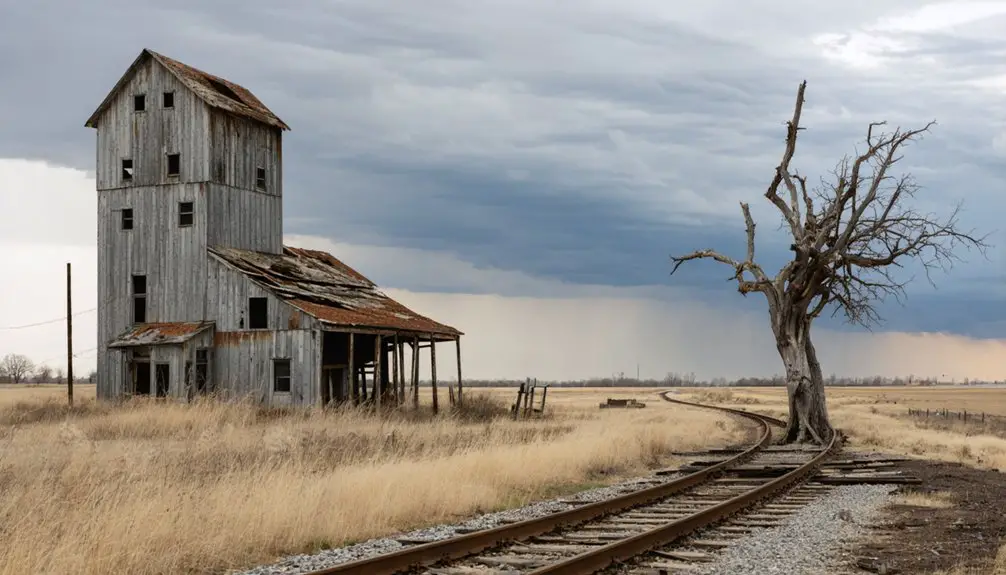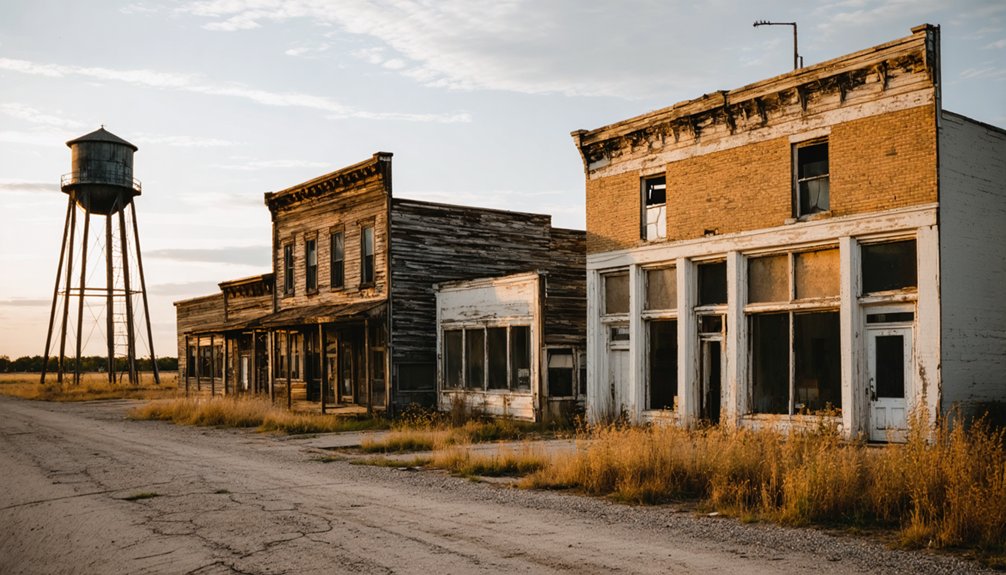
Minnesota contains 55 documented ghost towns, placing it in a twentieth-place tie among U.S. states out of 3,800 nationwide abandoned settlements. You’ll find these sites scattered across diverse counties, from iron mining communities in the northeast to agricultural settlements in southern regions. They’ve resulted from railroad bypasses, mining closures, economic downturns like the Panic of 1857, and natural disasters that drove populations elsewhere between the 1850s and mid-1900s. The following sections examine their geographic distribution, abandonment causes, and current accessibility.
Key Takeaways
- Minnesota has documented 55 ghost towns, ranking twentieth among U.S. states for abandoned settlements.
- These ghost towns represent a small fraction of the 3,800 mapped ghost towns across the United States.
- Minnesota’s ghost towns include completely abandoned sites, paper towns never developed, and settlements with remaining structures.
- Most ghost towns declined between the 1850s and mid-1900s due to economic downturns and population migration.
- Abandonment causes included railroad bypasses, mining closures, natural disasters, and transportation infrastructure failures.
Defining Ghost Towns and Minnesota’s Historical Settlements
Ghost towns are former settlements that have been abandoned, defined by Merriam-Webster as “a once-flourishing town wholly or nearly deserted usually as a result of the exhaustion of some natural resource.”
A once-thriving settlement left wholly or nearly deserted, typically following the depletion of its vital natural resources.
While popular culture often depicts these locations as desolate Old West landscapes with tumbleweeds rolling through empty streets, Minnesota’s ghost towns exist in varied physical states.
You’ll find everything from completely deserted landscapes to settlements with remaining structures like churches, homes, and cemeteries.
Some even retain functioning businesses, though they lack civic institutions such as town officials or post offices.
The classification extends beyond European-American communities to include Native American settlements.
Urban legends often embellish these locations’ histories, while preservation efforts work to document their factual narratives.
Some settlements existed only as “paper towns”—speculative ventures mapped and marketed by developers who never established actual communities. These paper towns often failed to advance beyond planning stages due to economic downturns or environmental issues. Many ghost towns now serve as regional reference points despite being uninhabited or significantly declined in population.
The Count: Minnesota’s Ghost Town Population Statistics
Minnesota’s abandoned settlements number 55 according to historical documentation, placing the state in a twentieth-place tie with Alabama among all U.S. states.
You’ll find this count represents a fraction of the 3,800 ghost towns mapped nationwide, though historians acknowledge these figures remain imprecise due to vanished structures and incomplete records.
Economic decline and population migration created Minnesota’s ghost towns between the 1850s and mid-1900s.
Elcor functioned as an unincorporated Mesabi Iron Range community from 1897 until its 1956 extinction.
Banning operated twenty years (1892-1912) with peak population reaching 300 residents.
Nininger’s population halved after its 1850s boom, dwindling to one resident by 1901.
Forestville peaked at 150 people with multiple businesses before railroads bypassed the settlement, triggering its abandonment.
Conover exemplifies this pattern, having grown to 1,500 residents by 1864 with hotels, stores, and saloons before railroads moved out and the land reverted to cropland by 1870.
Looking ahead, cities around Duluth, Brainerd, Grand Rapids, Hibbing, and Virginia are predicted to face major population drops by 2100, potentially creating new challenges for these communities.
Geographic Distribution Across Minnesota Counties
The geographic spread reveals distinct patterns:
- Southern counties like Fillmore preserved sites such as Forestville (established 1852) and former county seat Frankford Village.
- Central counties including Stearns harbored five prominent ghost towns like Leedstone and Georgeville.
- Morrison County mapped numerous paper towns near Fort Ripley, including Ausland and Briggs.
- Northeastern counties witnessed iron mining communities like Bovey in Itasca County, which peaked in the early 1900s before declining from 1,355 residents in 1940 to 662 by 1990.
Each region’s abandoned settlements reflect Minnesota’s volatile territorial period, where ambitious platting often exceeded sustainable development. These ghost towns are scattered across diverse environments, from forested areas to plains, often located near former transportation routes that once promised economic prosperity.
Why These Towns Were Abandoned: Historical Causes
Railroad companies determined which communities survived, deliberately bypassing Hennepin in the 1870s and choosing Maple Plain over Perkinsville in 1868.
When mining operations ceased, entire populations disappeared—Corsica’s 1954 closure forced Elcor residents to vacate by 1956.
Natural disasters delivered final blows to vulnerable settlements. Flooding repeatedly washed away San Francisco’s infrastructure after 1863, while its location below rapids made river navigation impractical.
You’ll find Mississippi River conditions prevented Nininger from becoming a viable steamboat port. Economic downturns like the Panic of 1857 further devastated settlements already struggling with transportation limitations.
Dorothy’s grain elevator closed in 1973 when the railroad was abandoned, eliminating the town’s primary economic purpose.
Visiting Minnesota’s Most Notable Ghost Towns Today
Scattered across Minnesota’s landscape, five ghost towns offer tangible connections to the state’s abandoned settlements, each accessible through different levels of preservation and infrastructure.
Most Accessible Sites:
- Forestville – Preserved 1850s buildings within state park boundaries require entrance fees but offer guided tours and maintained trails year-round.
- Wasioja – Seminary ruins stand open for independent exploration, connecting visitors to Civil War-era population loss.
- Nininger – Located 40 minutes from Minneapolis, this speculative development failure features township roads with minimal historical markers.
Elcor’s scattered mining-era foundations demand sturdy footwear for terrain navigation near Gilbert. Radium’s sparse agricultural remnants dot Pennington County’s rural roads. Travelers should research property ownership boundaries beforehand to avoid trespassing on private land while exploring these abandoned communities.
Economic decline devastated these communities, yet preservation efforts maintain Forestville‘s structures while other sites remain largely unrestored, allowing unrestricted access to Minnesota’s settlement history.
Frequently Asked Questions
Are Any Minnesota Ghost Towns Rumored to Be Haunted or Have Paranormal Activity?
You’ll find Grey Cloud Island carries the strongest haunted legends, with documented paranormal sightings near its cemetery. Forestville’s Mystery Cave adds intrigue, while Elcor’s desolate mining remnants create an eerie atmosphere that fuels supernatural speculation among visitors seeking unexplained phenomena.
Can People Legally Purchase Property in Minnesota’s Abandoned Ghost Towns?
You’ll face significant ownership challenges when attempting to purchase ghost town property in Minnesota. Property rights remain unclear due to historical mining company claims, private land designations, and incomplete deed records requiring extensive county-level title research before acquisition.
What Artifacts or Items Are Most Commonly Found in Minnesota Ghost Towns?
You’ll discover broken bricks contrast sharply with intact foundations as Minnesota’s most common historical artifacts. Abandoned structures reveal scattered building materials, kiln remnants, and domestic debris—tangible evidence of settlements that once thrived before economic collapse reshaped the landscape.
How Do Minnesota’s Ghost Towns Compare to Those in Neighboring States?
You’ll find Minnesota’s 100+ ghost towns mirror neighboring states’ patterns of economic decline and historical significance, though specific counts aren’t documented. Railroad bypasses, mining collapses, and agricultural shifts caused similar abandonments across the Upper Midwest region.
Are There Organized Tours Available to Visit Multiple Minnesota Ghost Towns?
No organized tours cover multiple Minnesota ghost towns. You’ll find historical preservation sites like Forestville offer individual access, but tourist attractions remain self-guided. Counties provide maps for independent exploration, respecting your freedom to discover these abandoned settlements at your own pace.
References
- https://en.wikipedia.org/wiki/List_of_ghost_towns_in_Minnesota
- https://www.loveexploring.com/gallerylist/188219/the-us-state-with-the-most-ghost-towns-revealed
- https://www.carvercountyhistoricalsociety.org/ghost_towns.php
- https://thievesriver.com/blogs/articles/ghost-towns-in-minnesota
- https://www.startribune.com/ghost-towns-minnesota-nininger-forestville-old-crow-wing/601169483
- https://www.youtube.com/watch?v=5bCG6B2rzZY
- https://quickcountry.com/minnesotas-abandoned-ghost-towns/
- https://www.geotab.com/ghost-towns/
- https://www.minnesotahistory.org/post/a-complete-guide-to-the-ghost-towns-of-hennepin-county
- https://www.scottcountyhistory.org/blog/ghost-towns-of-scott-county